International Relations

FSI researchers strive to understand how countries relate to one another, and what policies are needed to achieve global stability and prosperity. International relations experts focus on the challenging U.S.-Russian relationship, the alliance between the U.S. and Japan and the limitations of America’s counterinsurgency strategy in Afghanistan.

Foreign aid is also examined by scholars trying to understand whether money earmarked for health improvements reaches those who need it most. And FSI’s Walter H. Shorenstein Asia-Pacific Research Center has published on the need for strong South Korean leadership in dealing with its northern neighbor.

FSI researchers also look at the citizens who drive international relations, studying the effects of migration and how borders shape people’s lives. Meanwhile FSI students are very much involved in this area, working with the United Nations in Ethiopia to rethink refugee communities.

Trade is also a key component of international relations, with FSI approaching the topic from a slew of angles and states. The economy of trade is rife for study, with an APARC event on the implications of more open trade policies in Japan, and FSI researchers making sense of who would benefit from a free trade zone between the European Union and the United States.

-

This event is open to Stanford undergraduate students only. 

The Center on Democracy, Development, and the Rule of Law (CDDRL) is currently accepting applications from eligible juniors due February 27, 2015 who are interested in writing their senior thesis on a subject touching upon democracy, economic development, and rule of law (DDRL) from any university department. CDDRL faculty and current honors students will be present to discuss the program and answer any questions.

For more information on the CDDRL Senior Honors Program, please click here.


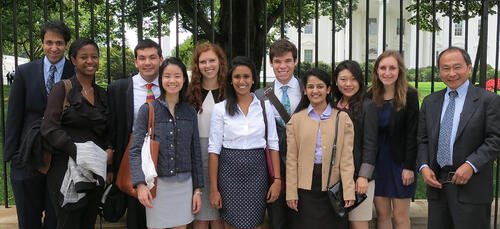
CDDRL Class of 2015 Class of 2015 in front of the White House with Francis Fukuyama.


[[{"fid":"217337","view_mode":"crop_870xauto","fields":{"format":"crop_870xauto","field_file_image_description[und][0][value]":"SHP15 Info Session Flyer","field_file_image_alt_text[und][0][value]":"","field_file_image_title_text[und][0][value]":"","field_credit[und][0][value]":"","field_caption[und][0][value]":"SHP15 Info Session Flyer","field_related_image_aspect[und][0][value]":"","thumbnails":"crop_870xauto","pp_lightbox":false,"pp_description":false},"type":"media","attributes":{"height":1056,"width":870,"class":"media-element file-crop-870xauto"}}]]
Encina Hall, C148
616 Jane Stanford Way
Stanford, CA 94305

0
Olivier Nomellini Senior Fellow at the Freeman Spogli Institute for International Studies
Director of the Ford Dorsey Master's in International Policy
Research Affiliate at The Europe Center
Professor by Courtesy, Department of Political Science
yff-2021-14290_6500x4500_square.jpg

Francis Fukuyama is the Olivier Nomellini Senior Fellow at Stanford University's Freeman Spogli Institute for International Studies (FSI), and a faculty member of FSI's Center on Democracy, Development and the Rule of Law (CDDRL). He is also Director of Stanford's Ford Dorsey Master's in International Policy, and a professor (by courtesy) of Political Science.

Dr. Fukuyama has written widely on issues in development and international politics. His 1992 book, The End of History and the Last Man, has appeared in over twenty foreign editions. His book In the Realm of the Last Man: A Memoir will be published in fall 2026.

Francis Fukuyama received his B.A. from Cornell University in classics, and his Ph.D. from Harvard in Political Science. He was a member of the Political Science Department of the RAND Corporation, and of the Policy Planning Staff of the US Department of State. From 1996-2000 he was Omer L. and Nancy Hirst Professor of Public Policy at the School of Public Policy at George Mason University, and from 2001-2010 he was Bernard L. Schwartz Professor of International Political Economy at the Paul H. Nitze School of Advanced International Studies, Johns Hopkins University. He served as a member of the President’s Council on Bioethics from 2001-2004. He is editor-in-chief of American Purpose, an online journal.

Dr. Fukuyama holds honorary doctorates from Connecticut College, Doane College, Doshisha University (Japan), Kansai University (Japan), Aarhus University (Denmark), the Pardee Rand Graduate School, and Adam Mickiewicz University (Poland). He is a non-resident fellow at the Carnegie Endowment for International Peace. He is a member of the Board of Trustees of the Rand Corporation, the Board of Trustees of Freedom House, and the Board of the Volcker Alliance. He is a fellow of the National Academy for Public Administration, a member of the American Political Science Association, and of the Council on Foreign Relations. He is married to Laura Holmgren and has three children.

(October 2025)

CV
Date Label
Honors Program Director

Encina Hall, C150
616 Jane Stanford Way
Stanford, CA 94305

0
Center Fellow, Freeman Spogli Institute for International Studies
didi_kuo_2023.jpg

Didi Kuo is a Center Fellow at the Freeman Spogli Institute for International Studies (FSI) at Stanford University. She is a scholar of comparative politics with a focus on democratization, corruption and clientelism, political parties and institutions, and political reform. She is the author of The Great Retreat: How Political Parties Should Behave and Why They Don’t (Oxford University Press) and Clientelism, Capitalism, and Democracy: the rise of programmatic politics in the United States and Britain (Cambridge University Press, 2018).

She has been at Stanford since 2013 as the manager of the Program on American Democracy in Comparative Perspective and is co-director of the Fisher Family Honors Program at CDDRL. She was an Eric and Wendy Schmidt Fellow at New America and is a non-resident fellow with the Carnegie Endowment for International Peace. She received a PhD in political science from Harvard University, an MSc in Economic and Social History from Oxford University, where she studied as a Marshall Scholar, and a BA from Emory University.

Date Label
Mentor
Authors
News Type
News
Date
Paragraphs

Michael McFaul, a Stanford political scientist and former U.S. ambassador to Russia, has been selected as the next director of the university’s Freeman Spogli Institute for International Studies.

The announcement was made Wednesday by Stanford Provost John Etchemendy and Ann Arvin, the university’s vice provost and dean of research. McFaul will succeed Mariano-Florentino Cuéllar, who was nominated in July as an associate justice of the California Supreme Court and elected Tuesday.

McFaul takes the helm of FSI in January.

"Stanford has long been a home for scholars who connect academia to policy and public service, and Professor McFaul is the embodiment of that model," Etchemendy said. "We are grateful for Mike's service and confident he will be a strong leader for FSI."

Arvin said McFaul is a strong fit for the position.

“Professor McFaul’s background as an outstanding scholar and his service as an influential ambassador give him a vital perspective to lead FSI, which is Stanford’s hub for studying and understanding international policy issues,” she said. “His scholarship, experience and energy will keep FSI and Stanford at the forefront of international studies as well as some of the most pressing global policy debates."

McFaul has been a faculty member in the department of political science at Stanford since 1994.  He joined the Obama administration in January 2009, serving for three years as Special Assistant to the President and Senior Director for Russian and Eurasian Affairs at the National Security Council at the White House. He then served as U.S. Ambassador to the Russian Federation from 2012 to 2014.

McFaul already has a deep affiliation with FSI. Before joining the government, he served as FSI deputy director from 2006 to 2009.  He also directed FSI’s Center on Democracy, Development, and the Rule of Law (CDDRL) from 2005 to 2009.

During his four years leading CDDRL, McFaul launched the Draper Hills Summer Fellowship program for mid-career lawyers, politicians, advocates and business leaders working to shore up democratic institutions in their home countries. He also established CDDRL’s senior honors program.  From 1992-1994, McFaul also worked as a Senior Research Fellow at FSI’s Center for International Security and Cooperation (CISAC).

“I am thrilled to be assuming a leadership role again at FSI,” McFaul said.  “FSI has become one of the premier institutions in the country for policy-relevant research on international affairs.  I look forward to using my recent government experience to deepen further FSI’s impact on policy debates in Washington and around the world.”

Arvin said McFaul’s previous positions at FSI and CDDRL will make for a smooth transition in the institute’s leadership.

“His familiarity with FSI’s history and infrastructure will allow him to start this new position with an immediate focus on the institute’s academic mission,” she said.

McFaul is also the Peter and Helen Bing Senior Fellow at the Hoover Institution, and plans to build on his long affiliations with both Hoover and FSI to deepen cooperation between these two premier public policy institutions on campus.

He has written and co-authored dozens of books including Advancing Democracy Abroad: Why We Should, How We CanTransitions To Democracy: A Comparative Perspective (with Kathryn Stoner); Power and Purpose: American Policy toward Russia after the Cold War (with James Goldgeier); and Russia’s Unfinished Revolution: Political Change from Gorbachev to Putin.

“In so many ways, Mike represents the best of FSI,” said Cuéllar, who has held leadership positions at FSI since 2004 and begins his term on the California Supreme Court in January. “He knows the worlds of academia and policy extremely well, and will bring unique experience and sound judgment to his new role at FSI.”

McFaul currently serves as a news analyst for NBC News, appearing frequently on NBC, MSNBC, and CNBC as a commentator on international affairs. He also appears frequently on The Charlie Rose Show and The Newshour, as well as PBS and BBC radio programs. He has recently published essays in Foreign AffairsThe New York TimesPolitico, and Time

McFaul was one of the first U.S. ambassadors to actively use social media for public diplomacy. He still maintains an active presence on Facebook at amb.mcfaul and on Twitter at @McFaul.

McFaul received his B.A. in International Relations and Slavic Languages and his M.A. in Russian and East European Studies from Stanford University in 1986.  As a Rhodes Scholar, he completed his D. Phil. in International Relations at Oxford University in 1991.

“Since coming here in 1981 as 17-year-old kid from Montana, Stanford has provided me with tremendous opportunities to grow as a student, scholar, and policymaker,” McFaul said. “I now look forward to giving back to Stanford by contributing to the development of one of the most vital and innovative institutions on campus.” 


Hero Image
mcfaul color large
All News button
1
-

SPEAKER BIO

Image
chaw chaw
Ms. Ohnmar Ei Ei Chaw is the Country Program Coordinator of the Australian-Asia Program to Combat Trafficking in Persons (AAPTIP) for Myanmar (Burma). Prior to this, she was the United Nations Inter-Agency Project on Human Trafficking’s Myanmar National Coordinator. She is responsible for the overall coordination and management of AAPTIP Myanmar Country Program, which is currently the largest of six country programs in the Australian $50 million five-year AAPTIP program. She liaises closely with whole-of-government partners on issues relevant to criminal justice sector capacity building, coordination, and law and policy harmonization, and other initiatives focusing on anti-trafficking in persons at the national level and regional level especially, ASEAN Trafficking in Persons Working Group’s initiatives. She has been engaged in the fight against human trafficking for more than a decade. She started her career working on the Street and Working Children Project of World Vision Myanmar in 1997. After attaining her post-graduate study on Gender and Development in 2001, she rejoined World Vision Myanmar to lead the first Anti-Trafficking Program which involved designing and implementation of prevention activities, facilitation of the return of trafficking survivors coming back from Thailand, and advocating government for the development of anti-trafficking legislation and national policy.

Reuben Hills Conference Room 2nd Floor, East Wing, Encina Hall

Ohnmar Ei Ei Chaw Country Program Coordinator, Australia -Asia Program to Combat Trafficking in Persons (AAPTIP)
Seminars
-

SPEAKERS BIOS

Image
chaw chaw
Ms. Ohnmar Ei Ei Chaw is the Country Program Coordinator of the Australian-Asia Program to Combat Trafficking in Persons (AAPTIP) for Myanmar (Burma). Prior to this, she was the United Nations Inter-Agency Project on Human Trafficking’s Myanmar National Coordinator. She is responsible for the overall coordination and management of AAPTIP Myanmar Country Program, which is currently the largest of six country programs in the Australian $50 million five-year AAPTIP program. She liaises closely with whole-of-government partners on issues relevant to criminal justice sector capacity building, coordination, and law and policy harmonization, and other initiatives focusing on anti-trafficking in persons at the national level and regional level especially, ASEAN Trafficking in Persons Working Group’s initiatives.


Image
mark taylor
Mr. Mark Taylor is the Team Leader for the Australia–Asia Program to Combat Trafficking in Persons (AAPTIP). The AAPTIP project was started in June 2013, and is a continuation of the Australian AID-funded Asia Regional Trafficking in Persons (ARTIP) Project. AAPTIP operates at both regional and national level and provides support to the Association of South East Asian Nations (ASEAN) and individual partner countries: Cambodia, Indonesia, Lao PDR, Myanmar, the Philippines, Thailand and Vietnam. Prior to this, Mr. Taylor spent 10 years working for the US State Department in Washington DC as a Senior Coordinator for Reports and Political Affairs. He spent two years based at the US Embassy in Nigeria where he opened the US State Department’s Narcotics and Law Enforcement Affairs Program in Lagos and Abuja, after years of aid embargo on Abacha ruled Nigeria. Mr. Taylor was in charge of developing and implementing over $12 million in projects over a range of eight issues including drug control, people smuggling, human trafficking, financial fraud, corruption, police reform and money laundering. Mr. Taylor also spent time in Yangon, Myanmar where he was responsible for reporting on the dynamic narco-insurgency landscape in the Shan State, and following the July 1995 release from house arrest of Daw Aung San Suu Kyi -- the political and human rights situation in the country, including coverage of NLD speeches, policy statements, and the party's leadership. He has a degree in Political Science and Government from Gordon College.


This seminar will also feature special discussant, Donald Emmerson, director of the Southeast Asia Program at Shorenstein APARC

The panel will be moderated by Helen Stacy, director of the Program on Human Rights at CDDRL.


[[{"fid":"216677","view_mode":"crop_870xauto","fields":{"format":"crop_870xauto","field_file_image_description[und][0][value]":"","field_file_image_alt_text[und][0][value]":"","field_file_image_title_text[und][0][value]":"","field_credit[und][0][value]":"","field_caption[und][0][value]":"","field_related_image_aspect[und][0][value]":"","thumbnails":"crop_870xauto","pp_lightbox":true,"pp_description":true},"type":"media","attributes":{"height":960,"width":870,"class":"media-element file-crop-870xauto"}}]]


CISAC Central Conference Room
2nd Floor, Encina Hall
616 Serra St.
Stanford, CA

Mark Taylor Australia-Asia Program to Combat Trafficking in Persons
Ohnmar Ei Ei Chaw Australia-Asia Program to Combat Trafficking in Persons
0
Senior Fellow Emeritus at the Freeman Spogli Institute for International Studies
Affiliated Faculty, CDDRL
Affiliated Scholar, Abbasi Program in Islamic Studies
aparc_dke.jpg PhD

At Stanford, in addition to his work for the Southeast Asia Program and his affiliations with CDDRL and the Abbasi Program in Islamic Studies, Donald Emmerson has taught courses on Southeast Asia in East Asian Studies, International Policy Studies, and Political Science. He is active as an analyst of current policy issues involving Asia. In 2010 the National Bureau of Asian Research and the Woodrow Wilson International Center for Scholars awarded him a two-year Research Associateship given to “top scholars from across the United States” who “have successfully bridged the gap between the academy and policy.”

Emmerson’s research interests include Southeast Asia-China-US relations, the South China Sea, and the future of ASEAN. His publications, authored or edited, span more than a dozen books and monographs and some 200 articles, chapters, and shorter pieces.  Recent writings include The Deer and the Dragon: Southeast Asia and China in the 21st Century (ed., 2020); “‘No Sole Control’ in the South China Sea,” in Asia Policy  (2019); ASEAN @ 50, Southeast Asia @ Risk: What Should Be Done? (ed., 2018); “Singapore and Goliath?,” in Journal of Democracy (2018); “Mapping ASEAN’s Futures,” in Contemporary Southeast Asia (2017); and “ASEAN Between China and America: Is It Time to Try Horsing the Cow?,” in Trans-Regional and –National Studies of Southeast Asia (2017).

Earlier work includes “Sunnylands or Rancho Mirage? ASEAN and the South China Sea,” in YaleGlobal (2016); “The Spectrum of Comparisons: A Discussion,” in Pacific Affairs (2014); “Facts, Minds, and Formats: Scholarship and Political Change in Indonesia” in Indonesian Studies: The State of the Field (2013); “Is Indonesia Rising? It Depends” in Indonesia Rising (2012); “Southeast Asia: Minding the Gap between Democracy and Governance,” in Journal of Democracy (April 2012); “The Problem and Promise of Focality in World Affairs,” in Strategic Review (August 2011); An American Place at an Asian Table? Regionalism and Its Reasons (2011); Asian Regionalism and US Policy: The Case for Creative Adaptation (2010); “The Useful Diversity of ‘Islamism’” and “Islamism: Pros, Cons, and Contexts” in Islamism: Conflicting Perspectives on Political Islam (2009); “Crisis and Consensus: America and ASEAN in a New Global Context” in Refreshing U.S.-Thai Relations (2009); and Hard Choices: Security, Democracy, and Regionalism in Southeast Asia (edited, 2008).

Prior to moving to Stanford in 1999, Emmerson was a professor of political science at the University of Wisconsin-Madison, where he won a campus-wide teaching award. That same year he helped monitor voting in Indonesia and East Timor for the National Democratic Institute and the Carter Center. In the course of his career, he has taken part in numerous policy-related working groups focused on topics related to Southeast Asia; has testified before House and Senate committees on Asian affairs; and been a regular at gatherings such as the Asia Pacific Roundtable (Kuala Lumpur), the Bali Democracy Forum (Nusa Dua), and the Shangri-La Dialogue (Singapore). Places where he has held various visiting fellowships, including the Institute for Advanced Study and the Woodrow Wilson International Center for Scholars. 


Emmerson has a Ph.D. in political science from Yale and a BA in international affairs from Princeton. He is fluent in Indonesian, was fluent in French, and has lectured and written in both languages. He has lesser competence in Dutch, Javanese, and Russian. A former slam poet in English, he enjoys the spoken word and reads occasionally under a nom de plume with the Not Yet Dead Poets Society in Redwood City, CA. He and his wife Carolyn met in high school in Lebanon. They have two children. He was born in Tokyo, the son of U.S. Foreign Service Officer John K. Emmerson, who wrote the Japanese Thread among other books.

Selected Multimedia

Date Label
Special Discussant
Moderator
Seminars
Paragraphs

Abstract:

The levels of violence in Mexico have dramatically increased in the last few years due to structural changes in the drug trafficking business. The increase in the number of drug trafficking organizations (DTOs) fighting over the control of territory and trafficking routes has resulted in a substantial increase in the rates of homicides and other crimes. This study evaluates the economic costs of drug-related violence. We propose electricity consumption as an indicator of the level of municipal economic activity and use two different empirical strategies to test this. We utilize an instrumental variable regression using as exogenous variation the instrument proposed by Castillo, Mejía, and Restrepo (2013) based on historical seizures of cocaine in Colombia interacted with the distance of the Mexican border towns to the United States. We find that marginal increases of violence have negative effects on labor participation and the proportion of unemployed in an area. The marginal effect of the increase in homicides is substantive for earned income and the proportion of business owners, but not for energy consumption. We also employ the methodology of synthetic controls to evaluate the effect that inter-narco wars have on local economies. These wars in general begin with a wave of executions between rival criminal organizations and are accompanied by the deterioration of order and a significant increase in extortion, kidnappings, robberies, murders, and threats affecting the general population. To evaluate the effect that these wars between different drug trafficking organizations have on economic performance, we define the beginning of a conflict as the moment when we observe an increase from historical violence rates at the municipal level beyond a certain threshold, and construct counterfactual scenarios as an optimal weighted average from potential control units. The analysis indicates that the drug wars in those municipalities that saw dramatic increases in violence between 2006 and 2010 significantly reduced their energy consumption in the years after the change occurred.

All Publications button
1
Publication Date
Authors
Beatriz Magaloni
Gabriela Calderón
Subscribe to International Relations