CDDRL Research in-brief
News Type
News
Date
Paragraphs

Introduction


Generative AI has become an incredibly attractive and widespread tool for people across the world. Alongside its rapid growth, AI tools present a host of ethical challenges relating to consent, security, and privacy, among others. As Generative AI has been spearheaded primarily by large technology companies, these ethical challenges — especially as viewed from the vantage point of ordinary people — risk being overlooked for the sake of market competition and profit. What is needed, therefore, is a deeper understanding of and attention to how ordinary people perceive AI, including its costs and benefits.

The Meta Community Forum Results Analysis, authored by Samuel Chang, James S. Fishkin, Ricky Hernandez Marquez, Ayushi Kadakia, Alice Siu, and Robert Taylor, aims to address some of these challenges. A partnership between CDDRL’s Deliberative Democracy Lab and Meta, the forum enables participants to learn about and collectively reflect on AI. The impulse behind deliberative democracy is straightforward: people affected by some policy or program should have the right to communicate about its contents and to understand the reasons for its adoption. As Generative AI and the companies that produce it become increasingly powerful, democratic input becomes even more essential to ensure their accountability. 

Motivation & Takeaways


In October 2024, the third Meta Community Forum took place. Its importance derives from the advancements in Generative AI since October 2023, when the last round of deliberations was held. One such advancement is the move beyond AI chatbots to AI agents, which can solve more complex tasks and adapt in real-time to improve responses. A second advancement is that AI has become multimodal, moving beyond the generation of text and into images, video, and audio. These advancements raise new questions and challenges. As such, the third forum provided participants with the opportunity to deliberate on a range of policy proposals, organized around two key themes: how AI agents should interact with users and how they should provide proactive and personalized experiences for them.

To summarize some of the forum’s core findings: the majority of participants value transparency and consent in their interactions with AI agents as well as the security and privacy of their data. In turn, they are less comfortable with agents autonomously completing tasks if this is not transparent to them. Participants have a positive outlook on AI agents but want to have control over their interactions. Regarding the deliberations themselves, participants rated the forum highly and felt that it exposed them to alternative perspectives. The deliberators wanted to learn more about AI for themselves, which was evidenced by their increased use of these tools after the deliberations. Future reports will explore the reasoning and arguments that they used while deliberating.


Image
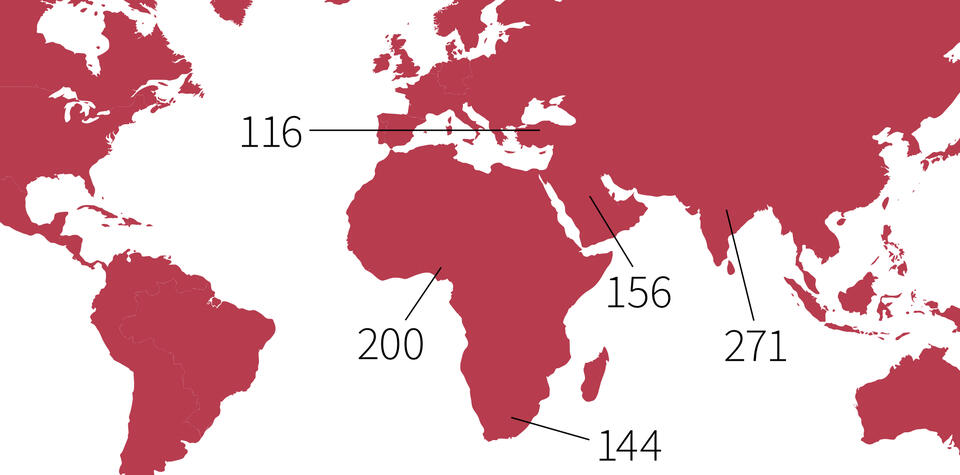
Map of where participants hailed from.


The participants of this Community Forum were representative samples of the general population from five countries - Turkey, Saudi Arabia, India, Nigeria, and South Africa. Participants from each country deliberated separately in English, Hindi, Turkish, or Arabic.


Methodology & Data


The deliberations involved around 900 participants from five countries: India, Nigeria, Saudi Arabia, South Africa, and Turkey. Participants varied in terms of age, gender, education, and urbanicity. Because the deliberative groups were recruited independently, the forum can be seen as five independent deliberations. Deliberations alternated between small group discussions and ‘plenary sessions,’ where experts answered questions drawn from the small groups. There were around 1000 participants in the control group, who did pre- and post-surveys, but without deliberating. The participant sample was representative with respect to gender, while the treatment and control groups were balanced on demography as well as on their attitudes toward AI. Before deliberating on the proposals, participants were presented with background materials as well as a list of costs and benefits to consider.

In terms of the survey data, large majorities of participants had previously used AI. There was a statistically significant increase in these proportions after the forum. For example, in Turkey, usage rates increased from nearly 70% to 84%. In several countries, there were large increases in participants’ sense of AI’s positive benefits after deliberating, as well as a statistically significant increase in their interest. The deliberations changed participants’ opinions about a host of claims; for example, “people will feel less lonely with AI” and “more proactive [agents] are intrusive” lost approval whereas “AI agents’ capability to increase efficiency…is saving many companies a lot of time and resources” and “AI agents are helping people become more creative” gained approval. After deliberating, participants demonstrated an improved understanding of some factual aspects of AI, although the more technical aspects of this remain challenging. One example here is AI hallucinations, or rather, the generation of false or nonsensical outputs, usually because of flawed training data.


Image
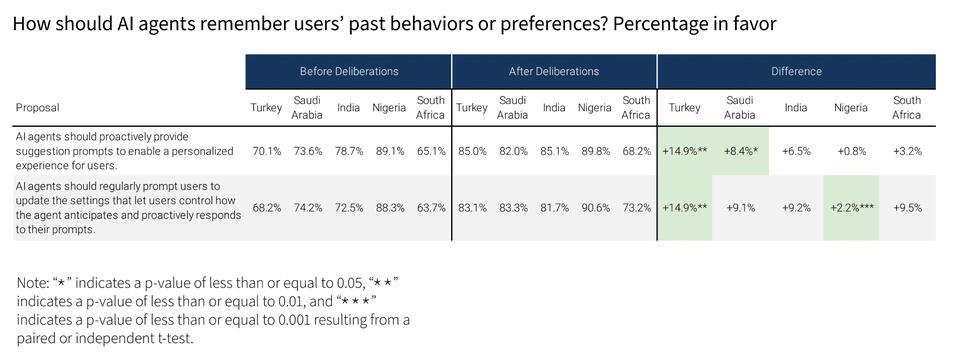
Chart: How should AI agents remember users' past behaviors or preferences? Percentage in favor


Proposals


Participants deliberated on nineteen policy proposals. To summarize these briefly: In terms of whether and how AI remembers users’ past behaviors and preferences, participants preferred proposals that allowed users to make active choices, as opposed to this being a default setting or only being asked once. They also preferred being reminded about the ability of AI agents to personalize their experience, as well as agents being transparent with users about the tasks they complete. Participants preferred that users be educated on AI before using it, as well as being informed when AI is picking up on certain emotional cues and responding in “human-like” ways. They also preferred proposals whereby AI would ask clarifying questions before generating output. Finally, when it comes to agents helping users with real-life relationships, this was seen as more permissible when the other person was informed. Across the proposals, gender was neither a significant nor consistent determinant of how they were rated. Ultimately, the Meta Community Forum offers a model for how informed, public communication can shape AI and the ethical challenges it raises.

*Research-in-Brief prepared by Adam Fefer.

 
Hero Image
Agentic AI Workflow Automation, Artificial intelligence AI driven decision-making concept illustration blue background
iStock / Getty Images
All News button
0
Subtitle

CDDRL Research-in-Brief [4-minute read]

Date Label
News Type
News
Date
Paragraphs

Argument & Key Findings


Global attention has periodically focused on Russia’s invasion of Ukraine, be it the security aspects of the war, the suffering experienced by Ukrainians, or forced conscription in Russia. Much less attention has been paid to those who have since emigrated from Russia.

The OutRush project, by Emil Kamalov, Karolina Nugumanova, and Ivetta Sergeeva, helpfully fills this gap. It presents results from surveys of thousands of Russian migrants, opening up the black box of who they are, where they have gone, how they have integrated into their new host countries, and their political beliefs. Readers come away with an enriched understanding of this population’s importance and diversity.

The authors present dozens of critical findings. Most Russian emigrants are unlikely to return in the short term, mainly because of the risks of military conscription and persecution by the Vladimir Putin regime. Migrants have become increasingly integrated into their host countries, speaking new languages, engaging with local politics and media, and making local acquaintances. At the same time, political engagement with Russia remains high. Secondary migration — i.e., from one host country to another — is also growing, owing to factors such as discrimination, legal barriers to residency, and others. Finally, the global environmental crisis has become a central political issue for many emigrants.

Data & Methods


OutRush is based on four waves of surveys. The report focuses on wave 4, conducted between July and November 2024. The nearly 8600 emigrants surveyed in wave 4 include prior respondents (i.e., to waves 1-3), those recruited through OutRush media partners like Telegram news channels, recipients of the link from friends, those who found the survey through social media, and emigrants who left Russia during an earlier period (2014-21). The survey work is complemented by interviews that add context and capture migrants’ lived experiences. Although survey respondents are not drawn at random, the study population is likely to be representative because Russian migrants across various demographics, such as gender, age, and education level, use social media or consume Telegram news.

The bulk of the report dives into specific issues:

Integration Into and Work Within Host Countries: One of the most comprehensive sections presents data on respondents’ experiences integrating socially, occupationally, and otherwise. Emigrants’ economic stability has improved, and reports of discrimination have declined. Meanwhile, legal instability, such as difficulties opening bank accounts or being granted asylum, has improved slightly but remains a significant concern. By contrast, trust in their host country governments has declined, mainly driven by concerns about political persecution and bureaucratic hurdles. Yet, processes of social integration appear to be increasingly successful: majorities of respondents are learning local languages, have a high level of trust in the host population, are engaged in local politics, and have three or more local acquaintances, despite primarily socializing with other Russians. Finally, the subjective well-being of migrants is improving.

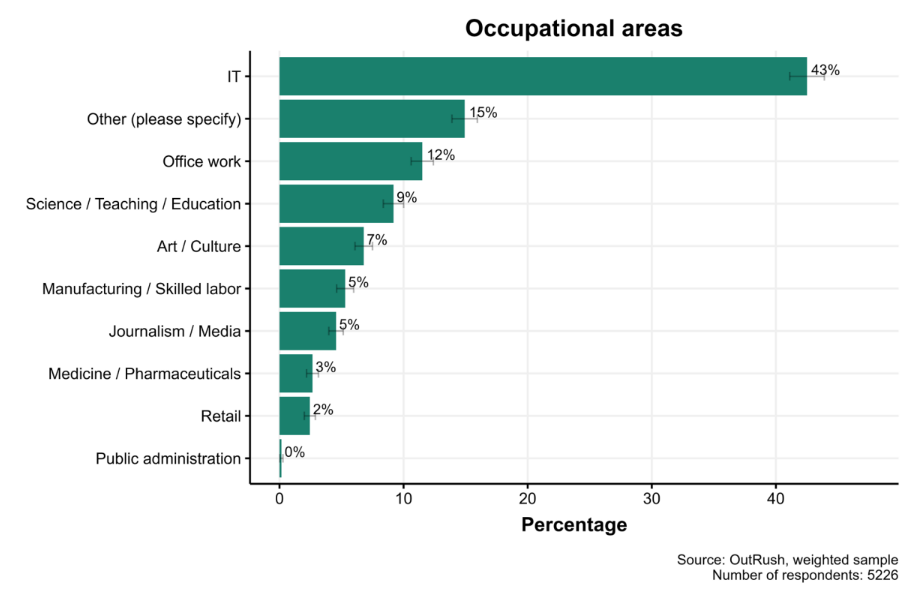
In terms of occupation, a plurality of migrants work in information technology, about a fifth work in the sphere of arts, education, and media, and a small but growing number plan to start their own businesses. Emigrants have found entrepreneurship challenging due to factors such as high taxes and complex bureaucracies in their host countries.


Figure 12. Professional composition of Russian emigration Figure 12. Professional composition of Russian emigration
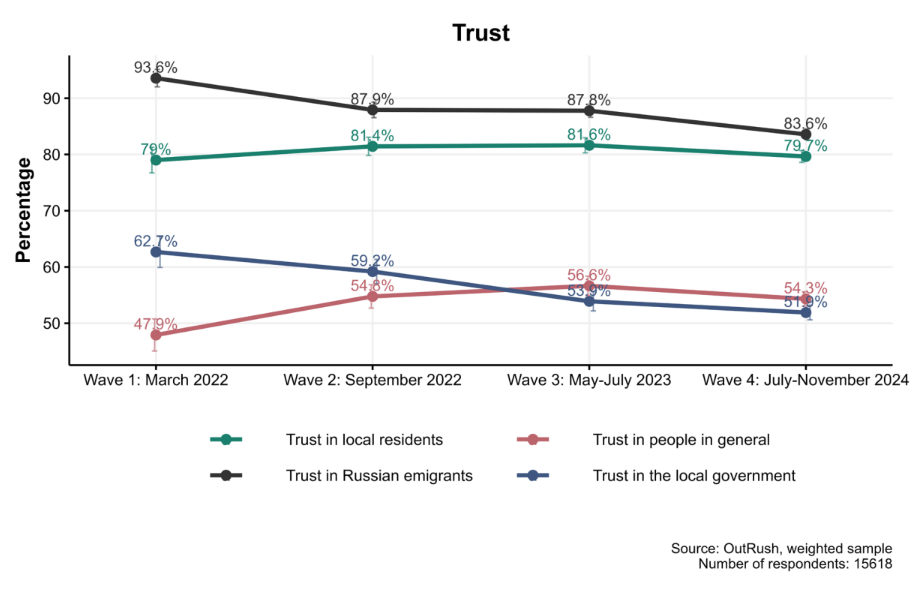
Figure 18. Changes in trust levels Figure 18. Changes in trust levels
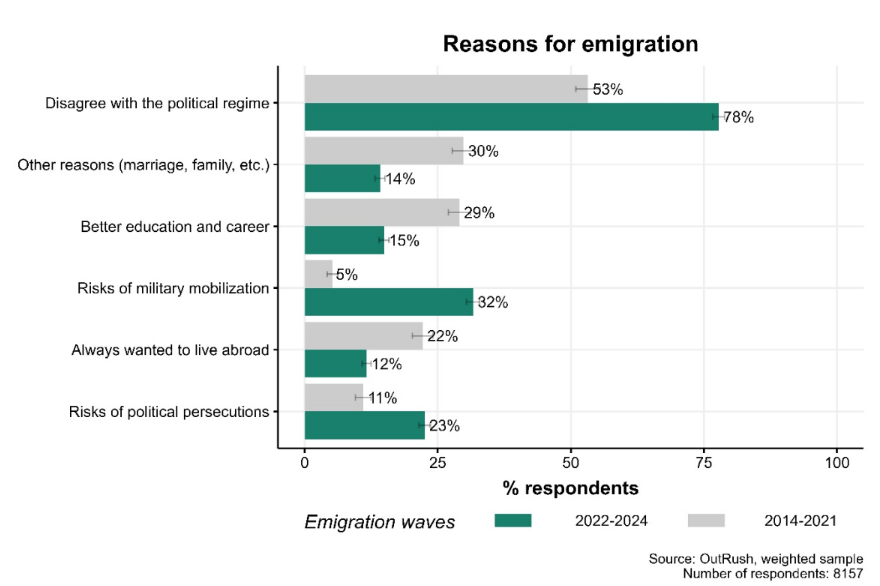
Figure 7. Key reasons for emigration. The question allowed for multiple selections if respondents had difficulty choosing one main reason. Figure 7. Key reasons for emigration. The question allowed for multiple selections if respondents had difficulty choosing one main reason.


Secondary Migration: Perhaps one of the most overlooked aspects of migration is its transient nature, as many individuals do not remain in the place where they first arrive. Indeed, over a fifth of respondents changed their country of residence, and nearly a third plan to do so within the next year. This is largely driven by discrimination or legal instability in their initial host countries. Serbia has become a key destination for secondary migration, attracting about a fifth of those who have left their initial destination. Much of this has to do with Serbia’s low levels of discrimination and its growing Russian-speaking community. 

Connections With and Plans to Return to Russia: Very few emigrants have returned or plan to do so in the short term. Of those who consider returning a possibility, doing so would largely depend upon military conscription becoming less likely and democratic reforms becoming more likely; as it stands, however, both of these scenarios appear quite distant. More than four out of five emigrants actively consume independent Russian media and stay in regular contact with their friends and family back home. Meanwhile, around two out of five consume English news, and about a quarter consume local media. Only a very small number are totally disengaged from politics or rely on Russian state propaganda. Yet large numbers of migrants fear persecution from the Russian government and their host states alike, especially given that many of their new homes are autocracies.

Political and Civic Activism: There continues to be high political interest in Russia. More than two out of five emigrants cast votes in the 2024 Russian presidential election. At the same time, overt political activism has declined, perhaps because of migrants’ perceived need to assimilate or because other challenges of migrant life have taken precedence. As mentioned above, large numbers are interested in the politics of their host countries. One of the most interesting findings concerns the large number of migrants — around three out of five — who are interested in the climate crisis. Their global focus overshadows their focus on environmental challenges specific to Russia or their host countries.

Implications & Prescriptions


The authors draw a number of conclusions from their interpretation of the survey data. Most centrally, Russian migrants are likely to remain in their host countries, that is, unless Russia undertakes meaningful change to its militarized, authoritarian status quo. As Russia pays a steep price, host countries gain considerably from one of the largest brain drains since the fall of the Soviet Union. At the same time, the authors call on host countries to rectify sources of legal and economic instability, including simplifying the process of legal emigration, encouraging entrepreneurship, and helping workers adapt to new labor markets. These prescriptions would not only ease the hardships faced by migrants but also create benefits for host countries.

*Research-in-Brief prepared by Adam Fefer.

 
Hero Image
Woman holding Russian passport with luggage
Alexander Nrjwolf
All News button
0
Subtitle

CDDRL Research-in-Brief [6-minute read]

Date Label
Authors
News Type
News
Date
Paragraphs

Argument & Key Findings


Conditional cash transfers (CCTs) have been a widespread and effective tool in reducing poverty in Latin America. CCT programs transfer cash to the poor on the condition that recipients engage in beneficial behaviors, like enrolling their children in school, vaccinating them, or taking them to see a physician. CCTs aim to break the intergenerational cycle of poverty, especially among women. Indeed, women are central to CCTs as they are often responsible for children’s health and nutrition as well as ensuring that they remain enrolled in school.

Alberto Díaz-Cayeros reviews the scholarship on CCTs in Latin America, where much of that research had originated, shedding light on these programs’ workings and effects. Particular focus is given to how CCTs have helped overcome shortcomings of democratic systems, including ‘clientelism,’ broadly understood as the practice of politicians trading goods or services for votes. Despite CCTs’ broad success, challenges persist, especially regarding their use to mitigate poverty that is concentrated in rural areas as well as among indigenous and Afro-descendant peoples. The reader learns that CCTs are deeply interwoven with the behavior of politicians and the mobilization of social groups for political goals. CCTs are very malleable tools, having been adapted to the advent of COVID-19 when contagion and income loss were prevalent among the poor. CCTs have been one of the most rigorously evaluated interventions by social scientists. Most generally, they have reduced poverty, inequality, and infant mortality, while increasing school enrollment and nutrition.


Despite CCTs’ broad success, challenges persist, especially regarding their use to mitigate poverty that is concentrated in rural areas as well as among indigenous and Afro-descendant peoples.


Conceptualizing & Measuring Poverty


Díaz-Cayeros builds an incredibly rich historical overview of poverty in Latin America. This includes both its persistence and its dramatic decline in recent decades, CCTs having played a key role in the latter process. However, national-level declines obscure the wide disparities that persist at the subnational level and among historically marginalized communities. In addition, efforts (like CCTs) aimed at tackling poverty have often failed to address inequality, because social spending in Latin America has at times been regressive, i.e., taking resources from the poor and giving them to the middle and upper classes. Meanwhile, fiscal resources are often transferred to poor regional governments, as opposed to the individuals within them.

Poverty persists in part because of ‘poverty traps,’ a technical concept tied to factors like limited access to credit and education as well as poor health. These problems are especially pronounced in rural areas, which are often isolated from economic activity, lack the social mobility of cities, and tend to feature systemic exclusion along ethno-racial lines. The measurement of poverty has become increasingly sophisticated, moving beyond income to incorporate assets, basic needs, and geospatial data. The upshot of Díaz-Cayeros’ overview is that measurements of poverty, which any evaluation of CCTs must incorporate, often fail to account for poverty traps and their concentration among distinct groups in specific areas.

Background & Variation


Díaz-Cayeros examines the historical roots of CCTs, highlighting the role of 20th-century Latin American governments in replacing Catholic charities and philanthropists as the primary actors addressing poverty. These governments sought to target primarily urban poverty, owing to large-scale processes of internal migration, which moved workers away from agriculture and into factories and the informal economy. This helps explain the persistence of rural poverty. State social spending was undermined by the Latin American debt crises of the 1980s and 1990s, which disproportionately harmed the rural poor. The 2010s commodity boom enabled a re-expansion of social spending, although these programs continued to be insufficient to lift historically marginalized peoples out of poverty. The creation of CCTs by Mexican economist Santiago Levy in the 1990s can thus be placed against this backdrop of poverty, austerity, and labor market change.

CCTs have been widely adopted across Latin America by governments of different partisan leanings. One important determinant of this process has been fiscal constraint: because CCTs are relatively inexpensive, wealthier countries adopted them later. It should also be noted that effective CCTs depend on effective states, which provide, among other things, the hospitals and schools that recipients must utilize. By the mid-2020s, nearly 60 programs existed across Latin America, varying widely in terms of the share of beneficiaries of the total population. Countries that adopted CCTs early on do not necessarily have larger shares of beneficiaries, and larger shares don’t necessarily mean a given CCT is effectively helping the poor.


One of the most important political aspects of CCTs is their potential resistance to ‘clientelism.’


Clientelism & Democracy


One of the most important political aspects of CCTs is their potential resistance to ‘clientelism.’ What this means is that universal and automatic criteria for CCT recipients can limit the ability of politicians to trade particular benefits for votes. As such, CCTs have helped improve Latin American democracy, partly because politicians who ‘credit-claim’ for implementing CCTs can be more readily held accountable. On the ground, politicians still find ways to perpetuate clientelism, for example by manipulating the distribution of non-CCT goods like water cisterns. However, the broader implications of CCT are significant: as citizens’ cash needs are met, they can more meaningfully participate in the democratic process.


The broader implications of CCT are significant: as citizens’ cash needs are met, they can more meaningfully participate in the democratic process.


Future Research


Díaz-Cayeros posits an agenda for future research. These include: (1) the ways that continued discrimination against indigenous and Afro-descendant communities may require changes to the design of CCTs, (2) the ways that CCTs can be complemented by private charities and NGOs; the ways that expansions to CCT might bring Latin American governments closer to providing a universal basic income, and (3) the sources of Latin American citizens’ support for CCTs, whether owing to moral sensibilities, fear of deprivation, or otherwise. Ultimately, CCTs have been broadly successful and adaptable, improving both the economic standing and political efficacy of poor citizens. Their long-term success depends upon addressing the victims of systemic exclusion and intergenerational poverty.

*Research-in-Brief prepared by Adam Fefer.

Hero Image
Ricardo Brugada, Asunción, Paraguay
Benjamin Shurance
All News button
0
Subtitle

CDDRL Research-in-Brief [4-minute read]

Date Label
News Type
News
Date
Paragraphs

Argument & Key Findings


Hesham Sallam draws our attention to a surprising pattern: Egyptian Islamists and leftists have, for several generations, criticized each other on remarkably similar grounds. Their arguments have sometimes focused on Islam and left-wing political goals. But just as — if not more — frequently, they have focused on how each other’s agendas are inauthentic to Egyptian society and promoted to benefit foreign actors. It is true that the contents of their critiques have differed: Islamists denounce the left as betraying Egypt’s pure, Islamic nation while acting on behalf of “Zionists” or “western imperialists.” Meanwhile, leftists see Islamists as inauthentic to Egypt’s secular, pluralistic history, as well as advancing foreign interests. These differences notwithstanding, a common structure of political argument has been preserved across decades. 

The article introduces the history of Islamist-leftist debate in Egypt since the 1970s. Central to this history was the process of reappropriation: Islamists criticized the left, and the left responded by criticizing Islamists using more or less the same script. The study draws upon an array of Arabic sources likely unknown to readers outside of Egypt, including editorials, monographs, and public debates.

The Islamist Critique


The article first presents the intricacies of Egyptian Islamists’ critique of the left. There is a long history of Egyptian political elites denouncing left-wing politics as inauthentic and foreign. For example, Gamal Abdel-Nasser accused Egyptian communists of conspiring with Zionists and Soviets, while Anwar al-Sadat accused them of atheism and thus betraying Egypt’s Islamic essence. As leftists were repeatedly accused of disloyalty, nationalist ideas became even more dominant within leftist circles — this despite the historical suspicions of left-wing thinkers of nationalism as a distraction from class politics. The Egyptian case thus mirrors the trajectory of Europe’s internationalist labor movements during World War II, when leftist political goals were abandoned for state nationalism. In any case, the Islamist critique, which was led principally by the Muslim Brotherhood, regularly accused the left of foreign loyalties and a betrayal of Egyptian values. Over time, this critique was extended to secular Egyptians and deployed increasingly virulent language; for example, an academic critic of Islamism was denied promotion, ostensibly for his writings that were described by an Islamist detractor as “spreading cultural AIDS.” They also drew on prominent social science frameworks like Samuel Huntington’s “Clash of Civilizations”: Egypt’s authentic Islamic nation was seen as pitted in an irresolvable clash against the atheistic West, which, they alleged, was simultaneously funding the Egyptian left. These are just a few of the examples Sallam uses to show how Islamists portrayed the left as inauthentic and disloyal, undermining its legitimacy in Egyptian politics.


As leftists were repeatedly accused of disloyalty, nationalist ideas became even more dominant within leftist circles.


The Leftist Critique


Sallam next shows us how the left struck back at their Islamist foes. A key process in this history concerns the Hosni Mubarak regime’s co-optation of influential leftists into the state’s cultural institutions. This occurred as a response to the Muslim Brotherhood’s electoral successes in the 1980s. Coincident with these institutional changes, leftists began appropriating the authenticity critique. They claimed that Islamists were engaged not in building a pure Islamic state and society, but in a narrow project meant to advance their own political standing. Rejecting the Islamist critique of them as atheists, leftists accused their opponents of weaponizing Islam and betraying its true essence. They rejected the distinction between so-called violent and nonviolent Islamism, on the grounds that nonviolent Islamists still were willing to justify violence. Islamists were said to be working on behalf of foreign interests like Sudanese president Omar Al-Bashir, whose designs on Egyptian territory went unnoticed by Islamists. The Brotherhood was deemed a cult-like vehicle for indoctrinating and promoting foreign goals, especially those of the Gulf. Far from authentic to Egyptian society, Islamists were seen as holding Egyptian Muslims in contempt for their alleged heresies. And in one of the most surprising appropriations, leftists claimed that Islamists were in fact quite similar to both Zionists and imperialists: all three sought to dominate the Middle East through sectarian politics. The Brotherhood’s Egyptian constitution was denigrated for being indistinguishable from versions published in Europe and Pakistan. Especially inauthentic to Egyptian society was the Brotherhood’s view of religious minorities as second-class citizens; this was deemed a fundamental betrayal of Egypt’s national essence, namely secular pluralism. These counter-critiques helped the left frame itself as the true guardian of the Egyptian nation.


In one of the most surprising appropriations, leftists claimed that Islamists were in fact quite similar to both Zionists and imperialists: all three sought to dominate the Middle East through sectarian politics.


Beyond Speech


Importantly, the Islamist-leftist debates were not mere rhetoric, but served as a basis for political action, especially when it came to questions of cooperation. For example, after the Islamist critic Farag Foda was assassinated, the so-called ‘moderate’ Islamist Mohamed Al-Ghazali defended his assassins; some leftists used these events to justify their refusal to cooperate with Islamists. More generally, they argued that Islamists’ quest for a religious state would only lead to political violence and exclusion, further grounds to reject compromise. Yet claims about authenticity and nationalism were also used to justify cooperation, as when leftists argued that both they and the Brotherhood were natural allies in the fight against foreign imperialism and Zionism. It is not clear whether a less confrontational approach would have helped Islamists and leftists cooperate against Egypt’s successive dictators, but their divisive rhetoric almost certainly did not help matters.


The Islamist-leftist debates were not mere rhetoric, but served as a basis for political action, especially when it came to questions of cooperation.


Contributions


The article will help readers understand why Egyptian politics has become increasingly marked by groups’ ‘affective’ hatreds for one another, as opposed to normal political disagreements. By weaving the themes of treason and inauthenticity through decades of history, Sallam shows us why this new status quo is not surprising. Affective polarization has led many Egyptians to view their opponents as unworthy of political inclusion, consistent with the rise of a global populism that emphasizes “us vs. them” distinctions. Sallam fleshes this out by relaying the different responses among leftists and Islamists to Egypt’s 2013 military coup, which ousted the Brotherhood leader Morsi. Leftists called the coup a necessary evil to counter foreign influences seeking to establish an Islamic state, while Islamists accused the left of being sponsored by the West. 

Readers will see the conflict between Islamists and leftists as not just fleeting moments of political disagreement, but a generations-long battle for domination in the realm of ideas.

*Research-in-Brief prepared by Adam Fefer.

Hero Image
Mosques with Minarets and Traditional Architecture of Historic Cairo - stock photo
Tomasz Bobrzynski via Getty Images
All News button
0
Subtitle

CDDRL Research-in-Brief [4.5-minute read]

Date Label
Subscribe to CDDRL Research in-brief