Paragraphs

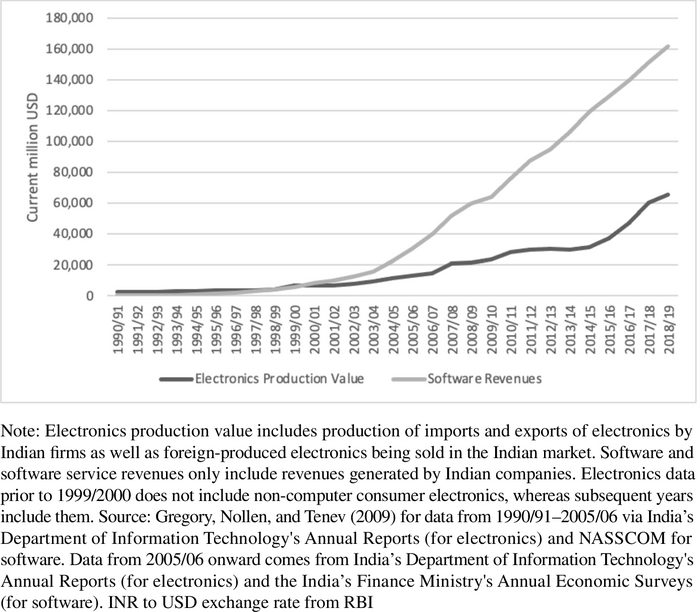
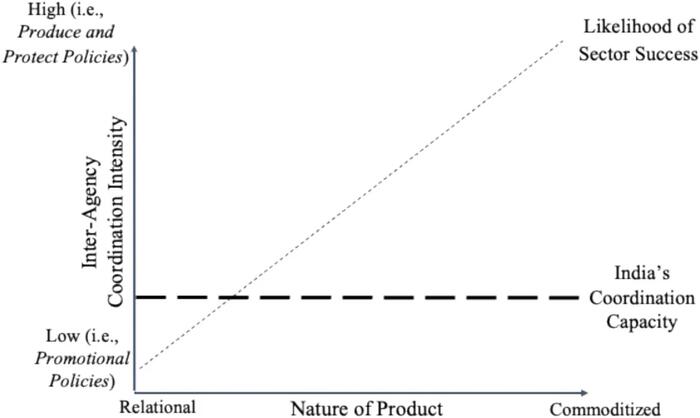
Economic growth is uneven within many developing countries as some sectors and industries grow faster than others. India is no exception, where anemic performance in manufacturing has been offset by robust growth in services. Standard scholarly explanations fail to explain this kind of variation. For instance, the factor endowments that are required for services—such as an educated workforce or access to electricity and other infrastructure—should also complement manufacturing. Reciprocally, if a state’s institutions hold back manufacturing, they should also impair growth in services. Why have services in India outperformed manufacturing? We examine India’s performance in the computing industry, where a dynamic software services sector has emerged even as its computer hardware manufacturing sector has flagged. We argue that the uneven outcomes between the software and hardware sectors are due to the variable needs of the respective sectors and the state’s capacity to coordinate agencies. The policies required to promote the software sector needed minimal coordination between state agencies, whereas the computer hardware sector required a more centralized state apparatus for successful state-business engagement. Domestic and transnational political networks were critical for the success of the software sector, but similar networks could not deliver the same benefits to the computer hardware industry, which required more coordination-intensive policies than software. A state’s ability to coordinate industrial policy is thus a critical determinant for effective sectoral political networks, shaping sectoral variations within an economy.

All Publications button
1
Publication Type
Journal Articles
Publication Date
Journal Publisher
Studies in Comparative International Development
Authors
Dinsha Mistree
Authors
Soraya Johnson
News Type
News
Date
Paragraphs

India’s once-robust democracy is in decline, with the Bharatiya Janata Party (BJP) being the only party with effective political organizing and a clear national message. FSI Mosbacher Senior Fellow in Global Democracy Larry Diamond, Hoover Senior Fellow Šumit Ganguly, and Hoover Research Fellow Dinsha Mistree reflected on this reality in a CDDRL seminar series talk. The discussion built on findings from their recently released book, The Troubling State of India's Democracy (University of Michigan Press, 2024).

The absence of a coordinated opposition in India has continued to threaten the functioning of its democracy. The challenges confronting the Indian National Congress Party (INC) are at the heart of the problem.

In the first half of the twentieth century, the INC emerged as a healthy political party. It enjoyed a unified national vision that championed secularism and independence from the British Empire. By being inclusive towards various political and religious identities, it unified a vast coalition across India’s broad geography, utilizing effective grassroots organizing mechanisms.

Today, however, the INC is hampered by extreme personalism due to the domineering role of the Gandhi family. The party lacks the organization or national vision to compete with the BJP. This decline began under the populist prime minister Indira Gandhi, who rose to power in the late 1960s. She replaced party leaders with loyalists and sycophants, weakening critical party mechanisms. The party began to set aside ideologically-driven political priorities in favor of more personalistic sinecures.

As subsequent members of the Gandhi family continued to lead the party, the INC failed to pose as an effective alternative to the BJP. The lack of political options results in a harmful feedback loop where citizens are discouraged from engaging with the opposition at all because they perceive no other candidates as having a chance at gaining power.

The future of India’s democratic competition requires the revival of opposition parties. Local parties at the state level are unlikely to grow to match the BJP, as they are often focused on specific ethnic and regional concerns, as well as lacking the infrastructure to take on the BJP nationally. The INC, once a leading national party, is unlikely to reinvent itself effectively unless it is released from the personalist grasp of the Gandhi family. The history of coalition building among the diversity of parties at the state and regional levels may provide a potential model for democratic checks or even electoral alternation. In any case, vigorous opposition must emerge from within India's political party system if backsliding is to be countered in the world's largest democracy.

A full recording of the seminar can be viewed below:

Read More

Keith Darden presented his research in a CDDRL/TEC REDS Seminar on February 6, 2025.
News

War and the Re-Nationalization of Europe

American University Political Scientist Keith Darden examines how the Russian-Ukrainian war is reshaping European institutions.
War and the Re-Nationalization of Europe
Alice Siu presented her research during a CDDRL seminar on January 30, 2025.
News

Can Deliberation Revitalize Democracy?

Alice Siu, Associate Director of CDDRL’s Deliberative Democracy Lab, demonstrates the wide-ranging effects of deliberation on democracy.
Can Deliberation Revitalize Democracy?
Ali Çarkoğlu
News

Polarization, Cleavages, and Democratic Backsliding: Electoral Dynamics in Turkey (1990-2023)

Using data from the World Values Survey and Turkish Election Studies, CDDRL Visiting Scholar Ali Çarkoğlu explores the rise of the Justice and Development Party (AKP) and the enduring influence of cultural divides on Turkey’s political landscape.
Polarization, Cleavages, and Democratic Backsliding: Electoral Dynamics in Turkey (1990-2023)
Hero Image
Larry Diamond, Šumit Ganguly, and Dinsha Mistree present their research in a CDDRL seminar.
Larry Diamond, Šumit Ganguly, and Dinsha Mistree (clockwise L to R) presented their research in a CDDRL seminar on February 13, 2025.
Nora Sulots
All News button
1
Subtitle

Stanford Scholars Larry Diamond, Šumit Ganguly, and Dinsha Mistree, co-editors of the recently released book "The Troubling State of India's Democracy," gathered to discuss how the decline of opposition parties in India has undermined the health of its democracy.

Date Label
Authors
News Type
Commentary
Date
Hero Image
Indian flag with text "Matters of Policy and Politics" overlayed
All News button
1
Subtitle

Šumit Ganguly joins Dinsha Mistree on the Hoover Institution's "Matters of Policy and Politics" podcast with host Bill Whalen to discuss what the future holds for India, which has the world’s largest population and whose demographics are changing, as well as its tastes in work, leisure, and family planning.

Date Label
Paragraphs

As India’s power and prominence rise on the international stage, its longstanding tradition of democracy is under threat. Since establishing a secular and democratic constitution in 1950, India has held elections at the local, state, and national levels with frequent transitions of power between opposing parties. This commitment to democracy has provided political order to a country that is twice the size of Europe and with a stunning array of social and economic divides.

Despite this rich tradition, India’s democracy faces an unprecedented threat with the rise of Narendra Modi and his Hindu nationalist party, the Bharatiya Janata Party. After decisively winning general elections in 2014, Modi and the BJP have pursued a range of anti-democratic policies in which the state and society are used to undermine the opposition, to stifle free speech, and to harass religious minorities. The Troubling State of India’s Democracy brings together leading scholars from around the world to assess the conditions of India’s democracy across three important dimensions: politics, specifically the state of political parties and the party system; the state, including the condition of federalism and the health of various institutions; and society, including NGOs, ethnic and religious tensions, and control of the media. Even though elements of India’s democracy seem to function—like its commitment to elections—the contributors document a disturbing trajectory, one that not only threatens to undermine India’s own stability, but could also affect the global order.

EDITORS:

Šumit Ganguly is Distinguished Professor of Political Science and holds the Tagore Chair in Indian Cultures and Civilizations at Indiana University, Bloomington. He is also a Visiting Fellow at the Hoover Institution at Stanford University.
Dinsha Mistree is Research Fellow at the Hoover Institution.
Larry Diamond is William L. Clayton Senior Fellow at the Hoover Institution and Mosbacher Senior Fellow in Global Democracy at the Freeman Spogli Institute for International Studies at Stanford University.

All Publications button
1
Publication Type
Books
Publication Date
Authors
Dinsha Mistree
Šumit Ganguly
Larry Diamond
Book Publisher
University of Michigan Press
Paragraphs

Food adulteration with toxic chemicals is a global public health threat. Lead chromate adulterated spices have been linked with lead poisoning in many countries, from Bangladesh to the United States. This study systematically assessed lead chromate adulteration in turmeric, a spice that is consumed daily across South Asia. Our study focused on four understudied countries that produce >80 % of the world's turmeric and collectively include 1.7 billion people, 22 % of the world's population. Turmeric samples were collected from wholesale and retail bazaars from 23 major cities across India, Pakistan, Sri Lanka, and Nepal between December 2020 and March 2021. Turmeric samples were analyzed for lead and chromium concentrations and maximum child blood lead levels were modeled in regions where samples had detectable lead. A total of 356 turmeric samples were collected, including 180 samples of dried turmeric roots and 176 samples of turmeric powder. In total, 14 % of the samples (n = 51) had detectable lead above 2 μg/g. Turmeric samples with lead levels greater than or equal to 18 μg/g had molar ratios of lead to chromium near 1:1, suggestive of lead chromate adulteration. Turmeric lead levels exceeded 1000 μg/g in Patna (Bihar, India) as well as Karachi and Peshawar (Pakistan), resulting in projected child blood lead levels up to 10 times higher than the CDC's threshold of concern. Given the overwhelmingly elevated lead levels in turmeric from these locations, urgent action is needed to halt the practice of lead chromate addition in the turmeric supply chain.

All Publications button
1
Publication Type
Journal Articles
Publication Date
Journal Publisher
Science of The Total Environment
Authors
Dinsha Mistree
Stephen P. Luby
Number
2024, 175003
Authors
News Type
News
Date
Paragraphs

Stanford senior Liza Goldberg (CDDRL Fisher Family Honors class of 2024)  is among the newest recipients of the Marshall Scholarship, which will support her graduate studies in the United Kingdom.

The prestigious fellowship supports up to three years of graduate study in any academic topic at any university in the U.K. It is fully funded by the British government.

Read the full announcement in the Stanford Report.

Hero Image
Liza Goldberg
Liza Goldberg, ’24, is a recipient of the Marshall Scholarship.
Courtesy Office of Global Scholarships
All News button
1
Subtitle

The scholarship will support Goldberg’s graduate studies in climate change, planetary health, and environment and development.

Paragraphs

The November 2023 issue of Democracy and Autocracy features essays from contributors to the forthcoming volume The Troubling State of India’s Democracy (University of Michigan Press, Emerging Democracies Series), co-edited by Larry Diamond (Stanford University), Šumit Ganguly (Indiana University), and Dinsha Mistree (Stanford University). Newsletter authors include Diamond, Ganguly, and Mistree; as well as Maya Tudor (University of Oxford); John Echeverri-Gent (University of Virginia); Aseema Sinha (Claremont McKenna College); Andrew Wyatt (University of Bristol); Kanta Murali (University of Toronto); and Eswaran Sridharan (University of Pennsylvania Institute for the Advanced Study of India in Delhi). Mukulika Banerjee (London School of Economics and Political Science) and Sushmita Pati (National Law School of India University, Bengaluru) also exchange reviews of their recent books, Cultivating Democracy: Politics and Citizenship in Agrarian India (Banerjee, Oxford University Press, 2021) and Properties of Rent: Community, Capital and Politics in Globalising Delhi (Pati, Cambridge University Press, 2022). Anindita Adhikari (U-M) and Nandini Dey (U-M) serve as guest editors.

The Weiser Center for Emerging Democracies at the University of Michigan hosted a roundtable connected to this issue in September 2023, with Diamond, Ganguly, and Mistree presenting as panelists and Adhikari and Dey serving as respondents. Watch the recording here.

All Publications button
1
Publication Type
Newsletters
Publication Date
Journal Publisher
APSA Democracy and Autocracy Newsletter
Authors
Larry Diamond
Šumit Ganguly
Dinsha Mistree
Number
2
0
CDDRL Honors Student, 2023-24
liza_goldberg.png

Major: Earth Systems
Minor: Data Science
Hometown: Washington, D.C.
Thesis Advisor: Erik Jensen & Stephen Luby

Tentative Thesis Title: Investigating and Addressing Psychological Climate Poverty Traps among India’s Rural Youth

Future aspirations post-Stanford: After I finish my undergraduate degree, I will pursue a PhD program in sustainable development. I seek to dedicate my education and career to applying groundbreaking satellite technology in aiding climate adaptation across low- and middle-income nations.

A fun fact about yourself: I'm currently learning Hindi and hope to be at least conversationally fluent by summer!

Paragraphs

How and when can religious times become focal points for communal violence? In the context of Hindu-Muslim riots in India, I argue that incompatible ritual holidays where one religion's rituals are at odds with the other religion (e.g. sacrificing cows or engaging in processions with idolatry) explains the positive effect of sacred time on religious rioting. Holidays with incompatible rituals provide doctrinal differences that make riots more likely. I provide support for this argument by (1) analyzing riot data across 100 years of Hindu-Muslim riots, (2) exploring individual-level surveys responses on holidays, and (3) describing the way different holiday rituals play a role in violence. By focusing on the content of religion, this paper demonstrates how particular religious holidays can provide the underlying conditions that riot entrepreneurs use to incite religious violence.

All Publications button
1
Publication Type
Working Papers
Publication Date
Journal Publisher
CDDRL Working Papers
Authors
Feyaad Allie
Authors
News Type
News
Date
Paragraphs

Indian politician Rahul Gandhi offered his perspectives on challenges to India’s democracy amid global transitions during a talk on May 31 at Stanford University.

“It’s in times like this, of great uncertainty and of turbulence, that you need acts of imagination,” he said during his address, "The New Global Equilibrium," which was sponsored by the Center on Democracy, Development and the Rule of Law (CDDRL), part of Stanford's Freeman Spogli Institute for International Studies (FSI).

Gandhi highlighted global innovations in mobility, energy systems, and artificial intelligence and big data, or connectivity. “They’re going to affect everything” in India and elsewhere.

Gandhi is a former member of the Indian Parliament, who represented the constituencies of Amethi, Uttar Pradesh, and Wayanad, Kerala in the Lok Sabha. He is a member of the main opposition party, the Indian National Congress, and was the party president from December 2017 to July 2019.

Gandhi reminisced about the ‘Unite India March,’ a democratic-inspired walk he led across the country that started with 125 people in September 2022 and ended with millions of people joining the 2,540-mile journey. And, although the ruling government had all the “force,” the instruments of control in society, the marchers were never stopped, he noted.

“This was a question that just kept rotating in my mind,” Gandhi said. “They have the force, but they don’t have power, and I realized that force and power are two completely different things. Most politicians confuse force and power, and they think they're the same thing. They’re completely different things. Power is an act of imagination, always in the present, and it is not linear. And power comes when you go close to the truth. That’s why we could not be stopped by force.”

Most politicians confuse force and power, and they think they're the same thing. They’re completely different things. Power is an act of imagination, always in the present, and it is not linear. And power comes when you go close to the truth.
Rahul Gandhi
Former President, Indian National Congress

He compared this to other moments of “power” in history, such as when President Kennedy said, ‘let’s go to the moon,’ or when Mahatma Gandhi stood up to the British Empire colonial powers in India, and when the American colonists created the Declaration of Independence to start separating from Britain.

Gandhi said acts of “force” did not drive these historical turning points; rather, they revealed the magnitude of the power of imagination that potentially exists among people to create a better, more just, and visionary world.

Such visioning needs to also inspire and transform the U.S.-India relationship, he believes.

“We already have a bridge between us, and it’s important that this bridge is not simply a bridge based on force, but that it is a bridge based on understanding of the realities of both our people,” said Gandhi, noting the software and technical skills of the Indian people in general match up extremely well with the leading-edge technology systems and markets in the U.S.

Dinsha Mistree and Rahul Gandhi
Rahul Gandhi (R) in conversation with CDDRL affiliated scholar Dinsha Mistree (L) during a speaking engagement at Stanford University on May 31, 2023. | Basil Raj Kunnel

U.S. Relationship, Manufacturing, China


After his remarks, Gandhi engaged in an audience Q&A and conversation with Dinsha Mistree, an affiliated scholar with CDDRL. Gandhi elaborated that the political disconnect in India is attributable to a concentration of wealth, inequality throughout society, the current political system, and technology that’s outpacing the ability of social systems and people to digest and manage all the connectivity.

“With social media and technology, there’s a bit of a lag between the political system and technological progress, and I think democracies are struggling with that. I think evolution in the systems is going to take some time, but it’ll happen,” he said.

With social media and technology, there’s a bit of a lag between the political system and technological progress, and I think democracies are struggling with that. I think evolution in the systems is going to take some time, but it’ll happen.
Rahul Gandhi
Former President, Indian National Congress

On economics, Gandhi said that while China’s Belt and Road Initiative, a massive infrastructure project that aims to stretch around the globe and seems to promote prosperity, it’s ultimately a non-democratic and authoritarian vision of the world. More visioning needs to be done by leading democratic countries on what prosperity entails for societies that may not be as wealthy as others.

“What’s the counter vision? So that’s where I see the gap. Of course, there is military cooperation (with the U.S.). That’s important. But it can’t just be military cooperation,” he said.

As for China, their top-down manufacturing policies are a challenge for democratic countries like India. Gandhi recommends that India follows a more decentralized manufacturing process.

“You cannot simply ignore the manufacturing might of China. You have to compete with. I don’t think it’s an option. So, what does that competition look like? I’m not talking about conflict, I’m talking about competition. How do we create an alternative vision?” he said, adding that it was a “fatal mistake” for the U.S. to parcel out its manufacturing in recent decades to China.

In response to an audience question on India’s position of formal neutrality in the Ukraine-Russia war, Gandhi said, “We have a relationship with Russia, and we have certain dependencies on Russia. So, I would have a very similar stance as the government of India. I mean, it might not be popular, but it is what it is. At the end of the day, we have to also look out for our interests.”

A packed auditorium of nearly 600 people gathered to hear Mr. Gandhi speak
A packed auditorium of nearly 600 people gathered to hear Mr. Gandhi speak. | Basil Raj Kunnel

Democracy and Political Opposition


Mistree shared in an email prior to the event that Gandhi believes that India and the U.S. could work together in better ways on trade and economics.

For example, Gandhi’s view is that India could become a manufacturing powerhouse, which is a departure from the current ruling party’s position, while the U.S. continues to innovate and turns to India for more of its manufacturing needs, Mistree said.

“There’s a lot of space for these two countries to work much more closely together,” he said, adding that the Indian diaspora in America represents the second largest immigrant group in the country right now, and both countries share common security challenges in Asia.

Larry Diamond, Mosbacher Senior Fellow in Global Democracy at FSI, noted that Gandhi is the leader of the most important opposition party in India.

“You can’t have a democracy unless you have a political opposition that is free to criticize the ruling party, and contest for power. He has also been questioning directly the concentration and abuse of power by the current government,” Diamond wrote in an email prior to Gandhi’s talk.

Diamond added that U.S. and India have important, economic and strategic interests that should move forward in partnership based on their own logic.

“We need to hear and take seriously the concerns of political opposition and civil society in India, and we need to make clear to the Indian government that violations of basic democratic standards present obstacles to the deepening of U.S.-Indian ties,” Diamond said.

We need to hear and take seriously the concerns of political opposition and civil society in India, and we need to make clear to the Indian government that violations of basic democratic standards present obstacles to the deepening of U.S.-Indian ties.
Larry Diamond
Mosbacher Senior Fellow in Global Democracy, FSI

Gandhi was on a six-day visit to the United States to interact with the Indian diaspora and express his party’s commitment to democratic values in India and across the world.

He said, “There are difficult times, but there are also times of opportunity. I think there are times when acts of imagination and acts of true power will resonate and can transform the way we think of ourselves.”

Rahul Gandhi takes photos with fans following his talk at Stanford University
Rahul Gandhi takes photos with fans following his talk at CEMEX Auditorium. | Basil Raj Kunnel

For additional coverage of this event, read "Rahul Gandhi emphasizes role of technology, imagining in India’s future," by Amina Wase in The Stanford Daily.

Read More

President Petro and Alberto Diaz-Cayeros
News

Colombian President Gustavo Petro Urges Transition to Green Energy

The event, which was largely student-driven, aimed to foster dialogue on how the Stanford community can engage with Latin America.
Colombian President Gustavo Petro Urges Transition to Green Energy
Michael McFaul, Oriana Skylar Mastro, Ken Jimbo, Kiyoteru Tsutsui, Larry Diamond, and Francis Fukuyama speaking at the Yomiuri Conference, Tokyo.
News

Stanford Experts Explore the Roles of Taiwan and Ukraine in Countering Autocratic Challenges to Democracy

At the Yomiuri International Conference, Freeman Spogli Institute scholars Larry Diamond, Francis Fukuyama, Oriana Skylar Mastro, Michael McFaul, and Kiyoteru Tsutsui examined lessons from the war in Ukraine, the risks of a crisis over Taiwan, and the impacts of both geopolitical flashpoints for defending democracy and for a coordinated approach to deterrence in the Indo-Pacific.
Stanford Experts Explore the Roles of Taiwan and Ukraine in Countering Autocratic Challenges to Democracy
Hero Image
Rahul Gandhi
Rahul Gandhi speaks at Stanford University on May 31, 2023.
Basil Raj Kunnel
All News button
1
Subtitle

Rahul Gandhi, an Indian politician and former president of the Indian National Congress, delivered a speech at Stanford University on May 31, emphasizing the power of imagination in overcoming challenges to India's democracy. Gandhi also discussed the need for a stronger U.S.-India relationship, addressed the impact of technological progress, and highlighted the importance of competition with China in manufacturing.

Subscribe to India