Paragraphs

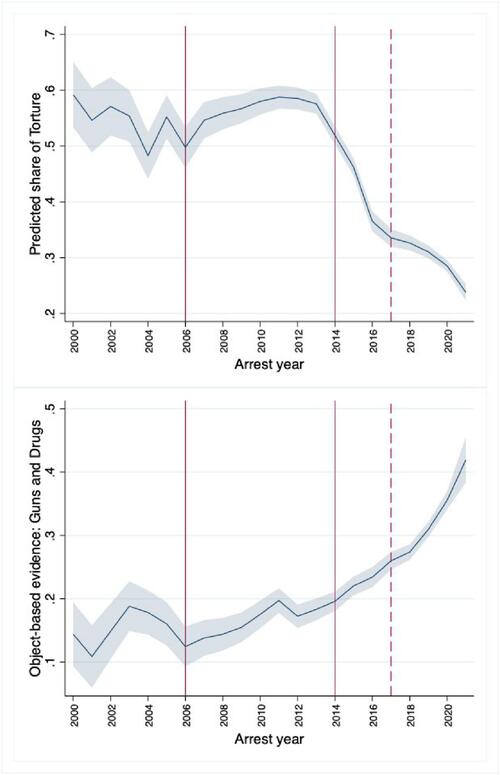
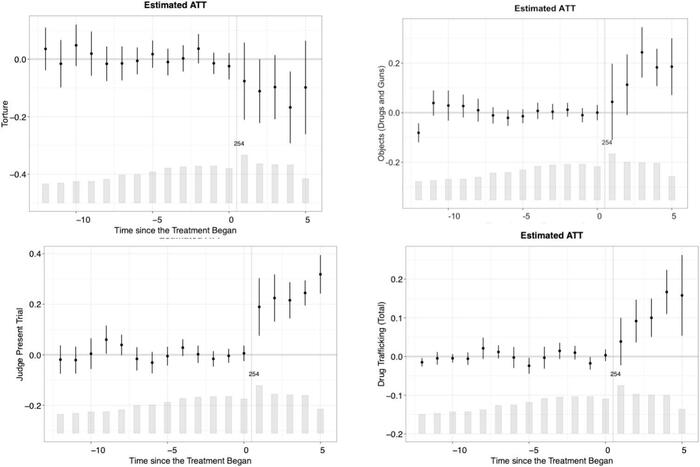
This paper examines how due process reforms enable evidence manipulation. During the past two decades, most Latin American countries have radically reformed their criminal justice systems, with the aim of strengthening rights protections and curbing abuses. Focusing on Mexico, we uncover a paradox of these institutional reforms: confronted with social pressures to punish crimes, police officers and prosecutors with limited investigation capacities fabricate criminal cases that pretend to conform with stricter judicial standards. Using difference-in-differences designs with a representative prison survey and ethnographic fieldwork among criminal prosecutors, we document a decline in torture and a parallel rise in convictions grounded in fabricated evidence, most commonly planted drugs and weapons. This shift toward what we call “fabricated justice” has fueled an increase in drug trafficking convictions. This recent increase in planted evidence suggests that when rule of law reforms are implemented without corresponding investments in state capacity, they can generate new and unexpected forms of abuse.

All Publications button
1
Publication Type
Journal Articles
Publication Date
Journal Publisher
World Development
Authors
Beatriz Magaloni
Number
March 2026, 107222
-
Venezuela Panel Event

The U.S. military operation known as Operation Absolute Resolve, which resulted in the capture and removal of Nicolás Maduro from Venezuela, represents a watershed moment in hemispheric politics. The operation, characterized by precision targeting, limited duration, and the absence of a formal occupation, has nonetheless created a profound political rupture inside Venezuela and raised far-reaching questions about sovereignty, legitimacy, governance, and democratic reconstruction.

This event convenes scholars and practitioners to examine what comes after such a military intervention, providing an analysis of post-extraction scenarios, drawing on comparative experience, Venezuelan political dynamics, and theories of post-authoritarian and post-conflict transitions.

The discussion does not seek to justify or condemn the intervention itself. Rather, it aims to assess the range of plausible futures now confronting Venezuela and the conditions under which the current rupture could lead to authoritarian rebalancing, prolonged disorder, or democratic recovery.

SPEAKERS:

  • María Ignacia Curiel
  • Héctor Fuentes
  • Dorothy Kronick
  • Harold Trinkunas
  • Diego A. Zambrano
     

MODERATOR: Alberto Díaz-Cayeros 

About the Speakers

Maria Curiel

Maria Ignacia Curiel

Research Scholar, CDDRL; Research Affiliate, Poverty, Violence, and Governance Lab
Link to bio

María Ignacia Curiel is a Research Scholar at the Center on Democracy, Development and the Rule of Law and Research Affiliate of the Poverty, Violence and Governance Lab at Stanford University. Curiel is an empirical political scientist using experimental, observational, and qualitative data to study questions of violence and democratic participation, peacebuilding, and representation.

Her research primarily explores political solutions to violent conflict and the electoral participation of parties with violent origins. This work includes an in-depth empirical study of Comunes, the Colombian political party formed by the former FARC guerrilla, as well as a broader analysis of rebel party behaviors across different contexts. More recently, her research has focused on democratic mobilization and the political representation of groups affected by violence in Colombia, Mexico, and Venezuela.

Hector Fuentes

Héctor Fuentes

Visiting Scholar, Center on Democracy, Development and the Rule of Law at the Freeman Spogli Institute for International Studies
Link to bio

Hector Fuentes is a Visiting Scholar at Stanford’s Center on Democracy, Development and the Rule of Law at Stanford University. His research focuses on Venezuelan elections, exploring the dynamics that led to this semi-competitive election, analyzing the strategic successes of the opposition, and identifying windows of opportunity for fostering a transition to democracy in Venezuela.

Dorothy_Kronick

Dorothy Kronick

Associate Professor of Public Policy, Goldman School of Public Policy at Berkeley
Link to bio

Dorothy Kronick is an Associate Professor of Public Policy at the Goldman School of Public Policy at Berkeley. She studies contemporary Latin American politics, focusing on Venezuelan politics and the politics of crime and policing. Her work has been published in the American Political Science Review, the Journal of Politics, Science, and Science Advances, among other outlets. Her commentary on Venezuelan politics has appeared in the New York Times and the Washington Post.

Harold Trinkunas

Harold Trinkunas

Deputy Director and a Senior Research Scholar at the Center for International Security and Cooperation at the Freeman Spogli Institute for International Studies
Link to bio

Harold Trinkunas is a Senior Research Scholar and the Deputy Director at the Center for International Security and Cooperation at the Freeman Spogli Institute for International Studies at Stanford University. His work has examined civil-military relations, ungoverned spaces, terrorist financing, emerging power dynamics, and global governance.

Diego Zambrano

Diego A. Zambrano

Associate Professor of Law, Stanford Law School & CDDRL Affiliated Faculty
Link to bio

Diego A. Zambrano is a Professor of Law and Associate Dean for Global Programs at Stanford Law School, specializing in the areas of civil litigation and comparative law. He is also the faculty director of the Neukom Center for the Rule of Law and Faculty Affiliate at the Center on Democracy, Development and Rule of Law at Stanford University. 

Alberto Díaz-Cayeros

Alberto Díaz-Cayeros

Senior Fellow, Freeman Spogli Institute (FSI), Affiliated faculty at the Center on Democracy, Development and the Rule of Law (CDDRL), Co-director, Democracy Action Lab (DAL)
Link to bio

Alberto Diaz-Cayeros joined the FSI faculty in 2013 after serving for five years as the director of the Center for US-Mexico studies at the University of California, San Diego. He earned his Ph.D at Duke University in 1997. He was an assistant professor of political science at Stanford from 2001-2008, before which he served as an assistant professor of political science at the University of California, Los Angeles. Diaz-Cayeros has also served as a researcher at Centro de Investigacion Para el Desarrollo, A.C. in Mexico from 1997-1999. His work has focused on federalism, poverty and violence in Latin America, and Mexico in particular. He has published widely in Spanish and English. His book Federalism, Fiscal Authority and Centralization in Latin America was published by Cambridge University Press in 2007 (reprinted 2016). His latest book (with Federico Estevez and Beatriz Magaloni) is: The Political Logic of Poverty Relief Electoral Strategies and Social Policy in Mexico. His work has primarily focused on federalism, poverty and economic reform in Latin America, and Mexico in particular, with more recent work addressing crime and violence, youth-at-risk, and police professionalization. He currently serves as the co-director of the Democracy Action Lab at the Center on Democracy, Development and the Rule of Law (CDRRL) at the Freeman Spogli Institute (FSI).

Alberto Díaz-Cayeros

William J. Perry Conference Room, Encina Hall 2nd Floor 

Virtual to Public. If prompted for a password, use: 123456
Only those with an active Stanford ID with access to the William J. Perry Conference Room in Encina Hall may attend in person.

Encina Hall, Suite 052
616 Jane Stanford Way
Stanford, CA 94305-6055

0
Research Scholar
Research Manager, Democracy Action Lab
Poverty, Violence, and Governance Lab Research Affiliate, 2024-25
CDDRL Postdoctoral Fellow, 2023-24
maria_curiel_2024.jpg

María Ignacia Curiel is a Research Scholar at the Center on Democracy, Development and the Rule of Law and Research Affiliate of the Poverty, Violence and Governance Lab at Stanford University. Curiel is an empirical political scientist using experimental, observational, and qualitative data to study questions of violence and democratic participation, peacebuilding, and representation.

Her research primarily explores political solutions to violent conflict and the electoral participation of parties with violent origins. This work includes an in-depth empirical study of Comunes, the Colombian political party formed by the former FARC guerrilla, as well as a broader analysis of rebel party behaviors across different contexts. More recently, her research has focused on democratic mobilization and the political representation of groups affected by violence in Colombia, Mexico, and Venezuela.

Curiel's work has been supported by the Folke Bernadotte Academy, the Institute for Humane Studies, and the APSA Centennial Center and is published in the Journal of Politics. She holds a Ph.D. in Political Science and dual B.A. degrees in Economics and Political Science from New York University.

Date Label
María Ignacia Curiel Research Scholar Research Manager Panelist Democracy Action Lab (DAL) and CDDRL, Freeman Spogli Institute for International Studies (FSI)
0
hector_fuentes.jpg

Héctor Fuentes is a Visiting Scholar at Stanford’s Center on Democracy, Development and the Rule of Law (2024-25). His research focuses on the critical juncture of the 2024 Venezuelan elections, exploring the dynamics that led to this semi-competitive election, analyzing the strategic successes of the opposition, and identifying windows of opportunity for fostering a transition to democracy in Venezuela. As the Director of EstadoLab, he has co-authored influential pieces on state fragility and democracy in Venezuela, as well as on state fragility across South America.

Héctor holds a Master of Global Affairs from Tsinghua University, where he was a Schwarzman Scholar, and a Master of Public Policy from the University of Oxford, supported by a Chevening Scholarship. His legal training was completed at the Central University of Venezuela, where he graduated as valedictorian. Throughout his career, Héctor has built extensive expertise in institutional capacity building, rule of law strengthening, and natural resource governance.

In addition to his research and academic work, Héctor has been actively involved in democracy promotion efforts in Venezuela. He co-founded EstadoLab, leading national campaigns that reached millions of young people and supported their participation in pro-democracy initiatives. He has also worked on various international projects aimed at rebuilding state capacity and promoting justice reform.

CDDRL Visiting Scholar, 2024-26
Fisher Family Summer Fellow, 2024
Date Label
Héctor Fuentes Visiting Scholar Panelist Freeman Spogli Institute for International Studies (FSI)
Dorothy Kronick Associate Professor of Public Policy Panelist Goldman School of Public Policy, U.C. Berkeley
Harold Trinkunas Senior Research Scholar & Deputy Director Panelist Center for International Security and Cooperation (CISAC) at the Freeman Spogli Institute for International Studies (FSI)

Room N346, Neukom Building
555 Nathan Abbott Way
Stanford, CA 94305

650.721.7681
0
Professor of Law, Stanford Law School
diego-zambrano-3-1024x684_square.jpg

Diego A. Zambrano’s primary research and teaching interests lie in the areas of civil procedure, transnational litigation, and judicial federalism. His work explores the civil litigation landscape: the institutions, norms, and incentives that influence litigant and judicial behavior. Professor Zambrano also has an interest in comparative constitutional law and legal developments related to Venezuela. He currently leads an innovative Stanford Policy Lab tracking “Global Judicial Reforms” and has served as an advisor to pro-democracy political parties in Venezuela. In 2021, Professor Zambrano received the Barbara Allen Babcock Award for Excellence in Teaching.

Professor Zambrano’s scholarship has appeared or is forthcoming at the Columbia Law Review, University of Chicago Law Review, Michigan Law Review, Northwestern University Law Review, Stanford Law Review, and Virginia Law Review, among other journals, and has been honored by the American Association of Law Schools (AALS) and the National Civil Justice Institute. Professor Zambrano will be a co-author of the leading casebook Civil Procedure: A Modern Approach (8th ed. 2024) (with Marcus, Pfander, and Redish). In addition, Professor Zambrano serves as the current chair of the Federal Courts Section of the AALS. He also writes about legal issues for broader public audiences, with his contributions appearing in the Wall Street Journal, BBC News, and Lawfare.

After graduating with honors from Harvard Law School in 2013, Professor Zambrano spent three years as an associate at Cleary Gottlieb in New York, focusing on transnational litigation and arbitration. Before joining Stanford Law School in 2018, Professor Zambrano was a Bigelow Teaching Fellow at the University of Chicago Law School.

CDDRL Affiliated Faculty
Date Label
Diego A. Zambrano Associate Professor of Law, CDDRL Affiliated Faculty Panelist Stanford Law School
Panel Discussions
Date Label
-
DAL Mexico Launch

Join us in celebrating the launch of the Democracy Action Lab (DAL) at Stanford University.


The Center for International Studies at El Colegio de México and the Center on Democracy, Development and the Rule of Law (CDDRL) at Stanford University are pleased to host keynote lectures by:

  • Dr. Adam Przeworski, Professor Emeritus of Political Science, New York University
  • Dr. Beatriz Magaloni, Graham H. Stewart Professor of International Relations, Stanford University


The session will explore urgent questions at the heart of today’s global democratic challenges:

  • What have we learned — through political science and lived experience — about how democracies emerge, erode, and can be renewed?
  • What knowledge, strategies, and collective action are needed now to halt democratic backsliding and spark a new wave of democratization worldwide?


Open to the public. Especially geared toward those dedicated to strengthening democracy.


DAL Mexico Launch in Spanish

Únete a nosotros para celebrar el lanzamiento del Laboratorio de Acción en Democracia (LAD) de la Universidad de Stanford.


El Centro de Estudios Internacionales de El Colegio de México y el Center on Democracy, Development and the Rule of Law (CDDRL) de la Universidad de Stanford tienen el gusto de invitarlos a las conferencia magistrales a cargo de:

  • Dr. Adam Przeworski, Profesor Emérito de Ciencia Política, Universidad de Nueva York
  • Dra. Beatriz Magaloni, Profesora Graham H. Stewart de Relaciones Internacionales, Universidad de Stanford


El evento abordará preguntas urgentes sobre los desafíos democráticos globales actuales:

  • ¿Qué hemos aprendido —a través de la ciencia política y de la experiencia vivida— sobre cómo surgen, se erosionan y pueden renovarse las democracias?
  • ¿Qué conocimientos, estrategias y acciones colectivas se necesitan hoy para detener el retroceso democrático e impulsar una nueva ola de democratización en el mundo?


Evento abierto al público. Especialmente dirigido a quienes se dedican a fortalecer la democracia.

speakers / Ponentes

Adam Przeworski

Dr. Adam Przeworski

Carroll and Milton Professor Emeritus of Politics at New York University
Profesor Emérito Carroll and Milton de Ciencia Política en la Universidad de Nueva York
website / sito web

Adam Przeworski is the Carroll and Milton Professor Emeritus of Politics and (by courtesy) Economics at New York University. Previously, he taught at the University of Chicago, where he was the Martin A. Ryerson Distinguished Service Professor, and held visiting appointments in India, Chile, France, Germany, Spain, and Switzerland. He is a member of the US National Academy of Arts and Sciences. Among his numerous awards, in 2010, he received the Johan Skytte Prize for "raising the scientific standards regarding the analysis of the relations between democracy, capitalism, and economic development."  He has studied political regimes, democracy, autocracy, and their intermediate forms, as well as the conditions under which regimes survive and change, and their consequences for economic development and income equality. His focus is on the role of elections as a mechanism of managing societal conflicts. His current projects concern the phenomenon of "democratic backsliding" and the historical evolution of constitutional rules for electing chief executives.

Adam Przeworski es Profesor Emérito Carroll and Milton de Ciencia Política y (por cortesía) de Economía en la Universidad de Nueva York. Anteriormente, fue profesor en la Universidad de Chicago, donde ocupó la cátedra distinguida Martin A. Ryerson Distinguished Service Professor, y tuvo nombramientos visitantes en India, Chile, Francia, Alemania, España y Suiza. Es miembro de la Academia Nacional de Artes y Ciencias de Estados Unidos. Entre sus numerosos premios, en 2010 recibió el Premio Johan Skytte por "elevar los estándares científicos en el análisis de las relaciones entre democracia, capitalismo y desarrollo económico." Ha estudiado los regímenes políticos, la democracia, la autocracia y sus formas intermedias, las condiciones bajo las cuales los regímenes sobreviven y cambian, así como sus consecuencias para el desarrollo económico y la igualdad de ingresos. Su enfoque se centra en el papel de las elecciones como mecanismo para gestionar los conflictos sociales. Sus proyectos actuales se refieren al fenómeno del "retroceso democrático" y la evolución histórica de las normas constitucionales para la elección de jefes de ejecutivo.

Beatriz Magaloni

Dr. Beatriz Magaloni

Graham H. Stuart Professor of International Relations and Senior Fellow at the Freeman Spogli Institute for International Studies, Stanford University
Profesora Graham H. Stuart de Relaciones Internacionales y Senior Fellow en el Freeman Spogli Institute for International Studies, Universidad de Stanford
website / sito web

Beatriz Magaloni is the Graham H. Stuart Professor of International Relations at the Department of Political Science and a Senior Fellow at the Freeman Spogli Institute, where she holds affiliations with the Center on Democracy, Development and the Rule of Law (CDDRL) and the Center for International Security and Cooperation (CISAC). She leads the Poverty, Violence, and Governance Lab (PovGov) and co-directs the Democracy Action Lab. In 2023, she was awarded the Stockholm Prize in Criminology for her research on police violence and how it can be reduced, and in 2024, she received the Boris Mints Institute (BMI) Prize for her work on authoritarianism and its return as a global challenge. Her research focuses on the study of authoritarian regimes; violence, public security, and human rights; “non-state” forms of governance; distributive politics and the provision of public goods in Latin America.

Beatriz Magaloni es Profesora Graham Stuart de Relaciones Internacionales en el Departamento de Ciencia Política y Senior Fellow en el Freeman Spogli Institute, donde mantiene afiliaciones con el Centro sobre la Democracia, el Desarrollo y el Estado de Derecho (CDDRL) y el Centro para la Seguridad Internacional y la Cooperación (CISAC). Dirige el Laboratorio de Pobreza, Violencia y Gobernanza (PovGov) y co-dirige el Laboratorio de Acción en Democracia. En 2023 fue galardonada con el Premio de Estocolmo en Criminología por su investigación sobre la violencia policial y cómo puede reducirse, y en 2024 recibió el Premio del Instituto Boris Mints (BMI) por su trabajo sobre el autoritarismo y su retorno como desafío global. Su investigación se centra en el estudio de los regímenes autoritarios; la violencia, la seguridad pública y los derechos humanos; las formas de gobernanza "no estatales"; la política distributiva y la provisión de bienes públicos en América Latina.

Sala Alfonso Reyes del Colegio de México (Ver mapa)
Carretera Picacho Ajusco 20, Col. Ampliación Fuentes del Pedregal, C.P. 14110
Tlalpan, Ciudad de México
Tel.: +52 55 54493000

Adam Przeworski

Dept. of Political Science
Encina Hall, Room 436
Stanford University,
Stanford, CA

(650) 724-5949
0
Senior Fellow at the Freeman Spogli Institute for International Studies
Graham H. Stuart Professor of International Relations
Professor of Political Science
beatriz_magaloni_2024.jpg MA, PhD

Beatriz Magaloni Magaloni is the Graham Stuart Professor of International Relations at the Department of Political Science. Magaloni is also a Senior Fellow at the Freeman Spogli Institute, where she holds affiliations with the Center on Democracy, Development and the Rule of Law (CDDRL) and the Center for International Security and Cooperation (CISAC). She is also a Stanford’s King Center for Global Development faculty affiliate. Magaloni has taught at Stanford University for over two decades.

She leads the Poverty, Violence, and Governance Lab (Povgov). Founded by Magaloni in 2010, Povgov is one of Stanford University’s leading impact-driven knowledge production laboratories in the social sciences. Under her leadership, Povgov has innovated and advanced a host of cutting-edge research agendas to reduce violence and poverty and promote peace, security, and human rights.

Magaloni’s work has contributed to the study of authoritarian politics, poverty alleviation, indigenous governance, and, more recently, violence, crime, security institutions, and human rights. Her first book, Voting for Autocracy: Hegemonic Party Survival and its Demise in Mexico (Cambridge University Press, 2006) is widely recognized as a seminal study in the field of comparative politics. It received the 2007 Leon Epstein Award for the Best Book published in the previous two years in the area of political parties and organizations, as well as the Best Book Award from the American Political Science Association’s Comparative Democratization Section. Her second book The Politics of Poverty Relief: Strategies of Vote Buying and Social Policies in Mexico (with Alberto Diaz-Cayeros and Federico Estevez) (Cambridge University Press, 2016) explores how politics shapes poverty alleviation.

Magaloni’s work was published in leading journals, including the American Political Science Review, American Journal of Political Science, Criminology & Public Policy, World Development, Comparative Political Studies, Annual Review of Political Science, Cambridge Journal of Evidence-Based Policing, Latin American Research Review, and others.

Magaloni received wide international acclaim for identifying innovative solutions for salient societal problems through impact-driven research. In 2023, she was named winner of the world-renowned Stockholm Prize in Criminology, considered an equivalent of the Nobel Prize in the field of criminology. The award recognized her extensive research on crime, policing, and human rights in Mexico and Brazil. Magaloni’s research production in this area was also recognized by the American Political Science Association, which named her recipient of the 2021 Heinz I. Eulau Award for the best article published in the American Political Science Review, the leading journal in the discipline.

She received her Ph.D. in political science from Duke University and holds a law degree from the Instituto Tecnológico Autónomo de México.

Director, Poverty, Violence, and Governance Lab
Co-director, Democracy Action Lab
CV
Date Label
Beatriz Magaloni
Lectures
Date Label
-
DAL Launch Event

Two decades after the close of the Third Wave of democratization, scholars and practitioners alike continue to grapple with the question of why some democracies erode while others endure. To advance this critical inquiry, Stanford University’s Center on Democracy, Development and the Rule of Law (CDDRL) is launching the Democracy Action Lab (DAL), a new initiative devoted to rigorous, comparative, and conceptually grounded research on the conditions of democratic backsliding and resilience. DAL will provide an academic home for refining definitions, testing theories, and generating knowledge that informs both scholarly debates and practical responses to the challenges facing democracy worldwide.

The launch will feature a roundtable, “Global Challenges & Responses to Democratic Erosion” with leading voices in the field — Kathryn Stoner, Beatriz Magaloni, Anna Grzymala-Busse, and Didi Kuo — moderated by María Ignacia Curiel. Panelists will reflect on conceptual clarity and contestation around “backsliding,” its relationship to fragile statehood, populism, and authoritarian resilience, and the mechanisms through which institutions weaken or recover. Drawing on comparative cases across Latin America, Europe, and beyond, the discussion will also chart new directions for research: refining metrics, mapping mechanisms of erosion, and theorizing pathways of democratic renewal. The event marks DAL’s commitment to placing cutting-edge academic work at the center of global conversations about democracy’s future.

Following the panel, attendees are invited to a celebratory reception.

SPEAKERS:

  • Anna Grzymala-Busse
  • Didi Kuo
  • Beatriz Magaloni
  • Kathryn Stoner
     

MODERATOR: María Ignacia Curiel

About the Speakers

Anna Grzymala-Busse

Anna Grzymala-Busse

Senior Fellow, Freeman Spogli Institute for International Studies, Michelle and Kevin Douglas Professor of International Studies, Professor of Political Science; Senior Fellow, Hoover Institution; Director of The Europe Center
Link to bio

Anna Grzymała-Busse is a professor in the Department of Political Science, the Michelle and Kevin Douglas Professor of International Studies, senior fellow at the Freeman Spogli Institute for International Studies and the director of The Europe Center. Her research interests include political parties, state development and transformation, informal political institutions, religion and politics, and post-communist politics. Anna's most recent book, Sacred Foundations: The Religious and Medieval Roots of the European State argues that the medieval church was a fundamental force in European state formation.

Didi Kuo

Didi Kuo

Center Fellow, Freeman Spogli Institute for International Studies
Link to bio

Didi Kuo is a Center Fellow at the Freeman Spogli Institute for International Studies (FSI) at Stanford University. She is a scholar of comparative politics with a focus on democratization, corruption and clientelism, political parties and institutions, and political reform. She is the author of The Great Retreat: How Political Parties Should Behave and Why They Don’t (Oxford University Press, forthcoming) and Clientelism, Capitalism, and Democracy: the rise of programmatic politics in the United States and Britain (Cambridge University Press, 2018).

She has been at Stanford since 2013 as the manager of the Program on American Democracy in Comparative Perspective and is co-director of the Fisher Family Honors Program at CDDRL. She was an Eric and Wendy Schmidt Fellow at New America and is a non-resident fellow with the Carnegie Endowment for International Peace. She received a PhD in political science from Harvard University, an MSc in Economic and Social History from Oxford University, where she studied as a Marshall Scholar, and a BA from Emory University.

Beatriz Magaloni

Beatriz Magaloni

Graham H. Stuart Professor of International Relations, School of Humanities and Sciences; Senior Fellow, Freeman Spogli Institute for International Studies; Director, Poverty, Violence, and Governance Lab
Link to bio

Beatriz Magaloni is the Graham Stuart Professor of International Relations at the Department of Political Science. Magaloni is also a Senior Fellow at the Freeman Spogli Institute, where she holds affiliations with the Center on Democracy, Development and the Rule of Law (CDDRL) and the Center for International Security and Cooperation (CISAC). She is also a faculty affiliate at Stanford’s King Center for Global Development. Magaloni has taught at Stanford University for over two decades.

She leads the Poverty, Violence, and Governance Lab (PovGov). Founded by Magaloni in 2010, PovGov is one of Stanford University’s leading impact-driven knowledge production laboratories in the social sciences. Under her leadership, PovGov has innovated and advanced a host of cutting-edge research agendas aimed at reducing violence and poverty and promoting peace, security, and human rights.

Kathryn Stoner

Kathryn Stoner

Mosbacher Director, Center on Democracy, Development, and the Rule of Law; Senior Fellow; Freeman Spogli Institute for International Studies
Link to bio

Kathryn Stoner is the Mosbacher Director of the Center on Democracy, Development, and the Rule of Law (CDDRL), and a Senior Fellow at CDDRL and the Center on International Security and Cooperation at FSI. From 2017 to 2021, she served as FSI's Deputy Director. She is Professor of Political Science (by courtesy) at Stanford and she teaches in the Department of Political Science, and in the Program on International Relations, as well as in the Ford Dorsey Master's in International Policy Program. She is also a Senior Fellow (by courtesy) at the Hoover Institution.

Maria Curiel

Maria Ignacia Curiel

Research Scholar, CDDRL; Research Affiliate, Poverty, Violence, and Governance Lab
Link to bio

María Ignacia Curiel is a Research Scholar at the Center on Democracy, Development and the Rule of Law and Research Affiliate of the Poverty, Violence and Governance Lab at Stanford University. Curiel is an empirical political scientist using experimental, observational, and qualitative data to study questions of violence and democratic participation, peacebuilding, and representation.

Her research primarily explores political solutions to violent conflict and the electoral participation of parties with violent origins. This work includes an in-depth empirical study of Comunes, the Colombian political party formed by the former FARC guerrilla, as well as a broader analysis of rebel party behaviors across different contexts. More recently, her research has focused on democratic mobilization and the political representation of groups affected by violence in Colombia, Mexico, and Venezuela.

María Ignacia Curiel

Panel: William J. Perry Conference Room, Encina Hall 2nd Floor 
Reception: Poverty, Violence, and Governance Lab, Encina Hall Garden Level S051

Virtual to Public. If prompted for a password, use: 123456
Only those with an active Stanford ID with access to the William J. Perry Conference Room in Encina Hall may attend in person. Registration is required.

Encina Hall
616 Jane Stanford Way
Stanford, CA  94305


(650) 723-4270
0
Senior Fellow at the Freeman Spogli Institute for International Studies
Michelle and Kevin Douglas Professor of International Studies
Professor of Political Science
Senior Fellow, Hoover Institution
anna_gb_4_2022.jpg

Anna Grzymała-Busse is a professor in the Department of Political Science, the Michelle and Kevin Douglas Professor of International Studies, senior fellow at the Freeman Spogli Institute for International Studies and the director of The Europe Center. Her research interests include political parties, state development and transformation, informal political institutions, religion and politics, and post-communist politics.

In her first book, Redeeming the Communist Past, she examined the paradox of the communist successor parties in East Central Europe: incompetent as authoritarian rulers of the communist party-state, several then succeeded as democratic competitors after the collapse of these communist regimes in 1989.

Rebuilding Leviathan, her second book project, investigated the role of political parties and party competition in the reconstruction of the post-communist state. Unless checked by a robust competition, democratic governing parties simultaneously rebuilt the state and ensured their own survival by building in enormous discretion into new state institutions.

Anna's third book, Nations Under God, examines why some churches have been able to wield enormous policy influence. Others have failed to do so, even in very religious countries. Where religious and national identities have historically fused, churches gained great moral authority, and subsequently covert and direct access to state institutions. It was this institutional access, rather than either partisan coalitions or electoral mobilization, that allowed some churches to become so powerful.

Anna's most recent book, Sacred Foundations: The Religious and Medieval Roots of the European State argues that the medieval church was a fundamental force in European state formation.

Other areas of interest include informal institutions, the impact of European Union membership on politics in newer member countries, and the role of temporality and causal mechanisms in social science explanations.

Director of The Europe Center
Anna Grzymala-Busse Michelle and Kevin Douglas Professor of International Studies and Senior Fellow Panelist Freeman Spogli Institute for International Studies

Encina Hall, C150
616 Jane Stanford Way
Stanford, CA 94305

0
Center Fellow, Freeman Spogli Institute for International Studies
didi_kuo_2023.jpg

Didi Kuo is a Center Fellow at the Freeman Spogli Institute for International Studies (FSI) at Stanford University. She is a scholar of comparative politics with a focus on democratization, corruption and clientelism, political parties and institutions, and political reform. She is the author of The Great Retreat: How Political Parties Should Behave and Why They Don’t (Oxford University Press) and Clientelism, Capitalism, and Democracy: the rise of programmatic politics in the United States and Britain (Cambridge University Press, 2018).

She has been at Stanford since 2013 as the manager of the Program on American Democracy in Comparative Perspective and is co-director of the Fisher Family Honors Program at CDDRL. She was an Eric and Wendy Schmidt Fellow at New America and is a non-resident fellow with the Carnegie Endowment for International Peace. She received a PhD in political science from Harvard University, an MSc in Economic and Social History from Oxford University, where she studied as a Marshall Scholar, and a BA from Emory University.

Date Label
Didi Kuo Center Fellow Panelist CDDRL, Freeman Spogli Institute for International Studies

Dept. of Political Science
Encina Hall, Room 436
Stanford University,
Stanford, CA

(650) 724-5949
0
Senior Fellow at the Freeman Spogli Institute for International Studies
Graham H. Stuart Professor of International Relations
Professor of Political Science
beatriz_magaloni_2024.jpg MA, PhD

Beatriz Magaloni Magaloni is the Graham Stuart Professor of International Relations at the Department of Political Science. Magaloni is also a Senior Fellow at the Freeman Spogli Institute, where she holds affiliations with the Center on Democracy, Development and the Rule of Law (CDDRL) and the Center for International Security and Cooperation (CISAC). She is also a Stanford’s King Center for Global Development faculty affiliate. Magaloni has taught at Stanford University for over two decades.

She leads the Poverty, Violence, and Governance Lab (Povgov). Founded by Magaloni in 2010, Povgov is one of Stanford University’s leading impact-driven knowledge production laboratories in the social sciences. Under her leadership, Povgov has innovated and advanced a host of cutting-edge research agendas to reduce violence and poverty and promote peace, security, and human rights.

Magaloni’s work has contributed to the study of authoritarian politics, poverty alleviation, indigenous governance, and, more recently, violence, crime, security institutions, and human rights. Her first book, Voting for Autocracy: Hegemonic Party Survival and its Demise in Mexico (Cambridge University Press, 2006) is widely recognized as a seminal study in the field of comparative politics. It received the 2007 Leon Epstein Award for the Best Book published in the previous two years in the area of political parties and organizations, as well as the Best Book Award from the American Political Science Association’s Comparative Democratization Section. Her second book The Politics of Poverty Relief: Strategies of Vote Buying and Social Policies in Mexico (with Alberto Diaz-Cayeros and Federico Estevez) (Cambridge University Press, 2016) explores how politics shapes poverty alleviation.

Magaloni’s work was published in leading journals, including the American Political Science Review, American Journal of Political Science, Criminology & Public Policy, World Development, Comparative Political Studies, Annual Review of Political Science, Cambridge Journal of Evidence-Based Policing, Latin American Research Review, and others.

Magaloni received wide international acclaim for identifying innovative solutions for salient societal problems through impact-driven research. In 2023, she was named winner of the world-renowned Stockholm Prize in Criminology, considered an equivalent of the Nobel Prize in the field of criminology. The award recognized her extensive research on crime, policing, and human rights in Mexico and Brazil. Magaloni’s research production in this area was also recognized by the American Political Science Association, which named her recipient of the 2021 Heinz I. Eulau Award for the best article published in the American Political Science Review, the leading journal in the discipline.

She received her Ph.D. in political science from Duke University and holds a law degree from the Instituto Tecnológico Autónomo de México.

Director, Poverty, Violence, and Governance Lab
Co-director, Democracy Action Lab
CV
Date Label
Beatriz Magaloni Graham H. Stuart Professor of International Relations and Senior Fellow Panelist Freeman Spogli Institute for International Studies

FSI
Stanford University
Encina Hall C140
Stanford, CA 94305-6055

(650) 736-1820 (650) 724-2996
0
Satre Family Senior Fellow, Freeman Spogli Institute for International Studies
kathryn_stoner_1_2022_v2.jpg MA, PhD

Kathryn Stoner is the Mosbacher Director of the Center on Democracy, Development, and the Rule of Law (CDDRL), and a Senior Fellow at CDDRL and the Center on International Security and Cooperation at FSI. From 2017 to 2021, she served as FSI's Deputy Director. She is Professor of Political Science (by courtesy) at Stanford and she teaches in the Department of Political Science, and in the Program on International Relations, as well as in the Ford Dorsey Master's in International Policy Program. She is also a Senior Fellow (by courtesy) at the Hoover Institution.

Prior to coming to Stanford in 2004, she was on the faculty at Princeton University for nine years, jointly appointed to the Department of Politics and the Princeton School for International and Public Affairs (formerly the Woodrow Wilson School). At Princeton she received the Ralph O. Glendinning Preceptorship awarded to outstanding junior faculty. She also served as a Visiting Associate Professor of Political Science at Columbia University, and an Assistant Professor of Political Science at McGill University. She has held fellowships at Harvard University as well as the Woodrow Wilson Center in Washington, DC. 

In addition to many articles and book chapters on contemporary Russia, she is the author or co-editor of six books: "Transitions to Democracy: A Comparative Perspective," written and edited with Michael A. McFaul (Johns Hopkins 2013);  "Autocracy and Democracy in the Post-Communist World," co-edited with Valerie Bunce and Michael A. McFaul (Cambridge, 2010);  "Resisting the State: Reform and Retrenchment in Post-Soviet Russia" (Cambridge, 2006); "After the Collapse of Communism: Comparative Lessons of Transitions" (Cambridge, 2004), coedited with Michael McFaul; and "Local Heroes: The Political Economy of Russian Regional" Governance (Princeton, 1997); and "Russia Resurrected: Its Power and Purpose in a New Global Order" (Oxford University Press, 2021).

She received a BA (1988) and MA (1989) in Political Science from the University of Toronto, and a PhD in Government from Harvard University (1995). In 2016 she was awarded an honorary doctorate from Iliad State University, Tbilisi, Republic of Georgia.

Download full-resolution headshot; photo credit: Rod Searcey.

Mosbacher Director, Center on Democracy, Development and the Rule of Law
Professor of Political Science (by courtesy), Stanford University
Senior Fellow (by courtesy), Hoover Institution
CV
Date Label
Kathryn Stoner Mosbacher Director of the Center on Democracy, Development, and the Rule of Law (CDDRL) Panelist Freeman Spogli Institute for International Studies
Panel Discussions
Date Label
Authors
News Type
News
Date
Paragraphs

Motivation


Retaliation (or the threat thereof) is a central component of human behavior. It plays a key role in sustaining cooperation — such as in international organizations or free trade agreements — because those known to retaliate come to acquire a reputation of being hard to exploit. But how does the use and function of retaliation vary across cultures, and how does it interact with formal forms of punishment?

In “Cross-cultural differences in retaliation: Evidence from the soccer field,” Alain Schläpfer tackles these questions using data on retaliation from association football. Retaliation is simply defined in terms of fouling: player B retaliates against player A if and only if, after A fouls B, B then fouls A. Among other findings, Schläpfer shows that players from cultures emphasizing revenge are more likely to retaliate on the football field. This form of ‘informal punishment’ by players also interacts with ‘formal punishment’ by referees: retaliation by B is less likely when A is sanctioned with a yellow card. Schläpfer’s paper increases our knowledge of the causes and consequences of retaliation, while showing how informal cultural norms interact with the formal rules of football.  

Data


Schläpfer creates a data set of fouls committed over three football seasons (2016-2019) in nine of the world’s top professional men’s leagues. This includes the European leagues of Premier League (England), Serie A (Italy), Bundesliga (Germany), LaLiga (Spain), and Ligue 1 (France), as well as Série A (Brazil), Liga Profesional (Argentina), Liga MX (Mexico), and Major League Soccer (United States). The dataset comprises 9,531 games, 230,113 fouls committed by 10,928 unique perpetrators from 139 countries against 11,115 unique victims from 137 countries.

Because Schläpfer hypothesizes that being from more revenge-centric cultures explains on-field retaliation, the key independent variable is measured using a dataset from Stelios Michalopoulos and Melanie Meng Xue that identifies revenge motifs in a culture’s folklore. Examples of this include supernatural forces avenging human murders or animals avenging the death of their friends by humans. Schläpfer uses a host of other independent variables, such as country-level survey data about the desire to punish — as opposed to rehabilitate — criminals, which is also theoretically linked to revenge. As stated above, retaliation is measured in terms of fouls committed. Schläpfer shows that there is substantial variation in retaliation rates among players from different countries, from Gabon (8%) to Iceland (31%). Can the folklore in the country of origin explain the behavior of players on the field?


Image
Fig. 1. The share of fouls retaliated in soccer games (top) and the prevalence of revenge motifs in folklore (bottom). Both variables tend to have higher values for players and folklore from the Middle East, Central Africa, Eastern Europe, and parts of South America.


Fig. 1. The share of fouls retaliated in soccer games (top) and the prevalence of revenge motifs in folklore (bottom). Both variables tend to have higher values for players and folklore from the Middle East, Central Africa, Eastern Europe, and parts of South America.


Findings


Retaliation:

Schläpfer finds evidence that players from cultures that value revenge are indeed more likely to retaliate for fouls. However, they are not more likely to commit fouls overall, cautioning us against conflating the concepts of retaliation and violence. Indeed, Schläpfer demonstrates that motifs of violence in a culture's folklore do not predict retaliation. Players are also found to be more retaliatory early on in a game, which is consistent with its use as a signal or aspect of one’s reputation. In other words, retaliation serves to deter future fouls. Victims of fouls also retaliate quickly. Indeed, retaliation rates are stable or slightly increasing during the first 30 minutes of a game, but then fall consistently thereafter.


Image
Table 1. Effect of the prevalence of revenge motifs in victim’s country of nationality on the predicted likelihood of retaliation for the foul.


Evidence is also provided to show that retaliation deters future transgressions: perpetrators are less likely to foul again if victims retaliate for the initial foul. However, this deterrence finding is only observed when the perpetrator is from a revenge culture. In other words, for retaliation to support cooperation (the absence of fouls), players must share a similar cultural background.

Schläpfer’s findings hold even when soccer-related or socioeconomic factors are taken into account. Further, the paper considers, but finds little support for, alternative explanations of why retaliation varies. These include that some teams encourage players to retaliate more or employ more players from revenge cultures. Further, retaliation does not appear to be driven by emotions; otherwise, it would be less likely to occur after halftime when players have had a chance to cool down, but this is not the case.


Image
Table 5. Other cultural measures rarely predict retaliation. Standardized coefficients reported.


Informal and Formal Sanctioning:

Finally, Schläpfer analyzes the interaction between player retaliation and refereeing. Most importantly, retaliation is significantly less likely if a foul is sanctioned with a yellow card. This illustrates the theoretical principle of formal punishment “crowding out” informal punishment, such as religious excommunication, which carries greater weight than social shunning or police fines compared to peer pressure. Both retaliation and referee sanctioning are shown to reduce the frequency of repeated offenses by perpetrators, especially among players from revenge cultures. However, Schläpfer finds that formal sanctioning is roughly three times more effective than retaliation. This suggests that football referees are doing a better job managing conflict between players than players themselves. 

Schläpfer concludes by mentioning a few of the paper’s limitations. First of all, retaliation is measured only by what referees sanction. However, referees may miss crucial incidents for which retaliation is a response, such as Zinedine Zidane’s 2006 World Cup headbutt after a verbal insult (that was not sanctioned). This is important because individuals from revenge cultures are likely to be particularly offended by verbal insults. Second, the paper does not capture retaliation that occurs across games played by the same teams over time, particularly when rivalries and hostilities have intensified. Similarly, it does not account for preemptive retaliation that does not follow a foul. Ultimately, Schläpfer deepens our understanding of retaliation in a domain where many would expect it not to operate or to do so with minimal significance. The article impressively marshals large-scale data from both sports and cultural history to clarify the causes and consequences of retaliation.

*Research-in-Brief prepared by Adam Fefer.

Hero Image
A person in a red and blue football uniform on a field Jona Møller via Unsplash
All News button
1
Subtitle

CDDRL Research-in-Brief [4-minute read]

Date Label
Authors
News Type
News
Date
Paragraphs

When it comes to managing the administrative tasks that are required to run a home and raise a family, women bear the brunt of the responsibility. According to one study of women in the United States, mothers take on 7 out of 10 so-called mental load tasks, which range from planning meals to scheduling activities for children.

All that extra work takes a toll, including on society: Women who carry more mental load are less interested in national politics (men who carry more mental load also report less political interest, but fewer men are in that position).

Read the full story in the Stanford Report.

Hero Image
Women at Lake Tanganyika
Yury Birukov
All News button
1
Subtitle

Political science professors Lisa Blaydes, Beatriz Magaloni, and James Fearon are among researchers at the King Center on Global Development addressing challenges such as gender-based violence and low labor participation, with the aim to inform supportive policy interventions.

Date Label

Encina Hall, E111
616 Jane Stanford Way
Stanford, CA 94305-6055

0
CDDRL Predoctoral Fellow, 2025-26
hanna_folsz_-_hanna_folsz.jpg

Hanna Folsz is a PhD candidate in Political Science at Stanford University. Her research focuses on opposition parties in authoritarian dominant-party regimes, with a particular focus on the challenges and opportunities they face in countering autocratization. More broadly, her work examines the causes and consequences of democratic backsliding, populism, media capture, and political favoritism — primarily in East-Central Europe and, secondarily, in Latin America. She uses a multi-method approach, including modern causal inference and text analysis techniques.

Her research has been supported by the National Science Foundation and the American Political Science Association, among others. She is the co-founder and co-organizer of EEPGW, a monthly online graduate student workshop on East European politics, and a co-founder and regular contributor to The Hungarian Observer, the most widely read online newsletter on Hungarian politics and culture. At Stanford, she is an active member of  CDDRL's Poverty, Violence, and Governance Lab (PovGov).

Date Label
-
Persisting in Hard Times

We are living through challenging times — but not for the first time. History reminds us that in our struggle, we are not alone. Across generations, people have risen to meet hardship with courage, community, and conviction — organizing for justice, teaching with purpose, advocating for change, and imagining a better future.

Join us for a powerful, moderated conversation with today’s changemakers — leaders, educators, and activists who are carrying forward this legacy of resilience and hope. Together, we’ll explore how they stay grounded, what inspires their work, and how each of us can play a part in building a more just and compassionate world. 

Event organized by Hakeem Jefferson and Gillian Slee.

MODERATORS: Hakeem Jefferson, Karina Kloos

SPEAKERS:

  • Alison Kamhi
  • Antonio López
  • DeCarol Davis
  • Pam Karlan

About the Speakers

Hakeem Jefferson

Hakeem Jefferson

Assistant Professor of Political Science & Director, Program on Identity, Democracy, and Justice, Stanford University
Link to bio

Hakeem Jefferson is an assistant professor of political science at Stanford University and faculty director of the Program on Identity, Democracy, and Justice at the Center on Democracy, Development, and the Rule of Law. His research centers on questions of race, identity, and political behavior in the United States. He is currently completing a book based on his award-winning dissertation that explores why members of stigmatized groups sometimes engage in policing and punishing their own. His academic work has been published in The American Political Science ReviewPublic Opinion QuarterlyPerspectives on Politics, and Electoral Studies. In addition to his scholarly work, Jefferson is a frequent contributor to public conversations about race and American politics, with writing appearing in outlets such asThe New York TimesFiveThirtyEightThe Washington Post, and The San Francisco Chronicle. He is a proud graduate of the University of Michigan and South Carolina public schools.

Karina Kloos

Executive Director, Stanford Democracy Hub
Link to bio

Karina Kloos is the Executive Director for the Democracy Hub and the newly launched ePluribus Stanford initiative.

Karina has also co-led the design and implementation of other emergent programs at Stanford, including the signature faculty fellowship, postdoctoral fellowship, PhD fellowship and Scholars in Service programs with Stanford Impact Labs, and the RAISE (Research, Action and Impact through Strategic Engagement) Doctoral Fellowship with the Vice Provost of Graduate Education.

She has professional experience in the domestic nonprofit, international development, and philanthropy sectors, and has published in both academic and media outlets on land rights; women’s rights; indigenous rights; sustainability; nonprofit evaluation; social movements; and democracy, including co-authorship with Doug McAdam of the 2014 book Deeply Divided: Racial Politics and Social Movements in Postwar America.

Having spent more than a decade at Stanford – the place where she met her husband and has brought two wee ones into the world – Karina is invested in the vibrancy and health of our community, as well as leveraging the immense talent and resources we have to engage and contribute positively beyond the university. She received her PhD in Sociology from Stanford in 2014.

Alison Kamhi

Alison Kamhi

Legal Program Director, Immigrant Legal Resource Center

Alison Kamhi is the Legal Program Director based in San Francisco. Alison leads the ILRC's Immigrant Survivors Team and conducts frequent in-person and webinar trainings on naturalization and citizenship, family-based immigration, U visas, and FOIA requests. She also provides technical assistance through the ILRC's Attorney of the Day program on a wide range of immigration issues, including immigration options for youth, consequences of criminal convictions for immigration purposes, removal defense strategy, and eligibility for immigration relief, including family-based immigration, U visas, VAWA, DACA, cancellation of removal, asylum, and naturalization and has co-authored a number of publications on the same topics. Alison facilitates the nine member Collaborative Resources for Immigrant Services on the Peninsula (CRISP) collaborative in San Mateo County to provide immigration services to low-income immigrants in Silicon Valley. Prior to the ILRC, Alison worked as a Clinical Teaching Fellow at the Stanford Law School Immigrants' Rights Clinic. Before Stanford, she represented abandoned and abused immigrant youth as a Skadden Fellow at Bay Area Legal Aid and at Catholic Charities Community Services in New York. She clerked for the Honorable Julia Gibbons in the U.S. Court of Appeals for the Sixth Circuit. Alison received her J.D. from Harvard Law School and her B.A. from Stanford University.

Antonio López

Antonio López

Poet Laureate, San Mateo County & Stanford Doctoral Candidate Modern Thought & Literature Program
Link to bio
Antonio López is a poetician working at the intersections of art, politics, and social change. Raised in East Palo Alto by Mexican immigrants from Michoacán, he is a first-generation college graduate with degrees from Duke University, Rutgers-Newark, and the University of Oxford, where he was a 2018 Marshall Scholar. His poetry and essays have appeared in Poetry Foundation, The Slowdown, Poetry Daily, and Latino Poetry: The Library of America Anthology. His debut poetry collection, Gentefication, won the 2019 Levis Prize from Four Way Books. In 2024, he received a Pushcart Prize. From 2020 to 2024, López served on the East Palo Alto City Council and also as its mayor, grounding his scholarship in community leadership and public service. He is completing his PhD in Modern Thought and Literature at Stanford University. His dissertation, Hood Playin’ Tricks on Me: Gentrification, Grief, and the Ghosts of East Palo Alto, won the Stanford Humanities Center Dissertation Book Prize. Structured as a Netflix-style miniseries, the project blends memoir, theory, oral history, and archival work to explore how gentrification haunts communities of color. López is the 5th Poet Laureate of San Mateo County (2025–2027). In fall 2025, he will be a Residential Fellow at the Stanford Humanities Center. He also serves as Associate Director of Research and Advocacy at ALAS, a nationally recognized Latinx cultural arts and justice organization working along the coastside of San Mateo County.
DeCarol Davis

DeCarol Davis

Director, Community Legal Services Program, Legal Aid at Work
Link to bio

DeCarol Davis is the Director of the Community Legal Services program, which provides free legal services to low-wage workers at Workers’ Rights Clinics throughout California. Prior to joining Legal Aid at Work in 2020, Davis, in addition to bartending and managing house at Shotgun Players, Ashby Stage, conducted international legal research with the University of Sydney, Australia on the exploitation of migrant workers. Prior to her research, Davis litigated as a plaintiff-side employment attorney at Bryan Schwartz Law.

As a Truman Scholar, Davis received her J.D. from Berkeley Law in 2017, where she served as a student director of the Workers’ Rights Clinic, was a two-time mock trial national champion, including regional and national titles in the ABA Labor and Employment Law Competition, and earned the Francine Marie Diaz Memorial Award for distinguished public service.

Before becoming an attorney, Davis was an officer in the U.S. Coast Guard.  Davis, who graduated top of her class at the Coast Guard Academy in 2008 with a degree in Electrical Engineering, served as a marine inspector, the author of Coast Guard field regulations, and a law enforcement officer. During her service, she was awarded the Judge Advocate General Field Regulations Award, Meritorious Team Commendation, and the Department of Defense STEM Role Model Award.
In 2022, she received the Berkeley Law Kathi Pugh Award for Exceptional Mentorship.

Pam Karlan

Pamela Karlan

Kenneth and Harle Montgomery Professor of Public Interest Law, Stanford Law School
Link to bio

Pamela Karlan is the Kenneth and Harle Montgomery Professor of Public Interest Law and co-director of the Supreme Court Litigation Clinic at Stanford Law School. She has argued ten cases before the Court and worked on over one hundred.

Pam’s primary scholarship involves constitutional litigation. She has published dozens of articles and is the co-author of three leading casebooks as well as a monograph on constitutional interpretation—Keeping Faith with the Constitution. She has received numerous teaching awards.

Pam’s public service including clerking for Justice Harry Blackmun, a term on California’s Fair Political Practices Commission, and two appointments as a Deputy Assistant Attorney General in the Civil Rights Division of the United States Department of Justice. She was also an assistant counsel at the NAACP Legal Defense and Educational Fund.

Pam is a member of the American Academy of Arts and Sciences and the American Law Institute, where she serves on the ALI Council. In 2016, she was named one of the Politico 50 — a group of “thinkers, doers, and visionaries transforming American politics”; earlier in her career, the American Lawyer named her to its Public Sector 45 — a group of lawyers “actively using their law degrees to change lives.”

Hakeem Jefferson
Hakeem Jefferson
Karina Kloos
Gillian Slee
(and co-organized by Gillian Slee.)

Psychology Building 420 — Main Quad, Classroom 041 (Lower Level)
450 Jane Stanford Way, Bldg. 420-041, Stanford

This event is in-person and open to the public. Registration is required.

Alison Kamhi Supervising Attorney & Trustee Panelist Immigrant Legal Resource Center; Palo Alto Unified School District
Antonio López Poet Laureate & Doctoral Candidate Panelist San Mateo County; Modern Thought & Literature Program, Stanford
DeCarol Davis Director, Community Legal Services Program Panelist Legal Aid at Work
Pamela Karlan Professor of Law & Former Principal Deputy Assistant Attorney General Panelist Stanford Law School; U.S. Department of Justice
Panel Discussions
News Feed Image
16x9 - IDJ - Persisting in Hard Times (1).jpg
Date Label
Authors
Khushmita Dhabhai
News Type
News
Date
Paragraphs

In a CDDRL research seminar series talk, FSI Senior Fellow Alberto Díaz-Cayeros presented his research on “Epidemiological Shocks, Governance, and Extraction in Colonial Mexico.”

The European conquest of the Americas brought dramatic changes to Indigenous societies, dismantling pre-colonial empires and city-states while imposing exploitative colonial systems. One such institution was the Encomienda, which placed Indigenous communities under the control of individual conquistadores. This system disrupted traditional authority, exploited indigenous labor, and deepened social and economic upheavals. Díaz-Cayeros’s study focuses on Tepetlaoztoc, a city-state in the Acolhua Kingdom of the Aztec Empire, to understand how demographic collapse, epidemic disease, and colonial rent extraction were interconnected.

The research challenges the widely accepted "virgin soil" hypothesis, which attributes the catastrophic population decline — over 90% — to Indigenous Peoples’ lack of immunity to European diseases. Instead, Díaz-Cayeros argues that colonial exploitation and the destruction of political autonomy played a significant role in amplifying the effects of these epidemics. This reframe shifts the narrative from viewing these declines as natural consequences of disease to seeing them as direct outcomes of systemic colonial policies.

Using historical records, Díaz-Cayeros’ study reconstructs population changes in Tepetlaoztoc and employs epidemiological models to analyze how diseases spread and killed so many. For instance, mortality rates during smallpox outbreaks were around 25%, while cocoliztli — a deadly hemorrhagic fever — caused up to 40% mortality. These rates varied depending on social factors, such as land ownership and class. Wealthier or more socially connected groups sometimes fared better, while laborers and marginalized groups were more vulnerable due to overwork and poor living conditions under colonial rule.

The study also employs advanced epidemiological modeling techniques to understand the spread of diseases. These models reveal that the devastation in Tepetlaoztoc was not solely due to pathogens but also to the breakdown of traditional agricultural systems and trade networks. The shift in land use toward livestock farming, for example, disrupted local food production and made recovery nearly impossible. This prolonged what the study calls a “poverty trap,” where the region remained economically and socially stagnant for centuries.

Importantly, the research highlights Indigenous resilience. Codices (historical documents) and oral histories show that indigenous communities actively responded to these crises, storing food and reorganizing resources to survive famine and disease. These accounts challenge the Eurocentric portrayal of Indigenous Peoples as passive victims and instead emphasize their adaptability and agency.

Díaz-Cayeros’ research provides a nuanced understanding of the catastrophic demographic changes in colonial Mexico. It shows that these were not inevitable consequences of disease but were exacerbated by colonial systems that exploited and dismantled Indigenous societies. By combining historical data with modern analytical tools, the study highlights the enduring impacts of colonialism and underscores the importance of including indigenous perspectives in understanding history.

You can view a complete recording of Díaz-Cayeros’ presentation below:

Read More

Alex Mierke-Zatwarnicki
News

Understanding Identity Politics: Strategies for Party Formation and Growth

CDDRL Postdoctoral Fellow Alex Mierke-Zatwarnicki explores how identity politics — strategies of political mobilization based on group identity — shape the development of new political parties, particularly those trying to establish themselves in a competitive environment.
Understanding Identity Politics: Strategies for Party Formation and Growth
Marc Lynch
News

The Middle East as a Transnationalized Warscape

Marc Lynch, Professor of Political Science at George Washington University and the Director of the Project on Middle East Political Science, applies a framework of “Warscape Theory” to better understand patterns of state failures, recurrent conflict, and authoritarian rule across the region.
The Middle East as a Transnationalized Warscape
Bryn Rosenfeld
News

The Transformative Power of Anger Under Authoritarian Repression

Cornell Assistant Professor of Political Science Bryn Rosenfeld’s work explains why ordinary citizens — those without activist ties — sometimes take extraordinary risks to stand up to authoritarian regimes.
The Transformative Power of Anger Under Authoritarian Repression
Hero Image
Alberto Díaz-Cayeros presents his research in a CDDRL seminar.
Alberto Díaz-Cayeros presented his research in a CDDRL seminar on January 9, 2025.
Khushmita Dhabhai
All News button
1
Subtitle

FSI Senior Fellow Alberto Díaz-Cayeros explores how demographic collapse, epidemic disease, and colonial rent extraction were interconnected in Tepetlaoztoc, a city-state in the Acolhua Kingdom of the Aztec Empire.

Date Label
Paragraphs

Democratic values are eroding just as citizens perceive increasing corruption, with numerous cases implicating the highest-level politicians. Could perceived increases in apex corruption be weakening democracy? We first present event study analyses of more than 170 high-profile corruption scandals involving some of the most prominent politicians in 17 Latin American countries. We show that in the aftermath of such apex corruption scandals, support for democracy falls by 0.07𝑠𝑑, support for authoritarianism rises by 11% and violent protests rise by 70%. We complement these results with a field experiment in Mexico. Randomized exposure to footage of apex corruption scandals, particularly implicating politicians known for their anticorruption platforms, decreases individuals’ support for democracy by 0.15𝑠𝑑, willingness to trust politicians and neighbors in incentivized games by 18% and 11%, volunteering as election observers by 45%, and actual voter turnout by about 5𝑝𝑝, while raising stealing from local mayors by 4%. The undermining of democratic values produces latent effects that even cumulate four months later. Seeking solutions, priming national identity proved an unsuccessful antidote, but providing exposure to national stock index funds holds some promise.

All Publications button
1
Publication Type
Working Papers
Publication Date
Journal Publisher
Stanford GSB
Authors
Saumitra Jha
Number
Working Paper No. 4166
Subscribe to Mexico