Authors
News Type
News
Date
Paragraphs

Motivation


Retaliation (or the threat thereof) is a central component of human behavior. It plays a key role in sustaining cooperation — such as in international organizations or free trade agreements — because those known to retaliate come to acquire a reputation of being hard to exploit. But how does the use and function of retaliation vary across cultures, and how does it interact with formal forms of punishment?

In “Cross-cultural differences in retaliation: Evidence from the soccer field,” Alain Schläpfer tackles these questions using data on retaliation from association football. Retaliation is simply defined in terms of fouling: player B retaliates against player A if and only if, after A fouls B, B then fouls A. Among other findings, Schläpfer shows that players from cultures emphasizing revenge are more likely to retaliate on the football field. This form of ‘informal punishment’ by players also interacts with ‘formal punishment’ by referees: retaliation by B is less likely when A is sanctioned with a yellow card. Schläpfer’s paper increases our knowledge of the causes and consequences of retaliation, while showing how informal cultural norms interact with the formal rules of football.  

Data


Schläpfer creates a data set of fouls committed over three football seasons (2016-2019) in nine of the world’s top professional men’s leagues. This includes the European leagues of Premier League (England), Serie A (Italy), Bundesliga (Germany), LaLiga (Spain), and Ligue 1 (France), as well as Série A (Brazil), Liga Profesional (Argentina), Liga MX (Mexico), and Major League Soccer (United States). The dataset comprises 9,531 games, 230,113 fouls committed by 10,928 unique perpetrators from 139 countries against 11,115 unique victims from 137 countries.

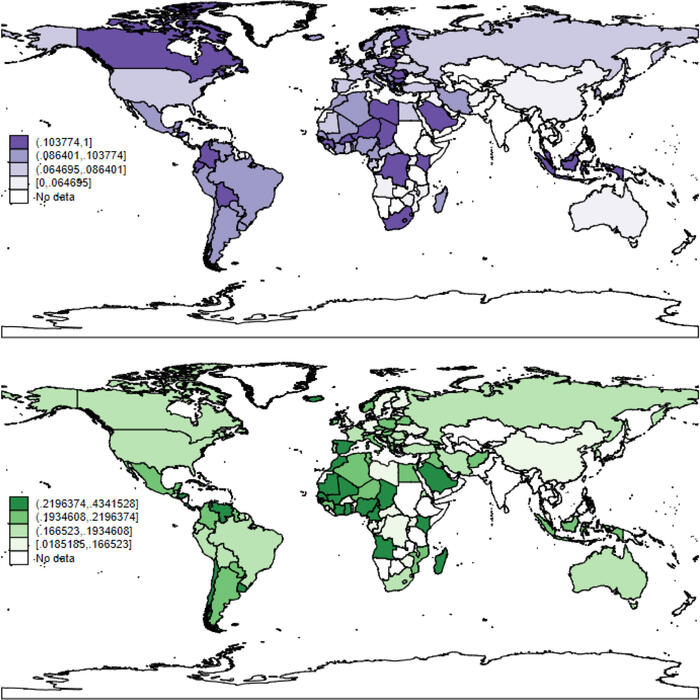
Because Schläpfer hypothesizes that being from more revenge-centric cultures explains on-field retaliation, the key independent variable is measured using a dataset from Stelios Michalopoulos and Melanie Meng Xue that identifies revenge motifs in a culture’s folklore. Examples of this include supernatural forces avenging human murders or animals avenging the death of their friends by humans. Schläpfer uses a host of other independent variables, such as country-level survey data about the desire to punish — as opposed to rehabilitate — criminals, which is also theoretically linked to revenge. As stated above, retaliation is measured in terms of fouls committed. Schläpfer shows that there is substantial variation in retaliation rates among players from different countries, from Gabon (8%) to Iceland (31%). Can the folklore in the country of origin explain the behavior of players on the field?


Image
Fig. 1. The share of fouls retaliated in soccer games (top) and the prevalence of revenge motifs in folklore (bottom). Both variables tend to have higher values for players and folklore from the Middle East, Central Africa, Eastern Europe, and parts of South America.


Fig. 1. The share of fouls retaliated in soccer games (top) and the prevalence of revenge motifs in folklore (bottom). Both variables tend to have higher values for players and folklore from the Middle East, Central Africa, Eastern Europe, and parts of South America.


Findings


Retaliation:

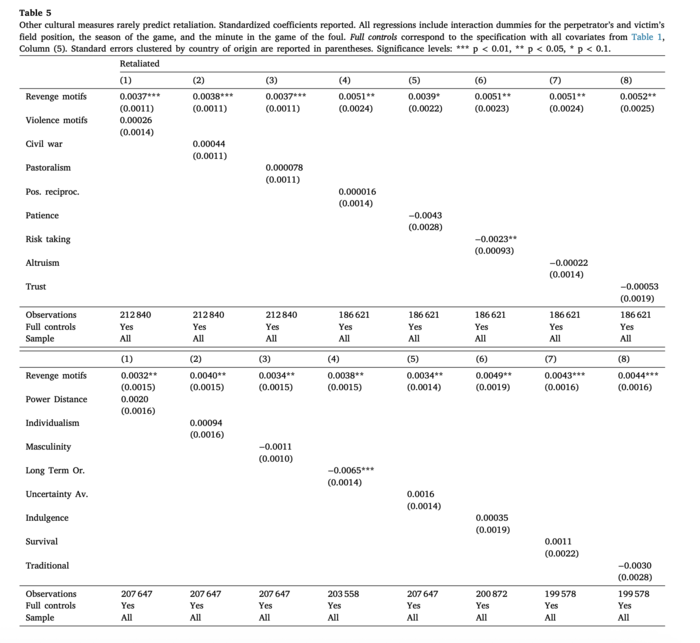
Schläpfer finds evidence that players from cultures that value revenge are indeed more likely to retaliate for fouls. However, they are not more likely to commit fouls overall, cautioning us against conflating the concepts of retaliation and violence. Indeed, Schläpfer demonstrates that motifs of violence in a culture's folklore do not predict retaliation. Players are also found to be more retaliatory early on in a game, which is consistent with its use as a signal or aspect of one’s reputation. In other words, retaliation serves to deter future fouls. Victims of fouls also retaliate quickly. Indeed, retaliation rates are stable or slightly increasing during the first 30 minutes of a game, but then fall consistently thereafter.


Image
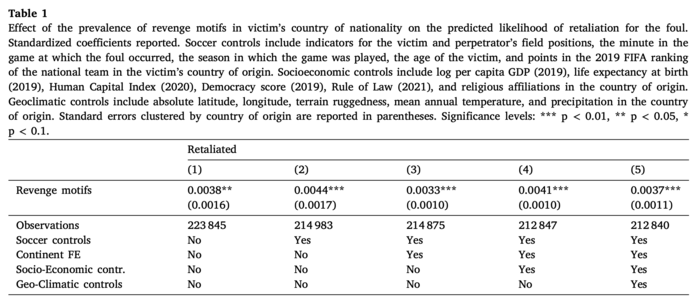
Table 1. Effect of the prevalence of revenge motifs in victim’s country of nationality on the predicted likelihood of retaliation for the foul.


Evidence is also provided to show that retaliation deters future transgressions: perpetrators are less likely to foul again if victims retaliate for the initial foul. However, this deterrence finding is only observed when the perpetrator is from a revenge culture. In other words, for retaliation to support cooperation (the absence of fouls), players must share a similar cultural background.

Schläpfer’s findings hold even when soccer-related or socioeconomic factors are taken into account. Further, the paper considers, but finds little support for, alternative explanations of why retaliation varies. These include that some teams encourage players to retaliate more or employ more players from revenge cultures. Further, retaliation does not appear to be driven by emotions; otherwise, it would be less likely to occur after halftime when players have had a chance to cool down, but this is not the case.


Image
Table 5. Other cultural measures rarely predict retaliation. Standardized coefficients reported.


Informal and Formal Sanctioning:

Finally, Schläpfer analyzes the interaction between player retaliation and refereeing. Most importantly, retaliation is significantly less likely if a foul is sanctioned with a yellow card. This illustrates the theoretical principle of formal punishment “crowding out” informal punishment, such as religious excommunication, which carries greater weight than social shunning or police fines compared to peer pressure. Both retaliation and referee sanctioning are shown to reduce the frequency of repeated offenses by perpetrators, especially among players from revenge cultures. However, Schläpfer finds that formal sanctioning is roughly three times more effective than retaliation. This suggests that football referees are doing a better job managing conflict between players than players themselves. 

Schläpfer concludes by mentioning a few of the paper’s limitations. First of all, retaliation is measured only by what referees sanction. However, referees may miss crucial incidents for which retaliation is a response, such as Zinedine Zidane’s 2006 World Cup headbutt after a verbal insult (that was not sanctioned). This is important because individuals from revenge cultures are likely to be particularly offended by verbal insults. Second, the paper does not capture retaliation that occurs across games played by the same teams over time, particularly when rivalries and hostilities have intensified. Similarly, it does not account for preemptive retaliation that does not follow a foul. Ultimately, Schläpfer deepens our understanding of retaliation in a domain where many would expect it not to operate or to do so with minimal significance. The article impressively marshals large-scale data from both sports and cultural history to clarify the causes and consequences of retaliation.

*Research-in-Brief prepared by Adam Fefer.

Hero Image
A person in a red and blue football uniform on a field Jona Møller via Unsplash
All News button
1
Subtitle

CDDRL Research-in-Brief [4-minute read]
Date Label
Authors
News Type
News
Date
Paragraphs

Motivation & Contribution


Over the past 10-15 years, both longstanding and relatively new democracies have suffered from backsliding and erosion, including India, the United States, Brazil, Turkey, and many others. Many social scientists have explained this wave of backsliding in terms of either (a) elected autocrats who undermine democracy from within or (b) declining popular support for democrats who have failed to deliver economic growth and prosperity. However, recent scholarship by Thomas Carothers and Brendan Hartnett has questioned the wisdom of the latter. For example, India enjoyed strong economic growth prior to its backsliding under Narendra Modi.

In “Delivering for Democracy,” Francis Fukuyama, Chris Dann, and Beatriz Magaloni set out to more systematically evaluate the evidence connecting popular support for democracy with delivery, examining both backsliding and non-backsliding countries. After finding preliminary evidence for the democracy-delivery relationship, they offer an explanation of why delivery is simultaneously so important and so elusive under democratic governance.

Evidence


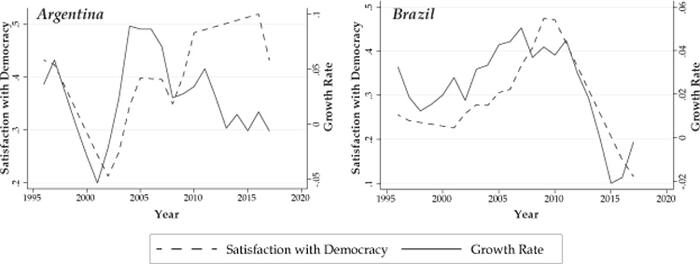
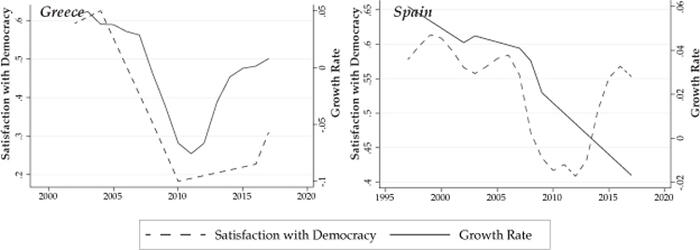
Using ten data sources covering 650,000 people in both old and new democracies, the authors find a strong, positive correlation between satisfaction with democracy and economic performance. This relationship holds not only for many countries at one point in time but for pairs of countries over time. In two developing democracies — Argentina and Brazil — as well as in two developed democracies — Greece and Spain — satisfaction and delivery have been closely connected since 2005, plummeting during economic crises and rising during periods of prosperity. These patterns call for an explanation for why voters care so much about delivery, such that they may be willing to sacrifice their democratic freedoms for it.


Image
Graphs showing satisfaction with democracy and growth rate in Argentina and Brazil


Image
Graphs showing satisfaction with democracy and growth rate in Greece and Spain


The Argument


Delivery is Important

The authors begin from the axiom that stable political life depends upon citizens perceiving their governments as legitimate. Legitimacy can be thought of in terms of both performance — the effective delivery of goods and services — and procedure, which encompasses policies that reflect the democratic will of the people. As the examples of China, Turkey, Saudi Arabia, and Singapore show, however, plenty of autocracies and backsliding democracies have not only delivered, but have also arguably outperformed their democratic peers. From China’s Belt and Road Initiative to Turkey’s Yavuz Sultan Selim Bridge, authoritarian leaders and ruling parties have achieved remarkable performance legitimacy. 

Although autocracies, by definition, cannot be procedurally legitimate, this may carry little weight for democratic citizens who experience prolonged unemployment or must deal with dilapidated infrastructure. Indeed, public engagement through procedural channels — such as voting or jury service — has steadily declined across the democratic world. Democratic voters are increasingly willing to support outsider candidates who build new infrastructure or promise to fight crime, but who nonetheless restrict their political freedoms. Many citizens of El Salvador — which now claims the world’s highest incarceration rate — continue to view Nayib Bukele’s administration as the surest way of delivering security, despite a years-long state of emergency that has seriously eroded democratic freedoms. 

Meanwhile, established democracies built much of their infrastructure decades ago, so investments primarily maintain these systems, rather than showcasing new projects that can garner public support. In some cases, democracies have struggled to even maintain their existing infrastructure, perhaps best exemplified by the collapse of Baltimore’s Francis Scott Key Bridge. All of this creates the conditions for voters to support far-right, anti-democratic parties, which often blame immigrants for economic problems and propose illiberal solutions.

Yet Democratic Delivery is Difficult

Elected democrats seeking to deliver may find themselves hamstrung in ways that autocrats are not. For one, democratic institutions are composed of ‘veto players’ who can stymie the introduction of badly needed policies: national and subnational governments, multiple legislative chambers, judges who review and overturn executive action, and so on. At the same time, democrats must worry about election cycles and term limits, decreasing their incentives to deliver for the long term when later politicians may take credit. Meanwhile, legal and regulatory systems, such as those intended to protect the environment, may prevent the building of critical infrastructure. Property rights prevent the forcible displacement of communities for development, while civil liberties prevent the repression of those who refuse to be displaced. Rules meant to prevent regulatory capture often become arenas where powerful interest groups block and delay government action. 

Independent news media present another potential impediment to delivery, as criticism from journalists can make incumbents wary of undertaking new projects. In addition, media bias can convince voters to remove politicians who do, in fact, deliver. By contrast, autocrats who censor media and arrest journalists can focus on delivery alone, even while their development schemes often rest on corrupt and nepotistic practices. Popular discontent with democratic government ultimately creates a damaging feedback loop: voters are unwilling to fund government projects, in turn leading government to function worse, generating further discontent.


Autocrats have figured out ways to deliver the goods and services their citizens want, but this does not make autocracy a just political system.


Prospects


Autocrats have figured out ways to deliver the goods and services their citizens want, but this does not make autocracy a just political system. By the same token, democracies may struggle to deliver, but their procedural legitimacy — especially voters’ ability to hold representatives to account — entails a powerful means of generating fair and inclusive delivery. As such, the authors call on democracies to examine their past and that of their peer countries — both developed and developing — for inspiration. For example, the U.S. New Deal was exemplary in building ambitious and popular infrastructure, as well as providing broad social and economic protections. (Of course, most of these projects would be hamstrung by modern-day regulatory frameworks.)

Meanwhile, Australia’s citizens have both benefited from a recent infrastructure boom and have demonstrated strong support for democracy. Finally, many Latin American countries have implemented popular and effective programs like conditional cash transfers. For the authors, addressing the issues most pressing to voters — such as job creation, which is especially salient to young people, who are most dissatisfied with democracy — will require democratic governments to strike the right balance between democracy and delivery.

*Research-in-Brief prepared by Adam Fefer.

Hero Image
Group of people protesting in Ibadan, Nigeria, holding a sign reading "#EndSARS #EndBadGov"
Group of people protesting in Ibadan, Nigeria.
Oladipo Adejumo via Unsplash
All News button
0
Subtitle

CDDRL Research-in-Brief [4-minute read]
Date Label
0
CDDRL Honors Student, 2025-26
dgg_headshot_-_dani_gonzalez-gaubeka.jpg

Major: International Relations
Minor: European Studies
Hometown: Palo Alto, California
Thesis Advisor: Anna Grzymała-Busse

Tentative Thesis Title: A Pact to Forget and the Fight to Remember: The Shifting Landscape of Democratic Memory Politics in Spain

Future aspirations post-Stanford: I look forward to returning to Europe to continue my study of politics and international affairs by pursuing a master’s degree. I may then pursue a PhD or begin a career in public policy.

A fun fact about yourself: I dance with XTRM, Stanford’s K-Pop dance team!

Date Label
Authors
Nora Sulots
News Type
News
Date
Paragraphs

The Stanford Deliberative Democracy Lab, housed within the Center on Democracy, Development and the Rule of Law (CDDRL) at the Freeman Spogli Institute for International Studies (FSI), in collaboration with Meta and the Behavioral Insights Team, has unveiled the results of the Meta Community Forum on Generative AI, based on the method of Deliberative Polling®. This groundbreaking event, part of a series of efforts by Meta to consult the public, engaged 1,545 participants in scientific samples from Brazil, Germany, Spain, and the United States. In each country, it offered the public’s views, both before and after deliberation, about future directions for the development of AI chatbots and how they should interact with humans.

“AI poses novel challenges, and these four national experiments revealed the public’s considered judgments about what it should — or should not — be able to use it for. National samples grappled with the pros and cons of each proposal and had their questions answered by panels of competing experts. This report shows what they concluded,” said James Fishkin, Senior Fellow at FSI and Director of the Stanford Deliberative Democracy Lab.

AI poses novel challenges, and these four national experiments revealed the public’s considered judgments about what it should — or should not — be able to use it for.
James Fishkin
Director, Stanford Deliberative Democracy Lab

Much of the agenda focused on specific proposals answering ten basic questions, including:

  • Which sources should AI chatbots draw information from?
  • Should AI chatbots use the user’s past conversations to improve user experience?
  • Should AI chatbots use the user’s online activity to personalize interactions?
  • Should AI chatbots be designed to be human-like?
  • Should users be allowed to use AI chatbots for romantic relationships?


The deliberators in each country were convened on the Stanford Online Deliberation Platform, developed by the Stanford Crowdsourced Democracy Team. This platform is AI-assisted and moderates video-based discussions in small groups of ten. 

Participants noted a generally positive impact of AI, with an increase in positive perceptions post-forum. "This shift in viewpoint, especially notable among those previously unfamiliar with AI, underscores the value of informed discussion in shaping public opinion," remarked Alice Siu, Senior Research Scholar at FSI and Associate Director of the Stanford Deliberative Democracy Lab.

The forum's methodical approach, with deliberations in 166 small groups and a separate control group for each country, ensured that the outcomes accurately reflected the effects of the deliberative process. Findings indicated that users and non-users of AI began to bridge their differences, aligning closer in their attitudes towards AI after the forum.

Siu also emphasized the significance of the event’s feedback, noting that "the high ratings from participants affirm the forum’s success in making complex discussions accessible and relevant. It is an encouraging sign for the future of democratic engagement with technology."

The Stanford Deliberative Democracy Lab is dedicated to deepening our understanding of deliberative democracy processes and their application to critical contemporary issues like AI. The insights from this forum will inform ongoing research and policy recommendations, ensuring that AI evolves in a manner that considers diverse values and voices across the globe.

The project report is available below:

For detailed information on the forum’s conclusions or forthcoming projects, please reach out to James Fishkin (Director, Stanford Deliberative Democracy Lab) or Alice Siu (Associate Director, Stanford Deliberative Democracy Lab) or visit the Deliberative Democracy Lab website.

Read More

Collage of modern adults using smart phones in city with wifi signals
News

Results of First Global Deliberative Poll® Announced by Stanford’s Deliberative Democracy Lab

More than 6,300 deliberators from 32 countries and nine regions around the world participated in the Metaverse Community Forum on Bullying and Harassment.
Results of First Global Deliberative Poll® Announced by Stanford’s Deliberative Democracy Lab
A voter casts their ballot in the Kentucky Primary Elections at Central High School on May 16, 2023 in Louisville, Kentucky.
Q&As

New National Deliberative Poll Shows Bipartisan Support for Polarizing Issues Affecting American Democracy

"America in One Room: Democratic Reform" polled participants before and after deliberation to gauge their opinions on democratic reform initiatives, including voter access and voting protections, non-partisan election administration, protecting against election interference, Supreme Court reform, and more. The results show many significant changes toward bipartisan agreement, even on the most contentious issues.
New National Deliberative Poll Shows Bipartisan Support for Polarizing Issues Affecting American Democracy
Alice Siu delivers a TEDxStanford talk
News

Deliberative Polling: A Path to Bridging Divides

In a TEDxStanford talk, Alice Siu discusses how applying and spreading deliberative democracy can better engage us all in our shared public problems.
Deliberative Polling: A Path to Bridging Divides
Hero Image
Chatbot powered by AI. Transforming Industries and customer service. Yellow chatbot icon over smart phone in action. Modern 3D render
Chatbot powered by AI. Photo: Da-Kuk / Getty Images
Da-Kuk / Getty Images
All News button
1
Subtitle

A multinational Deliberative Poll unveils the global public's nuanced views on AI chatbots and their integration into society.

Date Label

Room 212, Crown Quadrangle
559 Nathan Abbott Way
Stanford, CA 94305-8610

650.736.8771
0
Lecturer in Residence, Stanford Law School
jamie-oconnell-3-400x400.jpg

Jamie O’Connell is a Lecturer in Residence at Stanford Law School. He teaches and writes on political and legal development and has particular expertise in law and development, transitional justice, democratization, post-conflict reconstruction, and business and human rights. Until 2018, he was a Senior Fellow of the Honorable G. William and Ariadna Miller Institute for Global Challenges and the Law at the University of California, Berkeley, School of Law, as well as a Lecturer in Residence, teaching both law and undergraduate students.

O’Connell has worked on human rights and development in over a dozen countries in Africa, the Americas, Asia, and Europe, under the auspices of the United Nations, local and international non-governmental organizations, and academic institutions. He co-founded International Professional Partnerships for Sierra Leone, a non-governmental organization that worked with the government of Sierra Leone to enhance the performance of its agencies and civil servants. Earlier in his career, O’Connell studied international business as a researcher at Harvard Business School, publishing numerous case studies. He has directed the Human Rights Clinic at the University of Sierra Leone and taught as a visitor at Harvard Law School and Columbia Law School. O’Connell clerked for the Honorable James R. Browning on the U.S. Court of Appeals for the Ninth Circuit and is admitted to practice in California (inactive status) and New York. In 2016-17, he was a visiting professor and Fulbright Senior Scholar at the University of Valencia (Spain) Faculty of Law.

O’Connell’s scholarship includes “Representation, Paternalism, and Exclusion: The Divergent Impacts of the AKP’s Populism on Human Rights In Turkey” in Human Rights in a Time of Populism: Challenges and Responses (2020); “When Prosecution Is Not Enough: How the International Criminal Court Can Prevent Atrocity and Advance Accountability by Emulating Regional Human Rights Institutions” (with James L. Cavallaro, Yale Journal of International Law, 2020); “Common Interests, Closer Allies: How Democracy in Arab States Can Benefit the West” (Stanford Journal of International Law, 2012); “Empowering the Disadvantaged after Dictatorship and Conflict: Legal Empowerment, Transitions and Transitional Justice,” in Legal Empowerment: Practitioners’ Perspectives (2010); “East Timor 1999,” in The Responsibility to Protect: Moving the Campaign Forward (2007); “Gambling with the Psyche: Does Prosecuting Human Rights Violators Console Their Victims?” (Harvard International Law Journal, 2005); “Here Interest Meets Humanity: How to End the War and Support Reconstruction in Liberia, and the Case for Modest American Leadership” (Harvard Human Rights Journal, 2004); and Sierra Leone’s Truth and Reconciliation Commission and Special Court: A Citizen’s Handbook (with Paul James-Allen and Sheku B.S. Lahai, 2003).

CDDRL Affiliated Scholar
Date Label
-

*****LIBERATION TECHNOLOGY SPECIAL EVENT****
Change of location- now in Bechtel Conference Center
Encina Hall

A livestream will be available for this event. To watch please click here

Co-sponsored by the Association for Liberation Technology, the Center for Latin American Studies and the Stanford Human Rights Center 

Yoani Sánchez was born in 1975 in a tenement in Central Havana and, on starting school, she proudly put the Little Pioneer scarf around her neck, vowing to “Be like Che!” Fourteen when the Berlin Wall fell, her adolescence was marked by what Fidel Castro called “a special period in a time of peace,” a time of terrible scarcity and broad disillusionment.

At the University of Havana Yoani’s incendiary thesis, Words Under Pressure: A Study of the Literature of the Dictatorship in Latin America, eliminated the idea of an academic career. Already married—to Reinaldo Escobar, an ousted-journal­ist-turned-elevator-mechanic—and a mother, she cobbled together a living as a Spanish teacher and tour guide. In 2002, Yoani decided to emigrate, but in 2004 she returned to Cuba. “I promised myself that I would live in Cuba as a free person, and accept the consequences,” she said. All of her work since then has been a keeping of that promise.

Yoani launched her blog, Generation Y, in April of 2007; later that year a Reuters article brought her to the attention of the world. In 2008 she won Spain’s Ortega y Gasset Prize for digital journalism and Time magazine named her one of the 100 most influential people in the world. Recognition and awards followed, including an interview with Barack Obama, posted in her blog, and nomination by the Norwegian government for the 2012 Nobel Peace Prize.

Yoani is now the journalist she always wanted to be, one deeply immersed in technology. She started The Blogger Academy in her apartment in Havana and runs frequent courses in Twitter. She has published a manual on WordPress, and she works as a correspondent for Spain’s El Pais newspaper. Yoani plans to launch a newspaper in Havana, and is currently working toward that goal.

A livestream will be available for this event. To watch pleaseclick here 

Image

Bechtel Conference Center

Yoani Sanchez Blogger "Generation Y", Journalist and Publisher in Cuba Speaker
Seminars
Date Label
-

Abstract: Taiwan (the Republic of China) has been changing with the times. So has its diplomacy. Having served his country for more than 40 years in various important diplomatic posts under different administrations, Ambassador Chen is one of Taiwan’s most seasoned diplomats. He joins us to share his personal experience and perspectives of Taiwan’s diplomacy. It is a historical review, but also an attempt to explore the future. Ambassador Chen believes that the diplomacy of Taiwan is unique because of its unique background. Although it should be defined by its own people, the country has been heavily influenced by the Chinese Mainland and the United States of America. How to promote Taiwan’s interests while preserving its identity and dignity, and conducting the balancing exercises in an asymmetric international environment has always been the crux of diplomacy in Taiwan. Ambassador Chen’s insights will allow us a better understanding of diplomacy in Taiwan, its successes and frustrations and presenting a possible roadmap for the future.

C.J. Chen is the former Minister of Foreign Affairs of the Republic of China (1999-2000). He has also served as Taiwan’s de facto Ambassador to the United States (2000-2004) and European Union (2004-2006). Having spent most of his career in the Foreign Ministry, Mr. Chen is regarded as one of Taiwan’s most accomplished diplomats and an expert on U.S./Taiwan relations. He was educated in Taiwan, Britain, Spain and the US, and has extensive experience representing his nation in the United States. He began his first tour of duty in Washington, D.C. in 1971 and was later a key member of the team that negotiated with the United States government for the future relations between Taiwan and the U.S. after the U.S. switched diplomatic ties from the Republic of China (ROC) to the People’s Republic of China) in 1979. Mr. Chen was heavily involved in communicating with the U.S. Congress during the implementation of the Taiwan Relations Act (TRA) which still serves as the back bone and framework for U.S./ Taiwan relations. In addition to Mr. Chen’s diplomatic experience, he was also selected by the Kuomintang (KMT), to be a member of the Legislative Yuan, where served under both the blue (KMT) and green (DPP) administrations.

CISAC Conference Room

Ambassador C.J. Chen Founder, Taipei Forum and Minister of Foreign Affairs, Republic of China (1999-2000) Speaker
Seminars
-

Christopher Painter has been on the vanguard of cyber issues for twenty years. Most recently, Mr. Painter served in the White House as Senior Director for Cybersecurity Policy in the National Security Staff. During his two years at the White House, Mr. Painter was a senior member of the team that conducted the President's Cyberspace Policy Review and subsequently served as Acting Cybersecurity Coordinator. He coordinated the development of a forthcoming international strategy for cyberspace and chaired high-level interagency groups devoted to international and other cyber issues.

Mr. Painter began his federal career as an Assistant U.S. Attorney in Los Angeles where he led some of the most high profile and significant cybercrime prosecutions in the country, including the prosecution of notorious computer hacker Kevin Mitnick. He subsequently helped lead the case and policy efforts of the Computer Crime and Intellectual Property Section in the U.S. Department of Justice and served, for a short time, as Deputy Assistant Director of the F.B.I.'s Cyber Division. For over ten years, Mr. Painter has been a leader in international cyber issues. He has represented the United States in numerous international fora, including Chairing the cutting edge G8 High Tech Crime Subgroup since 2002. He has worked with dozens of foreign governments in bi-lateral meetings and has been a frequent spokesperson and presenter on cyber issues around the globe. He is a graduate of Stanford Law School and Cornell University.

Sloan Mathematics Center

Christopher Painter Coordinator for Cyber Issues Speaker US State Department
Seminars
-

Image
Alison Brysk is the Mellichamp Chair in Global Governance, Global and International Studies at UC Santa Barbara. She has authored or edited eight books on international human rights including the book From Human Trafficking to Human Rights. Professor Brysk has been a visiting scholar in Argentina, Ecuador, France, Spain, Sweden, the Netherlands, South Africa, and Japan, and in 2007 held the Fulbright Distinguished Visiting Chair in Global Governance at Canada's Centre for International Governance Innovation.


Image
Dr. Mohammed Mattar is the executive director of the Protection Project. He has worked in over 50 countries to promote state compliance with international human rights standards and has advised governments on drafting and implementing anti-trafficking legislation. He participated in drafting the United Nations model law on trafficking in persons and he authored the Inter-Parliamentarian Handbook on the appropriate responses to trafficking in persons. Dr. Mattar currently teaches courses on international and comparative law at Georgetown University, Johns Hopkins University (SAIS) and American University, and has authored numerous publications for law reviews and the United Nations on international human rights and Islamic law, trafficking in persons and reporting mechanisms.

Bechtel Conference Center

Alison Brysk Mellichamp Professor of Global Governance in the Global and International Studies Program Speaker UCSB
Dr. Mohammed Mattar Executive Director of the Protection Project Speaker Johns Hopkins University
Helen Stacy Director Host Program on Human Rights
Seminars
Subscribe to Spain