Authors
News Type
News
Date
Paragraphs

Motivation & Contribution


Over the past 10-15 years, both longstanding and relatively new democracies have suffered from backsliding and erosion, including India, the United States, Brazil, Turkey, and many others. Many social scientists have explained this wave of backsliding in terms of either (a) elected autocrats who undermine democracy from within or (b) declining popular support for democrats who have failed to deliver economic growth and prosperity. However, recent scholarship by Thomas Carothers and Brendan Hartnett has questioned the wisdom of the latter. For example, India enjoyed strong economic growth prior to its backsliding under Narendra Modi.

In “Delivering for Democracy,” Francis Fukuyama, Chris Dann, and Beatriz Magaloni set out to more systematically evaluate the evidence connecting popular support for democracy with delivery, examining both backsliding and non-backsliding countries. After finding preliminary evidence for the democracy-delivery relationship, they offer an explanation of why delivery is simultaneously so important and so elusive under democratic governance.

Evidence


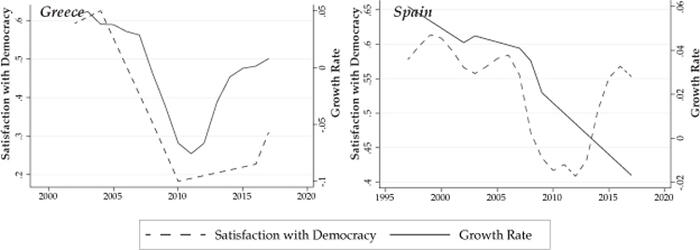
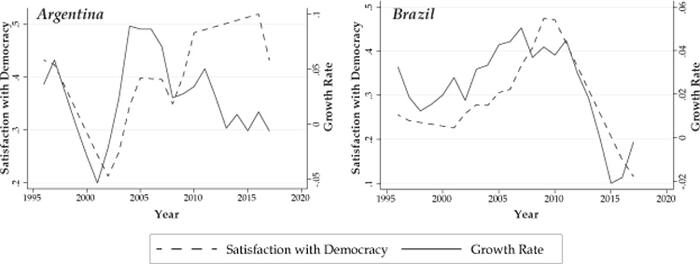
Using ten data sources covering 650,000 people in both old and new democracies, the authors find a strong, positive correlation between satisfaction with democracy and economic performance. This relationship holds not only for many countries at one point in time but for pairs of countries over time. In two developing democracies — Argentina and Brazil — as well as in two developed democracies — Greece and Spain — satisfaction and delivery have been closely connected since 2005, plummeting during economic crises and rising during periods of prosperity. These patterns call for an explanation for why voters care so much about delivery, such that they may be willing to sacrifice their democratic freedoms for it.


Image
Graphs showing satisfaction with democracy and growth rate in Argentina and Brazil


Image
Graphs showing satisfaction with democracy and growth rate in Greece and Spain


The Argument


Delivery is Important

The authors begin from the axiom that stable political life depends upon citizens perceiving their governments as legitimate. Legitimacy can be thought of in terms of both performance — the effective delivery of goods and services — and procedure, which encompasses policies that reflect the democratic will of the people. As the examples of China, Turkey, Saudi Arabia, and Singapore show, however, plenty of autocracies and backsliding democracies have not only delivered, but have also arguably outperformed their democratic peers. From China’s Belt and Road Initiative to Turkey’s Yavuz Sultan Selim Bridge, authoritarian leaders and ruling parties have achieved remarkable performance legitimacy. 

Although autocracies, by definition, cannot be procedurally legitimate, this may carry little weight for democratic citizens who experience prolonged unemployment or must deal with dilapidated infrastructure. Indeed, public engagement through procedural channels — such as voting or jury service — has steadily declined across the democratic world. Democratic voters are increasingly willing to support outsider candidates who build new infrastructure or promise to fight crime, but who nonetheless restrict their political freedoms. Many citizens of El Salvador — which now claims the world’s highest incarceration rate — continue to view Nayib Bukele’s administration as the surest way of delivering security, despite a years-long state of emergency that has seriously eroded democratic freedoms. 

Meanwhile, established democracies built much of their infrastructure decades ago, so investments primarily maintain these systems, rather than showcasing new projects that can garner public support. In some cases, democracies have struggled to even maintain their existing infrastructure, perhaps best exemplified by the collapse of Baltimore’s Francis Scott Key Bridge. All of this creates the conditions for voters to support far-right, anti-democratic parties, which often blame immigrants for economic problems and propose illiberal solutions.

Yet Democratic Delivery is Difficult

Elected democrats seeking to deliver may find themselves hamstrung in ways that autocrats are not. For one, democratic institutions are composed of ‘veto players’ who can stymie the introduction of badly needed policies: national and subnational governments, multiple legislative chambers, judges who review and overturn executive action, and so on. At the same time, democrats must worry about election cycles and term limits, decreasing their incentives to deliver for the long term when later politicians may take credit. Meanwhile, legal and regulatory systems, such as those intended to protect the environment, may prevent the building of critical infrastructure. Property rights prevent the forcible displacement of communities for development, while civil liberties prevent the repression of those who refuse to be displaced. Rules meant to prevent regulatory capture often become arenas where powerful interest groups block and delay government action. 

Independent news media present another potential impediment to delivery, as criticism from journalists can make incumbents wary of undertaking new projects. In addition, media bias can convince voters to remove politicians who do, in fact, deliver. By contrast, autocrats who censor media and arrest journalists can focus on delivery alone, even while their development schemes often rest on corrupt and nepotistic practices. Popular discontent with democratic government ultimately creates a damaging feedback loop: voters are unwilling to fund government projects, in turn leading government to function worse, generating further discontent.


Autocrats have figured out ways to deliver the goods and services their citizens want, but this does not make autocracy a just political system.


Prospects


Autocrats have figured out ways to deliver the goods and services their citizens want, but this does not make autocracy a just political system. By the same token, democracies may struggle to deliver, but their procedural legitimacy — especially voters’ ability to hold representatives to account — entails a powerful means of generating fair and inclusive delivery. As such, the authors call on democracies to examine their past and that of their peer countries — both developed and developing — for inspiration. For example, the U.S. New Deal was exemplary in building ambitious and popular infrastructure, as well as providing broad social and economic protections. (Of course, most of these projects would be hamstrung by modern-day regulatory frameworks.)

Meanwhile, Australia’s citizens have both benefited from a recent infrastructure boom and have demonstrated strong support for democracy. Finally, many Latin American countries have implemented popular and effective programs like conditional cash transfers. For the authors, addressing the issues most pressing to voters — such as job creation, which is especially salient to young people, who are most dissatisfied with democracy — will require democratic governments to strike the right balance between democracy and delivery.

*Research-in-Brief prepared by Adam Fefer.

Hero Image
Group of people protesting in Ibadan, Nigeria, holding a sign reading "#EndSARS #EndBadGov"
Group of people protesting in Ibadan, Nigeria.
Oladipo Adejumo via Unsplash
All News button
0
Subtitle

CDDRL Research-in-Brief [4-minute read]

Date Label
Authors
Nora Sulots
News Type
News
Date
Paragraphs

Please join us in congratulating Vicky Fouka, Associate Professor of Political Science at Stanford University and affiliated faculty at the Center on Democracy, Development and the Rule of Law, on being honored with the Bodossaki Distinguished Young Scientist Award in Social Sciences.

Presented biennially by the Bodossaki Foundation, the award celebrates exceptional Greek scientists under the age of 40 for their groundbreaking research, commitment to excellence, and contributions to Greece’s global visibility.

The Foundation's press release shared the following about Professor Fouka's selection:
 

Her presentation explored how she uses a blend of historical and statistical analysis to study societies that have experienced large migratory flows over time. She examines how various factors and state policies have shaped migrant integration and social identities. Drawing on models of human behaviour from economics and social psychology, she brings together a range of theoretical and empirical approaches. This convergence, she believes, ‘will help deepen our understanding of some of the most pressing challenges in contemporary society, such as political polarisation, the rise of political violence, and conflicts between social groups and nations.’

Vicky Fouka (second from left) and fellow laureates at the 2025 Bodossaki Distinguished Young Scientist Awards Ceremony
Vicky Fouka (second from left) and fellow laureates at the 2025 Bodossaki Distinguished Young Scientist Awards Ceremony in Athens, Greece. | Bodossaki Foundation

In addition to her roles at Stanford, Professor Fouka is a Faculty Research Fellow at the National Bureau of Economic Research (NBER) and a Research Affiliate at the Center for Economic Policy Research (CEPR). She is a political economist with interests in group identity and intergroup relations, culture, and historical social dynamics. Her articles have been published in journals such as the American Political Science Review, the Review of Economic Studies, the Journal of Politics, the Economic Journal, Public Opinion Quarterly, and Nature Human Behaviour. Her work has received the Joseph L. Bernd Award for the best paper published in the Journal of Politics, the Economic Journal's Austin Robinson Prize, and the Best Article Award from the APSA Migration and Citizenship section. She holds a PhD in Economics from Pompeu Fabra University.

The 2025 award ceremony, held on June 17 at the Zappeion in Athens, brought together leaders from government, academia, science, business, and culture to honor Fouka and her fellow laureates for advancing knowledge and inspiring future generations.

Read More

Vicky Fouka
News

National Stigmas and Past Atrocities in Germany

Stanford Associate Professor of Political Science Vicky Fouka shares her research on how public recognition of collective culpability has affected German national identity.
National Stigmas and Past Atrocities in Germany
Professor James S. Fishkin was presented with the Medal of Friendship certificate by Zandanshatar Gombojav.
News

Professor James S. Fishkin Awarded Friendship Medal of Mongolia

The award, decreed by President Ukhnaa Khurelsukh, is Mongolia’s highest state honor and recognizes Fishkin for his pioneering contributions to deliberative democracy.
Professor James S. Fishkin Awarded Friendship Medal of Mongolia
Stephen J. Stedman
News

Stephen J. Stedman Appointed Faculty Director of Stanford’s Program in International Relations

Professor Stedman is a Senior Fellow at the Freeman Spogli Institute for International Studies and director of CDDRL's Fisher Family Honors Program in Democracy, Development and Rule of Law.
Stephen J. Stedman Appointed Faculty Director of Stanford’s Program in International Relations
Hero Image
Vicky Fouka received the Bodossaki Distinguished Young Scientist Award in Social Sciences in Athens, Greece, on June 17, 2025.
Bodossaki Foundation
All News button
1
Subtitle

Recognized for her groundbreaking research on migration, identity, and intergroup relations, Fouka joins an elite group of Greek scientists shaping global scholarship.

Date Label
-

Abstract

From the point of view of institutional economics, growth is related to the implementation and enforcement of property rights. The system that emits, and enforces those rights needs to have very low transactions costs leading to the least possible frictions. The lowest the transactions costs the highest the level of security of investment, as well as the benefits of direct and indirect socioeconomic impacts. However, traditional economic development models do not focus on transactions costs and property rights systems, both of which seem to be the suspects for low productivity, slow growth, and informality. Many developing countries suffer from systems of property rights that are unpredictable because they are inundated with overwhelming bureaucracy, difficult to follow, track, and measure. The speaker has developed a methodology to best diagnose the reasons why a country has such high transactions costs and how to reduce them systematically. This diagnostic method is called Reality Check Analysis (RCA) and its outcomes allow for the best design of policy reforms and strategic application. The presentation will focus on the theoretical definition of the problem, the analysis of Reality Check Analysis, its application and important results measured through a socioeconomic 3,000 household survey. This survey presented the direct benefits of applying a simple property rights system to investment, savings, property values, trust, child labor, to mention a few.

Speaker Bio

Image
panaritis photo
Elena Panaritis until recently served as a senior economic advisor, handling the Euro and Greek Economic Crisis, to two Greek Governments (2009; 2015). In 2015 she also served as the Special Envoy for Negotiating the Greek Sovereign debt and lending program of Greece. Elena worked directly with 3 Greek Prime Ministers and the Minister of Finance, as well as EU and IMF high-level officials, lenders to Greece. In 2015 she was appointed the Alternate Director to the IMF of Italy, Greece, Portugal, Malta, Albania and San Marino, from which position she resigned the same year after strong political pressures. In 2009 she was appointed honorary Member of the Hellenic Parliament until 2012. She is the founder of Panel Group, a triple-bottom-line business that focuses in the informal sector, transforming the wealth base of poor property holders, to proud middle class owners. She has also founded Thought4Action, an Action Tank that works as an educational foundation to create awareness and calls for action, about transforming countries under solvency, economic crisis and informality. Elena Panaritis has taught economic development, housing finance and property markets reform courses at the Wharton Business School, University of Pennsylvania, INSEAD, and the Johns Hopkins University- School of Advanced International Studies (SAIS).

Elena Panaritis Founder and CEO Thought 4 Action - Panel Group
Seminars
News Type
News
Date
Paragraphs

Appeared in Stanford Report, May 29, 2014

By Clifton B. Parker

The electoral eruption of anti-European Union populism is a reflection of structural flaws in that body but does not represent a fatal political blow, according to Stanford scholars.

In the May 25 elections for the European Parliament, anti-immigration parties won 140 of the 751 seats, well short of control, but enough to rattle supporters of the EU, which has 28 member nations. In Britain, Denmark, France and Greece, the political fringe vote totals stunned the political establishments.

Stanford political scientist Francis Fukuyama said the rise of extremism and anti-elitism is not surprising in the wake of the 2008 economic downturn and subsequent high levels of unemployment throughout Europe. In one sense, the EU elites have themselves to blame, he said.

"The elites who designed the EU and the eurozone failed in a major way," he said. "There was a structural flaw in the design of the euro (monetary union absent fiscal union, and the method of disciplining countries once in the zone)," said Fukuyama, the Olivier Nomellini Senior Fellow at Stanford's Freeman Spogli Institute for International Studies and the Center for Democracy, Development and the Rule of Law, and Research Afflilate at The Europe Center.

Some have argued that the European Union should adopt a form of fiscal union because without one, decisions about taxes and spending remain at the national level.

As Fukuyama points out, this becomes a problem, as in the case of a debt-ridden Greece, which he believes should not have qualified for EU membership in the first place. In fact, he said, it would have been better for Greece itself to leave the euro at the outset of the 2008 crisis.

Still, Fukuyama said the big picture behind the recent election is clear – it was a confluence of issues and timing.

"It is a bit like an off-year election in the U.S., where activists are more likely to vote than ordinary citizens," he said.

Fukuyama believes the EU will survive this electoral crisis. "I think the EU will be resilient. It has weathered other rejections in the past. The costs of really exiting the EU are too high in the end, and the elites will adjust, having been given this message," he said.

Meanwhile, the populist parties in the different countries are not unified or intent on building coalitions with each other.

"Other than being anti-EU, most of them have little in common," Fukuyama said. "They differ with regard to specific positions on immigration, economic policy, and they respond to different social bases."

Ongoing anger

Dan Edelstein, a professor of French, said the largest factor for success by extremist candidates was "ongoing anger toward the austerity policy imposed by the EU," primarily by Germany.

Edelstein estimates that a large majority of French voters are still generally supportive of the EU. For the time being, the anti-EU faction does not have a majority, though they now have much more representation in the European Parliament.

Edelstein noted existing strains among the anti-EU parties – for example, the UK Independence Party in Britain has stated that it would not form an alliance with the National Front party in France.

Immigration remains a thorny issue for some Europeans, Edelstein said.

"'Immigration' in most European political debates, tends to be a synonym for 'Islam.' While there are some countries, such as Britain, that are primarily worried about the economic costs of immigration, in most continental European countries, the fears are cultural," he said.

As Edelstein put it, Muslims are perceived as a "demographic threat" to white or Christian Europe. However, he is optimistic in the long run.

"It seems a little early to be writing the obituary of the EU. Should economic conditions improve over the next few years, as they are predicted to, we will likely see this high-water mark of populist anger recede," said Edelstein.

Cécile Alduy, an associate professor of French, writes in the May 28 issue of The Nation about how the ultra-right-wing National Front came in first place in France's election.

"This outcome was also the logical conclusion of a string of political betrayals, scandals and mismanagement that were only compounded by the persistent economic and social morass that has plunged France into perpetual gloom," she wrote.

Historian J.P. Daughton said that like elsewhere in the world, immigration often becomes a contentious issue in Europe in times of economic difficulties.  

"High unemployment and painful austerity measures in many parts of Europe have led extremist parties to blame immigrants for taking jobs and sapping already limited social programs," he said.

Anti-immigration rhetoric plays particularly well in EU elections, Daughton said. "Extremist parties portray European integration as a threat not only to national sovereignty, but also to national identity.

Edelstein, Alduy and Daughton are all Faculty Affiliates of The Europe Center.

Wake-up call

Russell A. Berman, a professor of German studies and comparative literature, said many Europeans perceive the EU as "somehow impenetrable, far from the civic politics of the nation states."

As a result, people resent regulations issued by an "intangible bureaucracy," and have come to believe that the European Parliament has not grappled with major issues such as mustering a coherent foreign policy voice, he said.

"The EU can be great on details but pretty weak on the big picture," said Berman, who is the Walter A. Haas Professor in the Humanities, Senior Fellow at the Hoover Institution, and Faculty Affiliate of The Europe Center. "It is this discrepancy that feeds the dissatisfaction."

Yet he points out that the extremist vote surged in only 14 nations of the EU – in the other 14, there was "negligible extremism," as he describes it.

"We're a long way from talking about a fatal blow, but the vote is indeed a wake-up call to the centrists that they have to make a better case for Europe," Berman said.

Hero Image
A man walks past a board displaying provisional results of the European Parliament election at the EU Parliament in Brussels
A man walks past a board displaying provisional results of the European Parliament election at the EU Parliament in Brussels May 25, 2014.
REUTERS / Francois Lenoir
All News button
1
News Type
Commentary
Date
Paragraphs

Ruby Gropas is a lecturer in international relations at the law faculty of the Democritus University of Thrace (Komotini) and research fellow at the Hellenic Foundation for European and Foreign Policy (ELIAMEP). Gropas was in residence at CDDRL in 2011 as a visiting scholar. In this seminar she will discuss the ongoing Greek economic and political crisis, and what it means for the future of the European Union and monetary system. Is the crisis in Greece ‘internal’ or is it symptomatic of a wider European failure? Is the Greek crisis the result of failed modernity, or rather a precursor of things to come? Why has Greece become so important and why has it dominated global politics and world news for the past two years?  Are its malignancies purely domestic or are they representative of a wider malaise within Europe and possibly beyond? The collapse and orderly default of a eurozone country at the heart of the Western financial system arguably marks the end of an era. It has brought with it the deepest social and political crisis that modern Greecehas faced since the restoration of democracy and it has also led to Europe's deepest existential crisis. With the EU struggling to effectively managing the eurozone crisis and the burst of recent movements opposing neo-liberal orthodoxy and the “Occupy” movements – what does this mean for Europe? And what is next?

All News button
1
Authors
News Type
News
Date
Paragraphs

Stanford's Center on Democracy, Development, and the Rule of Law (CDDRL) is pleased to announce that undergraduate senior honors student, Anna Barrett Schickele, received the Firestone Medal for Excellence in Undergraduate Research. This university award is given to the top ten percent of honors theses in social science, science, and engineering.

Schickele's thesis entitled, "One Drop At A Time," examines the factors that inform farmers' decisions to use modern irrigation systems in the Lurín Valley of Peru, where she spent several months conducting fieldwork with a Lima-based NGO. Schickele — a public policy major —was able to collect primary data through interviews with farmers and fieldworkers to inform her research study that includes policy recommendations to the NGO community and government officials.

Anna Schickele (center) with Francis Fukuyama (left) and Larry Diamond (right).

Martin Carnoy, the Vida Jacks Professor of Education at the Stanford Graduate School of Education, served as Schickele's thesis advisor together with Rosamond L. Naylor, the director of the Center on Food Security and the Environment at FSI.

"Ana's thesis is an important contribution to our understanding of the barriers and openings for stimulating agricultural development among subsistence farmers," said Carnoy. "Her original insights make the thesis particularly valuable for those addressing development issues in the world’s poorest regions."

In August, Schickele will begin a research position at the Abdul Latif Jameel Poverty Action Lab at the Massachusetts Institute of Technology.

CDDRL's best thesis award was given to Kabir Sawhney, a management science and engineering major, who wrote his thesis on the effect of regime type and the propensity to default on sovereign debt. Advised by Professor of Political Science Gary Cox, Swahney cited the cases of Romania in the 1980s and more recently of Greece to conclude that the quality of government — rather than regime type alone — determines whether a country chooses to default. 

After graduation. Sawhney will join the consulting firm Accenture as an analyst in their San Francisco office.  

Three honors students' received fellowships from Stanford's Haas Center of Public Service to pursue public service-related work after graduation. Keith Calix and Imani Franklin both received the Tom Ford Fellowship in Philanthropy and will be working in New York for grant-making foundations, and Lina Hidalgo received the Omidyar Network Postgraduate Fellowship to work with an international organization.     

The CDDRL Undergraduate Senior Honors Program is an interdisciplinary honors program led by Francis Fukuyama, the Olivier Nomellini Senior Fellow at FSI. The program recruits a diverse group of talented students interested in writing original theses on topics impacting the field of democracy, development, and the rule of law. During the year-long program, students write their thesis in consultation with a CDDRL faculty member, participate in research workshops, and travel to Washington, D.C. for "honors college."

The nine members of the graduating class of 2013 CDDRL undergraduate honors students include:


Keith Calix


International Relations 

Wie is ek? Coloured Identity and Youth Involvement in Gangsterism in Cape Town, South Africa  

Advisor: Prudence Carter

Vincent Chen


Earth Systems; Economics

Democracy and the Environment: An Empirical Analysis and Observations from Taiwan’s Maturing Democracy  

Advisor: Larry Diamond

Holly Fetter


Comparative Studies in Race and Ethnicity 

From DC to the PRC: Examining the Strategies and Consequences of U.S. Funding for Chinese Civil Society  

Advisor: Jean Oi

Imani Franklin


International Relations

Living in a Barbie World: Skin Bleaching and the Preference for Fair Skin in India, Nigeria, and Thailand  

Advisor: Allyson Hobbs

Mariah Halperin


History

Religion and the State: Turkey under the AKP 

Advisor: Larry Diamond

Thomas Hendee


Human Biology

The Health of Pacification: A Review of the Pacifying Police Unit program in Rio de Janeiro, Brazil 

Advisors: Beatriz Magaloni & Paul Wise 

Lina Hidalgo


Political Science

Tiananmen or Tahrir? A Comparative Study of Military Intervention Against Popular Protest  

Advisors: Jean Oi & Lisa Blaydes

Kabir Sawhney


Management Science and Engineering

Repayment and Regimes: The Effect of Regime Type on Propensity to Default on Sovereign Debt    

Advisor: Gary Cox

Anna Schickele


 Public Policy

One Drop at a Time: Diffusion of Modern Irrigation Technology in the Lurín Valley, Peru  

Advisors: Martin Carnoy & Roz Naylor

Hero Image
Schickele Logo
All News button
1
Authors
News Type
News
Date
Paragraphs

Eleven talented Stanford seniors have completed the Undergraduate Senior Honors Program at the Center on Democracy, Development, and the Rule of Law (CDDRL) to graduate with honors in democracy, development, and the rule of law. Completing their theses on issues of global importance ranging from the impact of technology on government openness to the effectiveness of democratic governance projects, CDDRL honors students have contributed original research and analysis to policy-relevant topics. They will graduate from Stanford University on June 17.

Over the course of the year-long program, students worked in consultation with CDDRL affiliated faculty members and attended honors research workshops to develop their thesis project. Many traveled abroad to collect data, conduct interviews, and to spend time in the country they were researching. Collectively, their topics documented some of the most pressing issues impacting democracy today in China, Sudan, Greece, Zimbabwe, Ghana, Latin America, and beyond.  

Image
In recognition of their exemplary and original senior theses, Mitul Bhat and John Ryan Mosbacher received the CDDRL Department Best Thesis Award for their research exploring welfare programs in Latin America and the developing oil industry in Uganda, respectively. Otis Reid received the David M. Kennedy Honors Thesis Prize and the Firestone Medal for Excellence, the top prizes for undergraduate social science research, for his thesis on the impact of concentrated ownership on the value of publically traded firms on the Ghana Stock Exchange.

After graduation, several honors students will leave Stanford to pursue careers at McKinsey & Company consulting group, serve as war crime monitors in Cambodia, work at a brand and marketing consultancy in San Francisco, conduct data analysis at a Palo Alto-based technology firm, work at a Boston-based international development finance startup using targeted investment for poverty alleviation, and conduct research in the political science field. The rest will be pursuing advanced and co-terminal degrees at Columbia Journalism School, the University of Chicago, and Stanford University.

A list of the 2012 graduating class of CDDRL Undergraduate Honors students, their theses advisors, and a link to their theses can be found here:


Mitul Bhat

Not All Programs are Created Equal: An Exploration of Welfare Programs in Latin America and their Impact on Income Inequality

Advisor: Beatriz Magaloni


Shadi Bushra

Linkages Between Youth Pro-Democracy Activists in Sudan and the Prospects for Joint Collective Action

Advisor: Larry Diamond


Colin Casey

Waging Peace in Hostile Territory: How Rising Powers and Receding Leadership Constrained US Efforts in Sudan 

Advisor: Francis Fukuyama


Nicholas Dugdale

Is Reform Possible at a Time of Political Crisis?: An Assessment of Greece's Efforts to Combat Tax Evasion and Shadow Economy Participation 

Advisor: Francis Fukuyama


Daniel Mattes

Nunca Más: Trials and Judicial Capacity in Post-Transitional Argentina 

Advisor: Helen Stacy


Hava Mirell


Keeping Diamonds “Kosher”: Re-evaluating the Kimberley Process Certification Scheme in the Wake of Zimbabwe’s Marange Diamond Crisis 

Advisor: Kathryn Stoner-Weiss


Jack Mosbacher

Bracing for the Boom: Translating Oil into Development in Uganda 

Advisor: Larry Diamond


Jenna Nicholas

21st Century China: Does Civil Society Play a Role in Promoting Reform in China?  

Advisors: Francis Fukuyama & Thomas Fingar


Daniel Ong


Beyond the Buzzword: Analyzing the "Government 2.0" Movement of Technologists Around Government 

Advisor: Larry Diamond


Annamaria Prati

United Nations Development Programme: An Analysis of the Impact of the Structure on the Efficacy of its Democratic Governance Projects

Advisor: Stephen Stedman


Otis Reid

Monitoring, Expropriating, and Interfering: Concentrated Ownership, Government Holdings, and Firm Value on the Ghana Stock Exchange

Advisor: Avner Greif


Hero Image
DSC 0449  logo
All News button
1
Authors
News Type
News
Date
Paragraphs

Greece's recent elections failed to produce a parliamentary majority, leaving the political system fragmented and the economy on the brink of collapse. A fresh round of voting is scheduled for June 17 amidst skepticism that Greece may withdraw from the eurozone and default on its debt. Like French voters who elected a new president this month, Greeks are railing against harsh austerity measures and the European model of economic liberalism.

CDDRL Visiting Scholar Ruby Gropas is now in Athens as a lecturer at the Democritus University of Thrace and research fellow at the Hellenic Foundation for European and Foreign Policy where she researches trends of protest and opposition to Europe. During this pivotal moment in European history, Gropas interprets the election results and what they mean for the future of Greece and the EU.

Was the outcome of the Greek election a surprise to you?

It was not a surprise, but an unpleasant acknowledgement of a grim reality. The messages and trends had been clear for awhile. It is only the intensity of the results that shocked political analysts, politicians and even citizens both in Greece and the world over.

How has the Greek political system and society been affected by this election?

The political system has imploded. The two main governing parties are severely weakened, beaten, punished, defied and delegitimized, leaving the political scene more fragmented than ever. The election plunged the country into even further political and economic uncertainty as 50 percent of the votes cast were in support of parties from both the left and right that reject the terms of the bailout and denounce the associated austerity policies.

Politics and society have become polarized once more along a new political cleavage that is formulated as pro or anti-bailout positions. Severe austerity policies against a background of poor governance, corruption scandals, economic mismanagement, and growing economic insecurity have pushed the electorate to vote for the extremes.

What can we expect from the run-off elections?

Given that all attempts at creating a coalition government of one form or another failed, two very different dilemmas are put to the electorate. The centrist parties are declaring that the conditions of the bailout cannot be denounced. But they are suggesting that that there is room for adjustment through negotiation with our European partners.

The parties opposing the conditions of the ‘Solidarity Pact’ refute this, arguing that the choice put to voters next month is about ending austerity. Regardless of what position one takes, forthcoming elections are essentially a referendum for or against Greece’s European future.

What do the election results in Greece and France mean for Europe and the future of the eurozone?

In Greece, the vote was a call for anti-austerity agendas and programs aimed towards Brussels, Berlin, and Frankfurt (the European Central Bank seat), just as much as its own politicians. The election results have led to an outburst of declarations and scenarios claiming that Greece’s exit from the eurozone is now inevitable and even more claims that a ‘Grexit’ is by no means an option. Continued instability and uncertainty – combined with volatile markets – are sending ripples across the entire eurozone, testing the limits of European solidarity and most likely the endurance of the euro.

French President François Hollande’s victory has given hope to those wishing to revisit the 'Merkozy' austerity program and envision a new role for the European Central Bank.

Do you think these developments will incentivize political change in the EU?

They already have. Yet much more is needed. What is clear now is that the current state of Europe and the eurozone's political integration are neither sustainable nor a viable pattern for the future. There has long been a disconnect between Europe’s political elites and its citizens and for too long the academic and public debate has stressed the need to bridge this disconnect. It is now imperative to organize politics in Europe and give the eurozone a political framework to generate the policy consensus that it needs to address current and future challenges.

What is the message the European voter is sending through the ballot box?

The core messages are “Yes to Europe," but "No to this kind of Europe.” These election results have shown that severe austerity politics are not working and that citizens are calling – in some cases demanding – for a change of politics. More strikingly, they have also highlighted that discontented citizens who feel marginalized, ignored and insecure turn to extreme right-wing nationalist and xenophobic forces. These are the same forces that the entire project of European integration aimed at eradicating over half a century ago.

Is there a silver lining to recent events in Europe?

European citizens have returned to politics and are driven by a desire to provoke change in the EU. The eurozone crisis has transformed the political debate in more EU member states on ‘European’ matters and on what sort of politics and policies need to be pursued at the EU level. This is crucial for the development of a long-aspired transnational political space within and across the EU, and a greater politicization of Europe.

Hero Image
Greece logo
All News button
1
-

This event is co-sponsored with The Europe Center

Abstract:

Ruby Gropas is a lecturer in international relations at the law faculty of the Democritus University of Thrace (Komotini) and research fellow at the Hellenic Foundation for European and Foreign Policy (ELIAMEP). Gropas was in residence at CDDRL in 2011 as a visiting scholar. In this seminar she will discuss the ongoing Greek economic and political crisis, and what it means for the future of the European Union and monetary system. Is the crisis in Greece ‘internal’ or is it symptomatic of a wider European failure? Is the Greek crisis the result of failed modernity, or rather a precursor of things to come? Why has Greece become so important and why has it dominated global politics and world news for the past two years?  Are its malignancies purely domestic or are they representative of a wider malaise within Europe and possibly beyond? The collapse and orderly default of a eurozone country at the heart of the Western financial system arguably marks the end of an era. It has brought with it the deepest social and political crisis that modern Greecehas faced since the restoration of democracy and it has also led to Europe's deepest existential crisis. With the EU struggling to effectively managing the eurozone crisis and the burst of recent movements opposing neo-liberal orthodoxy and the “Occupy” movements – what does this mean for Europe? And what is next?

Speaker Bio: 

Ruby Gropas has worked on asylum and migration issues for UNHCR in Brussels and worked for McKinsey & Co. in Zurich and Athens (2000-2002). As part of the ELIAMEP team, her research concentrates on European integration and foreign policy, Transatlantic relations, human rights, migration and multiculturalism. She was Managing Editor of the Journal of Southeast European and Black Sea Studies (Taylor & Francis) between January 2006 and October 2009. Ruby has taught at the University of Athens and at College Year in Athens. She was Southeast Europe Policy Scholar at the Woodrow Wilson International Center for Scholars in Washington DC in 2007 and again in 2009. She is Vice-President of the Alexander S. Onassis Public Benefit Foundation Scholars' Association since June 2009, and was Member of the Academic Organisation Committee of the Global Forum for Migration and Development, Civil Society Days, Athens 2009.

Ruby studied Political Science at the Université Libre de Bruxelles (1994) and undertook graduate studies at the University of Leuven (MA in European Studies) and at Cambridge University (MPhil in International Relations). She holds a PhD in History from Cambridge University (New Hall, 2000).

Encina Ground Floor Conference Room

Encina Hall
Stanford, CA 94305-6055

0
R_Gropas.jpg PhD

Ruby Gropas is Lecturer in International Relations at the Law Faculty of the Democritus University of Thrace (Komotini) and Research Fellow at the Hellenic Foundation for European and Foreign Policy (ELIAMEP).

Ruby has worked on asylum and migration issues for UNHCR in Brussels and worked for McKinsey & Co. in Zurich and Athens (2000-2002). As part of the ELIAMEP team, her research concentrates on European integration and foreign policy, Transatlantic relations, human rights, migration and multiculturalism. She was Managing Editor of the Journal of Southeast European and Black Sea Studies (Taylor & Francis) between January 2006 and October 2009. Ruby has taught at the University of Athens and at College Year in Athens. She was Southeast Europe Policy Scholar at the Woodrow Wilson International Center for Scholars in Washington DC in 2007 and again in 2009. She is Vice-President of the Alexander S. Onassis Public Benefit Foundation Scholars' Association since June 2009, and was Member of the Academic Organisation Committee of the Global Forum for Migration and Development, Civil Society Days, Athens 2009.

Ruby studied Political Science at the Université Libre de Bruxelles (1994) and undertook graduate studies at the University of Leuven (MA in European Studies) and at Cambridge University (MPhil in International Relations). She holds a PhD in History from Cambridge University (New Hall, 2000).

CV
Ruby Gropas Lecturer in International Relations at the Law Faculty of the Speaker Democritus University of Thrance (Komotini)
Seminars
Subscribe to Greece