Paragraphs

We show how exposure to partisan peers, under conditions requiring high stakes cooperation, can trigger the breakthrough of novel political beliefs. We exploit the large-scale, exogenous assignment of soldiers from each of 34,947 French municipalities into line infantry regiments during World War I. We show that soldiers from poor, rural municipalities---where the novel redistributive message of the left had previously failed to penetrate---voted for the left by nearly 45% more after the war when exposed to left-wing partisans within their regiment. We provide evidence that these differences reflect persuasive information provision by both peers and officers in the trenches that proved particularly effective among those most likely to benefit from the redistributive policies of the left. In contrast, soldiers from neighbouring municipalities that served with right-wing partisans are inoculated against the left, becoming moderate centrists instead.

All Publications button
1
Publication Type
Working Papers
Publication Date
Journal Publisher
Rockwool Foundation Berlin
Authors
Saumitra Jha
Authors
News Type
News
Date
Paragraphs

Motivation


Retaliation (or the threat thereof) is a central component of human behavior. It plays a key role in sustaining cooperation — such as in international organizations or free trade agreements — because those known to retaliate come to acquire a reputation of being hard to exploit. But how does the use and function of retaliation vary across cultures, and how does it interact with formal forms of punishment?

In “Cross-cultural differences in retaliation: Evidence from the soccer field,” Alain Schläpfer tackles these questions using data on retaliation from association football. Retaliation is simply defined in terms of fouling: player B retaliates against player A if and only if, after A fouls B, B then fouls A. Among other findings, Schläpfer shows that players from cultures emphasizing revenge are more likely to retaliate on the football field. This form of ‘informal punishment’ by players also interacts with ‘formal punishment’ by referees: retaliation by B is less likely when A is sanctioned with a yellow card. Schläpfer’s paper increases our knowledge of the causes and consequences of retaliation, while showing how informal cultural norms interact with the formal rules of football.  

Data


Schläpfer creates a data set of fouls committed over three football seasons (2016-2019) in nine of the world’s top professional men’s leagues. This includes the European leagues of Premier League (England), Serie A (Italy), Bundesliga (Germany), LaLiga (Spain), and Ligue 1 (France), as well as Série A (Brazil), Liga Profesional (Argentina), Liga MX (Mexico), and Major League Soccer (United States). The dataset comprises 9,531 games, 230,113 fouls committed by 10,928 unique perpetrators from 139 countries against 11,115 unique victims from 137 countries.

Because Schläpfer hypothesizes that being from more revenge-centric cultures explains on-field retaliation, the key independent variable is measured using a dataset from Stelios Michalopoulos and Melanie Meng Xue that identifies revenge motifs in a culture’s folklore. Examples of this include supernatural forces avenging human murders or animals avenging the death of their friends by humans. Schläpfer uses a host of other independent variables, such as country-level survey data about the desire to punish — as opposed to rehabilitate — criminals, which is also theoretically linked to revenge. As stated above, retaliation is measured in terms of fouls committed. Schläpfer shows that there is substantial variation in retaliation rates among players from different countries, from Gabon (8%) to Iceland (31%). Can the folklore in the country of origin explain the behavior of players on the field?


Image
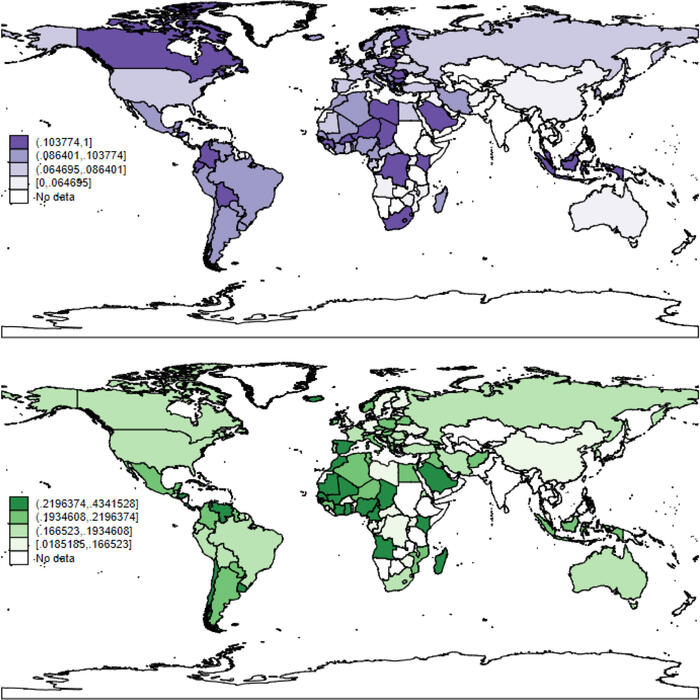
Fig. 1. The share of fouls retaliated in soccer games (top) and the prevalence of revenge motifs in folklore (bottom). Both variables tend to have higher values for players and folklore from the Middle East, Central Africa, Eastern Europe, and parts of South America.


Fig. 1. The share of fouls retaliated in soccer games (top) and the prevalence of revenge motifs in folklore (bottom). Both variables tend to have higher values for players and folklore from the Middle East, Central Africa, Eastern Europe, and parts of South America.


Findings


Retaliation:

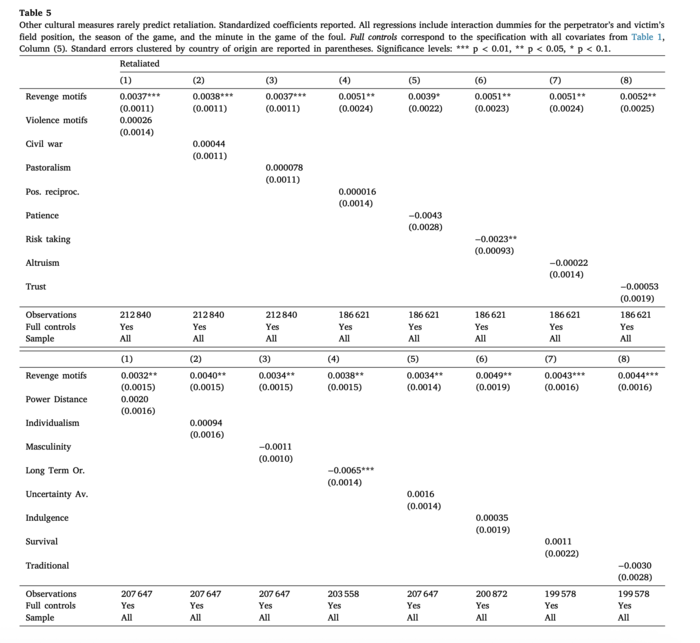
Schläpfer finds evidence that players from cultures that value revenge are indeed more likely to retaliate for fouls. However, they are not more likely to commit fouls overall, cautioning us against conflating the concepts of retaliation and violence. Indeed, Schläpfer demonstrates that motifs of violence in a culture's folklore do not predict retaliation. Players are also found to be more retaliatory early on in a game, which is consistent with its use as a signal or aspect of one’s reputation. In other words, retaliation serves to deter future fouls. Victims of fouls also retaliate quickly. Indeed, retaliation rates are stable or slightly increasing during the first 30 minutes of a game, but then fall consistently thereafter.


Image
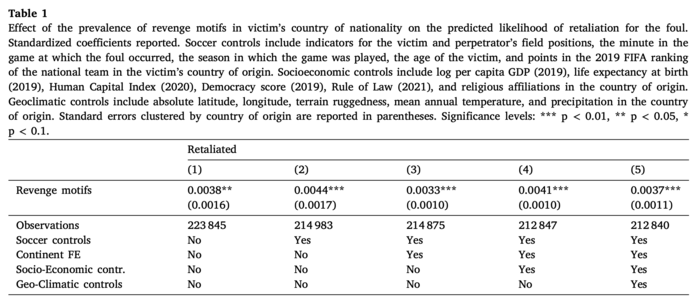
Table 1. Effect of the prevalence of revenge motifs in victim’s country of nationality on the predicted likelihood of retaliation for the foul.


Evidence is also provided to show that retaliation deters future transgressions: perpetrators are less likely to foul again if victims retaliate for the initial foul. However, this deterrence finding is only observed when the perpetrator is from a revenge culture. In other words, for retaliation to support cooperation (the absence of fouls), players must share a similar cultural background.

Schläpfer’s findings hold even when soccer-related or socioeconomic factors are taken into account. Further, the paper considers, but finds little support for, alternative explanations of why retaliation varies. These include that some teams encourage players to retaliate more or employ more players from revenge cultures. Further, retaliation does not appear to be driven by emotions; otherwise, it would be less likely to occur after halftime when players have had a chance to cool down, but this is not the case.


Image
Table 5. Other cultural measures rarely predict retaliation. Standardized coefficients reported.


Informal and Formal Sanctioning:

Finally, Schläpfer analyzes the interaction between player retaliation and refereeing. Most importantly, retaliation is significantly less likely if a foul is sanctioned with a yellow card. This illustrates the theoretical principle of formal punishment “crowding out” informal punishment, such as religious excommunication, which carries greater weight than social shunning or police fines compared to peer pressure. Both retaliation and referee sanctioning are shown to reduce the frequency of repeated offenses by perpetrators, especially among players from revenge cultures. However, Schläpfer finds that formal sanctioning is roughly three times more effective than retaliation. This suggests that football referees are doing a better job managing conflict between players than players themselves. 

Schläpfer concludes by mentioning a few of the paper’s limitations. First of all, retaliation is measured only by what referees sanction. However, referees may miss crucial incidents for which retaliation is a response, such as Zinedine Zidane’s 2006 World Cup headbutt after a verbal insult (that was not sanctioned). This is important because individuals from revenge cultures are likely to be particularly offended by verbal insults. Second, the paper does not capture retaliation that occurs across games played by the same teams over time, particularly when rivalries and hostilities have intensified. Similarly, it does not account for preemptive retaliation that does not follow a foul. Ultimately, Schläpfer deepens our understanding of retaliation in a domain where many would expect it not to operate or to do so with minimal significance. The article impressively marshals large-scale data from both sports and cultural history to clarify the causes and consequences of retaliation.

*Research-in-Brief prepared by Adam Fefer.

Hero Image
A person in a red and blue football uniform on a field Jona Møller via Unsplash
All News button
1
Subtitle

CDDRL Research-in-Brief [4-minute read]

Date Label
Paragraphs

We measure how a network of heroes can legitimize and diffuse extreme political behaviors. We exploit newly declassified intelligence files, novel voting data, and regimental histories to show that home municipalities of French line regiments arbitrarily rotated under Philippe Petain's generalship through the heroic World War I battlefield of Verdun diverge politically thereafter, particularly following Petain's own overt espousal of authoritarian views. Further, under Petain's collaborationist Vichy regime (1940–1944), they raise 7 percent more active Nazi collaborators per capita. These effects extend across all forms of Nazi collaboration and diffuse beyond the veterans themselves.

All Publications button
1
Publication Type
Journal Articles
Publication Date
Journal Publisher
American Economic Review
Authors
Saumitra Jha
Number
7
Paragraphs

We compare political mobilization and support for democratic values during the French Revolution among the home bailliages and among individual members of French regiments sent with the Comte de Rochambeau to fight alongside American revolutionaries (1781-83), to others also assigned there who failed to arrive due to logistical failures and British blockade. We provide evidence for revolutionary contagion: bailliages with 10% more Rochambeau veterans were 6.4% more likely to submit grievances to the King that were “Most Strongly Democratic” in 1789. They mobilize political clubs earlier, are more likely to engage in revolt and as individuals were more likely to show loyalty to moderate democratic revolutionary reforms both within the army and the National Assembly. Other veterans mobilize too, but less so and not for democratic principles. Similarly, exposure to Enlightenment ideas has limited effects absent American veterans. We interpret these results as reflecting the complementarity between exposure to democratic ideas and organizational skills of veterans in generating contagion between two of the world’s great revolutions.

All Publications button
1
Publication Type
Working Papers
Publication Date
Journal Publisher
CDDRL Working Papers
Authors
Saumitra Jha
Authors
News Type
News
Date
Paragraphs


Image
whitneyhorizontal

Stanford’s Center on Democracy, Development, and the Rule of Law (CDDRL) is proud to announce that undergraduate honors student Whitney McIntosh received the highest distinction for her thesis at Stanford. Each year, the David M. Kennedy Prize is awarded to four outstanding honors theses in the humanities, social sciences, engineering and the applied sciences. McIntosh’s thesis “France and the Internationalization of Security: A Conceptual History of Security During the Interwar Years (1919-1933),” was researched and written during her participation in CDDRL’s  Fisher Family Honors Program in Democracy, Development and Rule of Law.


This is the third Kennedy prize awarded to a CDDRL honors student in the past five years.


Under the supervision of Stephen Stedman, CDDRL’s deputy director and director of the Fisher Family Honors Program, McIntosh analyzed the meaning of security in France in the aftermath of World War I. While her thesis was historic in nature, it lessons resonate with contemporary French politics, underscoring the tensions between globalization and polarization in Western democracies.


“The thesis is an exemplary piece of multidisciplinary research that uses methods and insights from history, political science,linguistics and English,” said Stedman. “Many of Whitney’s sources are drawn from French archives and memoirs, and it is thrilling to see an undergraduate deftly move between French and English passages.”

Launched in 2010, the Fisher Family Honors Program trains a cohort of Stanford students to research and write an original thesis on a topic influencing the field of democratic development. Students work with faculty mentors, attend weekly seminars and attend Honors College in Washington, DC for a chance to interact with policymakers and gain practical knowledge to inform their thesis.


CDDRL Mosbacher Director Francis Fukuyama supported McIntosh’s nomination for the  prize: “Marshalling an impressive trove of sources Whitney  crafted an elegant and compelling explanation for shifting conceptions of security, and made a rigorous case for understanding the importance of security as a term and concept whose meaning adapts to suit needs of powerful actors and states,” said Fukuyama.  


McIntosh is planning to continue and expand her research in the future. In this short Q&A she discusses the genesis of her honor thesis research, shares tips for future honors students and shares how honored she was to receive this award.


1. How did you develop your interest in the topic?

At the beginning of my sophomore year, I started working as a research assistant for Professor Stephen Stedman on his project exploring the evolution of the concept of security over the twentieth century. That same year, Professor Stedman and I also began a research collaboration with Professor Mark Algee-Hewitt and Erik Fredner at the Stanford Literary Lab to look deeper into this question with both qualitative and quantitative methods. In this process, Professor Stedman and I began to talk more about how and when the concept re-emerged in the twentieth century. We began to hypothesize that it had arisen in France after the First World War. As I have some French language ability, I applied for and received a Global Mentored Fellowship grant from the Freeman Spogli Institute to travel to Paris that summer to conduct archival research on the topic. It was in the heart of the national archives in Paris that I began to think deeply about the complexities and intricacies of my research question, and found the necessary archival documents to support an honors thesis.  


2. Are you planning to pursue this further and how?

Due to time constraints, my honors thesis was limited to the years from 1919 to 1933. However, in my conclusions I realized that the period from 1933 to the beginning of World War II is an incredibly interesting time for France, as France was stricken by immense political fragmentation and social unrest, and this period may have had huge consequences on later conceptualizations of security. Given the time, I would be very interested in extending my research into this period to see how the concept evolved.


More broadly, my honors thesis gave me the opportunity to examine the way that cultures and contexts shape the way that political concepts emerge and change over time. I hope to continue to research how culture and politics interact, inform and influence each other in any future graduate work.


3. What does it mean to you to get this award?

It is an incredible honor to receive the Kennedy Thesis Prize for my honors thesis. It has been a wonderful opportunity to again express my thanks to those who guided me throughout the process, such as my advisor Professor Stedman. I am also glad to bring greater attention to CDDRL’s Fisher Family Honors Program which has been one of the most intellectually fulfilling experiences of my Stanford career, through its broad network of academics, inspiring thesis cohort and incredible program for furnishing honors work.


4. How did Honors College help with your research?

Our CDDRL Honors College in Washington D.C. was an incredible opportunity to meet with experts in a range of fields and policy areas. It really helped me to develop a better mental framework for posing successful research questions and then conducting the research necessary to answer them. Apart from learning from experts, it was also an important time to engage with and bounce ideas off my peers for our honors thesis.


5. What would be your tip for future applicants, who want to get the most out of Honors College?

For future applicants, I would advise you to be assertive, engage with the people that you meet, and keep in contact those who are relevant to your field. It’s immensely important to start thinking about your thesis early (and not procrastinate!), so it’s essential to use Honors College to gain as much guidance as soon you can and to think deeply about the direction you want to go in. Also—trust your peers! The cohort is a widely skilled and talented group, with many ideas that will help you along the way.

 
Hero Image
whitney
All News button
1
-

How do democratic societies respond to acts of terror? More precisely, what are the political consequences of the "Charlie Hebdo" attacks and the November 13 rampage in 2015 in Paris? Past research has examined the impact of threatening events on attitudes toward ethnic and religious minorities, as well as its influence on the endorsement of authoritarian policies. However, up until now, the impact of terrorist events on political participation has not been examined. This talk aims to assess the influence of fear and anger evoked by threat on the propensity to take part in various political activities, drawing on two representative surveys conducted in the aftermath of the January and November 2015 terrorist attacks in Paris.

Martial Foucault is a professor of political science at Sciences Po in Paris, director of the CEVIPOF (CNRS) and associate researcher within the Laboratoire Interdisciplinaire d’Evaluation des Politiques Publiques (LIEPP).


RSVP to Minjia Zhong at mzhong2@stanford.edu by Monday April 11.

For more information contact Cécile Alduy at alduy@stanford.edu

This lecture is co-sponsored by the French and Italian Department, The Europe Center, Stanford University Library, the France-Stanford Center for Interdisciplinary Studies, the Division of Literatures, Cultures and Languages, and the Center on Democracy, Development and the Rule of Law.


German Library, Room 252
Building 260

Martial Foucault Professor of Political Science speaker Institute of Political Science (Sciences Po), Paris
Lectures
News Type
News
Date
Paragraphs

Appeared in Stanford Report, May 29, 2014

By Clifton B. Parker

The electoral eruption of anti-European Union populism is a reflection of structural flaws in that body but does not represent a fatal political blow, according to Stanford scholars.

In the May 25 elections for the European Parliament, anti-immigration parties won 140 of the 751 seats, well short of control, but enough to rattle supporters of the EU, which has 28 member nations. In Britain, Denmark, France and Greece, the political fringe vote totals stunned the political establishments.

Stanford political scientist Francis Fukuyama said the rise of extremism and anti-elitism is not surprising in the wake of the 2008 economic downturn and subsequent high levels of unemployment throughout Europe. In one sense, the EU elites have themselves to blame, he said.

"The elites who designed the EU and the eurozone failed in a major way," he said. "There was a structural flaw in the design of the euro (monetary union absent fiscal union, and the method of disciplining countries once in the zone)," said Fukuyama, the Olivier Nomellini Senior Fellow at Stanford's Freeman Spogli Institute for International Studies and the Center for Democracy, Development and the Rule of Law, and Research Afflilate at The Europe Center.

Some have argued that the European Union should adopt a form of fiscal union because without one, decisions about taxes and spending remain at the national level.

As Fukuyama points out, this becomes a problem, as in the case of a debt-ridden Greece, which he believes should not have qualified for EU membership in the first place. In fact, he said, it would have been better for Greece itself to leave the euro at the outset of the 2008 crisis.

Still, Fukuyama said the big picture behind the recent election is clear – it was a confluence of issues and timing.

"It is a bit like an off-year election in the U.S., where activists are more likely to vote than ordinary citizens," he said.

Fukuyama believes the EU will survive this electoral crisis. "I think the EU will be resilient. It has weathered other rejections in the past. The costs of really exiting the EU are too high in the end, and the elites will adjust, having been given this message," he said.

Meanwhile, the populist parties in the different countries are not unified or intent on building coalitions with each other.

"Other than being anti-EU, most of them have little in common," Fukuyama said. "They differ with regard to specific positions on immigration, economic policy, and they respond to different social bases."

Ongoing anger

Dan Edelstein, a professor of French, said the largest factor for success by extremist candidates was "ongoing anger toward the austerity policy imposed by the EU," primarily by Germany.

Edelstein estimates that a large majority of French voters are still generally supportive of the EU. For the time being, the anti-EU faction does not have a majority, though they now have much more representation in the European Parliament.

Edelstein noted existing strains among the anti-EU parties – for example, the UK Independence Party in Britain has stated that it would not form an alliance with the National Front party in France.

Immigration remains a thorny issue for some Europeans, Edelstein said.

"'Immigration' in most European political debates, tends to be a synonym for 'Islam.' While there are some countries, such as Britain, that are primarily worried about the economic costs of immigration, in most continental European countries, the fears are cultural," he said.

As Edelstein put it, Muslims are perceived as a "demographic threat" to white or Christian Europe. However, he is optimistic in the long run.

"It seems a little early to be writing the obituary of the EU. Should economic conditions improve over the next few years, as they are predicted to, we will likely see this high-water mark of populist anger recede," said Edelstein.

Cécile Alduy, an associate professor of French, writes in the May 28 issue of The Nation about how the ultra-right-wing National Front came in first place in France's election.

"This outcome was also the logical conclusion of a string of political betrayals, scandals and mismanagement that were only compounded by the persistent economic and social morass that has plunged France into perpetual gloom," she wrote.

Historian J.P. Daughton said that like elsewhere in the world, immigration often becomes a contentious issue in Europe in times of economic difficulties.  

"High unemployment and painful austerity measures in many parts of Europe have led extremist parties to blame immigrants for taking jobs and sapping already limited social programs," he said.

Anti-immigration rhetoric plays particularly well in EU elections, Daughton said. "Extremist parties portray European integration as a threat not only to national sovereignty, but also to national identity.

Edelstein, Alduy and Daughton are all Faculty Affiliates of The Europe Center.

Wake-up call

Russell A. Berman, a professor of German studies and comparative literature, said many Europeans perceive the EU as "somehow impenetrable, far from the civic politics of the nation states."

As a result, people resent regulations issued by an "intangible bureaucracy," and have come to believe that the European Parliament has not grappled with major issues such as mustering a coherent foreign policy voice, he said.

"The EU can be great on details but pretty weak on the big picture," said Berman, who is the Walter A. Haas Professor in the Humanities, Senior Fellow at the Hoover Institution, and Faculty Affiliate of The Europe Center. "It is this discrepancy that feeds the dissatisfaction."

Yet he points out that the extremist vote surged in only 14 nations of the EU – in the other 14, there was "negligible extremism," as he describes it.

"We're a long way from talking about a fatal blow, but the vote is indeed a wake-up call to the centrists that they have to make a better case for Europe," Berman said.

Hero Image
A man walks past a board displaying provisional results of the European Parliament election at the EU Parliament in Brussels
A man walks past a board displaying provisional results of the European Parliament election at the EU Parliament in Brussels May 25, 2014.
REUTERS / Francois Lenoir
All News button
1
-

Abstract
The framework of "LGBT rights" can be critiqued as challenging tradition or as culturally specific, yet at the same time, it can be essential to one's sense of identity and justice.  Where can the discourse of "public health" help overcome barriers for LGBT people, both within the right to health and beyond? What are the limits to using public health to talk about human rights, LGBT or otherwise?  What are the dangers of conflating these distinct areas of concern?  We will explore these questions and focus on how academics and activists can most effectively navigate challenges to benefit both public health and LGBT rights.

Jessica Stern is the Executive Director of the International Gay and Lesbian Human Rights Commission. As the first researcher on lesbian, gay, bisexual and transgender (LGBT) human rights at Human Rights Watch, she conducted fact-finding investigations and advocacy around sexual orientation and gender identity in countries including Iran, Kyrgyzstan, South Africa, and the United Arab Emirates. As a Ralph Bunche Fellow at Amnesty International, she documented police brutality for what became its landmark report on police brutality in LGBT communities in the U.S., “Stonewalled.” She was a founding collective member and co-coordinator of Bluestockings, then New York’s only women’s bookstore. She has campaigned extensively for women’s rights, LGBT rights, and economic justice with the Center for Constitutional Rights, Control Ciudadano, the National Gay & Lesbian Task Force, and the Urban Justice Center. She holds a masters degree in human rights from the London School of Economics. She is frequently quoted in the Mail & Guardian, Al Jazeera English, the Associated Press, Reuters, Agence France Presse, Deutsche Welle, Voice of America, The Guardian and The BBC.

Building 200 (History Corner)
Room 205
Stanford University

Jessica Stern Executive Director Speaker International Gay and Lesbian Human Rights Commission
Seminars
News Type
Commentary
Date
Paragraphs

The republican tradition continues to frame French debates on empire, as it has done since the Revolution. French republicanism and Anglophone liberalism have shared numerous features in relation to empire: both are egalitarian traditions of moral universalism, and both uphold an ideal of political emancipation that has tended to entail assimilation to a European political model. This paper explores the course of French debates over empire from the period of Napoleon through the July Monarchy — the broader context for the thought of the iconic liberal republicans Constant and Tocqueville — with particular attention to the ways in which liberal and republican registers were deployed in both support and critique of empire, and to how the articulation of liberal and republican agendas in France was affected by the Algeria conquest. It also discusses the first Algerian contribution to French public deliberation about the conquest, Hamdan Khodja’s 1833 text Le Miroir, a work that self-consciously inhabited both a liberal cosmopolitan and a Muslim perspective and that was nearly alone in French debates in making a principled argument for Algerian.

All News button
1
Subscribe to France