-

This is a CDDRL's seminar within our Democracy in Taiwan Program.

Vincent Wei-cheng Wang is Chair and Associate Professor of Political Science at the University of Richmond. He was a former Coordinator of the American Political Science Association Conference Group on Taiwan Studies and a board member of the American Association for Chinese Studies. He has published over fifty scholarly articles and book chapters on Asian politics and international relations, Taiwan’s domestic politics and external relations, United States-Asian relations, and comparative political economy of East Asia and Latin America. His most recent publication is “Taiwan: Conventional Deterrence, Soft Power, and the Nuclear Option,” in Muthiah Alagappa, ed., The Long Shadow: Nuclear Weapons and Security in 21st Century Asia (Stanford, Calif: Stanford University Press, 2008). He received his Ph.D. from the University of Chicago.

Philippines Conference Room

Vincent Wei-cheng Wang Chair and Associate Professor Speaker Department of Political Science at University of Richmond
Seminars
Authors
Eric Chen-hua Yu
News Type
News
Date
Paragraphs

In Political Change in China: Comparisons with Taiwan, CDDRL's Democracy in Taiwan program marshals commentary from leading experts on what lessons, if any, Taiwan's experience of democratization might hold for China's future. The volume was co-edited by Larry Diamond and includes a chapter by Weitseng Chen, one of CDDRL's 2007-08 Hewlett Fellows.

Hero Image
diamond cover
All News button
1
Paragraphs

How might China become a democracy? And what lessons, if any, might Taiwan's experience of democratization hold for China's future? The authors of this volume consider these questions, both through comparisons of Taiwan's historical experience with the current period of economic and social change in the PRC, and through more focused analysis of China's current, and possible future, politics.This volume explores current, and possible future, political change in China in the context of Taiwan's experience of democratization.

Table of Contents

  • Comparing and Rethinking Political Change in China and Taiwan - B. Gilley.
  • Civil Society and the State. The Evolution of Political Values - Y.H. Chu.
  • Intellectual Pluralism and Dissent - M. Goldman and A. Esarey.
  • Religion and the Emergence of Civil Society - R. Madsen.
  • Business Groups: For or Against the Regime? - D.J. Solinger.
  • Regime Responses. Responsive Authoritarianism - R.P. Weller.
  • Developing the Rule of Law - R. Peerenboom and W. Chen.
  • Competitive Elections - T.J. Cheng and G. Lin.
  • International Pressures and Domestic Pushback - J. deLisle.
  • Looking Forward. Taiwan's Democratic Transition: A Model for China? - B. Gilley.
  • Why China's Democratic Transition Will Differ from Taiwan's - L. Diamond.

Author's Biography
Bruce Gilley is assistant professor of political studies at Queen's University in Canada. His numerous publications include China's Democratic Future, Model Rebels: The Rise and Fall of China's Richest Village, and Tiger on the Brink: Jiang Zemin and China's New Elite. Larry Diamond is senior fellow at the Freeman Spogli Institute for International Studies and also at the Hoover Institution, Stanford University, and founding coeditor of the Journal of Democracy. Most recent of his many works on democracy and democratization are Developing Democracy: Toward Consolidation and Promoting Democracy in the 1990s.

All Publications button
1
Publication Type
Books
Publication Date
Journal Publisher
Lynne Rienner Publishers
Authors
Larry Diamond
Weitseng Chen
Number
1588265935
  • -
  • -
  • -
  • -
  • -

This is the third annual conference of the Taiwan Democracy Program, which is part of Stanford University's Center on Democracy, Development, and the Rule of Law (CDDRL). The conference took stock of the last eight years of democracy in Taiwan under the Chen Shui-bian Administration and assessed Taiwan's progress toward democratic consolidation.


Agenda:

Day I

Morning Session--9:00 am-12:15 pm

Session I: Introduction

  1. Theoretical and Comparative Perspectives on Democratic Consolidation
  2. Polarized Politics, Quality of Governance and Support for Democracy in Taiwan: A View from Asian Barometer

Session II: The 2008 Elections

  1. The Legislative Yuan Election Campaigns, Results and Implications
  2. The Presidential Election Campaigns, Results and Implications

Afternoon Session--1:30 pm-5:15 pm

Session III: Partisan Alignments and Electoral System

  1. Dynamics of Partisanship, National Identity, and Issue Cleavages in the DPP Era
  2. The Democratic Progressive Party’s Clientelism: A Failed Political Action
  3. Taiwan’s First Legislative Election under the Mixed-Member Majoritarian System: What Happened and What It Implies

Session IV: How well are Democratic Institutions Functioning?

  1. Horizontal Accountability and Rule of Law in A Divided Polity: the Judicial and Control Yuan
  2. Parliament and Executive-Legislative Relations
  3. Constitutional and Institutional Reform

Day II

Morning Session--9:00 am-12:15 pm

Session V: Civil Society

  1. Engaging the State: Civil Society and the Institutional Transformation of Democracy
  2. Press Freedom, DPP Government and the Intellectuals


Session VI: Political Economy

  1. Politics and Business under the DPP: Restructuring State-Business Institutional Relations in Taiwan
  2. Inequality, Discontents, and the Popularization of “M-Shaped Society Conception in Taiwan

Afternoon Session--1:15 pm-4:30 pm

Session VII: Security and Democracy

  1. Democracy and Cross-Straits Relations: A Case Study of the “Three-Links”
  2. Security Apparatus and Depoliticization in Chen Shui-bian’s Era

Round Table Discussion

Is Taiwan's Democracy Consolidated?

Oksenberg Conference Room

Conferences
Date Label
-

How might one think about Chinese power, its dimensions, its effects, and its implications for change in the United States and elsewhere? Dr. David M. Lampton will put China's current trajectory and its conceptions of power in their historical contexts, discuss how China's neighbors are responding to the PRC's growing strength, and explore the vulnerabilities and uncertainties that lie ahead not only for China but the outside world.  
 
Dr. Lampton's work is based on interviews in China, in countries along the PRC's long periphery, and in the United States, as well as extensive documentary research. His book, The Three Faces of Chinese Power: Might, Money, and Minds, was just published by the University of California Press. 

David M. Lampton, Dean of Faculty, is George and Sadie Hyman Professor and Director of China Studies at the Johns Hopkins School of Advanced International Studies and Senior International Advisor on China for the law firm of Akin Gump. Before assuming the post at SAIS in December 1997, he was president of the National Committee on United States-China Relations in New York City for a decade. Dr. Lampton is the author of numerous books and articles on Chinese domestic and foreign affairs. His most recent book is, The Three Faces of Chinese Power: Might, Money, and Minds (University of California Press, 2008), and his articles have appeared in the American Political Science Review, The China Quarterly, Foreign Affairs, Foreign Policy, The New York Times, The Washington Post, and other venues academic and popular. Earlier books and edited volumes include: Same Bed, Different Dreams: Managing U.S.-China Relations, 1989-2000 (University of California Press, 2001) and (editor) The Making of Chinese Foreign and Security Policy in the Era of Reform (Stanford University Press, 2001).

Lampton received his PhD and undergraduate degrees from Stanford University and has lived in the Peoples Republic of China, Taiwan, and Hong Kong. He has an honorary doctorate from the Russian Academy of Sciences' Institute of Far Eastern Studies and is consultant to the Aspen Institute's Congressional Program, the Kettering Foundation, and various corporations and government agencies.

Levinthal Hall

David M. Lampton George and Sadie Hyman Professor and Director of China Studies Speaker the Johns Hopkins School of Advanced International Studies
Conferences
-

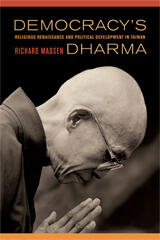
This is a CDDRL's Special Event within our Democracy in Taiwan Program. It is also co-sponsored by the Public Diplomacy/Emerging Publics Project of the Center for the Pacific Rim at University of San Francisco. In this seminar, Dr. Richard Madsen will talk about his new book that explores the religious renaissance that has reformed, revitalized, and renewed the practices of Buddhism and Daoism in Taiwan and how this religious renaissance embraces democracy modernity.  

Image
10896
Richard Madsen is distinguished professor and chair of the sociology department at the University of California, San Diego and a co-author (with Robert Bellah et al.) of The Good Society and Habits of the Heart which received the Los Angeles Times Book Award and was jury nominated for the Pulitzer Prize. He has authored or co-authored five books on China, including Morality and Power in a Chinese Village for which he received the C. Wright Mills Award; China's Catholics: Tragedy and Hope in an Emerging Civil Society; and China and the American Dream.  He also co-edited (with Tracy B. Strong) The Many and the One: Religious and Secular Perspectives on Ethical Pluralism in the Modern World. His latest book is Democracy’s Dharma: Religious Renaissance and Political Development in Taiwan.

Richard Madsen received an MA in Asian studies and a Ph.D. in sociology from Harvard.

"Madsen is a genial and well-informed guide, both to social-political change in Taiwan and to the ins and outs of religious movements. His engaging writing skillfully interweaves profound insights and themes into the descriptive analytical narrative. Democracy's Dharma presents new material based on recent research while offering a fresh spin on thinking about Asian religions."–Thomas Gold, editor of Social Connections in China: Institutions, Culture, and the Changing Nature of Guanxi

Philippines Conference Room

Richard Madsen Distinguished Professor Speaker Department of Sociology at the University of California, San Diego
Conferences
News Type
News
Date
Paragraphs
Larry Diamond has been appointed as a Senior Fellow in the Freeman Spogli Institute for International Studies (FSI). Currently a Senior Fellow at the Hoover Institution, a renowned scholar of democratization, and prolific in both editorial and policy work, Diamond is an active member of FSI’s Center on Democracy, Development, and the Rule of Law (CDDRL). He coordinates the Program on Democracy - Completed, which examines the comparative dynamics of democratic functioning and change in the contemporary world, with a particular focus on the countries of Africa, the Middle East, Asia, Latin America, and the post-communist world. He has also established the offshoot program, The Taiwan Democracy Project, in 2006, and is a central participant in the The Taiwan Democracy Project.

Primarily an Africanist, Diamond received his Ph.D. in Sociology from Stanford University in 1980. He currently serves as the co-director for the National Endowment for Democracy’s International Forum for Democratic Studies in Washington DC, as a member of U.S. Agency for International Development (USAID) Advisory Committee on Voluntary Foreign Aid, and as adviser and lecturer at the World Bank, the United Nations, and the U.S. Department of State. Previously he was senior adviser to the Coalition Provisional Authority in Iraq and consultant to USAID.

He is also founding co-editor of the Journal of Democracy, the premier journal in the field, and a co-director of the International Forum for Democratic Studies of the National Endowment for Democracy. He has an impressive record of public service, which includes numerous board memberships and government appointments, and he has published widely. In his prolific portfolio of books and papers, he has advanced the knowledge on the conceptualization, determinants, and importance of democracy by examining the relationship between development and democracy, the multidimensional nature of the democratization process, and the significance of democratic consolidation.

Diamond’s commitment and contributions to teaching are also reflected in his receipt of Stanford’s 2007 Lloyd W. Dinkelspiel Award for Distinctive Contributions to Undergraduate Education, a strong testament to the breadth and depth of his engagement at the University.
All News button
1
-
Teh-wei Hu is a Professor Emeritus of health economics at the University of California, Berkeley.  At Berkeley, he served as associate dean (1999-2002) and department chair (1990-1993) in the School of Public Health.  He received his PhD in Economics from the University of Wisconsin.  

During the past 40 years, Professor Hu has been teaching and conducting research in health economics, particularly in healthcare financing and the economics of tobacco control.  Hu was a Fulbright scholar in China. He has served as consultant or advisor to the World Bank, the World Health Organization, the National Institutes of Health, the Institute of Medicine, the Rand Corporation, the Ministry of Health in the People's Republic of China, Department of Health and Welfare in Hong Kong, Department of Health in the Republic of China (Taiwan), and many private research institutions and foundations. 

Professor Hu will speak to us immediately after an April trip to China, sharing his research and perspectives on the economics of tobacco control and the debate about healthcare system reforms in China (including a possible link between the two through financing expansions in coverage through increased tobacco taxation).

Philippines Conference Room

Teh-wei Hu Professor Emeritus Speaker University of California, Berkeley, School of Public Health
Seminars
Subscribe to Taiwan