Samet, O. (2024). When you come at the king: Opposition coalitions and nearly stunning elections. American Journal of Political Science, 69(4), 1469-1485.
Many authoritarian countries hold elections where the incumbent might lose. The odds tend to be quite narrow, however, owing to the autocrat’s asymmetric control over economic resources, security forces, media, and so on. An important practical and theoretical question, then, is how the opposition can beat these narrow odds.
Some scholars have argued that oppositions can defeat authoritarian incumbents by building broad, multiparty coalitions. Doing so should not only decrease the autocrat’s vote share but should also deter him from deploying state repression against the opposition’s supporters. Indeed, security forces will struggle or be hesitant to shoot at such large numbers of people, and doing so will likely attract international condemnation. All of this sounds intuitively plausible.
In “When you come at the king,” Oren Samet shows how arguments for building big coalitions overlook a crucial possibility: If the opposition unites and performs well but still fails to defeat the autocrat, he may be “spooked” and react by doubling down on repression. This is because elections provide the government with information about its own and the opposition’s popularity. Too much opposition success further decreases the autocrat’s willingness to tolerate popular elections and freedoms. Therefore, the same strategy enabling oppositions to achieve a “stunning election” can — if the coalition fails to take power — lead to a “nearly stunning” election that further entrenches authoritarianism. Hence the paper’s title, a quote from The Wire’s Omar Little: when “you come at the king, you best not miss.”
The paper provides both cross-national data and an in-depth case study of Cambodia to show how the logic of nearly stunning elections poses a serious dilemma for democracy promoters: When oppositions cannot defeat autocrats, then they must achieve a “sweet spot” of neither too many votes (which scares the incumbent into autocratizing) nor too few (which fails to threaten the incumbent and compel him to make democratic concessions). Yet deliberately planning to hit this sweet spot is simply not possible. Samet thus offers an important challenge to the claim that bigger is better in authoritarian elections.
Oren Samet shows how arguments for building big coalitions overlook a crucial possibility: If the opposition unites and performs well but still fails to defeat the autocrat, he may be “spooked” and react by doubling down on repression.
Cross-National Findings:
Samet’s argument about the pitfalls of nearly stunning elections implies three hypotheses. First, and as previous scholarship suggests, coalitions should outperform individual opposition parties in authoritarian elections. Second, absent the incumbent’s defeat, autocratization is more likely as the opposition’s vote share increases. And third, absent the incumbent’s defeat, countries with high-performing oppositions should witness (a) an increase in state repression and (b) decreases in the quality of elections in the years following a nearly stunning election. Samet then analyzes all elections from 1990 to 2022 in cases where the same authoritarian leader or party had ruled for at least 10 years. This yields 286 elections: 58 (20%) featured coalitions, and 28 (10%) featured electoral turnovers. These numbers alone paint a bleak picture of the prospects for beating dictators.
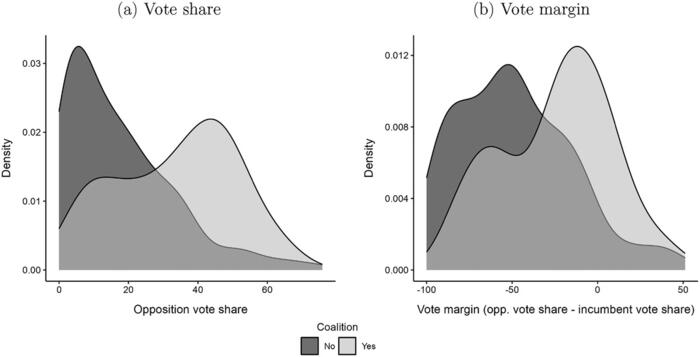
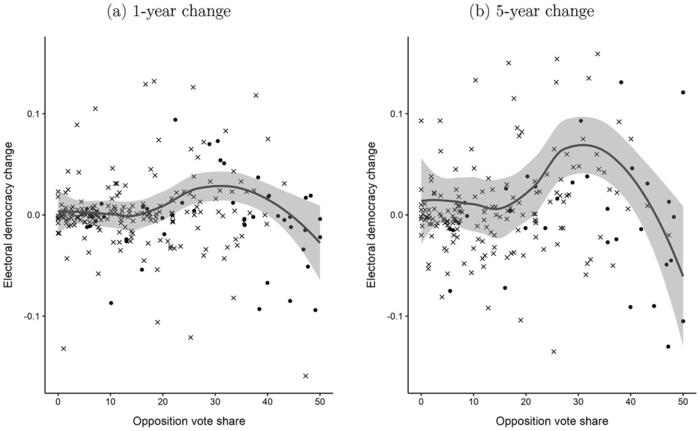
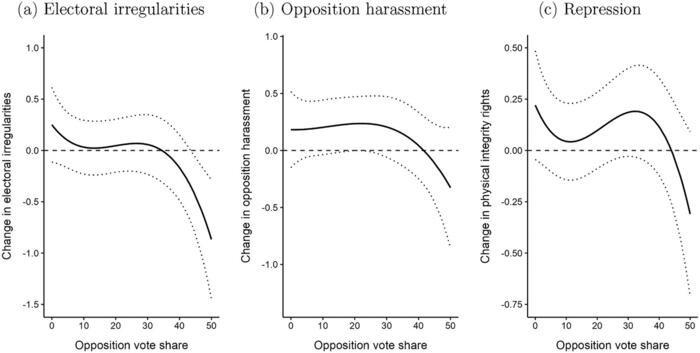
The statistical results broadly support Samet’s hypotheses. Coalitions do in fact perform better at the ballot box, winning a median vote share of 36% (compared to just 13% for individual parties). In addition, and consistent with the idea that hitting the “sweet spot” will encourage autocrats to make concessions, Samet finds a positive association between moderately strong opposition performance and democratic change. Importantly, however, levels of democracy decline sharply as the opposition vote share approaches 50%. Nearly stunning elections thus appear to provoke autocratization, both in the short- and medium-term. Finally, the relationship between nearly stunning elections and repression or electoral fraud is somewhat weaker. This may be because the autocrat has more than just these two tools at his disposal — he might limit the number of seats that can be contested in future elections, prevent the opposition from accessing state media, and so on.
Image
FIGURE 2: Opposition performance in authoritarian elections. Note: Density plots display the frequency of specific opposition (opp.) vote shares (left) and vote margins (right) broken down by coalition status.
Image
FIGURE 3: Opposition performance and electoral democracy change. Note: Displays elections that did not feature turnovers, plotted along two dimensions: opposition vote share and change in electoral democracy. ∙ (dot) denotes election with coalitions; × denotes election without. The gray lines plot LOESS regressions fit to the data, with gray shading indicating 95% confidence intervals.
Image
FIGURE 6: Predicted change in repression and electoral manipulation, with controls. Note: Displays predicted post-election changes in (1) V-Dem measure of electoral irregularities, comparing election at t with election at t + 1; (2) V-Dem measure of government intimidation of opposition, comparing election at t with election at t + 1; (3) Fariss (2014) physical integrity rights measure 3 years after election, using the lagged score as a baseline. Includes all elections that did not result in turnovers. Dotted lines indicate 95% confidence intervals.
The Cambodia Case:
Samet concludes by showing how his theoretical process — oppositions uniting, nearly winning an election, frightening the incumbent, then increasing authoritarianism — is borne out in Cambodia’s recent political history. Throughout the 2000s, Cambodia’s opposition was fragmented, in part due to deliberate actions by its authoritarian Prime Minister, Hun Sen. Ahead of the 2013 elections, in the face of mounting popular dissatisfaction with the government, the two largest opposition parties coalesced. Hun Sen was confident in his position, in part because Cambodia’s strongest opposition party had won just 22% of the vote in 2008. As such, he pardoned Sam Rainsy, one of the country’s most prominent opposition leaders, whom he invited to return from exile.
The coalition did remarkably well in 2013, winning around 45% of the vote, but then alleged fraud and refused to take their seats in parliament. Opposition supporters then took to the streets in protest, where they were met with state violence. Yet Hun Sen made a number of concessions to successfully quell the protest crisis, including reforming the election commission.
By 2015, however, signs of autocratization became glaring. Opposition lawmakers were publicly beaten by the personal bodyguards of Hun Sen, who withdrew his prior pardon of Rainsy. Other opposition leaders faced politically motivated legal cases. Ahead of the 2018 elections, Hun Sen’s government hired an external survey firm, which found the opposition had become even more popular among Cambodians since 2013. Hun Sen’s fears were aggravated by a strong opposition performance in the 2017 local elections.
Samet argues that this was the last straw: the government responded by promptly arresting and exiling opposition leaders and dissolving their coalition. All of this constituted the most dramatic instance of autocratization in Cambodia since the 1990s. Hun Sen’s allies then ran unopposed in the 2018 elections. By this time, the opposition was once again divided — particularly as regards how to face a government whose elections could barely be characterized as anything other than window-dressing. “When you come at the king” offers an important if distressing lesson for practitioners and scholars of democracy.
In a CDDRL research seminar held on October 30, 2025, Einstein-Moos Postdoctoral Fellow Oren Samet presented his research on how opposition parties engage internationally to challenge authoritarian regimes, focusing on the costs and benefits of a phenomenon he terms “opposition diplomacy.” This CDDRL research seminar highlighted Samet’s book project, which explores how opposition actors shape international politics and what their strategies reveal about the global landscape of democracy.
Samet defines opposition diplomacy as the explicit efforts by political actors in the opposition to engage with international policymakers, promote their own priorities, and influence the foreign policies of external states. His research focuses on opposition diplomacy directed at Western governments in the post-Cold War era, undertaken by parties and politicians seeking to gain power through elections.
As Samet highlighted, opposition diplomacy can take several forms, including direct lobbying, international networking, diaspora mobilization, and public relations. These efforts can shape foreign policy decisions by building coalitions of international allies with overlapping goals and with influence within foreign policy establishments, as well as by persuading policymakers that opposition parties are credible partners. This, in turn, can be beneficial, as it draws attention to repression, strengthens advocacy for democratic reform, and helps motivate external pressure, including through public statements of solidarity and specific policies such as sanctions.
To study how these relationships operate, Samet analyzes data from party internationals – formal networks that connect political parties across countries – and their links with ideological groups represented within the European Parliament. He shows that when an opposition party from a country belonged to a party international with such links, members of the associated group in the European Parliament were more likely to raise issues about that country’s democratic deficits, indicating that these ties can increase visibility and solidarity abroad.
Samet further highlights this dynamic through the case of Cambodia, where opposition leaders have long appealed to Western governments and mobilized diaspora networks to pressure the prevailing autocratic regime. Their outreach helped bring international attention to Cambodia’s democratic backsliding and contributed to the imposition of European Union sanctions by increasing the visibility of regime abuses and helping to legitimize calls for stronger international action.
However, Samet emphasized that the costs of opposition diplomacy can often outweigh its benefits. International engagement can expose politicians to repression or legal risks, divert financial and human resources from domestic mobilization, and enable ruling regimes to portray opposition parties as agents of foreign influence. In Cambodia, for example, opposition figures who engaged in international outreach faced arrests, restrictions, and bans on political participation, showing how consequential such engagement can be. Additionally, as Samet discussed, opposition diplomacy can sometimes produce unintended effects by giving regimes further justification to tighten control or discredit opposition leaders in the eyes of the public. Ultimately, due to these risks, opposition diplomacy is most common when domestic opportunities are scarce, leaving opposition parties with few alternatives.
Samet closed by noting that these tradeoffs reveal the complex nature of opposition diplomacy. While opposition politicians can be influential global actors, their impact depends on how they weigh the risks and rewards of engaging abroad. Hence, the international environment for democratization is shaped not only by governments but also by the strategic choices of opposition actors themselves.
Read More
News
Elite Cohesion and the Politics of Electoral Repression
UC Davis Political Scientist Lauren Young examines why authoritarian incumbents use electoral repression selectively, why they often outsource it, and how elite cohesion shapes its organization, targeting, and effectiveness.
Foreign Aid and the Performance of Bureaucrats — Maria Nagawa
CDDRL postdoctoral scholar Maria Nagawa examines how foreign aid projects influence bureaucrats’ incentives, effort, and the capacity of bureaucratic institutions.
Opposition coalitions under electoral authoritarianism have been associated with greater likelihood of opposition victory and democratization. I argue, however, that coalitions also entail significant downside risks with implications for longer term prospects for democracy. Where coalitions produce strong electoral outcomes but fail to force turnovers, regimes are left with both the incentive and capacity to repress and reconsolidate power. I show cross-nationally that opposition coalitions are associated with stronger opposition performance overall, but that when oppositions fail to take power, exceptionally strong performance is associated with greater autocratization in the subsequent years, including increased repression and poorer electoral quality in future contests. Probing the case of Cambodia, I demonstrate how the very features that make opposition coalitions a useful tool in strengthening performance also invite new threats from regimes. I argue that this makes coalition formation a particularly risky proposition.
At a CDDRL event on February 3, human rights activist Virak Ou, president of the Cambodian Center for Human Rights, discussed the recent protests in Cambodia, addressing the potential conditions for revolution.
Hero Image
Virak Ou, human rights activist, speaks on the prospect of revolution in Cambodia. Photo taken in Encina Hall at Stanford University. | Christian Ollano
Virak Ou will discuss the possibility and demographic underpinnings of a so-called “Cambodian Spring” — and will offer suggestions for what the international community can do to assist Cambodians during this transitional, tense time.
Speaker Bio:
Human rights activist and intellectual Virak Ou is the president of the Cambodian Center for Human Rights (CCHR), one of Cambodia’s most prominent human rights organizations. Ou is the recipient of the 2007 Reebok Human Rights Award for his campaign to free activists and decriminalize defamation in Cambodia. He is also the founder of the Alliance for Freedom of Expression in Cambodia, otherwise known as AFEC. He is a survivor of the Cambodian Khmer Rouge era and was a child refugee before settling in the United States in 1989. Ou holds an MA in economics from San Jose State University.
Cambodia is currently experiencing unprecedented social upheaval, in the wake of the hotly contested elections of last summer. Ou’s CCHR has been at the forefront of advocating for human rights protections and free speech for both sides of the political debate.
Larry Diamond, director of the Center on Democracy, Development, and the Rule of Law at Stanford's Freeman Spogli Institute for International Studies (FSI), received the 2013 Richard W. Lyman Award at a ceremony on January 22.
The Stanford Alumni Association (SAA) presents the annual Lyman Award to a faculty member who has gone "above and beyond" to engage alumni through volunteer activities that further the SAA's goal of lifelong learning.
Stanford Provost John Etchemendy presented the Lyman award to Diamond, recognizing him as "a university citizen of the highest degree," noting his willingness to engage Stanford alumni "whenever and wherever around the globe."
Along with his academic and administrative roles at Stanford, Diamond has dedicated time and enthusiasm to engaging Stanford's alumni community through events and travel study trips.
Diamond, a senior fellow at FSI, also is a senior fellow at the Hoover Institution and serves as the faculty co-director of the Haas Center for Public Service. He earned three degrees at Stanford: a bachelor's degree in political organization and behavior in 1974; a master's degree at the Food Research Institute in 1978; and a doctorate in sociology in 1980.
In accepting the award, Diamond described his first visit to Stanford as a high school debate student where his eyes were as big as saucers when he first saw the campus. From that moment forward he set his sights on doing everything he could to study at Stanford.
"My smartest decision was to turn down Harvard to come to Stanford," said Diamond. "It has been a gift to be at Stanford for the most of the past 45 years and to witness the remarkable growth of the university."
Diamond also recognized the leadership of Stanford's seventh president, Richard Lyman, who Diamond got to know when he was a student leader on campus during the turbulence of the early 1970's.
Since 1991, Diamond has presented talks at regional alumni meetings in cities across the country, including Honolulu, Seattle, Denver, Chicago, Washington, D.C., and New York. He also spoke at Leading Matters, a series of events that shared Stanford's vision for the future with nearly 13,000 alumni, family members and friends around the world during the five-year Stanford Challenge fundraising campaign.
Diamond recently returned from a two-week Stanford Travel-Study trip to Burma. He also has served as the faculty leader on alumni trips to Vietnam, Laos and Cambodia, Korea, South Africa, and the Middle East.
On campus, Diamond has presented "Classes Without Quizzes" at Reunion Homecoming. During last year's Commencement weekend, he gave the Class Day Lecture. In 2007 Diamond received Stanford's Lloyd W. Dinkelspiel Award for outstanding contributions to undergraduate education.
The award was established in 1983 in honor of the late Richard W. Lyman, Stanford’s seventh president, who died in 2012. In addition to the award, the prize includes funding toward books and materials designated by the recipient for the Stanford University Libraries.
Recent Lyman Award winners include Hank Greely, a law professor; Lyman P. Van Slyke, professor emeritus of history; and Al Camarillo, professor of history and special assistant to the provost for faculty diversity.
A well-known puzzle in the study of Asian democratization is the inverse relationship between the level of democracy and the support for the "D" word. According to the latest Asian Barometer survey, Thailand, China, Vietnam, Mongolia, and Cambodia have a much higher level of overt support for democracy than those well-recognized democracies such as Japan, South Korea, and Taiwan. To unravel this puzzle, the authors develop a new regression method for the two-dimensional typological analysis including the "D" word and the liberal democratic attitude. Four ideal types of democratic orientation are defined and analyzed: Consistent Democrats (high support for democracy, high liberal democratic value), Critical Democrats (low support for democracy, high liberal democratic value), Non-Democrats (low support for democracy, low liberal democratic value), and Superficial Democrats (High support for democracy, low liberal democratic value). Different from most of the regression methods, the dependent variables in typological regression include the radius and the azimuth and therefore transform the categorical nature of the two-by-two typology into distinctive types with a continuous character. The preliminary result indicates the high support rate of the "D" word in those less democratic countries is associated with a phenomenon that the word "democracy" has lost its distinctive semantic meaning and could embrace all desirable political values, covering any variety of political systems in the world.
The Center on Democracy, Development, and the Rule of Law (CDDRL) at Stanford University is pleased to announce the 2014 class of undergraduate senior honors students.
Honors students will spend four quarters participating in research seminars to refine their proposed thesis topic, while working in consultation with a CDDRL faculty advisor to supervise their project. In September, the group will travel to Washington, D.C. for honors college where they will visit leading government and development organizations to witness policymaking in practice and consult with key decision-makers.
Please join CDDRL in congratulating the 2014 Senior Honors students and welcoming them to the Center.
Below are profiles of the nine honors students highlighting their academic interests, why they applied to CDDRL, and some fun facts.
Image
Aline Bass
Major: History, minor in East Asian Studies
Hometown: Dallas, TX
Thesis Title: How do the concepts of law and morality in China reflect and impact the development of private property rights, specifically urban land-use rights, in the post-Mao era?
Why is this topic important to the field of democracy, development, and the rule of law? In the Western tradition, clarification of property rights is an essential catalyst for economic development and foundation for the rule of law. China’s unparalleled economic growth and rapid urbanization since the beginning of the reform era offers a counterpoint experience, which I hope to examine through the lens of land use rights, since, historically and currently, land ownership has played a crucial role in determining social security and wealth in Chinese society. My thesis will combine historical and qualitative analysis and examination of the current real property situation in China’s urban areas, which should contribute perspective to the broader study of China’s development as well as urban property rights in emerging countries.
What attracted you to the CDDRL undergrad honors program? An opportunity to work under the guidance of the CDDRL faculty and alongside fellow honors students in an interdisciplinary program provides an ideal and challenging intellectual environment. In addition, CDDRL’s focus on development and its inextricable ties to good governance offers a unique insight into various development situations, their associated successes, shortcomings, and consequences for social improvement.
Future aspiration post-Stanford: I hope to attend law school after Stanford, work and live abroad, and pursue a career related to China.
What are your summer research plans: I will be working in a law firm in Shanghai this summer and conducting research in both Shanghai and Beijing.
Fun fact about yourself: I can consume more ice cream than a Ben and Jerry’s factory tour group.
Image
Meaghan Conway
Major:Science, Technology & Society
Hometown: New York City, NY
Thesis Title: Blended ROI? Analyzing the economic and social returns of private equity investment in emerging markets
Why is this topic important to the field of democracy, development, and the rule of law? For my honors thesis I plan to research private equity investments in sub-Saharan Africa. I hope to investigate whether private equity investments (and partnerships with international financial institutions such as the IFC and World Bank) generate robust returns for the investors as well as catalyze development in their communities. I hope that my thesis, while adding to the literature in the field, will more importantly serve as support for further investment in developing economies and promote the power of impact investing.
What attracted you to the CDDRL undergrad honors program? The people! I am thrilled to have the opportunity to be mentored by some of Stanford’s most renowned faculty and I am excited to learn from my fellow undergraduates in the CDDRL.
Future aspiration post-Stanford: For my career, I would love to be able to combine my interest in finance and my interest in development. I hope to travel, attend business school, and be a socially responsible investor.
What are your summer research plans: First I will be interning in investment banking in New York and then I hope to head to South Africa to conduct some field research for my thesis!
Fun fact about yourself: I spent this past summer working in Dubai and had the opportunity to ride a camel and play with penguins!
Image
Mahilini Kailaiyangirichelvam
Major: International Relations, minor in Economics
Hometown: Jaffna, Sri Lanka
Thesis Title: The impact of civil war on food production in Sri Lanka
Why is this topic important to the field of democracy, development, and the rule of law? War can pose serious threats to food security within a country. These threats stem from disruption of the economy and institutions as well as from policy changes. It is through understanding the impacts of these factors on food security that food insecurity and hunger can be alleviated or avoided. The understanding gained from this work can guide development work.
What attracted you to the CDDRL undergrad honors program? My research on the impact of war cannot be understood using concepts drawn only from economics or politics. CDDRL views issues using a broader, integrated lens of economics, politics, and law, and it provides a wonderful forum that brings senior scholars and student researchers pursuing a wide variety of topics together for discussions. This interdisciplinary environment offers the perfect academic home for me.
Future aspiration post-Stanford: I hope to pursue doctoral studies either in international economics or development economics. I would like to become a professor and pursue research and development work in Asia.
What are your summer research plans: I will be collecting and analyzing food production data and interviewing policy experts and farmers in Sri Lanka so that I can better understand the changes in food economy that results from the civil war in Sri Lanka.
Fun fact about yourself: I grew up learning sword fighting in the ancient tradition of Tamil kingdom. I also enjoy listening to carnatic music, and playing Veena.
Image
Haiy Le
Major: International Relations
Hometown: Charlotte, NC
Thesis Title: How is the Media Used to Advocate for Land Rights in Vietnam?
Why is this topic important to the field of democracy, development, and the rule of law? Civil society actors are using the media network in Vietnam - from the state-owned press to the increasingly vocal blogosphere - to advocate for policy change on land rights. My research will contribute to the literature on how information technology is affecting the media and how it can be directed towards positive social impact.
What attracted you to the CDDRL undergrad honors program? I want my undergraduate education to culminate in a project in which I take ownership of my learning and contribute to scholarly knowledge on a topic that is meaningful to me. I am not sure if grad school lies in the future, and the honors program is a wonderful opportunity to have the resources of the university and the mentorship of the CDDRL community to ask these questions.
Future aspiration post-Stanford: I hope that the process of completing a thesis will connect me with the resources to pursue my interest in democratic development and liberation technology.
What are your summer research plans: I will be in Vietnam collecting data for my research. I also have plans to travel to Cambodia, Thailand, and Singapore!
Fun fact about yourself: I coincidentally saw Professor Larry Diamond in Hue, Vietnam when I was traveling there. I believe it was fate, and I knew I had to join the CDDRL community and return to Vietnam to work with him on my thesis!
Image
Devanshi Patel
Major: International Relations, minor in Comparative Studies in Race and Ethnicity
Hometown: San Jose, CA
Thesis Title: How the Chain of Command Structure of the U.S. Military Affects the Reporting and Prosecution of Internal Sexual Assault Cases
Why is this topic important to the field of democracy, development, and the rule of law? Though the Department of Defense observes a “zero tolerance policy,” in the year 2011 alone 3,191 military sexual assaults were reported. Because most assaults are not reported, Secretary of Defense Leon Panetta estimates that the number is closer to 19,000, translating into a 16.7% reporting rate. Some legislation has suggested developing joint jurisdiction between the Department of Defense and the Department of Justice to prosecute sexual assault cases. Through my thesis, I hope to explore the "rule of law" aspect of the zero tolerance policy, and assess the effects of internal prosecution.
What attracted you to the CDDRL undergrad honors program? So far, I have enjoyed deepening my understanding of research methods through the CDDRL weekly seminar. I am drawn to the program because of its interdisciplinary nature that will allow me to blend both quantitative and qualitative approaches to research.
Future aspiration post-Stanford: I hope to study human rights law and spend considerable time studying and working abroad.
What are your summer research plans: I will be interviewing members of the military in different regions of the United States, including California and Washington, DC.
Fun fact about yourself: I enjoy cooking vegetarian food and experimenting with new recipes!
Image
Janani Ramachandran
Major: International Relations
Hometown: Fremont, CA and Bangalore, India
Thesis Title: Anti-Americanism in Pakistan
Why is this topic important to the field of democracy, development, and the rule of law? I believe that the general American narrative on anti-American perceptions lacks nuance, and I hope to present a more complex picture with a framework of the various anti-Americanisms, particularly in Pakistan, a critical geo-political partner to the U.S. I hope such a study can help inform U.S. foreign policy for future relationships with Pakistan and other strategic conflict-ridden states in the non-Western world, to minimize levels of distrust and promote mutual respect and sustainable relations.
What attracted you to the CDDRL undergrad honors program? I have always been a fan of the work of CDDRL and its fellows throughout my time at Stanford. As a research assistant for international human rights expert Helen Stacy, I understood the value of close interactions and guidance from scholars at CDDRL. The honors program provided the perfect opportunity to pursue my research passion, along with the guidance of some of the world's most respected scholars in the field.
Future aspiration post-Stanford: To work in the foreign policy and international human rights space in Washington D.C. and abroad
What are your summer research plans:I will conduct virtual interviews with individuals in Pakistan, and prepare for a research trip to Islamabad in December. I will also be interning at the Ashoka Foundation in Caracas, Venezuela on social entrepreneurship projects, and the Ford Foundation in New Delhi, India, on governance projects.
Fun fact about yourself: I've visited 23 countries, speak four languages, and grew up in India and the US. I was voted "most likely to be a future leader" in fourth grade.
Image
Danna Seligman
Major: Political Science
Hometown: Newbury Park, CA
Thesis Title: The Origins of Political Gridlock- Institutional and Societal Mechanisms that Inhibit Government Productivity in the United States
Why is this topic important to the field of democracy, development, and the rule of law? Gridlock has become a paralyzing constraint to our current American political institutions, but little has been done in an attempt to overcome such a significant strain to our democratic system. Legislative productivity and representation in government have been compromised by our government's inability to make, pass and execute laws. In many ways, political gridlock blocks the government from affecting the will of the people and effectively addressing its constituents needs.
What attracted you to the CDDRL undergrad honors program? The interdisciplinary nature of the program was truly key for the thesis I wanted to write. I appreciate the freedom to use different methods to approach relevant questions about society and government, and the CDDRL faculty is the best resource any Stanford student could ask for.
Future aspiration post-Stanford: I plan to attend law school after Stanford, but also hope to do some campaign work during the 2014 midterm elections. I hope to pursue a career in national politics and eventually be in a position to implement the ideas and theories my thesis and CDDRL endorses for better democracy and governance.
What are your summer research plans: I will be in Washington D.C. this summer working for Congressman Xavier Becerra, and hope to use my time in D.C. to conduct interviews with prominent political thinkers and actors.
Fun fact about yourself: I was a Stanford Dollie 2011-2012.
Belina Tang
Belinda Tang
Major: Economics & Public Policy
Hometown: San Jose, CA
Thesis Title: The Implications of Women Policymakers in a Natural Experiment in Lesotho
Why is this topic important to the field of democracy, development, and the rule of law? A lot of previousresearch has shown that, when it comes to making decisions on how to allocate resources, women, at both the household and government-level, make different decisions than males do, particularly for health and education-related public goods. If that's also a result of giving women power in local government in an African country, then increasing the institutional power of women could represent a strong mechanism through which we can improve development indicators in the world's poorest region.
What attracted you to the CDDRL undergrad honors program? The inspiring cohort of students I will be able to work with and learn from (and the abundance of free lunches!).
Future aspiration post-Stanford: To do research with implications for the lives of individuals in poverty.
What are your summer research plans: I will be doing fieldwork in Lesotho in July and August.
Fun fact about yourself: My name in Chinese tells a story of how many small and seemingly insignificant streams can flow together to form a large and powerful one - I like to think this is a metaphor for my life!
Image
Aditya Todi
Major: International Relations
Hometown: Kathmandu, Nepal
Thesis Title: The role and importance of political parties in consolidating democracy with a focus on Nepal and potentially South Africa and Ghana
Why is this topic important to the field of democracy, development, and the rule of law? Political parties are an integral part of democracies anywhere, but even so in countries undergoing democratic transition. Nepal has already had two failed "experimentations" with democracy in the past fifty years. The historic elections of 2008 have paved the way for Nepal to move forward and consolidate democracy. Going forward, it will be crucial for political parties to play their part in strengthening democracy in Nepal and to represent the people of the country to the best of their abilities.
What attracted you to the CDDRL undergrad honors program? Other than the free lunches, it would have to be the faculty and the interdisciplinary aspect of the program. The faculty as well as inter-student engagement makes the program very unique and appealing.
Future aspiration post-Stanford: Pursue further studies in business and public policy as well as have a chance to travel extensively within Nepal.
What are your summer research plans: I will be doing some preliminary research in Nepal during the two weeks I am there this summer. I also hope to gather data and learn about the political parties in Ghana during my time as a Stanford in Government (SIG) Fellow at the Center for Democratic Development.
Fun fact about yourself: I enjoy playing and watching cricket and would be down to watch a Hindi film any time of day.
Abstract: During its first decade, the International Criminal Court has experienced a range of apprehensions and surrenders of indicted suspects, and it has been frustrated by the continued reality of indicted fugitives who remain at large. This talk will examine the record to date and factors that have influenced different strategies employed by the ICC and various governments in cooperation with the Court. In addition to cooperation strategies, Professor Scheffer will discuss the utility of an international instrument that would facilitate more effective means by which to achieve custody of indicted fugitives.
Ambassador David Scheffer is the Mayer Brown/Robert A. Helman Professor of Lawat Northwestern and serves as the Director of the Center for International Human Rights. He teaches International Human Rights Law and International Criminal Law. Scheffer supervises the International Externship Program. He received the Dean’s Teaching Award 2007-2008 and founded and co-edited (2007-2011) the Cambodia Tribunal Monitor. Scheffer is the U.N. Secretary-General's Special Expert on United Nations Assistance to the Khmer Rouge Trials. He was selected by Foreign Policy Magazine as one of the "Top Global Thinkers of 2011."
Oksenberg Conference Room
Ambassador David J. Scheffer
Special Expert to the Secretary General
Speaker
U.N Assistance to the Khmer Rouge Trails
Lectures
Sanela Diana Jenkins Human Rights Series on the International Criminal Court



 Belina Tang


