Authors
Hicham Ben Abdallah
News Type
Commentary
Date
Paragraphs
For the last 20 years authoritarian regimes have refashioned themselves in order to stay in power, writes CDDRL visiting scholar Hicham Ben Abdallah in Le Monde Diplomatique. As the middle class under these regimes becomes increasingly disengaged from local politics, many social groups see the hope for their future outside the national context.

Since the first Gulf War, most authoritarian régimes in the Arab world have been able to maintain the well-worn structures of governance that have persisted since the end of World War II and the process of decolonization. Hoped-for agents of change have been unable to mount effective political challenges and régimes that often seemed to be on the edge of international and domestic credibility have been able to refashion themselves in the ways necessary to maintain power and control.

New movements and agents of change have appeared, but they have not been had the transformative results hoped for, and régimes were able to accommodate any challenges they represented. The results of the last 20 years in the region and the world---in the socioeconomic, political, ideological, and international dimensions—have ended up disappointing expectations. Neo-liberal economic policies have failed to transform the economies of the region. New middle classes have not achieved the political independence necessary to overcome clientilist structures and challenge regimes. The middle class has, rather, become disengaged from local politics; many social groups see the hope for their future outside the national context. Furthermore, the divergent perspectives of different social classes, as well as secular and Islamic elements regarding democracy, makes a forceful challenge to authoritarianism more difficult.

In fact, regimes have adapted to the demands of different actors, and played off the tensions among different social actors, to reconstruct the apparatus of authoritarianism. Regimes have been able to pose as protectors of moderation against extremism and to adopt limited reforms that absorb some of the demands for democratization. In this way, regimes have been able to construct simulacra of civil society and upgrade the accoutrements of authoritarianism.

Meanwhile, behind the quasi-mythological narrative of nationalism and unity, currents of social and ideological tension persist, now embedded in an international context of fear and crisis. New challenges to the possibility of democratization arise from the international context of violence and intervention, from Iraq to Pakistan. The distortions imposed by the “war on terror,” including the internationalization of l’état sécuritaire and the parallel internationalization of jihadi militancy—end up providing another alibi for authoritarian regimes.

Finally, social and political tensions remain, and there is no perfect mechanism of accommodation or cooptation. There remains the possibility of change from lateral as opposed to frontal actions, and from surprising new actors. For any kind of democratization to occur, it is crucial that we “re-indigenize” a message of progressive change in the countries of the regions—creating a renewed sense of shared purpose that includes the nation and Islam, but is not confined by them, that speaks to people’s local concerns while it connects them to wider projects of peace and democracy in the region and the world.

All News button
1
-
Simon Chapman will share his expertise on the spoiled identity of smoking, smokers, and the tobacco industry. Dr. Simon Chapman is a Professor, Director of Research, and Fellow at the School of Public Heatlh A27 of the University of Sydney, Australia.

Anthropology, Building 50, Room 51A
450 Serra Mall
(Inner Quad, next to Memorial Church)

Simon Chapman Professor, Director of Research, and Fellow Speaker University Sentate, School of Public Health A27, University of Sydney
Lectures
-
Mary Assunta, Research Fellow will speak on Tobacco Control--TTCs in Asia, with her experience as part of the Tobacco Documentation Project, School of Public Health, and Faculty of Medicine at The University of Sydney, Australia.

Anthropology
Building 50, Room 51A
(Inner Quad, next to the Memorial Church)

Mary Assunta Resarch Fellow Speaker Tobacco Documentation Project, School of Public Health, Faculty Medicine, University of Sydney, Australia
Lectures
News Type
News
Date
Paragraphs
Hans Blix, the U.N.'s chief weapons inspector from 2000-03, led the inspections in Iraq prior to the U.S. invasion. On the five-year anniversary of the invasion, Dr. Blix spoke with Rebecca Tuhus-Dubrow, associate editor of Boston Review Books, about what makes a good diplomat, the Iraq inspections, and his new book from Boston Review Books calling for new, global disarmament efforts. He will discuss his book, Why Nuclear Disarmament Matters, at a special Program on Global Justice workshop Friday, April 4.

How did you get involved in diplomacy and inspection work?

I had originally intended to become a professor. I took a PhD at Cambridge and I also studied at Columbia University for two years. Then as I got back to Stockholm and did some teaching, I was asked to come in as a consultant to the Foreign Ministry, and gradually I got gobbled up by the ministry.

Can you describe the experience of doing inspections in Iraq?

My job was mainly to make sure that our inspectors had all their rights to do what they needed to do, that they were not stopped. Remember that in the '90s, Iraq frequently stopped inspectors and we suspected that they had something to hide. But in 2002-2003, we were never stopped for any inspection, not even the so-called palaces of Saddam Hussein. I thought that in the '90s sometimes the inspectors from New York had been a bit too Rambo-like, and of course inspectors from the teams often had people from the intelligence side, both from the U.S. and the U.K. We were determined to be completely independent. And I think we were. We were in nobody's pocket.

There were moments which were thrilling. At one point our inspectors found some munitions which had been for chemical weapons. There was no chemical in them, but they had not been declared. For a moment we thought maybe this is the tip of an iceberg, but gradually came to the conclusion that it was floes from an iceberg that had been there.

Preemption is where you see an attack coming, where an attack is imminent... You can take action when the airplanes or the missiles are approaching your territory. Another matter, however, is to attack a foreign country saying that we suspect that they will attack us.

From the beginning, like most people, our gut feelings were that there were weapons of mass destruction, although when we were asked about it we said, we are not here to tell you gut feelings, but to inspect. But as we inspected more and more cases, and did not find any weapons of mass destruction, the gut feeling changed, naturally.

There's a sad feeling about the whole thing that we were not able to have a greater impact. I was sometimes told, or it was assumed, that my phone had been bugged. And my reflection on that is simply that I wish that they had listened better to what I had to say.

There were also things that were amusing.

Do you have any amusing anecdotes you want to share?

Well, I remember that before we were admitted, Kofi Annan tried to bring me into discussions with Iraqis in the spring of 2002, and the Iraqis would have nothing to do with me, because they were negative to inspections, and they called me a spy. Before that they said I was a nonentity. Eventually when they accepted inspection, I was addressed as Your Excellency. So I thought when I became a spy I'd at least been promoted from a nonentity, and then when I was addressed as Your Excellency I'd really arrived.

What do you think is the key to being an effective diplomat?

You have to know your mandate first. In our case that was set by the resolutions, 1284 and 1441. As a lawyer I knew them very well. Our role was to inspect and report to the Security Council. We were not there to tell the Council what it should do. We were, as it were, the police investigation and they were the judges.

The second is that you must know your dossier. The facts. We spent lots of time going through what had happened in the '90s.

The third point I think is to exercise critical thinking, as police investigations do. They have a hypothesis, but you must collect and examine all the evidence. If you do not have the right diagnosis, how can [the] Security Council find the right therapy? This was the error, the big error, in the U.S. and the U.K. They did not have critical minds. They came, and they relied far too much on defectors. And the defectors were not interested in inspection, they were interested in invasion.

It also has to do something with--this is the fourth point--how inspectors behave. As I said I thought sometimes in the '90s the animosity and difficulty that they had in Iraq was due to the conduct of the inspectors--Rambo-style. I said when I took over that we intended to use all the rights that we had under the Security Council resolutions, but we were not there in order to provoke or harass or humiliate the Iraqis. When you ask what is important in diplomacy, I think that one of the most important things is always to avoid humiliation.

You say in your book that the climate for arms control has deteriorated, even as international cooperation has increased in some other areas like health and the environment. Why do you think that is?

The interdependence that results from more communication and transport and increased trade forces the world into a great deal of agreements, because it wouldn't function otherwise. SARS or avian flu or what have you--all this requires cooperation. The body of international law has increased tremendously, and most of it functions without any courts or any threats of sanctions.

We also have basic rules about how states conduct against each other, like diplomatic relations and the interpretation of treaties and consular relations, but also, nowadays, on the use of force. And that's an area, as I say in my book, where law is much less reliable. It's relatively new. Such rules did not exist before the U.N. Charter. The League of Nations did not prohibit states to go to war. It obliged them to try first with peaceful means. It's only in 1945 that people in San Francisco laid down the rule that states must not use armed force against each other unless they do it in self-defense against an armed attack or unless they do it under authorization of the Security Council. So that was a leap forward in 1945. Now, during the Cold War there were many violations of this. But what was new in 2002 was that the U.S. National Security Strategy declared that the rules of the Charter were too narrow for them, and they declared that they would take armed action regardless of these limitations in the Charter.

And this is no small point. This is a question of preventive war. Preemption is where you see an attack coming, where an attack is imminent. It is generally recognized that you can take action before the bombs fall. You can take action when the airplanes or the missiles are approaching your territory. Another matter, however, is to attack a foreign country saying that we suspect that they will attack us. In the case of Iran, that's taking armed action already at the sight of a few grams of uranium enriched to 4 percent. Now that's not an armed attack.

What do you think about the current prospects for disarmament?

I'm delighted to see that there's a strong body of American opinion, non-partisan, and led by former Secretary of State Shultz, and Kissinger, and Sam Nunn and Bill Perry. Many, including Colin Powell, side with them. They say, yes, the arsenal of nuclear weapons was needed during the Cold War, but no longer, and it can only damage and give ideas to other people; if the great powers need nuclear weapons maybe we also need them. So they urge the United States to take the initiative vis-a-vis Russia to move toward nuclear disarmament. They're not starry-eyed idealists. They know this is going to take time, but there are plenty of things that can be undertaken now.

And what are the most important steps to be taken now?

I have no hesitation that the most important signal would be a ratification and entry into force of the Comprehensive Test Ban Treaty. This was rejected by the U.S. Senate during the Clinton administration. Both Hillary Clinton and Barack Obama have said that they would want to have that treaty ratified. And I think the chances are that if the US ratifies it then China will, if China will, India will, if India does I think Pakistan will, then we will get the whole bunch. So this is at the top of the agenda. But taking nuclear weapons off hair-trigger alert--which really is a relic from the cold war--I think is also very high up on the agenda.

What do you think is the most worrisome development in terms of nuclear weapons today?

I think the most acute questions are the negotiations with North Korea and with Iran. I'm favorable to the approach that's been taken lately by the U.S. in relation to North Korea. I don't think that threatening the North Koreans with any military action is a defensible policy. Military pressure is more likely to be counterproductive and lead them to a hardening of their positions; that's what we have seen in the past. However, the six-power talks in Beijing have been looking much more for carrots, and including, notably, a guarantee against attack, and also a guarantee of diplomatic relations with the U.S. and with Japan, if the North Koreans go along with a nuclear settlement. I think this is much more likely to yield results.

In the case of Iran, I think that while the Europeans have a number of carrots on the table, they say that these carrots are only available to Iran if, first, Iran does its part. There's a precondition that Iran should suspend enrichment. I don't know any negotiations in which one party says, yes, I will do my part and then we'll discuss what you'll give me for it. But the two elements I mentioned in the case of North Korea are not, to my knowledge, on the table in the case of Iran. Namely, a guarantee against attack, and talk about diplomatic relations. So I think that playing these two cards would be enormously valuable.

What about the possibility of nuclear weapons falling into terrorist hands?

One can hardly exclude any risk, but most experts deem it highly unlikely that non-state actors would be able to master this. They have to put together the weapons; they also have to find some means of delivery. And we also know from the case of terrorists in Tokyo a number of years ago that they chose rather the chemical weapons in their attack in the subway. There's some talk about what they call dirty bombs, a way of using radioactive material and exploding it and contaminating an area. That would be a terror weapon, but can by no means be compared to a nuclear weapon.

What's your advice to U.S. voters who are concerned about nuclear weapons?

I certainly think that McCain is a respectable, upright person with integrity. But from the point of view of disarmament, and the need for a new wind in international relations, I think that both Hillary and Obama are far better placed.

What are you up to these days?

I give a lot of lectures around the world. I travel much too much.

Actually, what I would want to do and what I'm starting to do is write a book about the development of international law and disarmament. How can we move the world slowly towards more peaceful relations? Well, you'll find beginnings of my thinking in Why Disarmament Matters. This is something I should do, but all these engagements to speak at various conferences take a lot of my time.

Aside from the former U.S. statesmen who support disarmament, are there any other causes for optimism you can see?

We need, as I said, a new wind. And I think a change of leaders, perhaps, could give a chance to that. In Russia you have a change of leaders even though Putin hovers over the scene. In Washington you will have a new leader. In France it's new, in Germany relatively new, and in the U.K., the new government is much more pro-disarmament. So there are some glimmers of hope.

All News button
1
-

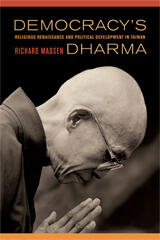
This is a CDDRL's Special Event within our Democracy in Taiwan Program. It is also co-sponsored by the Public Diplomacy/Emerging Publics Project of the Center for the Pacific Rim at University of San Francisco. In this seminar, Dr. Richard Madsen will talk about his new book that explores the religious renaissance that has reformed, revitalized, and renewed the practices of Buddhism and Daoism in Taiwan and how this religious renaissance embraces democracy modernity.  

Image
10896
Richard Madsen is distinguished professor and chair of the sociology department at the University of California, San Diego and a co-author (with Robert Bellah et al.) of The Good Society and Habits of the Heart which received the Los Angeles Times Book Award and was jury nominated for the Pulitzer Prize. He has authored or co-authored five books on China, including Morality and Power in a Chinese Village for which he received the C. Wright Mills Award; China's Catholics: Tragedy and Hope in an Emerging Civil Society; and China and the American Dream.  He also co-edited (with Tracy B. Strong) The Many and the One: Religious and Secular Perspectives on Ethical Pluralism in the Modern World. His latest book is Democracy’s Dharma: Religious Renaissance and Political Development in Taiwan.

Richard Madsen received an MA in Asian studies and a Ph.D. in sociology from Harvard.

"Madsen is a genial and well-informed guide, both to social-political change in Taiwan and to the ins and outs of religious movements. His engaging writing skillfully interweaves profound insights and themes into the descriptive analytical narrative. Democracy's Dharma presents new material based on recent research while offering a fresh spin on thinking about Asian religions."–Thomas Gold, editor of Social Connections in China: Institutions, Culture, and the Changing Nature of Guanxi

Philippines Conference Room

Richard Madsen Distinguished Professor Speaker Department of Sociology at the University of California, San Diego
Conferences
News Type
News
Date
Paragraphs
Larry Diamond has been appointed as a Senior Fellow in the Freeman Spogli Institute for International Studies (FSI). Currently a Senior Fellow at the Hoover Institution, a renowned scholar of democratization, and prolific in both editorial and policy work, Diamond is an active member of FSI’s Center on Democracy, Development, and the Rule of Law (CDDRL). He coordinates the Program on Democracy - Completed, which examines the comparative dynamics of democratic functioning and change in the contemporary world, with a particular focus on the countries of Africa, the Middle East, Asia, Latin America, and the post-communist world. He has also established the offshoot program, The Taiwan Democracy Project, in 2006, and is a central participant in the The Taiwan Democracy Project.

Primarily an Africanist, Diamond received his Ph.D. in Sociology from Stanford University in 1980. He currently serves as the co-director for the National Endowment for Democracy’s International Forum for Democratic Studies in Washington DC, as a member of U.S. Agency for International Development (USAID) Advisory Committee on Voluntary Foreign Aid, and as adviser and lecturer at the World Bank, the United Nations, and the U.S. Department of State. Previously he was senior adviser to the Coalition Provisional Authority in Iraq and consultant to USAID.

He is also founding co-editor of the Journal of Democracy, the premier journal in the field, and a co-director of the International Forum for Democratic Studies of the National Endowment for Democracy. He has an impressive record of public service, which includes numerous board memberships and government appointments, and he has published widely. In his prolific portfolio of books and papers, he has advanced the knowledge on the conceptualization, determinants, and importance of democracy by examining the relationship between development and democracy, the multidimensional nature of the democratization process, and the significance of democratic consolidation.

Diamond’s commitment and contributions to teaching are also reflected in his receipt of Stanford’s 2007 Lloyd W. Dinkelspiel Award for Distinctive Contributions to Undergraduate Education, a strong testament to the breadth and depth of his engagement at the University.
All News button
1
-

Lant Pritchett is Professor of the Practice of Economic Development at the Kennedy School of Government at Harvard University (as of July 1, 2007).

In addition he works as a consultant to Google.org, is a non-resident fellow of the Center for Global Development, and is a senior fellow of BREAD. He is also co-editor of the Journal of Development Economics.

He graduated from Brigham Young University in 1983 with a B.S. in Economics and in 1988 from MIT with a PhD in Economics.

After finishing at MIT Lant joined the World Bank, where he held a number of positions in the Bank's research complex between 1988 and 1998, including as an adviser to Lawrence Summers when he was Vice President 1991-1993. From 1998 to 2000 he worked in Indonesia. From 2000 to 2004 Lant was on leave from the World Bank as a Lecturer in Public Policy at the Kennedy School of Government at Harvard University. In 2004 he returned to the World Bank and moved to India where he worked until May 2007.

He has been part of the team producing many World Bank reports, including: World Development Report 1994: Infrastructure for Development, Assessing Aid: What Works, What Doesn't and Why (1998), Better Health Systems for Indias Poor: Findings, Analysis, and Options (2003), World Development Report 2004: Making Services Work for the Poor, Economic Growth in the 1990s: Learning from a Decade of Reforms (2005).

In addition he has authored (alone or with one of his 22 co-authors) over 50 papers published in refereed journals, chapters in books, or as articles, as least some of which are sometimes cited. In addition to economics journals his work has appeared in specialized journals in demography, education, and health. In 2006 he published his first solo authored book Let Their People Come.

Lant, an American national, was born in Utah in 1959 and raised in Boise Idaho. Perhaps because of this, he has worked in, or traveled to, over forty countries and has lived in three other countries: Argentina (1978-80), Indonesia (1998-2000), and India (2004-2007).

CISAC Conference Room

Lant Pritchett Professor, Practice of Economic Development at the Kennedy School of Government Speaker Harvard University
Seminars
-
The European Union has been described as "an economic giant but a political pygmy". Will its new Reform Treaty, currently being ratified by the member states, enable it to play a more powerful role in world affairs? 

Dick Leonard wrote the best-selling book, The Economist Guide to the European Union  (9 editions, translated into nine languages), widely recognised as the most authoritative guide to the EU.  A former British Member of Parliament, he has been covering the European Union as a Brussels-based journalist for over 25 years.

A former Assistant Editor of The Economist, he has also worked for the BBC and The Observer and has contributed to leading newspapers in the United States, Canada, Australia, India, Japan and New Zealand, as well as the Brussels-based publications, European Voice and The Bulletin. He was for many years a contributing editor of the Washington-based magazine, Europe.

Apart from his work as a journalist, he has been a Professor at Brussels University (ULB), a senior consultant to the Centre for European Policy Studies (CEPS), the well-known think tank, and European Advisor to the British publishing industry.

A long-term campaigner for British membership of the European Union, he was one of the minority of Labour MPs who voted in favour of British entry in 1971, despite the opposition of his party. During his time as an MP, he served as Parliamentary Private Secretary to Anthony Crosland, who was later Foreign Secretary.

Dick Leonard is the author or part-author of some 20 books, including Eminent Europeans, How to Win the Euro Referendum, Elections in Britain (five editions) and The Pro-European Reader, which he co-edited with his son, Mark Leonard. The ninth edition of his book, The Economist Guide to the European Union, published in 2005, has been widely and enthusiastically reviewed. Since then he has published the highly praised A Century of Premiers: Salisbury to Blair, to be followed by 19th British Century Premiers: Pitt to Rosebery, which will appear in May 2008.

A highly experienced broadcaster and public speaker, he has made five successful lecture tours in the United States and Canada, as well as lecturing regularly in London, Brussels and other European cities.

Richard and Rhoda Goldman Conference Room

Dick Leonard Journalist and author Speaker
Seminars
-
Teh-wei Hu is a Professor Emeritus of health economics at the University of California, Berkeley.  At Berkeley, he served as associate dean (1999-2002) and department chair (1990-1993) in the School of Public Health.  He received his PhD in Economics from the University of Wisconsin.  

During the past 40 years, Professor Hu has been teaching and conducting research in health economics, particularly in healthcare financing and the economics of tobacco control.  Hu was a Fulbright scholar in China. He has served as consultant or advisor to the World Bank, the World Health Organization, the National Institutes of Health, the Institute of Medicine, the Rand Corporation, the Ministry of Health in the People's Republic of China, Department of Health and Welfare in Hong Kong, Department of Health in the Republic of China (Taiwan), and many private research institutions and foundations. 

Professor Hu will speak to us immediately after an April trip to China, sharing his research and perspectives on the economics of tobacco control and the debate about healthcare system reforms in China (including a possible link between the two through financing expansions in coverage through increased tobacco taxation).

Philippines Conference Room

Teh-wei Hu Professor Emeritus Speaker University of California, Berkeley, School of Public Health
Seminars
Subscribe to Asia-Pacific