Read an excerpt of an address delivered by Larry Summers, the Charles W. Eliot University Professor at Harvard University, at the Stanford Institute for Economic Policy Research on February 19, 2019.
Didi Kuo joins Thomas Carothers<, senior Vice President for studies at the Carnegie Endowment for International Peace, in outlining the ways in which ideas, experiences, and lessons from other countries can magnify reform in the United States.
Larry Diamond explains to the American Interest that while democracy is not declining, developing countries are taking a turn for the worse. Read ithere.
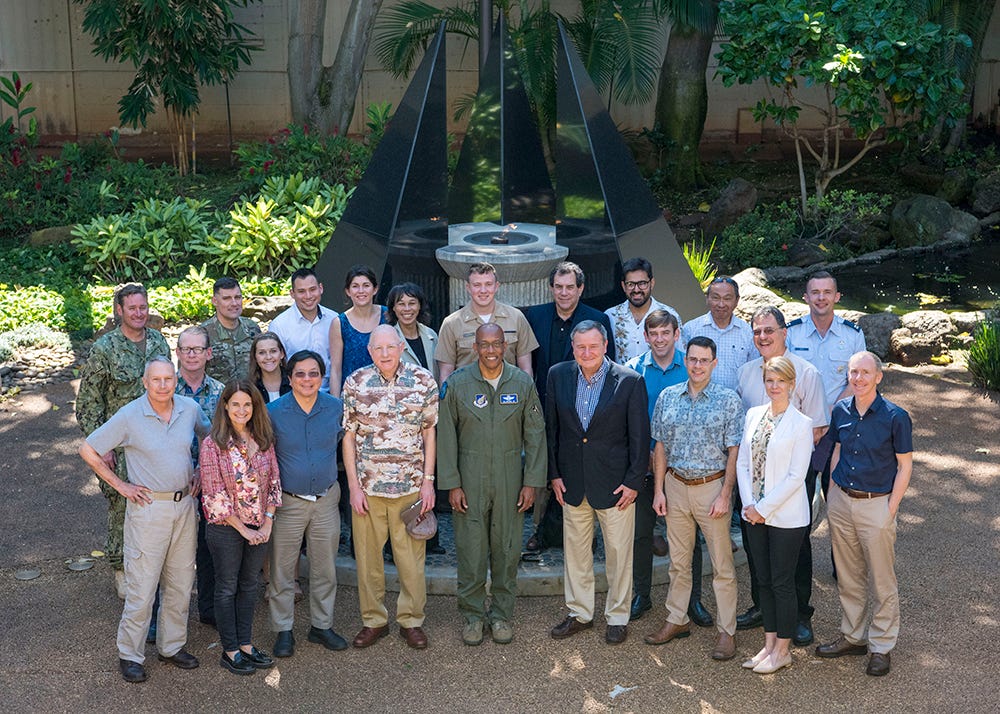
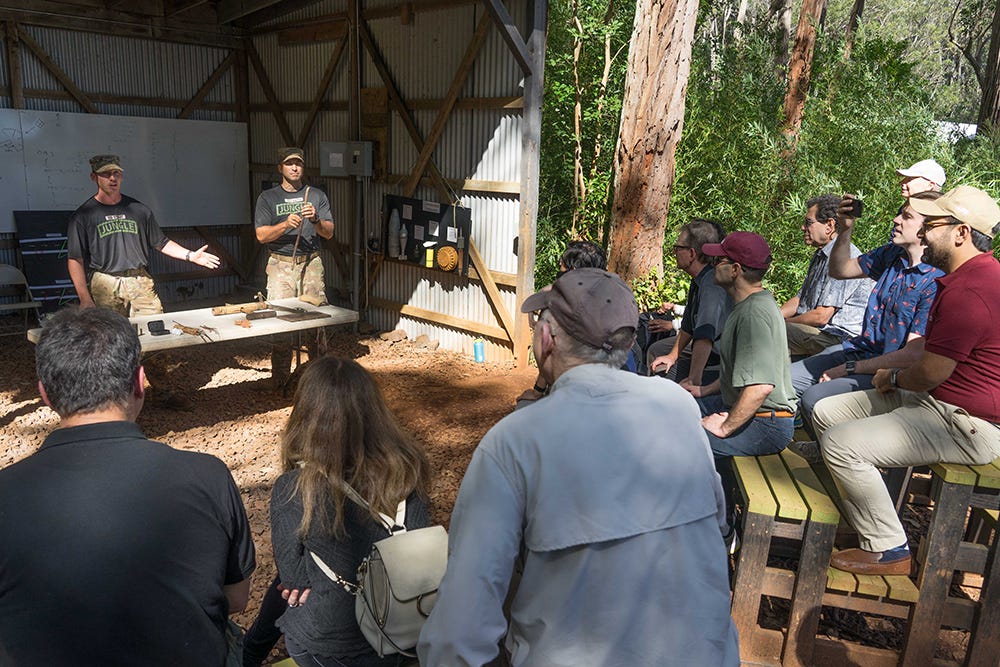
A group of 20 faculty and fellows participate in an orientation visit to Indo-Pacific Command headquarters, Honolulu, Hawaii, February 21–22, 2019, organized and sponsored by the U.S.-Asia Security Initiative. Photo courtesy of the U.S.-Asia Security Initiative
On February 21–22, faculty and fellows from Stanford University traveled to Oahu, Hawaii for an orientation visit at the United States Indo-Pacific Command (INDOPACOM), the U.S. military command responsible for the conduct of the U.S. military’s missions throughout the Indian and Pacific Oceans, and Asia.
The visit brought together scholars and researchers from Stanford, the Massachusetts Institute of Technology, the Council on Foreign Relations, and Macquarie University, Australia. Organized by the U.S.-Asia Security Initiative (USASI) and the Shorenstein Asia-Pacific Research Center at the Freeman Spogli Institute for International Studies (FSI), the visit included meetings with the commanders and staffs of INDOPACOM and five of its subordinate commands (U.S. Army Pacific, U.S. Pacific Fleet, U.S. Air Forces Pacific, U.S. Marine Forces Pacific, and U.S. Special Operations Command Pacific), and a tour of Arleigh Burke-class Aegis destroyer USS John Paul Jones (DDG-52).
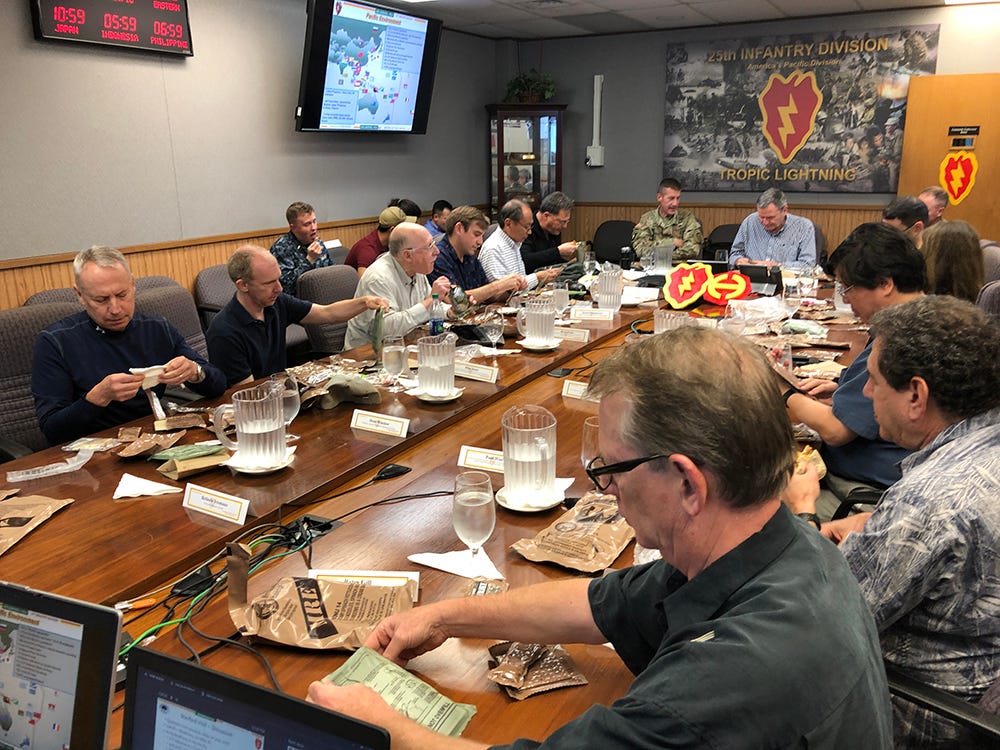
The visitors also interacted with the U.S. Army’s 25th Infantry Division’s leadership and the unit’s Jungle Training Center. The busy itinerary provided the group a superb opportunity to learn about INDOPACOM’s and its subordinate units’ threat assessments, capabilities, doctrine, regional partnerships, and readiness challenges.
These trips offer great access to America’s armed forces to those whose research focuses on or relates to national security issues, says Karl Eikenberry.
Karl Eikenberry, Director of the U.S.-Asia Security Initiative (USASI), a former U.S. ambassador to Afghanistan and himself a retired U.S. Army lieutenant general said: “USASI has over the past five years organized annual trips to U.S. military commands for Stanford FSI faculty and fellows. These trips offer great access to America’s armed forces to those whose research focuses on or relates to national security issues. The insights gained inform analysis, while the host organizations gain fresh perspectives different from those found within their commands.”
Photo courtesy of the U.S.-Asia Security Initiative
Discussions began on February 21st at Camp H.M. Smith, the Headquarters of INDOPACOM. Brigadier General Jonathan Braga, U.S. Army, SOCPAC Commander and his staff discussed his command’s unique capabilities and roles in both conventional and counterterrorist/counterinsurgency warfare operations. Major General Michael Minihan, U.S. Air Force, INDOPACOM Chief of Staff, then hosted a wide-ranging session on his organization’s implementation of the National Security Strategy and National Defense Strategy at a time of dynamic change within the region.
Photo courtesy of Timothy R. Mungie
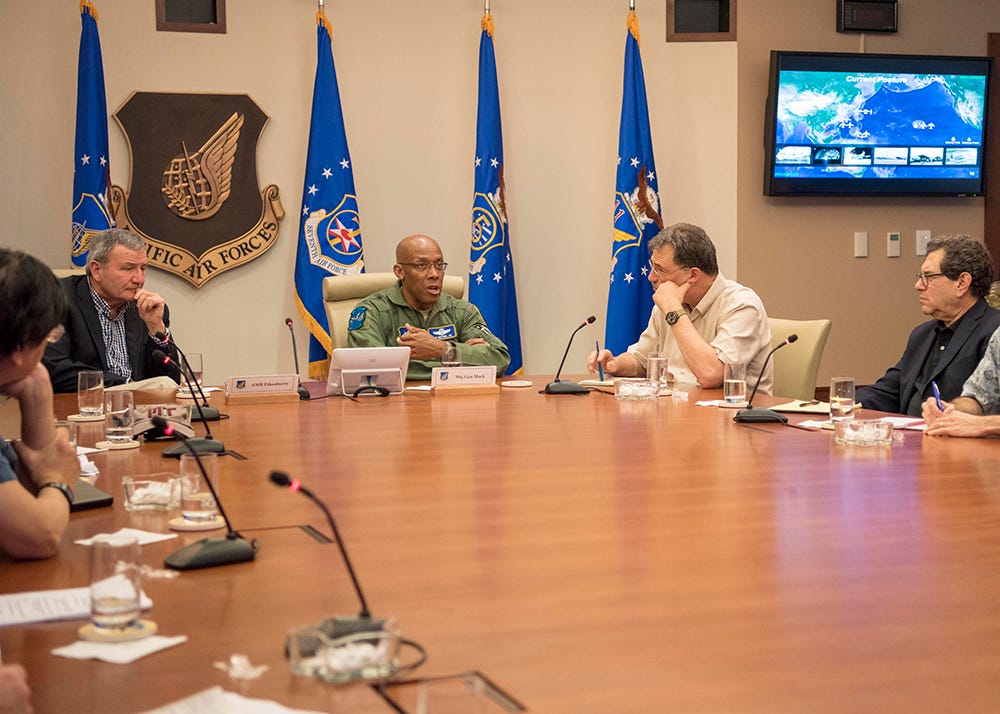
This was followed by a working lunch at the INDOPACOM Flag Mess with key staff members of MARFORPAC who explained U.S. Marine force posture and contingency missions throughout the Pacific Region. The Stanford group then proceeded to Hickam Field and met with General Charles Brown, Commander, PACAF, and his Deputy Commander, Major General Russell Mack. General Brown detailed the critical role played by airlift and airpower in the vast Indo-Pacific region, and the development of new concepts for the employment of U.S. Air Force capabilities in joint (inter-service) and combined (inter-allied) operations.
Photo courtesy of Timothy R. Mungie
The visiting faculty and fellows then transited to Pearl Harbor for a tour of USS John Paul Jones led by Commanding Officer, Commander Jesse Mink, United States Navy, and Executive Officer, Commander Robert Watts, USN. Noteworthy was the destroyer’s sophisticated integrated air, surface, and underseas warfare systems, and the emphasis placed on resilience in high-end combat situations. Following the ship tour, the group attended a PACFLT command briefing chaired by the Commander, Admiral John Aquilino.
The dialogue made clear PACFLT’s emphasis on a holistic approach to deterrence and decisive operations, with an eye on future requirements. The first day of the trip ended with a working reception at the historic “Nimitz House” hosted by Admiral Aquilino, offering the attendees a chance to engage in conversations with the Commander and his staff.
The second day of the trip began with an introduction to the Daniel K. Inouye Asia-Pacific Center for Security Studies (APCSS), followed by expert presentations and breakout sessions on select topics including the Chinese One Belt One Road plan, the security of Taiwan, pandemic threats in the Indo-Pacific region, and cyber operations. The Stanford team then traveled to Fort Shafter for a meeting with Brigadier General Pete Andrysiak, U.S. Army and Chief of Staff, USARPAC. BG Andrysiak and the USARPAC staff elaborated on the evolving U.S. Army’s regional doctrine and extensive partnership activities.
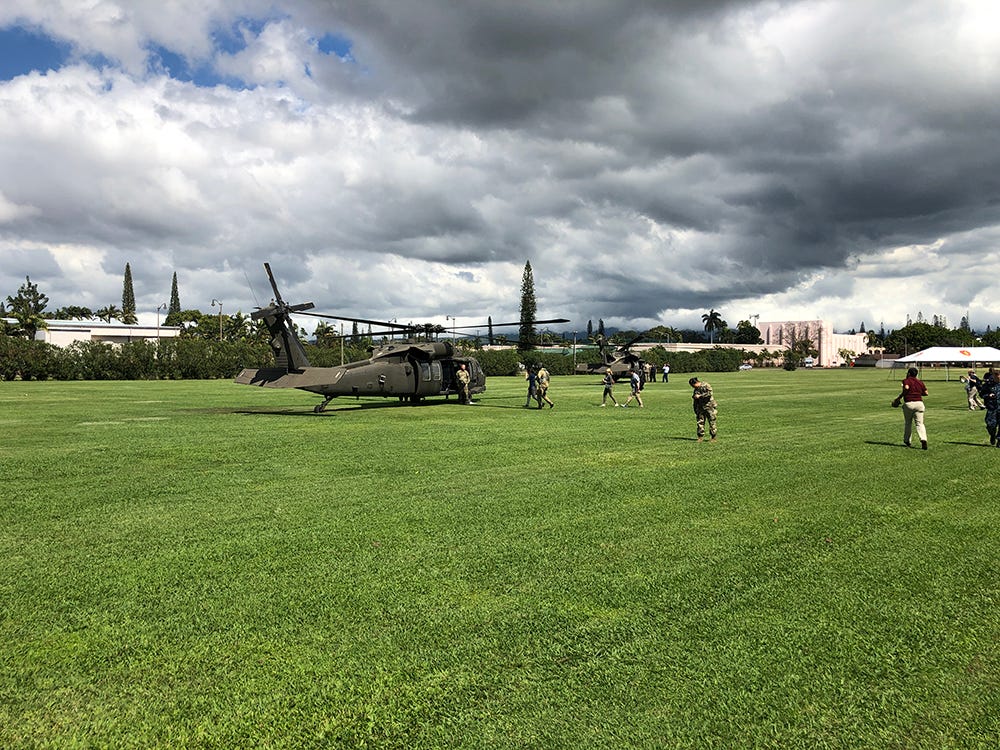
A highlight of the group’s time in Oahu came with a visit to the U.S. Army’s 25th Infantry Division at Schofield Barracks, and the 25th ID Jungle Training center via UH-60 Blackhawk Helicopters. There Brigadier General J.B. Vowell, Assistant Division Commander, 25th Infantry Division and U.S. Army Hawaii (himself a former FSI Senior Military Fellow), discussed the division’s extensive missions throughout the region, including in the Korean Peninsula.
Photo courtesy of Francis Fukuyama
Faculty and fellows were also able to “get their boots (or at least tennis shoes) muddy” in the U.S. Army’s rugged training area in northern Oahu, with highly skilled soldiers demonstrating jungle warfare tactics and techniques. The trip ended with the participants hosting a reception at the Hale Koa Hotel Warriors Lounge for their many hosts over the past two days.
The trip to INDOPACOM Headquarters provided a rare opportunity for participants to talk directly with senior U.S. military leaders in the most important region of the world and to gain a better understanding of their perspectives and the many challenges that they are addressing. Faculty and fellows interacted with junior leaders at the tactical level, helping them gain an appreciation of the ethos of those serving at the cutting edge. The hosts all commented on the benefit of learning the views of scholars, many of whom have spent their academic careers writing about national security issues.
The trip provided fascinating insights into how the U.S. military views the rapidly evolving national security challenges in the Indo-Pacific region, says Larry Diamond.
“The trip provided fascinating insights into how the U.S. military views the rapidly evolving national security challenges in the Indo-Pacific region, and how it is organized to defend against the threats. You can read about much of this in the media and the journals, but there is just no substitute for being there, seeing our facilities on the ground, and engaging directly with the remarkable men and women (and one thing that struck me is that there are quite a number of women) who are responsible for our defense,” said Larry Diamond, senior fellow at the Hoover Institution and at the Center on Democracy, Development & the Rule of Law (CDDRL) at FSI.
FSI scholars particularly valued the opportunity to connect one-on-one.
“It was invaluable to meet and hear directly from the individuals and organizations who are working so hard to ensure our security,” said Center for International Security and Cooperation (CISAC) Senior Research Scholar Megan Palmer. For CISAC Pre-doctoral Fellow Erik Lin-Greenberg, “the opportunity to interact with decision-makers from tactical to strategic levels was incredibly valuable and helped inform my own research.”
VALID STANFORD ID CARD MUST BE PRESENTED UPON ARRIVAL
ABSTRACT: The United States has been the world’s dominant power for more than a century. Now many analysts believe China is taking its place. Is China an emerging superpower? Should the United States gear up for a new cold war in Asia? In this seminar, I show that China actually lags far behind the United States by the most important measures of national wealth and power—and will probably fall further behind in the coming decades. The most likely threat to American security, therefore, is not a confident Chinese peer competitor, but a deeply insecure China that lashes out after failing to live up to the global hype about its rise. I will discuss how the United States can contain this threat without starting a cold or hot war with Beijing.
Image
PROFILE: Michael Beckley is an assistant professor of political science at Tufts University and a fellow at Harvard's Kennedy School of Government. His research focuses on the rise of China and has received “best article” awards from the American Political Science Association and the International Studies Association and has been featured by numerous media, including CNN, Fox News, the Financial Times, the New York Times, NPR, and the Washington Post. Previously, Professor Beckley worked at the U.S. Department of Defense, the RAND Corporation, and the Carnegie Endowment for International Peace. He currently consults for the Pentagon’s Office of Net Assessment, the Joint Staff, and the National Intelligence Council. He holds a PhD in political science from Columbia University and his first book, Unrivaled: Why America Will Remain the World’s Sole Superpower, was published last fall by Cornell University Press. Part of his talk is based on a Foreign Affairs web article that was named one of the ten “best of 2018.”
Michael Beckley
Assistant Professor of Political Science Tufts University
This event is open to Stanford undergraduate students only.
The Center on Democracy, Development, and the Rule of Law (CDDRL) is currently accepting applications from eligible juniors due February 15, 2019 who are interested in writing their senior thesis on a subject touching upon democracy, economic development, and rule of law (DDRL) from any university department. CDDRL faculty and current honors students will be present to discuss the program and answer any questions.
For more information on the Fisher Family CDDRL Honors Program, please click here.
CDDRL
Encina Hall, C152
616 Jane Stanford Way
Stanford, CA 94305-6055
(650) 725-2705
(650) 724-2996
0
sstedman@stanford.edu
Senior Fellow at the Freeman Spogli Institute for International Studies
Professor, by courtesy, of Political Science
Stedman_Steve.jpg
PhD
Stephen Stedman is a Senior Fellow at the Freeman Spogli Institute for International Studies (FSI) and the Center on Democracy, Development and the Rule of Law (CDDRL), an affiliated faculty member at CISAC, and professor of political science (by courtesy) at Stanford University. He is director of CDDRL's Fisher Family Honors Program in Democracy, Development and Rule of Law, and will be faculty director of the Program on International Relations in the School of Humanities and Sciences effective Fall 2025.
In 2011-12 Professor Stedman served as the Director for the Global Commission on Elections, Democracy, and Security, a body of eminent persons tasked with developing recommendations on promoting and protecting the integrity of elections and international electoral assistance. The Commission is a joint project of the Kofi Annan Foundation and International IDEA, an intergovernmental organization that works on international democracy and electoral assistance.
In 2003-04 Professor Stedman was Research Director of the United Nations High-level Panel on Threats, Challenges and Change and was a principal drafter of the Panel’s report, A More Secure World: Our Shared Responsibility.
In 2005 he served as Assistant Secretary-General and Special Advisor to the Secretary- General of the United Nations, with responsibility for working with governments to adopt the Panel’s recommendations for strengthening collective security and for implementing changes within the United Nations Secretariat, including the creation of a Peacebuilding Support Office, a Counter Terrorism Task Force, and a Policy Committee to act as a cabinet to the Secretary-General.
His most recent book, with Bruce Jones and Carlos Pascual, is Power and Responsibility: Creating International Order in an Era of Transnational Threats (Washington DC: Brookings Institution, 2009).
Director, Fisher Family Honors Program in Democracy, Development and Rule of Law
Director, Program in International Relations
Affiliated faculty at the Center for International Security and Cooperation
Encina Hall, C150
616 Jane Stanford Way
Stanford, CA 94305
0
jdkuo@stanford.edu
Center Fellow, Freeman Spogli Institute for International Studies
didi_kuo_2023.jpg
Didi Kuo is a Center Fellow at the Freeman Spogli Institute for International Studies (FSI) at Stanford University. She is a scholar of comparative politics with a focus on democratization, corruption and clientelism, political parties and institutions, and political reform. She is the author of The Great Retreat: How Political Parties Should Behave and Why They Don’t (Oxford University Press) and Clientelism, Capitalism, and Democracy: the rise of programmatic politics in the United States and Britain (Cambridge University Press, 2018).
She has been at Stanford since 2013 as the manager of the Program on American Democracy in Comparative Perspective and is co-director of the Fisher Family Honors Program at CDDRL. She was an Eric and Wendy Schmidt Fellow at New America and is a non-resident fellow with the Carnegie Endowment for International Peace. She received a PhD in political science from Harvard University, an MSc in Economic and Social History from Oxford University, where she studied as a Marshall Scholar, and a BA from Emory University.
the Center on Democracy, Development and the Rule of Law
Indonesia features Southeast Asia’s most vibrant and dynamic democracy, but debilitating institutional dysfunctions persist. Age-old patronage-style practices remain commonplace, despite voter demands for governance reform. In effect, two mutually incompatible systems operate simultaneously: the rule of law on the one hand—“Ruler’s Law” on the other. The disarray provides space for mafias and Islamist fringe groups to wield clout. The contradiction tends to deter investment that Indonesia sorely needs in order to escape a “middle-income trap.” What are the prospects for change in the April 2019 national elections? Join the Indonesia political analyst Kevin O’Rourke for a presentation and discussion of poll data, political trends, and potential post-2019 scenarios in the world’s fourth most populous country.
Image
Kevin O’Rourke’s Reformasi Weekly analyzes politics and policy-making for organizations operating in Indonesia. Subscribers include embassies, NGOs, universities, and companies. His firm, Reformasi Information Services, provides political risk consulting and customized research. His latest publication, 2019 Election Primer: Players, Playing Field and Scenarios (Nov. 2018), reviews in detail the rules, issues, and possible results of the country’s nationwide elections in April 2019. Earlier writings include Who’s Who in Yudhoyono’s Indonesia (2010) and Reformasi: The Struggle for Power in Post-Soeharto Indonesia (2002). Kevin started his career in Indonesia in 1994 as an equity research analyst. He is a graduate of Harvard University with an honors degree in government.
The following report was originally published by the Hoover Institution.
Scholars from the Hoover Institution, the Freeman Spogli Institute for International Studies, and other organizations today issued a report that examines China’s efforts to influence US institutions and calls for protecting American values, norms, and laws from such interference, while also warning against “demonizing” any group of people.
According to the 192-page document, which was unveiled today (Nov. 29) at a Hoover DC press event, China is attempting on a wide scale to manipulate state and local governments, universities, think tanks, media, corporations, and the Chinese American community. (Click here to read the report, titled “Chinese Influence & American Interests: Promoting Constructive Vigilance.”)
The document was produced by researchers convened by the Hoover Institution and the Asia Society’s Center on US-China Relations, along with support from The Annenberg Foundation Trust at Sunnylands. The working group included leading China scholars who researched the issue for more than a year and a half. Project cochairs are Larry Diamond, senior fellow at the Freeman Spogli Institute for International Studies and the Hoover Institution, and Orville Schell, the Arthur Ross Director at Asia Society Center on US-China Relations.
The objective of the Chinese entities is to promote sympathetic views of China, especially its government, policies, society and culture, the report concludes. The work is described as a “summons to greater awareness of the challenges our country faces and greater vigilance in defending our institutions,” and explicitly not intended to cause unfairness or recklessness towards any group of Americans.
On this point, Diamond and Schell wrote in the afterword, “At the same time that we fortify ourselves against harmful outside interference, we must also be mindful to do no harm. In particular, we must guard against having this report used unfairly to cast aspersions on Chinese, whether Chinese American immigrants who have become (or are becoming) United States citizens, Chinese students, Chinese businesspeople, or other kinds of Chinese visitors, whose contributions to America’s progress over the past century have been enormous.”
The report’s findings include the following:
The Chinese Communist party-state leverages a broad range of party, state, and non-state actors to advance its influence-seeking objectives, and in recent years it has significantly accelerated both its investment and the intensity of these efforts.
In American federal and state politics, China seeks to identify and cultivate rising politicians. Chinese entities employ prominent lobbying and public relations firms and cooperate with influential civil society groups.
On American university campuses, Confucius Institutes provide the Chinese government access to US student bodies, and Chinese Students and Scholars Associations sometimes report on their compatriots on American campuses and put pressure on American universities that host events deemed politically offensive to China.
At think tanks, researchers, scholars, and other staffers report regular attempts by Chinese diplomats and other intermediaries to influence their activities within the United States. China has also begun to establish its own network of US think tanks.
In business, China is using its companies to advance strategic objectives abroad, gaining political influence and access to critical infrastructure and technology. China has made foreign companies’ continued access to its domestic market conditional on their compliance with Beijing’s stance on Taiwan and Tibet.
In the technology sector, China is engaged in a multifaceted effort to misappropriate technologies it deems critical to its economic and military success. Beyond economic espionage, theft, and the forced technology transfers that are required of many joint venture partnerships, China also captures much valuable new technology through its investments in US high-tech companies and by exploiting the openness of the American economy.
In the American media, China has all but eliminated independent Chinese-language media outlets that once served Chinese American communities. It has co-opted existing Chinese-language outlets and established its own new media outlets.
Policy principles
Looking to the future, the scholars offer a set of policy principles for guiding American relationships with Chinese entities. These include:
promoting greater transparency of financial and other relationships that with Chinese entities which may be subject to improper influence;
promoting the integrity of American institutions; and
seeking greater reciprocity for American institutions to operate in China to an extent commensurate with Chinese institutions’ ability to operate in the United States.
For example, the report urges that the US media should undertake careful, fact-based investigative reporting of Chinese influence activities, and it should enhance its knowledge base for undertaking responsible reporting. Also, Congress should perform its constitutional role by continuing to investigate, report on, and recommend appropriate action concerning Chinese influence activities in the United States.
However, the report should not be viewed as an invitation to a McCarthy era-like reaction against Chinese in America, the researchers noted.
“We reiterate: it is absolutely crucial that whatever measures are taken to counteract harmful forms of Chinese influence seeking not end up demonizing any group of Americans, or even visitors to America, in ways that are unfair or reckless,” wrote Diamond and Schell.
The emergence of a global digital ecosystem has been a boon for global communication and the democratization of the means of distributing information. The internet, and the social media platforms and web applications running on it, have been used to mobilize pro-democracy protests and give members of marginalized communities a chance to share their voices with the world. However, more recently, we have also seen this technology used to spread propaganda and misinformation, interfere in election campaigns, expose individuals to harassment and abuse, and stir up confusion, animosity and sometimes violence in societies. Even seemingly innocuous digital technologies, such as ranking algorithms on entertainment websites, can have the effect of stifling diversity by failing to reliably promote content from underrepresented groups. At times, it can seem as if technologies that were intended to help people learn and communicate have been irreparably corrupted. It is easy to say that governments should step in to control this space and prevent further harms, but part of what helped the internet grow and thrive was its lack of heavy regulation, which encouraged openness and innovation. However, the absence of oversight has allowed dysfunction to spread, as malign actors manipulate digital technology for their own ends without fear of the consequences. It has also allowed unprecedented power to be concentrated in the hands of private technology companies, and these giants to act as de facto regulators with little meaningful accountability. So, who should be in charge of reversing the troubling developments in our global digital spaces? And what, if anything, can be done to let society keep reaping the benefits of these technologies, while protecting it against the risks?
The two-day forum, part of a project of the American Academy of Arts and Sciences, led by the Freeman Spogli Institute’s Karl Eikenberry and Stephen Krasner, gathered experts to examine trends in civil wars and solutions moving forward.
Image
The Council on Foreign Relations presently tracks six countries in a state of civil war, including three (South Sudan, Afghanistan, and Yemen) where the situation is currently worsening. Furthermore, three states (Central African Republic, Myanmar, and Nigeria) are experiencing sectarian violence with the potential to become larger conflicts. With two months still remaining in 2018, the combined fatalities in Afghanistan, Syria, and Yemen alone is fast approaching 100,000 for the year.
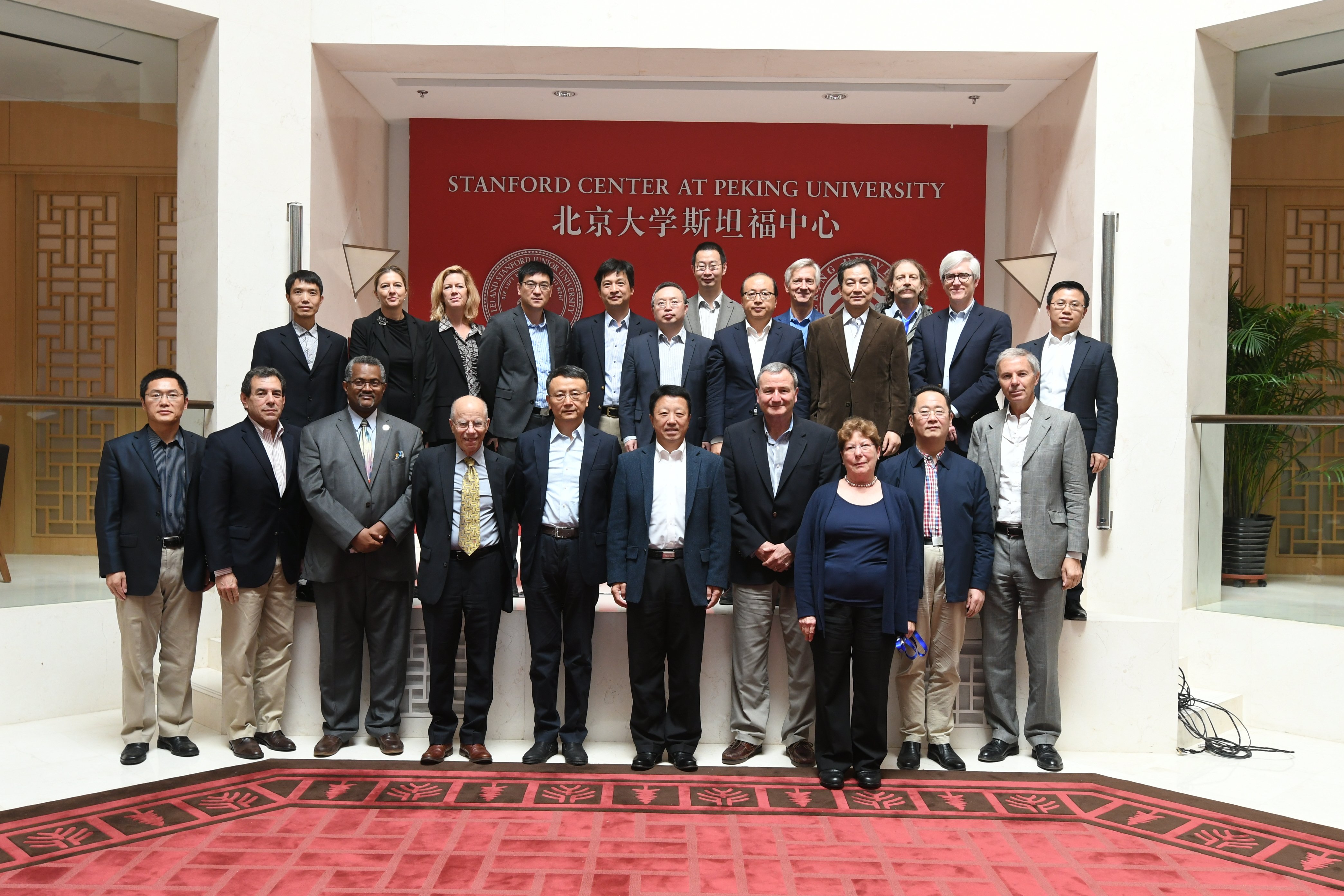
It was against this backdrop that Shorenstein APARC’s U.S.-Asia Security Initiative (USASI), the American Academy of Arts and Sciences (AAAS), and the School for International Studies at Peking University recently co-hosted the security workshop “Civil Wars, Intrastate Violence, and International Responses.” Held in Beijing, on October 22-23, the workshop brought together thirty-five U.S. and international experts to gain a wider perspective on intrastate violence and consider the possibilities for, and limits of, intervention. The workshop is the latest activity of the AAAS project on Civil Wars, Violence, and International Responses, chaired by Ambassador Karl Eikenberry, director of USASI, and by Stephen Krasner, senior fellow at the Freeman Spogli Institute for International Studies (FSI) and professor of international relations.
“Some of the major discussion topics included the appropriate political and economic development models to apply to fragile states recovering from internal conflict, justifications for intervention, and the likely impact of great power competition on the future treatment of civil wars." - Karl Eikenberry
Workshop participants included academics and professionals with expertise in political science, global health, diplomacy, refugee field work, United Nations, and the military. Countries represented at the table included the United States, Ethiopia, France, and China. Throughout the two-day session, they examined three crucial questions: What is the scope of intrastate conflicts and civil wars, and to what extent is it attributable to domestic or international factors? What types of threats to global security emanate from state civil wars? What policy options are available to regional powers and the international community to deal with such threats?
Image
USASI Director Karl Eikenberry addresses one of the sessions
China’s Emerging Role in Addressing Intrastate Violence
The workshop’s timing and location was prescient. Over the past two decades, China’s global exposure–through trade, investment, and financing–has increased dramatically. Coupled with a growing number of its citizens living abroad, China’s equity in other states has reached the point where it has a direct interest in those experiencing or are at risk of political instability and internal violence. Indeed, through its ambitious Belt and Road Initiative, China has the opportunity to help stabilize fragile states by stimulating economic development.
“The workshop revealed, at least for me, that China is backing away from its absolute defense of sovereignty and non-intervention,” said Stephen Krasner. “As Chinese interests have expanded around the world, and as both its investments and the number of its citizens living abroad have increased, the Chinese have become more concerned with political conditions in weakly governed countries.”
With China’s growing policy and academic interests in addressing civil wars and intrastate violence, as well as its higher international profile in places like United Nations peacekeeping operations, the Beijing event provided an excellent opportunity for Chinese experts to exchange views with their international colleagues.
The Beijing workshop was arranged into four sessions, with themes focusing on trends in intrastate violence, the threats it poses to international security, the limits of intervention, and advice to policymakers.
Each panel included presentations of prepared papers, moderator comments, and an open discussion by all participants. A fifth and final session provided an opportunity to summarize the preceding discussions. The workshop then closed out with an open conversation, where participants offered insight and policy recommendations developed over the preceding two days of dialogue.
Image
“The workshop,” observed Martha Crenshaw (shown above), a Senior Fellow at FSI, “was a unique opportunity to exchange views with Chinese colleagues on the subject of civil conflict in the contemporary world. A valuable learning experience for all of us."
The "Civil Wars, Intrastate Violence, and International Responses” workshop marks the second phase of the AAAS project by the same name that launched in 2015. The first phase of the project culminated in the publication of 28 essays across two volumes of the AAAS quarterly journal Dædalus. The ongoing second phase consists of a series of roundtables and workshops in which project participants engage with academics and with government and international organization officials to build a larger conceptual understanding of the threats posed by the collapse of state authority associated with civil wars, and to contribute to current policymaking. Project activities have included meetings with the United Nations leadership and staff; academic activities in the United States; sessions with the U.S. executive and legislative branches; and a visit to Nigeria.
Throughout the workshop, Chatham House Rule of non-attribution applied to all dialogue. A workshop report will be published by the co-hosts in early 2019.
The U.S.-Asia Security Initiative is part of Stanford University’s Walter H. Shorenstein Asia-Pacific Research Center (APARC). Led by former U.S. Ambassador and Lieutenant General (Retired) Karl Eikenberry, USASI seeks to further research, education, and policy relevant dialogues at Stanford University on contemporary Asia-Pacific security issues.