


The Heart of the Matter: The Humanities and Social Sciences for a Vibrant, Competitive and Secure Nation
Related Multimedia
Talk by ballroom dancing legend Pierre Dulaine
-
Abstract:
Ballroom dancing legend Pierre Dulaine will discuss his 'Dancing Classrooms' method which he applied in his award winning documentary 'Dancing in Jaffa' to bring Arab and Jewish children together through dance. Mr. Dulaine will speak about the film, his journey into the world of dance and his experience as a Judge on the Arabic version of the TV show 'So You Think You Can Dance.' Talk features audio-visual presentation and free lunch.
Speaker Bio:
Image
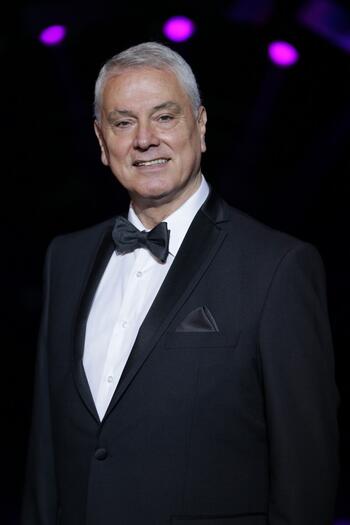
Pierre Dulaine was born in Jaffa, Palestine in 1944 to an Irish father and a Palestinian mother--both of whom fled the area in 1948. After eight months of moving several times, Dulaine's family settled in Amman, Jordan. In 1956, the Suez Crisis forced Dulaine's parents to flee the country, eventually resettling in Birmingham, England. In 1994 Dulaine founded the Dancing Classrooms program in New York City's public schools in which he encouraged children from various backgrounds to dance together. He later traveled to the city of his birth, Jaffa, to visit his childhood home and to make a film, 'Dancing in Jaffa,' where he brought Israeli Arabs and Jews together through dance and music. His life was also fictionalized in the film Take the Lead starring Antonio Banderas. More recently, Pierre Duaine has gained much acclaim in the Arab world for his role as Judge on the Arabic version of the TV show 'So You Think You Can Dance' where he encouraged young Arab men and women to pursue dance as way of dealing with difficult circumstances and certain outdated social
(See flyer for a list of the co-sponsors)
Note: A screening of 'Dancing in Jaffa' will take place on campus on May 29. For more information, click here.
[[{"fid":"218684","view_mode":"crop_870xauto","fields":{"format":"crop_870xauto","field_file_image_description[und][0][value]":"PD flyer","field_file_image_alt_text[und][0][value]":"","field_file_image_title_text[und][0][value]":"","field_credit[und][0][value]":"","field_caption[und][0][value]":"","field_related_image_aspect[und][0][value]":"","thumbnails":"crop_870xauto","pp_lightbox":false,"pp_description":false},"type":"media","attributes":{"height":1344,"width":870,"class":"media-element file-crop-870xauto"}}]]
Stanford Language Center,
Building 30-102,
Stanford, CA
Pierre Dulaine
Lectures
Paul Amar examines social militarization in Egypt and Brazil [VIDEO]
News Type
Commentary
Date
Paragraphs
As part of the Arab Reform and Democracy Program's speaker series, UC Santa Barbara Political Scientist Paul Amar discussed his book The Security Archipelago, winner of the 2014 Charles Taylor Book Award of the American Political Science Association. The book provides an alternative historical and theoretical framing of the refashioning of free-market states and the rise of humanitarian security regimes in the Global South by examining the pivotal, trendsetting cases of Brazil and Egypt. Addressing gaps in the study of neoliberalism and biopolitics, Amar describes how coercive security operations and cultural rescue campaigns confronting waves of resistance have appropriated progressive, antimarket discourses around morality, sexuality, and labor. Homing in on Cairo and Rio de Janeiro, Amar reveals the innovative resistances and unexpected alliances that have coalesced in new polities emerging from the Arab Spring and South America's Pink Tide. These have generated a shared modern governance model that he terms the "human-security state."
Hero Image

All News button
1
War on Gaza in the Age of Human Rights: Prospects for Accountability
-
Abstract:
In July and August, hostilities in the Gaza Strip left 2,131 Palestinians and 71 Israelis dead, including 501 Palestinian children and one Israeli child. Of Gaza’s 1.8 million residents, 475,000 are living in temporary shelters or with other families because their homes have been severely damaged. The extent of destruction has raised questions around culpability for war crimes on all sides of the conflict. International organizations including the United Nations Human Rights Council, Amnesty International and Human Rights Watch have called for independent investigation. At the end of 2014, Palestine deposited a 12(3) application to the ICC for ad-hoc jurisdiction as well as acceded to the Rome Statute, thus granting the International Criminal Court the authority to investigate war crimes conducted in Palestinian territory. Such an investigation would bring both Israel and Palestine under scrutiny for events from this summer and as far back as 2012, and possibly to 2002 when the ICC was first formed to investigate war crimes. This is the third large scale military offensive against the besieged coastal enclave since Israel’s unilateral disengagement in 2005. Given the shortcomings of the ceasefire on August 26, 2014, another attack is seemingly inevitable. How is such civilian carnage possible notwithstanding the humanitarian and human rights legal regimes established to reduce civilian suffering? And what are the prospects for accountability under international criminal law and beyond? This lecture will explore these questions and specifically the prospects for accountability at the ICC.
Speaker Bio:
Image

Noura Erakat is a human rights attorney, activist, and an Assistant Professor at George Mason University. Her scholarship investigates the laws of war, human rights, refugee law, and national security. She is a Co-Editor of Jadaliyya, an electronic magazine that leverages scholarly expertise and local knowledge on the Middle East. She has taught International Human Rights Law and the Middle East at Georgetown University since Spring 2009 and before beginning at George Mason University, she was a Freedman Teaching Fellow at Temple University, Beasley School of Law. She has served as Legal Counsel for a Congressional Subcommittee in the House of Representatives, chaired by Congressman Dennis J. Kucinich. She helped to initiate and organize several national formations including Arab Women Arising for Justice (AMWAJ) and the U.S. Palestinian Community Network (USPCN). While an undergraduate student at UC Berkeley, Noura helped launch the first university divestment campaign at UC Berkeley in 2001 and upon graduating from Berkeley Law School, she helped seed BDS campaigns throughout the country uas the National Organizer with the US Campaign to End the Israeli Occupation. There, she also helped initiate federal lawsuits in the U.S. against Israeli officials in for war crimes and crimes against humanity. She has lived and worked throughout the Middle East including as part of a legal fact-finding delegation to the Gaza Strip in the aftermath of Israel’s Winter 2008/09 onslaught and spent the Spring 2010 academic semester in Beirut, Lebanon as a Visiting Scholar at the American University in Beirut. Noura has appeared on PBS News Hour, BBC World Service, NPR’s “To The Point,” MSNBC's "Up With Chris Hayes," Fox’s “The O’ Reilly Factor,” NBC’s “Politically Incorrect,” Democracy Now, and Al-Jazeera Arabic and English. Her non-scholarly publications have appeared in the New York Times, USA Today, the Los Angeles Review of Books, The Nation, Huffington Post, and Foreign Policy among others. Most recently, she co-published an anthology entitled Aborted State? The UN Initiative and New Palestinian Junctures.
This event is co-sponsored by the Sohaib and Sara Abbasi Program in Islamic Studies.
[[{"fid":"218623","view_mode":"crop_870xauto","fields":{"format":"crop_870xauto","field_file_image_description[und][0][value]":"Noura Erakat flyer","field_file_image_alt_text[und][0][value]":"","field_file_image_title_text[und][0][value]":"","field_credit[und][0][value]":"","field_caption[und][0][value]":"","field_related_image_aspect[und][0][value]":"","thumbnails":"crop_870xauto","pp_lightbox":false,"pp_description":false},"type":"media","attributes":{"width":"870","class":"media-element file-crop-870xauto"}}]]
Okimoto Conference Room
3rd Floor East Wing
Encina Hall
616 Serra Street
Stanford, California 94305
Noura Erakat
Assistant Professor
George Mason University
Seminars
Israeli election results reflect deep divisions in that society, say Stanford scholars
News Type
News
Date
Paragraphs
 Israel's next chapter awaits the fallout from a contentious election unrivaled in that country's history, say Stanford faculty experts.
Benjamin Netanyahu's center-right Likud party won a narrow victory this week over its principal rival, the center-left Zionist Union. The next step is for Netanyahu to form a coalition government after an election characterized by heated rhetoric and issues of existential importance to Israel.
Russell Berman, a Stanford professor of German studies and of comparative literature, said that Netanyahu's nearly single-minded focus on security issues won him votes that would have otherwise gone to smaller right-wing parties.
"The conservative political spectrum, in total, fared less well than it did in the previous election, although Likud now emerges as the uncontested leader of that camp," said Berman.
He said the center-left spectrum suffered from candidates without charisma as well as a split among its multiple parties: "Beyond this partisan political arithmetic, it is clear that security concerns were the key to the election and Netanyahu articulated them more effectively than his competition."
As for Israel's stance against Iran's nuclear program, Berman said that the real issue is not Israel's stance but America's strategy in the Middle East.
"The consistent U.S. policy of reducing its footprint throughout the region has caused regional actors to begin to behave differently with greater attention to their own security. The real question is whether giving up on Pax Americana will also mean giving up on Pax," said Berman, the Walter A. Haas Professor in the Humanities and a senior fellow at the Hoover Institution and the Freeman Spogli Institute for International Studies.
He explained that during the Cold War, some Europeans doubted the credibility of the American nuclear shield, asking whether the United States would risk nuclear war with Russia in order to defend West Germany. Recent events in Ukraine have revived these concerns in the Baltic states and Poland, he added.
"This lesson is not lost in Israel, as Iran acquires enrichment capacity, all the while expanding its ballistic missile capacity," he said.
Berman believes the Israeli elections have had no impact on the possible reality of a nuclear Iran. "If Isaac Herzog [from the Zionist Union] had won, the Iranian nuclear enrichment would not have disappeared."
Political, religious, social divisions
This was arguably the most contentious election in Israel's history, said Reut Itzkovitch-Malka, a visiting scholar at Stanford's Center on Democracy, Development and the Rule of Law. A researcher from the Israel Institute, she studies political representation, gender and politics, political parties and elections.
"It means more of the same," said Itzkovitch-Malka, referring to the Netanyahu victory. "He has no reason and no incentive to change his policy, especially in regard to Iran. This is an issue he feels very strongly about, as well as one which, most likely, bought him some of the electoral revenues he got."
Depending on how the nuclear talks with Iran progress, she said, this could become a substantial problem for Israel, one with serious implications for the U.S.-Israel relationship.
The election exposed serious fault lines in Israeli society between the religious and the secular, and the right and the left, said Itzkovitch-Malka. She said Israel is composed of different social groups with distinct national, communal and religious elements.
"Group identities that are prominent in national politics reflect the rifts between Jewish and Arab citizens, between religious [Orthodox] and non-religious Jews; and between Ashkenazi Jews [whose origins are in Europe] and Mizrahi Jews [whose origins are in North Africa and Asia]," she said.
In the last two decades, Israeli society has become more fragmented than ever, said Itzkovitch-Malka. Some of the recent campaign rhetoric reflected an "us or them" mentality, portraying the other side as demonic and destructive for Israeli society, she said. Racism against Arabs was also used in the politicking, she said.
And so, domestic and economic issues have almost taken a backseat to the focus on security and group-minded politics, said Itzkovitch-Malka.
"To some extent, it is hard or even impossible to talk about a common feeling or common mood, given the deep divisions in Israeli society," she said. The country's pressing concerns are the Palestinian issue, the growing cost of living, the deepening social cleavages and racism, she noted.
Two-state solution?
Stephen Krasner, Stanford's Graham H. Stuart Professor of International Relations and a senior fellow at the Freeman Spogli Institute for International Studies, said that Netanyahu's apparent rejection of a two-state solution for now is a tactical mistake.
"Even if a two-state agreement is not likely, there is nothing else on offer for now, and Israel loses nothing by keeping it on the table but risks alienating international support if it takes it off the table," he said.
Krasner said the outlines of a two-state solution have been on the table at least since the Camp David meetings at the end of the Clinton administration.
"The fundamental impediment to reaching this settlement has been spoilers, especially but not exclusively on the Palestinian side, and the involvement of external actors," he said.
Krasner said he believes it would not be hard for the Israelis and the Palestinians to come to an agreement if "somehow the area between the Jordan River and the Mediterranean Sea could be isolated from the rest of the world."
As it stands now, it is much harder to reach a two-state solution agreement since neither side is able to assess its relative power, he noted.
In regard to the Iranian nuclear issue, Krasner described it as a threat to the stability of the Middle East and the world: "The only durable solution is regime change in Iran but this can only come from within Iran. It may or may not happen."
Hero Image

All News button
1
LAD Case Studies
The case studies below are integral teaching tools for the Leadership Academy for Development workshops conducted around the world.
Sheila Carapico examines the paradoxes of political aid in the Arab world [VIDEO]
News Type
Commentary
Date
Paragraphs
As part of the Arab Reform and Democracy Program's speaker series, University of Richmond Political Scientist Sheila Carapico discussed findings from her ground-breaking study Political Aid and Arab Activism: Democracy Promotion, Justice, and Representation (Cambridge University Press, 2013) which explores two decades’ worth of projects sponsored by American, European, and other transnational agencies in four key sub-fields: the rule of law, electoral design and monitoring, female empowerment, and civil society. European and US-based scholars and practitioners have debated the purposes and sometimes the (limited) macro-effects of programs designed to promote transitions from authoritarianism to democracy in Middle East countries. Yet this discussion often lacks analysis of on-the-ground experiences or ignores the cumulative wisdom of local counterparts and intermediaries. Carapico discussed controversies and contradictions surrounding projects in Egypt, Palestine, and Iraq (the three main cases) and Jordan, Morocco, Yemen, Algeria, Tunisia, and Lebanon (where democracy brokers also work) to help explain why so many feminists and other advocates for justice, free elections, and civic agency concluded that foreign funding is inherently political and paradoxical.
Hero Image

All News button
1
Diamond: Facing up to the democratic recession
News Type
News
Date
Paragraphs
In the 25th anniversary edition of The Journal of Democracy, CDDRL Director Larry Diamond reflects on the current democratic recession and why this trend is so troubling.
Diamond, who serves as the founding co-editor of The Journal of Democracy, argues that the world is in a mild but protracted democratic recession, which raises alarm due to the rate of democratic failures and where they are occurring. In surveying global empirical trends, Diamond cites 25 breakdowns of democracy since 2000 that were not the cause of military coups but rather the slow erosion of democratic rights and procedures.
Another worrisome trend for Diamond is the declining freedom in a number of countries and regions since 2005. This is most notable in Africa where corruption and the abuse of power are leading to the decline of the rule of law and political rights across the region. It is also affecting countries of global strategic importance with large populations and economic influence– from Taiwan to Mexico – and leading to the resurgence of authoritarianism in Russia and China. Diamond also looks to the U.S. where the dysfunction and breakdown of American democracy sets a bad precedent for the rest of the world.
Diamond concludes on an optimistic note, stressing that strong public support for democracy may reverse many of these troubling trends and help sustain longer-term democratic progress.
 From left to right: Thomas Carothers, Carnegie Endowment for International Peace; Alina Mungiu-Pippidi, Hertie School of Governance (Berlin); Marc Plattner, National Endowment for Democracy; Larry Diamond, Stanford University; Steven Levitsky, Harvard University; and Lucan Way, University of Toronto.
Hero Image

All News button
1
Steven Heydemann examines the future of authoritarianism in the Arab world [VIDEO]
News Type
Commentary
Date
Paragraphs
As part of the Arab Reform and Democracy Program speaker series, US Institute of Peace Vice-President for Applied Research on Conflict Steven Heydemann examined the future of authoritarian rule in the Arab region in the aftermath of the Arab uprisings. The uprisings that spread across the Middle East in 2011 created new hope for democratic change in the Arab world. Four years later, the euphoria that greeted the Arab uprisings has given way to a far more somber mood, a recognition of the limits of mass protests to bring about political change, and acknowledgement that the region's entrenched authoritarian regimes are more resilient than many protesters imagined. Yet in responding to the challenge of mass politics, authoritarian regimes in the Middle East have not simply shown their resilience. In adapting to new challenges they have also changed, giving rise to new and more troubling forms of authoritarian rule, suggesting that the turmoil of recent years may be only the beginning of an extended period of political instability, violence, and repression in many parts of the Middle East.
Hero Image

All News button
1