


Reimagining Civil Society in Sub-Saharan Africa: Opportunities for Action on Behalf of Minorities
-
Abstract:
African civil society is grappling with the stagnation of democratization after the highs of the Arab Spring and the crackdowns in its aftermath. Many governments, including several in sub-Saharan Africa, have retreated to repressive laws, big security budgets and expensive patronage that is straining resources and, in some instances, reigniting tensions between communities. More than dealing with bad governance as usual, African civil society is challenged to find new ways to protect the most vulnerable groups. Renowned Ugandan lawyer Nicholas Opiyo, celebrated anti-corruption activist John Githongo, and distinguished scholar of democracy, Larry Diamond, unpack the tool kit for civil society actors to find new ways to confront old dangers to minorities in sub-Saharan Africa.
Bios:
Image
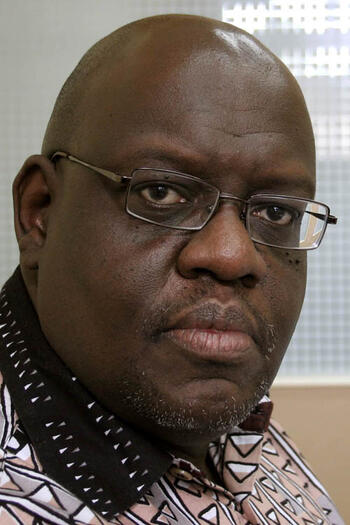 John Githongo
Image
John Githongo, former correspondent for The Economist, is a courageous leader in the struggle to combat corruption and improve governance in Kenya.
Selected in 2011 as one of the world’s 100 most influential Africans by New African magazine and one of the world’s top 100 global thinkers by Foreign Policy magazine, Mr. Githongo currently serves as CEO of Inuka Kenya, an NGO that works with Kenyan youth to provide civic education and address societal problems.
From 2003 to 2004, he served as permanent secretary for governance and ethics in Kenya’s post-transition government, and risked his life and career to expose one of the biggest government corruption scandals in Kenyan history.
Mr. Githongo has served as CEO of Transparency International Kenya, vice president of World Vision, senior associate member at St. Antony’s College Oxford, and member of the Kenya Human Rights Commission.
Image
 Nicholas Opiyo
Image
Opiyo is a former Secretary of the Ugandan bar association and a vocal defender of human rights outside the courts as regular commentator on public affairs. He heads Chapter Four Uganda – a legal charity and think tank named after Chapter Four, the bill of rights in Uganda’s constitution. As well as consulting widely on human rights related issues for the World Bank and other international agencies, he leads a team of lawyers seeking out strategic litigation in defense of human rights and providing immediate legal representation to human rights defenders. His public interest cases include challenges to Uganda’s anti-pornography law, discrimination under the HIV Prevention and Control Act, Uganda’s laws on defamation and freedom of expression amongst others. He is also engaged in litigation before the regional East African Court of Justice as well before the African Commission on Human and People’s Rights.
Image
 Larry Diamond
Image
Larry Diamond is a senior fellow at the Hoover Institution and at the Freeman Spogli Institute for International Studies, where he directs the Center on Democracy, Development, and the Rule of Law. Diamond also serves as the Peter E. Haas Faculty Co-Director of the Haas Center for Public Service at Stanford. He is the founding co-editor of the Journal of Democracy and also serves as Senior Consultant (and previously was co-director) at the International Forum for Democratic Studies of the National Endowment for Democracy. During 2002-3, he served as a consultant to the U.S. Agency for International Development (USAID) and was a contributing author of its report Foreign Aid in the National Interest. He has also advised and lectured to the World Bank, the United Nations, the State Department, and other governmental and nongovernmental agencies dealing with governance and development.
Nicholas Opiyo
Visiting Ugandan Constitutional and Human Rights Lawyer
John Githongo
2015 Mimi and Peter E. Haas Distinguished Visitor at Stanford University
Larry Diamond
Senior Fellow at the Freeman Spogli Institute for International Studies, Director of the Center on Democracy, Development, and the Rule of Law
Seminars
Corruption, Democracy and Security
-
AUDIO FROM SEGMENT OF TALK
Abstract:
A democratic recession is underway across much of Africa. Ironically it coincides with sustained economic growth since 1998. Much of this growth derived from political and economic liberalization in the 1990s, that has accelerated over the past 15 years due to an upsurge in demand for Africa’s natural resources. GDP growth does not mean development, however, and deepening inequality is more easily politicised and militarized along identity lines by elites in an era where across the world the politics of identity is resurgent. Both the war against terror and the rise of the Chinese governance model – authoritarian but efficient and compelling politically and economically – have seen elites consolidate power in fewer hands stalling and/or reversing the democratic developments of the last two decades. This elite capture of democratic processes is not limited to the South and has led to a delegitimisation of traditional political parties and players. Additionally, the securitization of geopolitics that has accompanied the ‘war against terror’ has fed a dramatic upsurge in spending on ‘national security’. National security is the last refuge of the corrupt. Indeed, this securitization has been accompanied not only by an upsurge in graft but the ongoing democratic recession. My presentation asks why and how this has come about. Finally, how can democratic gains be protected, consolidated and expanded.
Speaker Bio:
Image

John Githongo
Visiting Anti-Corruption Journalist, Haas Center
Visiting Anti-Corruption Journalist, Haas Center
Visiting Anti-Corruption Journalist, Haas Center
Seminars
LAD Case Studies
The case studies below are integral teaching tools for the Leadership Academy for Development workshops conducted around the world.
Diamond: Facing up to the democratic recession
News Type
News
Date
Paragraphs
In the 25th anniversary edition of The Journal of Democracy, CDDRL Director Larry Diamond reflects on the current democratic recession and why this trend is so troubling.
Diamond, who serves as the founding co-editor of The Journal of Democracy, argues that the world is in a mild but protracted democratic recession, which raises alarm due to the rate of democratic failures and where they are occurring. In surveying global empirical trends, Diamond cites 25 breakdowns of democracy since 2000 that were not the cause of military coups but rather the slow erosion of democratic rights and procedures.
Another worrisome trend for Diamond is the declining freedom in a number of countries and regions since 2005. This is most notable in Africa where corruption and the abuse of power are leading to the decline of the rule of law and political rights across the region. It is also affecting countries of global strategic importance with large populations and economic influence– from Taiwan to Mexico – and leading to the resurgence of authoritarianism in Russia and China. Diamond also looks to the U.S. where the dysfunction and breakdown of American democracy sets a bad precedent for the rest of the world.
Diamond concludes on an optimistic note, stressing that strong public support for democracy may reverse many of these troubling trends and help sustain longer-term democratic progress.
 From left to right: Thomas Carothers, Carnegie Endowment for International Peace; Alina Mungiu-Pippidi, Hertie School of Governance (Berlin); Marc Plattner, National Endowment for Democracy; Larry Diamond, Stanford University; Steven Levitsky, Harvard University; and Lucan Way, University of Toronto.
Hero Image

All News button
1
Digital Humanitarians
-
Abstract
The overflow of information generated during disasters can be as paralyzing to humanitarian response as the lack of information. Making sense of this flash flood of information, "Big Data", is proving an impossible challenge for traditional humanitarian organizations; so they’re turning to Digital Humanitarians: tech-savvy volunteers who craft and leverage ingenious crowdsourcing solutions with trail-blazing insights from artificial intelligence. Digital Humanitarians take online collective action to the next level—particularly when spearheading relief efforts in countries ruled by dictatorships. This talk charts the rise of Digital Humanitarians and concludes with their collective action in repressive contexts.
Speaker Bio
Patrick Meier is the author of the book " Digital Humnitarians: How Big Data is Changing the Face of Humanitarian Response." He directs QCRI's Social Innovation Program where he & his team use human and machine computing to develop "Next Generation Humanitarian Technologies" in partnership with international humanitarian organizations. Patrick was previously with Ushahidi and the Harvard Humanitarian Initiative. He has a PhD from The Fletcher School, Pre-Doc from Stanford and an MA from Columbia. His influential blog iRevolutions has received over 1.5 million hits. Patrick tweets at @patrickmeier.
**** NOTE LOCATION****
School of Education
Room 128
Patrick Meier
Director of Social Innovation at QCRI
Class Debate
-
The final class will pose nine questions, each question digging into
each of the nine topics covered over the quarter. Pizza at 6pm!
Bechtel Conference Center, EncinaHall
Helen Stacy
Africa (Up)Rising: Confronting the New Authoritarianism
-
*Please note that the seminar begins with a reception at 4:00pm where you can meet and talk with Mr. Githongo, followed by a lecture at 5:00pm in Paul Brest Hall at Stanford University.*
Speaker Bio:
 John Githongo
Image
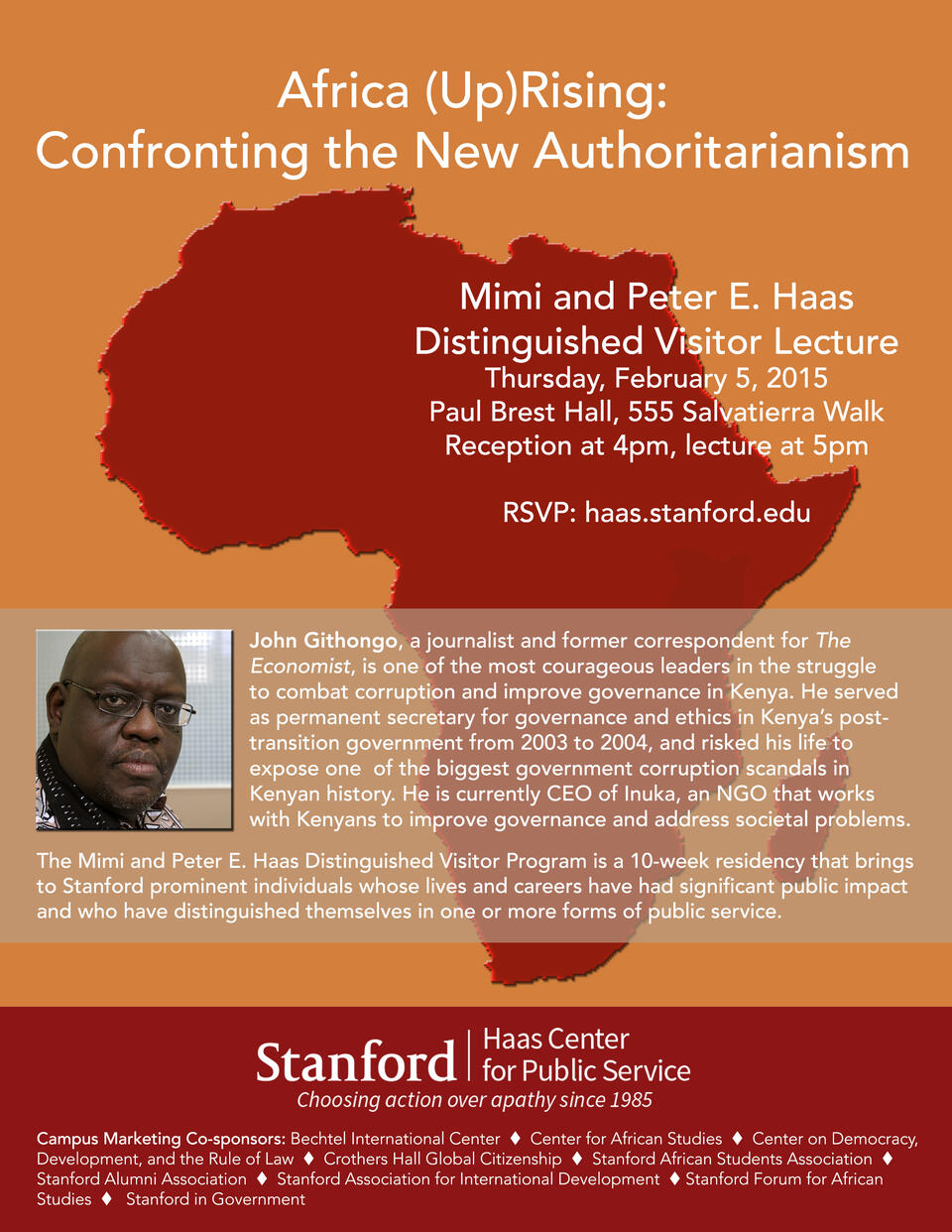
This event is co-sponsored by the Center on Democracy, Development and the Rule of Law.
Paul Brest Hall
555 Salvatierra Walk
Stanford, CA
John Githongo
2015 Mimi and Peter E. Haas Distinguished Visitor
Seminars
Facing Up to the Democratic Recession
All Publications button
1
Publication Type
Journal Articles
Publication Date
Journal Publisher
Journal of Democracy
Number
1
Why is Democracy Performing So Poorly?
All Publications button
1
Publication Type
Journal Articles
Publication Date
Journal Publisher
Journal of Democracy
Number
1