Technology
Paragraphs

In an era marked by rapid technological advancements, increasing political polarization, and democratic backsliding, reimagining democracy requires innovative approaches that foster meaningful public engagement. Over the last 30 years, Deliberative Polling has proven to be a successful method of public consultation to enhance civic participation and informed decision-making. In recent years, the implementation of online Deliberative Polling using the AI-assisted Stanford Online Deliberation Platform, a groundbreaking automated platform designed to scale simultaneous and synchronous deliberation efforts to millions, has put deliberative societies within reach. By examining two compelling case studies—Foreign Policy by Canadians and the Metaverse Community Forum—this paper highlights how technology can empower diverse voices, facilitate constructive dialogue, and cultivate a more vibrant democratic process. This paper demonstrates that leveraging technology in deliberation not only enhances public discourse but also paves the way for a more inclusive and participatory democracy.
 

About "Deliberative Approaches to Inclusive Governance: An Essay Series Part of the Democratic Legitimacy for AI Initiative"


Democracy has undergone profound changes over the past decade, shaped by rapid technological, social, and political transformations. Across the globe, citizens are demanding more meaningful and sustained engagement in governance—especially around emerging technologies like artificial intelligence (AI), which increasingly shape the contours of public life.

From world-leading experts in deliberative democracy, civic technology, and AI governance we introduce a seven-part essay series exploring how deliberative democratic processes like citizen’s assemblies and civic tech can strengthen AI governance. The essays follow from a workshop on “Democratic Legitimacy for AI: Deliberative Approaches to Inclusive Governance” held in Vancouver in March 2025, in partnership with Simon Fraser University’s Morris J. Wosk Centre for Dialogue. The series and workshop were generously supported by funding from the Canadian Institute for Advanced Research (CIFAR), Mila, and Simon Fraser University’s Morris J. Wosk Centre for Dialogue

All Publications button
1
Publication Type
Book Chapters
Publication Date
Subtitle

Part of "Deliberative Approaches to Inclusive Governance: An Essay Series Part of the Democratic Legitimacy for AI Initiative," produced by the Centre for Media, Technology and Democracy.

Authors
Alice Siu
Book Publisher
Centre for Media, Technology and Democracy
Paragraphs

In October 2024, Meta, in collaboration with the Stanford Deliberative Democracy Lab, implemented the third Meta Community Forum. This Community Forum expanded on the October 2023 deliberations regarding Generative AI. For this Community Forum, the participants deliberated on ‘how should AI agents provide proactive, personalized experiences for users?’ and ‘how should AI agents and users interact?’ Since the last Community Forum, the development of Generative AI has moved beyond AI chatbots and users have begun to explore the use of AI agents — a type of AI that can respond to written or verbal prompts by performing actions for you, or on your behalf. And beyond text-generating AI, users have begun to explore multimodal AI, where tools are able to generate content images, videos, and audio as well. The growing landscape of Generative AI raises more questions about users’ preferences when it comes to interacting with AI agents. This Community Forum focused deliberations on how interactive and proactive AI agents should be when engaging with users. Participants considered a variety of tradeoffs regarding consent, transparency, and human-like behaviors of AI agents. These deliberations shed light on what users are thinking now amidst the changing technology landscape in Generative AI.

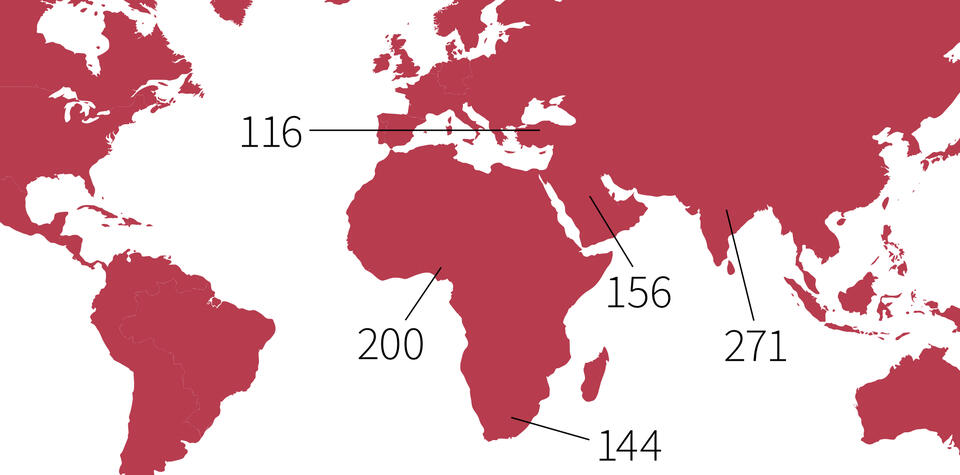
For this deliberation, nearly 900 participants from five countries: India, Nigeria, Saudi Arabia, South Africa, and Turkey, participated in this deliberative event. The samples of each of these countries were recruited independently, so this Community Forum should be seen as five independent deliberations. In addition, 1,033 persons participated in the control group, where the participants did not deliberate in any discussions; the control group only completed the two surveys, pre and post. The main purpose of the control group is to demonstrate that any changes that occur after deliberation are a result of the deliberative event.

All Publications button
1
Publication Type
Reports
Publication Date
Subtitle

April 2025

Authors
James S. Fishkin
Alice Siu
Authors
News Type
News
Date
Paragraphs

In October 2024, Meta, in collaboration with the Stanford Deliberative Democracy Lab, implemented the third Meta Community Forum. This Community Forum expanded on the October 2023 deliberations regarding Generative AI. For this Community Forum, the participants deliberated on ‘how should AI agents provide proactive, personalized experiences for users?’ and ‘how should AI agents and users interact?’

At a high level, Meta used this Forum to:

  • Expand public input into AI development beyond the Global North, and into the Global South. This latest Forum involved roughly 1,000 people from India, Turkey, Nigeria, Saudi Arabia, and South Africa.
  • Push the boundaries on the topics that the public will have input into. We moved from the foundational principles people wanted to see in GenAI towards addressing specific value and risk tradeoffs associated with issues like personalization and human-like AI.


The Forum resulted in several key findings on the principles that should underpin AI agents, including:
 

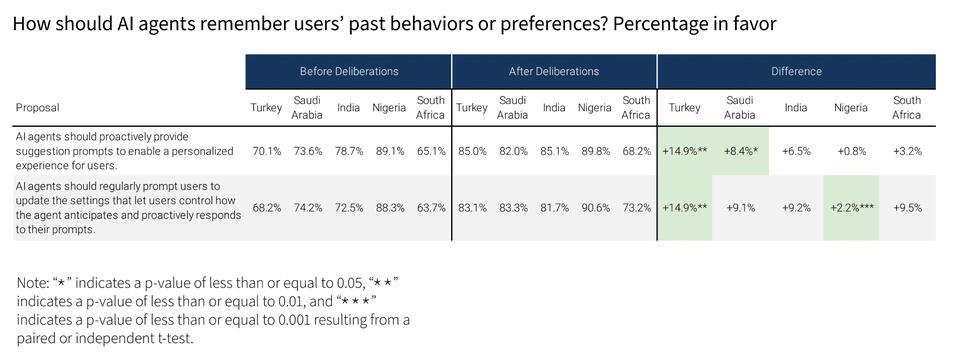
  • Participants supported AI agents remembering their prior conversations to personalize their experience, especially if transparency and user controls are in place.
  • Participants were more supportive of culturally/regionally-tailored AI agents compared to standardized AI agents.
  • Participants were in favor of human-like AI agents that can respond to emotional cues.
  • Across topics, participants consistently favored options for AI to include transparency and user control features.

Maturing our Community Forum Program


Beyond the findings of any one Forum, the Deliberative Democracy Lab and Meta have heard important feedback from stakeholders and have implemented several programmatic changes to mature our program. These include:
 

  • More disclosure around the impact of results: Meta will share more information about how results are being actioned within the company on its Transparency Center page, which will be updated throughout the year.
  • Following up with participants: We heard the importance of going back to participants to explain what we learned from their input and what we are doing with it. The Deliberative Democracy Lab will be hosting calls with participants from each of our past Community Forums, dating back to 2022, to update them on the findings from the Forum and Meta’s response.
  • Supporting AI deliberation: A team of Meta AI experts has begun partnering with the Deliberative Democracy Lab to conduct research on how AI might further scale deliberation and optimize the Community Forum process. This includes, but is not limited to, using AI to aggregate themes that are emerging in discussions in real time and support engagement between participants and experts in plenary sessions.
  • Supporting external research: Meta is supporting a consortium of independent researchers from around the world who will evaluate the data from its Forums and publish research papers on the deliberations and results. This will culminate in an academic conference later this year.

Read More

Chatbot powered by AI. Transforming Industries and customer service. Yellow chatbot icon over smart phone in action. Modern 3D render
News

Navigating the Future of AI: Insights from the Second Meta Community Forum

A multinational Deliberative Poll unveils the global public's nuanced views on AI chatbots and their integration into society.
Navigating the Future of AI: Insights from the Second Meta Community Forum
Collage of modern adults using smart phones in city with wifi signals
News

Results of First Global Deliberative Poll® Announced by Stanford’s Deliberative Democracy Lab

More than 6,300 deliberators from 32 countries and nine regions around the world participated in the Metaverse Community Forum on Bullying and Harassment.
Results of First Global Deliberative Poll® Announced by Stanford’s Deliberative Democracy Lab
Hero Image
Back view of crop anonymous female talking to a chatbot of computer while sitting at home Getty Images
All News button
1
Subtitle

Participants deliberated on ‘how should AI agents provide proactive, personalized experiences for users?’ and ‘how should AI agents and users interact?’

Date Label
Paragraphs

The Chinese government is revolutionizing digital surveillance at home and exporting these technologies abroad. Do these technology transfers help recipient governments expand digital surveillance, impose internet shutdowns, filter the internet, and target repression for online content? We focus on Huawei, the world’s largest telecommunications provider, which is partly state-owned and increasingly regarded as an instrument of its foreign policy. Using a global sample and an identification strategy based on generalized synthetic controls, we show that the effect of Huawei transfers depends on preexisting political institutions in recipient countries. In the world’s autocracies, Huawei technology facilitates digital repression. We find no effect in the world’s democracies, which are more likely to have laws that regulate digital privacy, institutions that punish government violations, and vibrant civil societies that step in when institutions come under strain. Most broadly, this article advances a large literature about the geopolitical implications of China’s rise.

All Publications button
1
Publication Type
Journal Articles
Publication Date
Journal Publisher
Perspectives on Politics
Authors
Erin Baggott Carter
Brett Carter
Number
Published online 2025:1-20
Paragraphs

We are on the verge of a revolution in public sector decision-making processes, where computers will take over many of the governance tasks previously assigned to human bureaucrats. Governance decisions based on algorithmic information processing are increasing in numbers and scope, contributing to decisions that impact the lives of individual citizens. While significant attention in the recent few years has been devoted to normative discussions on fairness, accountability, and transparency related to algorithmic decision-making based on artificial intelligence, less is known about citizens’ considered views on this issue. To put society in-the-loop, a Deliberative Poll was thus carried out on the topic of using artificial intelligence in the public sector, as a form of in-depth public consultation. The three use cases that were selected for deliberation were refugee reallocation, a welfare-to-work program, and parole. A key finding was that after having acquired more knowledge about the concrete use cases, participants were overall more supportive of using artificial intelligence in the decision processes. The event was set up with a pretest/post-test control group experimental design, and as such, the results offer experimental evidence to extant observational studies showing positive associations between knowledge and support for using artificial intelligence.

All Publications button
1
Publication Type
Journal Articles
Publication Date
Journal Publisher
AI & SOCIETY
Authors
James S. Fishkin
Alice Siu
Authors
News Type
News
Date
Paragraphs

It was 5 p.m. Pacific Time on a Wednesday. While Silicon Valley was ending its workday, dozens of tech professionals from around the world were logging on to Zoom to participate in Ethics, Technology + Public Policy for Practitioners. The seven-week course was taught digitally in fall 2023 by Rob Reich, Mehran Sahami, and Jeremy M. Weinstein, three professors whose disciplinary grounding spans philosophy, computer science, and public policy, at Stanford University, supported by the course’s managing director, Megan Mellin, MSM ’19.

Read the full article from Stanford Digital Education.

Hero Image
In an earlier iteration of the course, Professor Jeremy Weinstein lectured to students via Zoom in an experimental multi-screen format. Copyright and credit: Bob Smith, MSME, ’82
Bob Smith, MSME, ’82
All News button
1
Subtitle

In its fourth year, "Ethics, Tech + Public Policy for Practitioners," taught by Rob Reich, Mehran Sahami, and Jeremy M. Weinstein, experiments with setting up long-term communities of professionals interested in responsible tech governance.

Authors
Nora Sulots
News Type
News
Date
Paragraphs

The Stanford Deliberative Democracy Lab, housed within the Center on Democracy, Development and the Rule of Law (CDDRL) at the Freeman Spogli Institute for International Studies (FSI), in collaboration with Meta and the Behavioral Insights Team, has unveiled the results of the Meta Community Forum on Generative AI, based on the method of Deliberative Polling®. This groundbreaking event, part of a series of efforts by Meta to consult the public, engaged 1,545 participants in scientific samples from Brazil, Germany, Spain, and the United States. In each country, it offered the public’s views, both before and after deliberation, about future directions for the development of AI chatbots and how they should interact with humans.

“AI poses novel challenges, and these four national experiments revealed the public’s considered judgments about what it should — or should not — be able to use it for. National samples grappled with the pros and cons of each proposal and had their questions answered by panels of competing experts. This report shows what they concluded,” said James Fishkin, Senior Fellow at FSI and Director of the Stanford Deliberative Democracy Lab.

AI poses novel challenges, and these four national experiments revealed the public’s considered judgments about what it should — or should not — be able to use it for.
James Fishkin
Director, Stanford Deliberative Democracy Lab

Much of the agenda focused on specific proposals answering ten basic questions, including:

  • Which sources should AI chatbots draw information from?
  • Should AI chatbots use the user’s past conversations to improve user experience?
  • Should AI chatbots use the user’s online activity to personalize interactions?
  • Should AI chatbots be designed to be human-like?
  • Should users be allowed to use AI chatbots for romantic relationships?


The deliberators in each country were convened on the Stanford Online Deliberation Platform, developed by the Stanford Crowdsourced Democracy Team. This platform is AI-assisted and moderates video-based discussions in small groups of ten. 

Participants noted a generally positive impact of AI, with an increase in positive perceptions post-forum. "This shift in viewpoint, especially notable among those previously unfamiliar with AI, underscores the value of informed discussion in shaping public opinion," remarked Alice Siu, Senior Research Scholar at FSI and Associate Director of the Stanford Deliberative Democracy Lab.

The forum's methodical approach, with deliberations in 166 small groups and a separate control group for each country, ensured that the outcomes accurately reflected the effects of the deliberative process. Findings indicated that users and non-users of AI began to bridge their differences, aligning closer in their attitudes towards AI after the forum.

Siu also emphasized the significance of the event’s feedback, noting that "the high ratings from participants affirm the forum’s success in making complex discussions accessible and relevant. It is an encouraging sign for the future of democratic engagement with technology."

The Stanford Deliberative Democracy Lab is dedicated to deepening our understanding of deliberative democracy processes and their application to critical contemporary issues like AI. The insights from this forum will inform ongoing research and policy recommendations, ensuring that AI evolves in a manner that considers diverse values and voices across the globe.

The project report is available below:

For detailed information on the forum’s conclusions or forthcoming projects, please reach out to James Fishkin (Director, Stanford Deliberative Democracy Lab) or Alice Siu (Associate Director, Stanford Deliberative Democracy Lab) or visit the Deliberative Democracy Lab website.

Read More

Collage of modern adults using smart phones in city with wifi signals
News

Results of First Global Deliberative Poll® Announced by Stanford’s Deliberative Democracy Lab

More than 6,300 deliberators from 32 countries and nine regions around the world participated in the Metaverse Community Forum on Bullying and Harassment.
Results of First Global Deliberative Poll® Announced by Stanford’s Deliberative Democracy Lab
A voter casts their ballot in the Kentucky Primary Elections at Central High School on May 16, 2023 in Louisville, Kentucky.
Q&As

New National Deliberative Poll Shows Bipartisan Support for Polarizing Issues Affecting American Democracy

"America in One Room: Democratic Reform" polled participants before and after deliberation to gauge their opinions on democratic reform initiatives, including voter access and voting protections, non-partisan election administration, protecting against election interference, Supreme Court reform, and more. The results show many significant changes toward bipartisan agreement, even on the most contentious issues.
New National Deliberative Poll Shows Bipartisan Support for Polarizing Issues Affecting American Democracy
Alice Siu delivers a TEDxStanford talk
News

Deliberative Polling: A Path to Bridging Divides

In a TEDxStanford talk, Alice Siu discusses how applying and spreading deliberative democracy can better engage us all in our shared public problems.
Deliberative Polling: A Path to Bridging Divides
Hero Image
Chatbot powered by AI. Transforming Industries and customer service. Yellow chatbot icon over smart phone in action. Modern 3D render
Chatbot powered by AI. Photo: Da-Kuk / Getty Images
Da-Kuk / Getty Images
All News button
1
Subtitle

A multinational Deliberative Poll unveils the global public's nuanced views on AI chatbots and their integration into society.

Date Label
Paragraphs

The Stanford Deliberative Democracy Lab, in collaboration with Meta and the Behavioral Insights Team, has unveiled the results of the second Meta Community Forum, based on the method of Deliberative Polling. This groundbreaking event engaged 1,545 participants from Brazil, Germany, Spain, and the United States. In each country, it offered the public’s views, both before and after deliberation, about future directions for the development of AI chatbots and how they should interact with humans.

The Deliberative Democracy Lab (DDL) at Stanford University is housed within the Center on Democracy, Development and the Rule of Law at the Freeman Spogli Institute for International Studies.

The Crowdsourced Democracy Team (CDT) at Stanford University is housed within the Department of Management Science and Engineering.

Report Contributors (in alphabetical order): Samuel Chang, Estelle Ciesla, Michael Finch, James Fishkin, Lodewijk Gelauff, Ashish Goel, Ricky Hernandez Marquez, Shoaib Mohammed, and Alice Siu.

All Publications button
1
Publication Type
Reports
Publication Date
Subtitle

"What principles should guide generative AI’s engagement with users?"

Authors
James S. Fishkin
Lodewijk L. Gelauff
Alice Siu
-
AI in Education Deliberative Poll for High School Educators

Are you worried about the impact AI can have on your classroom or excited about its potential? Do you wonder how you can utilize AI in your teaching or do you feel like it dehumanizes the learning process? Are you eager to learn about what “Artificial Intelligence” entails and how it can impact your classroom? 

If any of these questions have crossed your mind, we invite you to join Stanford's Deliberative Democracy Lab on Saturday, May 18, from 10:00 am to 2:45 pm (Pacific Time) to discuss with fellow educators how AI should be used and regulated in schools. You will discuss policies regarding the use of AI in schools — whether it should be banned from the Wi-Fi or left up to teachers and students to discern what “appropriate usage” means. You will also get to meet and ask questions to experts in the fields.

This will be an online event hosted on Stanford's Online Deliberation Platform. There will be sessions between deliberating teachers and expert panels where there will be Q&A time. Further details will be emailed to you.

SCHEDULE

10:00 am - 11:15 am: First Small Group Deliberation Session

11:15 am - 12:00 pm: Plenary Session 1

12:00 pm - 12:45 pm: Break

12:45 pm - 2:00 pm: Second Small Group Deliberation Session

2:00 pm - 2:45 pm: Plenary Session 2

This event is being led by students at The Quarry Lane School, Saratoga High School, and Lynbrook High School.

Online.

Open to high school educators only.

Workshops
Subscribe to Technology