Khalid Mustafa Medani joins ARD to discuss his recently released book, Black Markets and Militants Informal Networks in the Middle East and Africa (Cambridge University Press, 2021).
Understanding the political and socio-economic factors which give rise to youth recruitment into militant organizations is at the heart of grasping some of the most important issues that affect the contemporary Middle East and Africa. In this book, Medani explains why youth are attracted to militant organizations, examining the specific role economic globalization, in the form of outmigration and expatriate remittance inflows, plays in determining how and why militant activists emerge. The study challenges existing accounts that rely primarily on ideology to explain militant recruitment.
Based on extensive fieldwork, Medani offers an in-depth analysis of the impact of globalization, neoliberal reforms, and informal economic networks as a conduit for the rise and evolution of moderate and militant Islamist movements and as an avenue central to the often violent enterprise of state-building and state formation. In an original contribution to the study of Islamist and ethnic politics more broadly, he thereby shows the importance of understanding when and under what conditions religious rather than other forms of identity become politically salient in the context of changes in local conditions.
ABOUT THE SPEAKER
Image
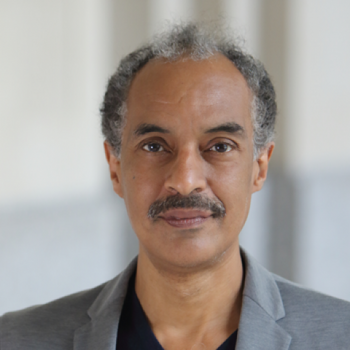
Dr. Khalid Mustafa Medani is currently associate professor of political science and Islamic Studies at McGill University, and he has also taught at Oberlin College and Stanford University. Dr. Medani received a B.A. in Development Studies from Brown University, an M.A. in Development Studies from the Center for Contemporary Arab Studies at Georgetown University, and a Ph.D. in Political Science from the University of California, Berkeley. His research focuses on the political economy of Islamic and Ethnic Politics in Africa and the Middle East.
Dr. Medani is the author of Black Markets and Militants: Informal Networks in the Middle East and Africa(Cambridge University Press, 2021) and he is presently completing another book manuscript on the causes and consequences of Sudan’s 2018 popular uprising and the prospects and obstacles for Democracy in that country. In addition, he has published extensively on civil conflict with a special focus on the armed conflicts in Sudan and Somalia. His work has appeared in Political Science and Politics (PS), the Journal of Democracy, the Journal of North African Studies, Current History, Middle East Report, Review of African Political Economy, Arab Studies Quarterly, and the UCLA Journal of Islamic Law.
Dr. Medani is a previous recipient of a Carnegie Scholar on Islam award from the Carnegie Corporation of New York (2007-2009) and in 2020-2021 he received a fellowship from the Woodrow Wilson International Center for Scholars to conduct research on his current book manuscript on the democratic transition in Sudan.
This event is co-sponsored by the Abbasi Program in Islamic Studies and the Center for African Studies at Stanford University.
Hesham Sallam
Online via Zoom
Khalid Mustafa Medani
Associate Professor of Political Science and Islamic Studies
McGill University
I am a political scientist (PhD degree expected in July 2021 from Harvard) working on political parties, social welfare policies and local governance, primarily in the Middle East and North Africa. My dissertation project focuses on secular parties in the region and explores why they could not form a robust electoral alternative to the Islamist parties in the post-uprisings period. In other projects, I explore voters' responses to executive aggrandizement (focusing on Turkey), and social welfare in the context of ethnic and organizational diversity (focusing on Lebanon). Prior to PhD, I worked as an education policy analyst in Turkey, managing several research projects in collaboration with the Ministry of Education, World Bank and UNICEF. I hold a BA degree in Political Science from Boğaziçi, and Master's degrees from the LSE and Brown.
This event is cosponsored by the Abbasi Program in Islamic Studies at Stanford University and the Ten Years On Project, www.TheArabUprisings.org
ABSTRACT
During the height of the mass uprisings against authoritarian rule, excitement about the prospects for a more just and representative political order across the Arab region was often tempered by questions concerning the role that Islamist parties would play in post-authoritarian transitions. Movements that maintained deep social roots but were often on the margins of state power were poised to implement an Islamist political project decades in the making. The outcomes of the subsequent transitions, particularly the legacy of destructive civil conflicts, foreign interventions, and authoritarian resurgence, have frequently obscured attempts to understand the impact of the Arab uprisings on Islamism.
This talk examines these recent developments by placing them within a broader historical analysis that traces the evolution of Islamist thought and activism from its tentative embrace of the nation state to its wholehearted entry into national party politics. It argues that, by the eve of the uprisings, the posture of Islamist movements reflected a set of political commitments that had emerged largely at the expense of their ideological program and social mission. Rooted in the historical and recent acceptance of state institutions and political structures, expressions of Islamism by parties across the Arab region reflected a shift that subsumed long held beliefs beneath the needs of (alternately or in combination) democratic pluralism and political expediency, most clearly visible in the transformation of Tunisia’s Ennahda Party. That tension has been exacerbated in the wake of political defeats experienced by many of these movements, particularly Egypt’s Muslim Brotherhood. While the “Islamist idea” is likely to endure its current bout with state repression, its survival as a political force in the future will depend on its determination to complete this evolution, a process that was both accelerated and interrupted during the critical moments of the Arab uprisings.
SPEAKER BIO
Image
Abdullah Al-Arian is an associate professor of history at Georgetown University in Qatar where he specializes in the modern Middle East and the study of Islamic social movements. He is the author of Answering the Call: Popular Islamic Activism in Sadat's Egypt (Oxford University Press). His upcoming book compares the historical experiences of Islamist movements in six different Arab states and will be published by Cambridge University Press. He is also editor of the Critical Currents in Islam page on Jadaliyya ezine.
This talk is based on the speakers’ recently published edited volume The Unfinished Arab Spring: Micro-Dynamics of Revolts between Change and Continuity. Adopting an original analytical approach in explaining various dynamics at work behind the Arab revolts and giving voice to local dynamics and legacies rather than concentrating on debates about paradigms, we highlight micro-perspectives of change and resistance as well as of contentious politics that are often marginalized and left unexplored in favor of macro-analyses. First, we re-examine the stories of the uprisings in Tunisia, Egypt, Syria, Morocco and Algeria through diverse and novel perspectives, looking at factors that have not yet been sufficiently underlined but carry explanatory power for what has occurred. Second, rather than focusing on macro-comparative regional trends – however useful they might be – we focus on the particularities of each country, highlighting distinctive micro-dynamics of change and continuity.
SPEAKERS BIO
Image
Fatima el Issawi is a Reader in Journalism and Media Studies at the University of Essex. Her research focuses on the intersection between media, politics and conflicts in transitional contexts to democracy in North Africa. She is the Principal Investigator for the research project “Media and Transitions to Democracy: Journalistic Practices in Communicating Conflicts- the Arab Spring” funded by the British Academy Sustainable Development Programme, looking at media’s impact on communicating political conflicts in post uprisings in North Africa. Since 2012, el Issawi has been leading empirical comparative research projects on the interplay between media and political change, funded by Open Society Foundation and the Middle East Centre/LSE, covering Egypt, Tunisia, Morocco, Libya and Algeria. El Issawi’s expertise crosses journalism, public communication, policy and academia. She has over fifteen years of experience as international correspondent in conflict zones in the MENA region. She is the author of “Arab National Media and Political Change” investigating the complex intersections between traditional journalists and politics in uncertain times of transitions to democracy.
Image
Francesco Cavatorta is full professor of political science and director of the Centre Interdisciplinaire de Recherche sur l’Afrique et le Moyen Orient (CIRAM) at Laval University, Quebec, Canada. His research focuses on the dynamics of authoritarianism and democratization in the Middle East and North Africa. His current research projects deal with party politics and the role of political parties in the region. He has published numerous journal articles and books.
This talk is based on the speaker's recently released book Archive Wars The Politics of History in Saudi Arabia (Stanford University Press, 2020). The production of history is premised on the selective erasure of certain pasts and the artifacts that stand witness to them. From the elision of archival documents to the demolition of sacred and secular spaces, each act of destruction is also an act of state building. Following the 1991 Gulf War, political elites in Saudi Arabia pursued these dual projects of historical commemoration and state formation with greater fervor to enforce their postwar vision for state, nation, and economy. Seeing Islamist movements as the leading threat to state power, they sought to de-center religion from educational, cultural, and spatial policies. With this book, Rosie Bsheer explores the increasing secularization of the postwar Saudi state and how it manifested in assembling a national archive and reordering urban space in Riyadh and Mecca. The elites' project was rife with ironies: in Riyadh, they employed world-renowned experts to fashion an imagined history, while at the same time in Mecca they were overseeing the obliteration of a thousand-year-old topography and its replacement with commercial megaprojects. Archive Wars shows how the Saudi state's response to the challenges of the Gulf War served to historicize a national space, territorialize a national history, and ultimately refract both through new modes of capital accumulation.
SPEAKER BIO
Image
Rosie Bsheer is Assistant Professor of History at Harvard University, where she teaches graduate and undergraduate courses on oil and empire, social and intellectual movements, urban history, historiography, and the making of the modern Middle East. Rosie’s publications include Archive Wars: The Politics of History in Saudi Arabia (Stanford University Press, 2020) and “A Counterrevolutionary State: Popular Movements and the Making of Saudi Arabia,” Past and Present (2018). She is Associate Producer of the 2007 Oscar-nominated film My Country, My Country and a co-editor of Jadaliyya E-zine.
This talk examines the multiple crises manifesting in Lebanon today and their impact on the fate of the uprising that began in October 2019. While the currency, fiscal, and infrastructural crises were central to the making of Lebanon’s uprising, the novel strategic innovations that the protesters made were key to shaping its trajectory relative to past protests. More recently, the COVID-19 pandemic has both exacerbated existing dynamics while also providing respite to the government and some of the traditional political parties. The presentation therefore engages these complexities to take stock of the current status of popular mobilizations, elite efforts to contain them, and the economic structures that undergird both.
SPEAKER BIO
Image
Ziad Abu-Rish is Assistant Professor of History at Ohio University, where he is founding director of the Middle East & North Africa Studies Certificate Program. His research explores state formation, economic development, and popular mobilizations in the Middle East, with a particular focus on Lebanon and Jordan. Abu-Rish is co-editor of The Dawn of the Arab Uprisings: End of an Old Order? (2012). He currently serves as Senior Editor at Arab Studies Journal, co-editor at Jadaliyya e-zine, and board member of the Lebanese Studies Association. He is also a Research Fellow at the Lebanese Center for Policy Studies (LCPS).
This event is co-sponsored with The Abbasi Program in Islamic Studies.
ABSTRACT
Benazir Bhutto in Pakistan, Roza Otunbayva in Kyrgystan, Megawati Sukarno Putri in Indonesia: female Muslim leaders are seen as pioneers at the forefront of the empowerment of women in Muslim-majority countries and more generally the empowerment of women on a global scale. The younger generation of women Muslim leaders have forged their political struggle and discourse in the post-9/11 context. More recently, they have surfed the wave of hope and disillusion of the Spring revolution(s). A major difference with the first generation of female Muslim leaders is that the younger generation’s political identity is strongly grounded in Islamic references. They are (or have labelled themselves) as Islamists, Islamist democrats or Muslim democrats that propose an alternative to the exclusive secular discourse.
Through the experience of Sayida Ounissi, we explore the genuine and challenging role of a new generation of female leaders, in Muslim democrats or Islamist parties. This discussion goes beyond the common assumptions and clichés of the veil oppressed Muslim women, the question of the compatibility between Islam and democracy or Islam and feminism. It rather looks at the rise of young women Muslim democrats in Islamist or Muslim parties in a way to grasp the feminine, and sometimes feminist, re-definition of the Islamic tradition and Islamist or Muslim democrats discourse. It explores the modes of transmission of political struggle and ideologies, from fathers to daughters, and from mothers, whether passive or active Islamists, to daughters. Finally, it examines the challenges posed to their ascensions within their parties and society by analysing how these women are re-appropriating conservative Islamic codes, other cultural or religious practices, and the social and political concepts inherent to their respective local and global context, in order to secure legitimate ascension in their parties and societies.
SPEAKRER BIO
Image
Sayida Ounissi is a member of the Tunisian Assembly of People’s Representatives and Minister for Employment and Vocational Training. She represents Tunisians living in the North of France for the Ennahdha Party and was first elected in October 2014 and reelected in October 2019. In 1993, her family fled the dictatorship of Ben-Ali for France where she completed all of her schooling. In 2005, she joined the University of Paris 1 Panthéon Sorbonne for a double degree in History and Political Science. She obtained her Masters at the Institute for the Study of Economic and Social Development, and completed her studies with an internship at the African Development Bank in Tunis. In 2016, she was recruited by Prime Minister Youssef Chahed to join his Cabinet as Secretary of State in the Ministry of Employment and Vocational Training, charged with vocational training and private initiative. In 2018, she was promoted as the Minister for Employment and Vocational Training, becoming the youngest minister in Tunisia.
MODERATOR BIO
Image
Sophie Lemiere is a Political Anthropologist and FSI-Humanities Center International Visitor, 2019-20, at Stanford University. She is a former Fellow for the Democracy in Hard Places Initiative at the Ash Center for Democracy, Harvard University. In 2014, she received her PhD from Sciences-Po, France. Her thesis was the first study on the political role of gangs through umbrella NGOs in Malaysia. In 2019-2020, Sophie has been awarded the Visiting Fellowship at the Center for Southeast Asian Studies at Kyoto University and the Reagan-Fascell Democracy Fellowship at the International Forum for Democratic Studies (National Endowment for Democracy-NED), in Washington, D.C.
Encina Commons Room 123 Encina Commons 615 Crothers Way Stanford, CA
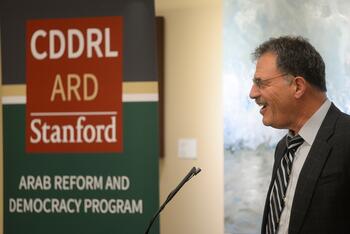
CDDRL’s Program on Arab Reform and Democracy held its annual conference at Stanford University on October 11 and 12, titled “The Struggle for Political Change in the Arab World.” The conference is an outgrowth of ARD’s efforts to support new research on the dynamics of political change in the countries of the Arab world. Scholars from across different disciplines sought to understand how social, economic, and political dynamics at the national level, as well as international and regional conflict and power rivalries, impact struggles for political and social change in the region.
Overview of Panels and Speakers
Image
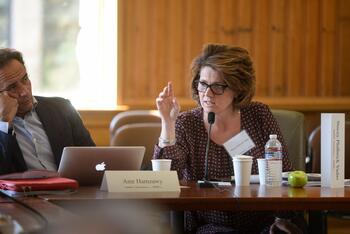
Following opening remarks by FSI Senior Fellow Larry Diamond, the first panel titled “The Boundaries of Authoritarianism post-Arab Uprisings” featured CDDRL Senior Research Scholar Amr Hamzawy. His paper examined how the regime of Abdel Fattah Al-Sisi has employed discursive strategies to discredit calls for democratic change in the country. Sean Yom, Associate Professor of Political Science at Temple University, outlined how the protest strategies of Jordanian youth have limited their effectiveness in advancing meaningful political change. University of California, Davis Scholar Samia Errazzouki discussed the failure of state-led political and economic reform in Morocco.
Chaired by Harvard University Fellow Hicham Alaoui, the second panel was titled “Popular Uprisings and Uncertain Transitions.” University of California, Santa Cruz Political Scientist Thomas Serres provided an overview of the economic disruptions that contributed to Algeria’s uprising. Lindsay Benstead, who is an Associate Professor of Political Science at Portland State University, analyzed the electoral successes of Tunisia’s Ennahda Party. Khalid Medani, Professor of Political Science at McGill University, explained how Sudanese protesters leveraged new strategies of contention to force Omar Al-Bashir out of power.
Farah Al-Nakib (right) and Michael Herb (left)
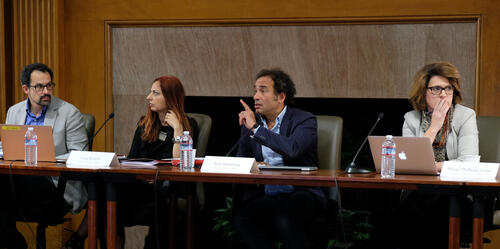
The third panel, titled “Politics, Succession and Sectarianism in the GCC States,” included Oxford University Fellow Toby Matthiesen, who discussed how Saudi Arabia and the GCC states have increasingly sought to protect their regimes by actively molding the politics of their autocratic patrons in the region, and by using new technologies to upgrade the effectiveness of their surveillance states. Georgia State University Political Scientist Michael Herb explained how the aging of the Saudi line of succession contributed to the political ascendancy of Crown Prince Mohammad Bin Salman and the decay of family rule in the country. Cal Poly Historian Farah Al-Nakib described how Kuwait’s royal family has used its sponsorship of large-scale development projects to sidestep the country’s political polarization, undermine the power of the parliament, and weaken public access to spaces of political contestation.
Image
The fourth panel focused on “Social Strife and Proxy Conflict in the Middle East.” Chatham House Scholar Lina Khatib described Syria’s transformation during the civil war from a highly centralized security state to a transactional state in which the regime depends heavily on local powerbrokers. Stacey Philbrick Yadav, Associate Professor and Chair of the Department of Political Science at Hobart and William Smith Colleges, discussed differences in how local communities in Yemen have been affected by the country’s conflict. David Patel, who serves as Associate Director for Research at the Crown Center for Middle East Studies at Brandeis University, argued that Iraq’s democratic institutions have been impressively robust to a series of existential challenges, but he also highlighted a widespread feeling among the Iraqi public that its parliamentary system is failing to deliver.
Image
Finally, the fifth panel examined the topic of “International Forces in the Arab Political Arena.” Stanford University Political Scientist Lisa Blaydes suggested that China’s efforts to involve itself in the regional economy may improve its reputation among economically-frustrated Arab citizens, but that such efforts also spell trouble for democracy and human rights in the Middle East. Hamid & Christina Moghadam Director of Iranian Studies at Stanford University Abbas Milani argued that Iran’s ideological commitment to exporting the Islamic Revolution has been remarkably consistent for several decades. Colin Kahl, Co-director of the Center for International Security and Cooperation at FSI, reviewed the strategies of US administrations toward the Middle East, and posited that President Trump’s approach of pursuing maximalist objectives with minimal commitments is particularly likely to heighten instability in the region. FSI Scholar Ayca Alemdaroglu emphasized that Turkey’s neo-Ottoman foreign policy has failed to achieve its objectives in the face of mounting regional upheaval.
Common Themes of Political Change and Continuity
Image
Several themes emerged from conference presentations. First, across the panels, scholars discussed the lessons learned by autocrats and activists alike in the aftermath of the Arab Spring, and the ways in which these lessons have transformed regional politics. Hamzawy emphasized that the Sisi regime in Egypt has increasingly relied on intensive repression over cooptation to maintain stability, while at the same time refusing to grant even limited political openings as existed under Hosni Mubarak’s presidency. In part, this change appears to be rooted in the regime’s belief that relaxing the state’s authoritarian posture had contributed to the revolutionary upheaval of 2011. Likewise, Matthiesen suggested that Saudi Arabia and the Gulf Cooperation Council States have learned to become more aggressive in strengthening their surveillance apparatus and policing popular discourse transnationally. By contrast, Serres discussed how the Algerian military and bureaucracy have responded to mass protests not by intensifying repression, but instead by attempting to coopt anti-corruption initiatives and democratic reforms to limit political and economic change. Similarly, regarding Kuwait, Al-Nakib illustrated how the restructuring of urban spaces has proved itself a subtle but successful strategy for the royal family to rehabilitate its reputation while limiting geographic focal points for popular politics.
Image
Activists have also learned their own lessons from the aftermath of the Arab Spring. According to Yom, Jordanian activists continue to look to the leaderless revolutions of Tunisia and Egypt as a model to be emulated. As a result, they prioritize agility and horizontality in their protests, and they forgo the organization of formal political movements. This approach has succeeded in acquiring short-term concessions from the regime but has failed to generate broader structural changes. On the other hand, activists in Sudan appear to have been more successful at using lessons from the Arab Spring to push for systematic transformations of their political system. According to Medani, Sudanese protesters developed novel tactics to avoid the repression of the coercive apparatus, and they were effective at gradually forging a counterhegemonic discourse that clearly exposed the regime’s failures to the public. Following the overthrow of Omar Al-Bashir, activists in Sudan have also insisted on dismantling the political and economic might of the deep state to avoid following Egypt’s path.
Image
Second, the conference discussion indicated widespread dissatisfaction with formal political institutions across the region. For instance, Hamzawy suggested that Sisi’s regime has been relatively successful at discrediting civilian political institutions, including the legislature and civilian-led ministries. Errazzouki highlighted widespread dissatisfaction in Morocco with existing political institutions. Likewise, Yom’s discussion of activists in Jordan emphasized their lack of interest in entering formal politics. In Kuwait, the royal court has found an opening to pursue urban development projects outside of normal institutions in part because of the public’s frustration with gridlock in the legislature. Patel speculated that frustration with the parliament and muhasasa system in Iraq may finally prompt major changes to the country’s political process.
Image
Third, despite this disillusionment with formal politics, these political institutions have proved remarkably durable in countries across the region. For example, though current frustrations may finally prompt change in Iraq, Patel also highlighted the resilience of the parliamentary system in the face of a sectarian civil war, US troop withdrawal, the rise of ISIS, and a number of other major challenges. For both Algeria and Sudan, Serres and Medani stressed that militaries continue to exercise significant influence despite the popular uprisings. Meanwhile, for Egypt, Hamzawy noted the firm grip of the current military regime on power, and for Morocco, Errazzouki described the lack of systematic changes to the country’s ruling monarchy, even after years of popular pressure.
Image
Fourth, this durability has not precluded a number of important shifts within existing political institutions. Regarding Syria, for instance, Khatib explained how the survival of Bashar al-Asad’s presidency has depended on moving state institutions away from a centralized security state to a transactional state reliant on local actors with a degree of independence from the regime. Herb described how the consensus-based family rule of the Saudi monarchy fell victim to deaths among the aging senior princes, which opened up opportunities for the king to appoint more officials in a manner that heightened his direct influence. Herb suggested that Mohammad Bin Salman recognized this change and knew that he would likely lose relevance upon his father’s death; as a result, he was motivated to gamble on consolidating his control while his father still held the power to issue royal decrees. In Algeria, the influence of the military and bureaucracy may remain paramount for now, but Serres also pointed out that protesters have succeeded in stripping away the civilian intermediaries who used to protect these institutions. Regarding the durability of local institutions, Yadav noted how pre-conflict and even pre-unification institutions in Yemen have continued to operate effectively in a number of local communities around the country.
Image
Fifth, foreign interventions will continue to destabilize the region and impede prospects for democratization or post-conflict reconstructions in the coming years. Khatib noted that Russia has positioned itself as the agenda setter who can bring the Syrian state back to its feet, but also that Russia and Iran are competing to profit off the country’s reconstruction. For Yemen, Yadav argued that fragmentation at the local level has important implications for best practices in the international community’s reconstruction efforts, but that current actors are not well positioned to understand these trends. Kahl predicted that the Middle East strategy of the Trump administration would likely contribute to further destabilization of the region because of its emphasis on empowering allies to do what they want and go after Iran while the United States maintains its distance. Meanwhile, Blaydes’ presentation on China’s regional involvement, Milani’s discussion of Iran’s efforts to export the Islamic Revolution, and Matthiesen’s observations about the GCC States’ authoritarian coordination all illustrated how intervening states are reducing prospects for democratic political change.
Image
Sixth, even as interventionist countries have contributed to the destabilization of the region, they have also confronted major obstacles themselves – and in some cases have failed outright to achieve their primary objectives. Khatib noted that Iran has faced backlash in Syria, while Abbas Milani and David Patel pointed to backlash against Iran in Iraq. Kahl emphasized that the Trump administration’s Middle East policy was unlikely to achieve its goals. Blaydes observed that China has not acquired greater salience in the Middle East despite its more active economic involvement, and individuals in many of the region’s countries – particularly those that are more developed – do not see China’s growth as a positive force. She also stressed the reputational risks China is taking in pursuing potentially unpopular investments through the Belt and Road Initiative. The GCC States are attempting to prop up strongmen in both Libya and Sudan, but this strategy has struggled in the face of local political dynamics; furthermore, the intervention in Yemen has been a disaster for Saudi Arabia and the UAE. Finally, Alemdaroglu stressed that Turkey’s ambitious “neo-Ottoman” foreign policy, which reflects a desire to revive Turkish influence in areas ruled by the Ottoman Empire, has largely failed. In particular, the architect of the policy, former foreign minister Ahmet Davutoglu, lost his job; the country miscalculated badly in how it handled the aftermath of the Arab Spring; and Turkey’s relations with many of its neighbors have soured.
Hero Image
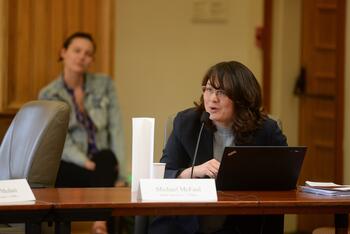
ARD 2019 Annual Conference participants. Front row (from left): Sean Yom, Stacey Philbrick Yadav, Lindsay Benstead, David Patel, Michael Herb. Middle row (from left): Colin Kahl, Lina Khatib, Hicham Alaoui, Larry Diamond, Samia Errazzouki, Lisa Blaydes, Hesham Sallam. Back row (from left): Toby Matthiesen, Ayca Alemdaroglu, Abbas Milani, Amr Hamzawy, Michael McFaul, Scott Williamson
In a talk dated May 31, 2019, UC Santa Cruz scholars Muriam Haleh Davis and Thomas Serres examined Algeria’s recent uprising, which led to the resignation of President Abdelaziz Bouteflika. The talk shed light on the protests, analyzing them both in a historical lens while also addressing the future prospects for democratic change and their implications for regional geopolitics. The speakers explored the role of the war of independence (1954-1962) and civil war (1992-1999) in political contestation, questions of language and national identity, and the landscape of the current political opposition.
In a talk dated October 7, 2019, Georgetown University Associate Professor of Government Daniel Brumberg analyzed the outcome of Tunisia’s legislative election and its implications for democratic consolidation in the country. Brumberg argued that the election provides a vital although not an easy opportunity to move beyond the power sharing, consensus-based political pact negotiated in 2014, to a more consolidated democracy.






 Farah Al-Nakib (right) and Michael Herb (left)