History
-

*This event is free and open to the public.*


PANELISTS

Don Emmerson - Director of the Southeast Asia Forum, Shorenstein Asia-Pacific Research Center; Affiliated Scholar, Abbasi Program in Islamic Studies; Affiliated Faculty, CDDRL

Erik Jensen - Professor of the Practice of Law, Stanford Law School; Senior Advisor for Governance and Law, The Asia Foundation; Senior Research Scholar, CDDRL; Director, Rule of Law Program, Stanford Law School

Norman Naimark - Director of the Stanford Global Studies Division; Professor of History

Diane H. Steinberg (Panel Chair) - Visiting Scholar at Stanford's Program on Human Rights, Center on Democracy, Development, and the Rule of Law (CDDRL)


Image

 
The Act of Killing visits former Indonesian death squad killers who wreaked havoc in 1965 and 1966 in the aftermath of Indonesia's military coup and yet have never been held accountable for slaughtering between 200,000 to 2 million people in a genocide often forgotten.  The dramatic reenactments of the murders in the documentary catalyze an unexpected emotional journey for Anwar Congo from arrogance to regret as he confronts for the first time in his life the full implications of what he has done.
 
The Act of Killing is an award-winning documentary film directed by Joshua Oppenheimer with co-director Christine Cynn and and an anonymous co-director from Indonesia. It is a Danish-British-Norwegian co-production, presented by Final Cut for Real in Denmark and produced by Signe Byrge Sørensen. It was recently nominated for an Academy Award for Best Documentary Feature.

"Director Joshua Oppenheimer has made a documentary in which he interviews the leaders of Indonesian death squads, who were responsible, collectively, for the deaths of millions of Communists, leftists and ethnic Chinese in 1965 and 1966. But he doesn't just interview them. He has them re-enact their crimes and even invites them to write, perform and film skits dramatizing their murders." Mick LaSalle, San Francisco Chronicle, 8/8/2013
 
"The Act of Killing is a bold reinvention of the documentary form, as well as an astounding illustration of man's infinite capacity for evil." Rene Rodriguez, The Miami Herald, 8/15/2013
 
After the screening of the  Director's Cut of The Act of Killing (160 minutes), there will be a thirty-minute panel discussion.
 
For more information regarding the film, please visit: http://theactofkilling.com/.
 
This event is presented and sponsored by Stanford Global Studies, CDDRL's Program on Human Rights, and the Vice Provost of Undergraduate Education.

Cubberley Auditorium

Conferences
-


Abstract
In 1955, the Museum of Modern Art mounted one of the most widely seen – and widely excoriated – photography exhibitions of all time, The Family of Man. For the last forty years, critics have decried the show as a model of the psychological and political repression of cold war America. This talk challenges that view. It shows how the immersive, multi-image aesthetics of the exhibition emerged not from the cold war, but from the World War II fight against fascism. It then demonstrates that The Family of Man aimed to liberate the senses of visitors and especially, to enable them to embrace racial, sexual and cultural diversity – even as it enlisted their perceptual faculties in new modes of collective self-management. For these reasons, the talk concludes, the exhibition became an influential prototype of the immersive, multi-media environments of the 1960s – and of our own multiply mediated social world today.

 
Fred Turner is Associate Professor of Communication and Director of the Program in Science, Technology, and Society at Stanford. He is the author of several books on media technology and American cultural history. In January, the University of Chicago Press published The Democratic Surround: Multimedia and American Liberalism from World War II to the Psychedelic Sixties, from which this talk is drawn.
 

Wallenberg Theater

Fred Turner Associate Professor of Communication and Director of the Program in Science, Technology, and Society Speaker Stanford University
Seminars
Date Label
Paragraphs

In an article published in the January 2014 issue of Current History, Larry Diamond urges civil society and policy leaders to stay optimistic about democracy’s future, arguing that its historical moment has not passed. Despite recent examples of democratic breakdowns, particularly in the Middle East and North Africa, Diamond claims that values are shifting, giving way to an empowered and vocal citizenry, which may pressure governments toward more accountable and democratic forms of rule. 

All Publications button
1
Publication Type
Journal Articles
Publication Date
Journal Publisher
Current History
Authors
Larry Diamond
-

Speaker Bio:

Nabil Mouline is a senior researcher in The French National Centre for Scientific Research (CNRS) and The School for Advanced Studies in the Social Sciences (EHESS). Prior to this, he was a research professor at the Institute of Political Studies of Paris (Sciences Po).
He earned a Ph.D. in history from the Paris-Sorbonne University and a Ph.D. in political science from the Institute of Political Studies of Paris (Sciences Po).

He is the author, among other works, of The Imaginary Caliphate of Ahmad al-Mansûr: Power and Diplomacy in Morocco in the 16th Century (PUF, Paris, 2009) and The Clerics of Islam: Religious Authority and Political Power in Saudi Arabia (PUF, Paris, 2011). Cambridge University Press and Yale University Press will publish the English translation of these two books in 2014 respectively.

During his residency at Stanford, he will work on a book on the sociological history of Saudi Arabia.

Encina Ground Floor Conference Room

Encina Hall
616 Serra Street
Stanford, CA 94305-6055

0
Visiting Scholar, ARD
Mouline_HS.jpg
Nabil Mouline is a senior researcher in The French National Centre for Scientific Research (CNRS) and The School for Advanced Studies in the Social Sciences (EHESS). Prior to this, he was a research professor at the Institute of Political Studies of Paris (Sciences Po).
 
He earned a Ph.D. in history from the Paris-Sorbonne University and a Ph.D. in political science from the Institute of Political Studies of Paris (Sciences Po).
 
He is the author, among other works, of The Imaginary Caliphate of Ahmad al-Mansûr: Power and Diplomacy in Morocco in the 16th Century (PUF, Paris, 2009) and The Clerics of Islam: Religious Authority and Political Power in Saudi Arabia (PUF, Paris, 2011). Cambridge University Press and Yale University Press will publish the English translation of these two books in 2014 respectively.
 
During his residency at Stanford, he will work on a book on the sociological history of Saudi Arabia.
Nabil Mouline Visiting Scholar, Program on Arab Reform and Democracy Speaker CDDRL
Seminars
-

Image


Abstract:

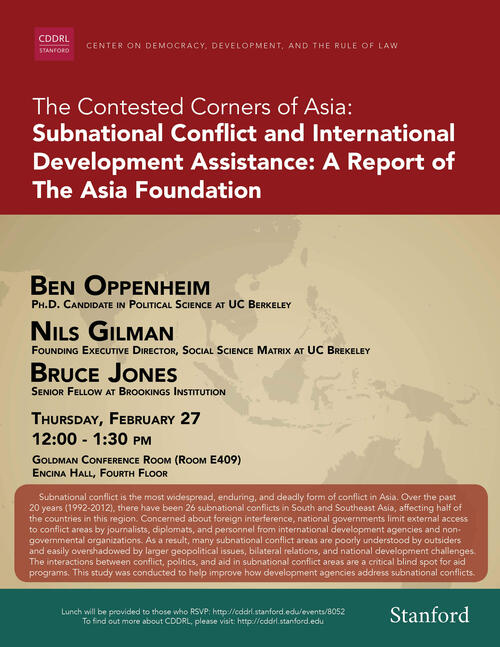
Subnational conflict is the most widespread, enduring, and deadly form of conflict in Asia. Over the past 20 years (1992-2012), there have been 26 subnational conflicts in South and Southeast Asia, affecting half of the countries in this region. Concerned about foreign interference, national governments limit external access to conflict areas by journalists, diplomats, and personnel from international development agencies and non-governmental organizations. As a result, many subnational conflict areas are poorly understood by outsiders and easily overshadowed by larger geopolitical issues, bilateral relations, and national development challenges. The interactions between conflict, politics, and aid in subnational conflict areas are a critical blind spot for aid programs. This study was conducted to help improve how development agencies address subnational conflicts.


Speaker Bios:

Ben Oppenheim is a Fellow (non-resident) at the Center on International Cooperation at New York University. His research spans a diverse set of topics, including fragile states, transnational threats (including pandemic disease risks and terrorism), and the strategic coherence and effectiveness of international assistance in fragile and conflict-affected areas.

Oppenheim has consulted for organizations including the World Bank, the United Nations, the Asia Foundation, the Institute for the Future, and the Fritz Institute, on issues including organizational learning, strategy, program design, foresight, and facilitation. In 2009, he served as Advisor to the first global congress on disarmament, demobilization, and reintegration, supported by the World Bank and the UN.

In 2013, Oppenheim was a visiting fellow at the Uppsala University Forum on Democracy, Peace, and Justice. His research has been supported by a Simpson Fellowship, and a fellowship with the Institute on Global Conflict and Cooperation. He was also a research fellow with UC Berkeley's Institute of International Studies, affiliated with the New Era Foreign Policy Project.


Nils Gilman is the Executive Director of Social Science Matrix. He holds a B.A., M.A. and Ph.D. in History from the University of California, Berkeley. Gilman’s first scholarly interest was in American and European intellectual history, with a particular focus on the institutional development of the social sciences, the lateral transfer and translation of ideas across disciplinary boundaries, and the impact of social scientific ideas on politics and policy.

Gilman is the author of Mandarins of the Future: Modernization Theory in Cold War America (Johns Hopkins University Press, 2004), the co-editor of Staging Growth: Modernization, Development, and the Global Cold War (University of Massachusetts Press, 2003) and Deviant Globalization: Black Market Economy in the 21st Century (Continuum Press, 2011), as well as the founding Co-editor of Humanity: An International Journal of Human Rights, Humanitarianism, and Development. He also blogs and tweets.

Prior to joining Social Science Matrix in September 2013, Gilman was research director at Monitor 360, a San Francisco consultancy that addresses complex, cross-disciplinary global strategic challenges for governments, multinational businesses, and NGOs. He has also worked at a variety of enterprise software companies, including Salesforce.com, BEA Systems, and Plumtree Software. Gilman has taught and lectured at a wide variety of venues, from the Harvard University, Columbia University, and National Defense University, to PopTech, the European Futurists Conference, and the Long Now Foundation.


Bruce Jones is a senior fellow and the director of the Project on International Order and Strategy in the Foreign Policy program at the Brookings Institution. He is also the director of the Center on International Cooperation at New York University.

Jones served as the senior external advisor for the World Bank’s 2011 World Development Report, Conflict, Security and Development, and in March 2010 was appointed by the United Nations secretary-general as a member of the senior advisory group to guide the Review of International Civilian Capacities. He is also consulting professor at the Center for International Security and Cooperation at Stanford University and professor (by courtesy) at New York University’s department of politics.

Jones holds a Ph.D. from the London School of Economics, and was Hamburg fellow in conflict prevention at Stanford University.

He is co-author with Carlos Pascual and Stephen Stedman of Power and Responsibility: Building International Order in an Era of Transnational Threats (Brookings Press, 2009); co-editor with Shepard Forman and Richard Gowan of Cooperating for Peace and Security (Cambridge University Press, 2009); and author of Peacemaking in Rwanda: The Dynamics of Failures(Lynne Reinner, 2001).

Jones served as senior advisor in the office of the secretary-general during the U.N. reform effort leading up to the World Summit 2005, and in the same period was acting secretary of the Secretary-General’s Policy Committee. In 2004-2005, he was deputy research director of the High-level Panel on Threats, Challenges and Change. From 2000-2002 he was special assistant to and acting chief of staff at the office of the U.N. special coordinator for the Middle East peace process. 

Richard and Rhoda Goldman Conference Room

Ben Oppenheim Ph.D. Candidate in Political Science Speaker UC Berkeley
Nils Gilman Founding Executive Director, Social Science Matrix Speaker UC Berkeley
Bruce Jones Senior Fellow Speaker Brookings Institution
Seminars
-

Abstract:
The peoples of Burma/Myanmar have faced military rule, human rights violations, and poor health outcomes for decades. The country Is now undergoing a political liberalization, and multiple changes in political, social and economic life. The human rights and health situation of the country's many ethnic nationalities remain challenging, and represent one of the clearest threats to the prospect of successful transition to peace, and to democracy. We will explore the current health and human rights situation in the country, the ongoing threats to peace, and ways forward for this least developed nation as it emerges from 5 decades of military rule.

Chris Beyrer MD, MPH, is a professor of Epidemiology, International Health, and Health, Behavior, and Society at the Johns Hopkins University Bloomberg School of Public Health. He is the founding Director of the University¹s Center for Public Health and Human Rights, which seeks to bring the tools of population-based sciences to bear on Health and rights threats. Dr. Beyrer also serves as Associate Director of the Johns Hopkins Centers for AIDS Research (CFAR) and of the Center for Global Health. He has been involved in health and human rights work with Burmese populations since 1993. Prof. Beyrer is the author of more than 200 scientific papers, and author or editor of six books, including War in the Blood: Sex, Politics and AIDS in Southeast Asia, and Public Health and Human Rights: Evidence-Based Approaches. He has served as a consultant and adviser to numerous national and international institutions, including the National Institutes of Health, the World Bank, WHO, UNAIDS, the Open Society Foundations, the Walter Reed Army Institute for Research, amfAR The Foundation for AIDS Research, Physicians for Human Rights and Human Rights Watch. Dr. Beyrer received a BA in History from Hobart and Wm. Smith Colleges, his MD from SUNY Downstate in Brooklyn, NY, and completed his residency in Preventive Medicine, public health training, an MPH and a Infectious Diseases Fellowship at Johns Hopkins University in Baltimore. He received an honorary Doctorate (PhD) in Health Sciences from Chiang Mai University in Thailand, in 2012, in recognition of his 20 years of public health service in Thailand

Building 200 (History Corner)
Room 205
Stanford University

Chris Beyrer Director Speaker Johns Hopkins Center for Public Health & Human Rights
Seminars
-


Abstract
Earlier generations of radicals understood themselves to be in an ongoing battle against the privatization of land and water.  They instrumentalized maps in the court system as a tool for battling for native sovereignty over traditional lands, protecting the rights of squatters, and securing access to water by poor farmers in the developing world.   Wherever battles for the commons take the form of a war for access to particular spaces, maps can help, whether activists are striking against high rents in the city, or protecting rivers from pollution.  Today, crowdsourced maps of land, food, and water present an opportunity for makers who want to work in support of a movement. My talk will highlight some of the most and least promising frontiers ahead.

 Professor Jo Guldi is presently Assistant Professor in the History of Britain and its Empire at Brown, where I teach courses related to capitalism, empire, land use, and computation.  Born in Dallas, Texas, I received my AB from Harvard University, and then studied at Trinity College, Cambridge before completing my PhD in History at the University of California, Berkeley, after which I continued on to postdocs at the University of Chicago and the Harvard Society of Fellows.  My first book, Roads to Power: Britain Invents the Infrastructure State (Harvard University Press, 2011), tells the story of how Britain built the first nation connected by infrastructure and technology caused strangers to stop speaking on the public street.  My next monograph, The Long Land War, will tell the story of international land reform movements from the Irish land war to Movimiento sin Tierra, lingering on legal reformers and civil servants, London's dredlocked squatters and their accidental influence on World Bank Policy, and the genesis of participatory mapping from Marxist development economists in the 1970s through radical coders in contemporary Chennai.

Wallenberg Theater

Prof. Jo Guldi Asst Prof., Department of History Speaker Brown University
Seminars
Date Label
-

Speaker bio:

Karl Eikenberry is the William J. Perry Fellow in International Security at the Center for International Security and Cooperation and a faculty member of the Shorenstein Asia-Pacific Research Center at Stanford University.  He is also an affiliated faculty member with the Center for Democracy, Development, and Rule of Law, and researcher with The Europe Center.

Prior to his arrival at Stanford, he served as the U.S. Ambassador to Afghanistan from May 2009 until July 2011, where he led the civilian surge directed by President Obama to reverse insurgent momentum and set the conditions for transition to full Afghan sovereignty.

Before appointment as Chief of Mission in Kabul, Ambassador Eikenberry had a thirty-five year career in the United States Army, retiring in April 2009 with the rank of Lieutenant General.  His military operational posts included commander and staff officer with mechanized, light, airborne, and ranger infantry units in the continental U.S., Hawaii, Korea, Italy, and Afghanistan as the Commander of the American-led Coalition forces from 2005-2007. 

He has served in various policy and political-military positions, including Deputy Chairman of the North Atlantic Treaty Organization (NATO) Military Committee in Brussels, Belgium; Director for Strategic Planning and Policy for U.S. Pacific Command at Camp Smith, Hawaii; U.S. Security Coordinator and Chief of the Office of Military Cooperation in Kabul, Afghanistan; Assistant Army and later Defense Attaché at the United States Embassy in Beijing, China; Senior Country Director for China, Taiwan, Hong Kong and Mongolia in the Office of the Secretary of Defense; and Deputy Director for Strategy, Plans, and Policy on the Army Staff.

He is a graduate of the U.S. Military Academy, has master’s degrees from Harvard University in East Asian Studies and Stanford University in Political Science, and was a National Security Fellow at the Kennedy School of Government at Harvard.

Ambassador Eikenberry earned an Interpreter’s Certificate in Mandarin Chinese from the British Foreign Commonwealth Office while studying at the United Kingdom Ministry of Defense Chinese Language School in Hong Kong and has an Advanced Degree in Chinese History from Nanjing University in the People’s Republic of China. 

His military awards include the Defense Distinguished and Superior Service Medals, Legion of Merit, Bronze Star, Ranger Tab, Combat and Expert Infantryman badges, and master parachutist wings.  He has received the Department of State Distinguished, Superior, and Meritorious Honor Awards, Director of Central Intelligence Award, and Chairman of the Joint Chiefs of Staff Joint Distinguished Civilian Service Award.  He is also the recipient of the George F. Kennan Award for Distinguished Public Service and Harvard University Graduate School of Arts and Sciences Centennial Medal.  His foreign and international decorations include the Canadian Meritorious Service Cross, French Legion of Honor, Afghanistan’s Ghazi Amir Amanullah Khan and Akbar Khan Medals, and the NATO Meritorious Service Medal.

Ambassador Eikenberry serves as a Trustee for the International Institute for Strategic Studies, The Asia Foundation, and the National Committee on American Foreign Policy, and is a Fellow of the American Academy of Arts and Sciences.  He is a member of the Council on Foreign Relations, the American Academy of Diplomacy, and the Council of American Ambassadors, and was previously the President of the Foreign Area Officers Association.  His articles and essays on U.S. and international security issues have appeared in Foreign Affairs, The Washington Quarterly, American Foreign Policy Interests, The New York TimesThe Washington Post, Foreign Policy, and The Financial Times.  He has a commercial pilot’s license and instrument rating, and also enjoys sailing and scuba diving.

Reuben W. Hills Conference Room

Karl Eikenberry William J. Perry Fellow in International Security at CISAC, CDDRL, TEC, and Shorenstein APARC Distinguished Fellow; and Former U.S. Ambassador to Afghanistan and Retired U.S. Army Lt. General Speaker FSI
Seminars
-

 Abstract:

That the Cairo Conference has been overshadowed by the wartime summits at Teheran and Yalta is understandable given the start of the Cold War in Europe almost immediately after the German surrender in May 1945. To understand the collapse of relations between the Anglo-American allies on the one hand and the Soviet Union on the other, it is important to look at the conferences at Teheran and Yalta, the interactions between Churchill, Roosevelt, and Stalin, the understandings they reached, and their misunderstandings. That said, the Cairo Conference also marked an important turning point in the relations between the allies in the war against Japan: China, Great Britain, and the United States, the consequences of which were critical to the defeat of Japan and the post-war order in East Asia.

The interaction of Churchill, Roosevelt, and Chiang in Cairo is every bit as compelling from a human interest perspective as the interplay between Churchill, Roosevelt, and Stalin at Teheran and Yalta, albeit less studied, and offers a sobering reminder of what can happen when policy is made at the very highest level by individuals who know relatively little about the culture of their partners and are not able to separate myths and stereotypes from realities. Summit conferences may make for good theater, but do not necessarily result in good policies as an examination of the Cairo Conference reveals.

Each of the parties at the Cairo Conference came with their own agendas, frequently contradictory. Generalissimo and Madame Chiang hoped to obtain a commitment to make the China-Burma-India theater of war the focal point in the war against Japan, a matter not only of strategic importance to them but also of poetic justice. They also sought to redress grievances against Japan and Great Britain in the post-war era. Roosevelt hoped to buoy the ego and spirits of Chiang and to insure that the Kuomintang regime would not make a separate peace with Japan thus allowing the Japanese to redeploy the nearly one million troops they had stationed in China. Churchill had no real interest in meeting with Chiang and his wife at Cairo at all, but felt obliged to humor Roosevelt and to make sure that no agreements would be reached in Cairo that would in any way prejudice British colonial interests in Southeast Asia in the post-war era. Given these conflicting agendas, it is no wonder that none of the participants would be satisfied with the results of their labors in Cairo.


Speaker Bio:

Ronald Heiferman is Professor of History and Director of the Asian Studies Program at Quinnipiac University in Hamden, Connecticut, and a Fellow of Berkeley College at Yale University. He has also taught at Connecticut College and the City University of New York. Dr. Heiferman was educated at Yale and New York University (Ph.D.). Professor Heiferman has authored or co-authored more than a dozen books, including Flying Tigers (New York: Ballantine, 1971), World War II (London: Hamlyn, 1973), Wars of the Twentieth Century (London: Hamlyn, 1974), The Rise and Fall of Imperial Japan (New York: Military Press, 1981), the Rand-McNally Encyclopedia of World II (New York: Rand-McNally, 1978), and The Cairo Conference of 1943: Roosevelt, Churchill, Chiang Kai-shek and Madame Chiang (McFarland, 2011). His latest book, The Chinese Idyll of Franklin D. Roosevelt, will be published in 2014. Professor Heiferman was a Yale-Lilly Fellow in 1978, a Yale-Mellon Fellow in 1984, and has also been the recipient of five National Endowment for the Humanities Fellowships: Duke University (1974), University of Chicago (1977), Stanford University (1980), Harvard University (1987), and the University of Texas (1991).

CISAC Conference Room

Ronald Heiferman Professor of History and Director of the Asian Studies Program Speaker Quinnipiac University
Seminars
-

Abstract:  

Image
Arabs and Israelis: Conflict and Peacemaking in the Middle East is a new, ground-breaking textbook on the history of the Arab-Israeli conflict. It is the first on this hyper-sensitive subject to have been team-written by a Palestinian, an Israeli, and an Egyptian representing a broader Arab perspective: The book presents competing narratives that the different parties have developed and adopted with respect to the conflict's various milestones and provides a toolbox for analyzing past, current and future developments in the conflict and in the efforts to resolve it.

At the CDDRL seminar, two of the book's three authors, Shai Feldman and Khalil Shikaki will address the challenges associated with teaching the Arab-Israeli conflict and the manner in which they suggest overcoming these challenges. In addition, they will share what insights they gain from the historical record of the efforts to resolve the Arab-Israeli conflict when assessing the likely prospects of the most recent attempt to end the Palestinian-Israeli conflict, launched and orchestrated by Secretary of State John Kerry. 

Speaker bios:

Image
Shai Feldman is the Judith and Sidney Swartz Director of the Crown Center for Middle East Studies and Professor of Politics at Brandeis University. Prof. Feldman is also a Senior Fellow and a member of the Board of Directors of Harvard University’s Belfer Center for Science and International Affairs where he serves as Co-Chair of the Middle East Security Project. In 1997-2005, he was Head of the Jaffee Center for Strategic Studies at Tel Aviv University and in 2001-2003, he served as a member of the UN Secretary General’s Advisory Board on Disarmament Matters. Educated at the Hebrew University in Jerusalem, Prof. Feldman was awarded his Ph.D. by the University of California at Berkeley in 1980.

Prof. Feldman is the author of numerous publications. These include five books: Israeli Nuclear Deterrence: A Strategy for the 1980s (New York: Columbia University Press, 1982); The Future of U.S.-Israel Strategic Cooperation (Washington D.C.: The Washington Institute for Near East Policy, 1996); Nuclear Weapons and Arms Control in the Middle East (Cambridge: MIT Press, 1997); Bridging the Gap: A Future Security Architecture for the Middle East (Lanham, Maryland: Rowman & Littlefield, 1997 – with Abdullah Toukan (Jordan); and, Track-II Diplomacy: Lessons from the Middle East (Cambridge: MIT Press, 2003 – with Hussein Agha, Ahmad Khalidi, and Zeev Schiff).


Image

Khalil Shikaki is a professor of political science and director of the Palestinian Center for Policy and Survey Research in Ramallah. Since 2005 he has been a senior fellow at the Crown Center for Middle East Studies at Brandeis University. He earned his PhD in Political Science from Columbia University in 1985, and taught at several Palestinian and American universities. Between 1996-99, Prof. Shikaki served as the dean of scientific research at al Najah University in Nablus. Since 1993 he has conducted more than 200 polls among Palestinians in the West Bank and the Gaza Strip and, since 2000, dozens of joint polls among Palestinians and Israelis.

He is the co-author of the annual report of the Arab Democracy Index. His recent publications include “The future of Israel-Palestine: a one-state reality in the making,” NOREF Report, May 2012; "Coping with the Arab Spring; Palestinian Domestic and Regional Ramifications," Middle East Brief, no. 58, Crown Center for Middle East Studies, Brandeis University, December 2011; Public Opinion in the Israeli-Palestinian Conflict: The Public Imperative During the Second Intifada, with Yaacov Shamir, Indiana University Press, 2010.

CISAC Conference Room

Seminars
Subscribe to History