

Human rights experts weigh in on Syria conflict
News Type
News
Date
Paragraphs
On November 10, CDDRL and the WSD Handa Center for Human Rights and International Justice welcomed Human Rights Watch's Director of Emergencies Peter Bouckaert and Sareta Ashraph, senior analyst on the UN Commission of Inquiry on the Syrian Arab Republic, for a discussion on the ongoing human rights and refugee crises in Syria. The talk was moderated by Stanford Law School's Beth Van Schaack, Leah Kaplan Visiting Professor in Human Rights.
Photo Album
Hero Image

Human Rights Watch's Peter Bouckaert (left) and Sareta Ashraph (right), senior analyst at the UN Commission of Inquiry for the Syria, with Stanford Law School's Beth Van Schaack.
Christian Ollano
All News button
1
Advancing Human Rights through Tech and Data
-
Abstract
Human rights groups have only two assets: people and information. Learn about Benetech’s decade of putting information technology tools into the hands of human rights activists, with the goal of making these two assets more effective in advancing the global cause of human rights.
Speaker bio
Jim Fruchterman is the founder and CEO of Benetech, a Silicon Valley nonprofit technology company that develops software applications to address unmet needs of users in the social sector. He is the recipient of numerous awards recognizing his work as a pioneering social entrepreneur, including the MacArthur Fellowship, Caltech’s Distinguished Alumni Award, the Skoll Award for Social Entrepreneurship, and the Migel Medal—the highest honor in the blindness field—from the American Foundation for the Blind. Since its founding in 1989, Benetech has touched the lives of hundreds of thousands of people. Its tools and services have transformed the ways in which people with disabilities access printed information, at-risk human rights defenders safely document abuse, and environmental practitioners succeed in their efforts to protect species and ecosystems. Through his work with Benetech and as a trailblazer in the field of social entrepreneurship, Jim continues to advance his vision of a world in which the benefits of technology reach all of humanity, not just the wealthiest and most able five percent.
Wallenberg Hall
Bulding 160
Room 124
Jim Fruchterman
Founder and CEO
Benetech
Seminars
Conflict and Crisis: Implications of Ongoing Human Rights Violations in Syria
-
**To RSVP, please email Jessie Brunner at jbrunner@stanford.edu.**
[[{"fid":"221010","view_mode":"crop_870xauto","fields":{"format":"crop_870xauto","field_file_image_description[und][0][value]":"","field_file_image_alt_text[und][0][value]":"","field_file_image_title_text[und][0][value]":"","field_credit[und][0][value]":"","field_caption[und][0][value]":"","field_related_image_aspect[und][0][value]":"","thumbnails":"crop_870xauto"},"type":"media","attributes":{"width":"870","class":"media-element file-crop-870xauto"}}]]
Abstract
As the protracted and chaotic conflict in Syria continues into its fifth year, Syrians of all backgrounds are being subjected to gross human rights violations. A growing number of parties to the conflict, including the Government and the Islamic State, display disregard for international legal conventions and employ tactics such as sexual violence, murder, and torture that have resulted in mass civilian casualties, large-scale displacement, and the destruction of Syria’s cultural heritage.
Peter Bouckaert
Peter Bouckaert is Human Rights Watch’s emergencies director, coordinating the organization’s response to major wars and other human rights crises. A Belgian-born Stanford Law School graduate, Bouckaert has conducted fact-finding missions around the world, including currently documenting Syrian refugees in Europe.
Sareta Ashraph
Sareta Ashraph specializes in international criminal, humanitarian, and human rights law and has served since 2012 as the Senior Analyst on the UN Commission of Inquiry on the Syrian Arab Republic, investigating and reporting on violations of international law in the context of ongoing events in Syria.
To RSVP, please email Jessie Brunner at jbrunner@stanford.edu.
Peter Bouckaert
Director, Emergencies, Human Rights Watch
Sareta Ashraph
Senior Analyst, UN Commission of Inquiry on the Syrian Arab Republic
Seminars
The Aborigine Constituencies in the Taiwanese Legislature
Paragraphs
The Republic of China on Taiwan has long reserved legislative seats for its indigenous minority, the yuanzhumin. While most of Taiwan’s political institutions were transformed as the island democratized, the dual aborigine constituencies continue to be based on an archaic, Japanese-era distinction between “mountain” and “plains” aborigines that corresponds poorly to current conditions. The aborigine quota system has also served to buttress Kuomintang (KMT) control of the legislature: the Democratic Progressive Party (DPP) and “pan-indigenous” parties have been almost entirely shut out of these seats. Nevertheless, aborigine legislators have made a modest but meaningful difference for indigenous communities. The reserved seats were initially established during the martial law era as a purely symbolic form of representation, but during the democratic era they have acquired substantive force as well. Taiwan’s indigenous peoples have not always been well-served by their elected legislators, but they would be worse off without them.
All Publications button
1
Publication Type
Working Papers
Publication Date
Syria today, Syria tomorrow: Politics, security, and society
-
Abstract:
The Syrian crisis continues to grind on without a viable settlement to the conflict in sight. The problems spurred by the crisis, from refugees to extremist groups, have become a tangible concern for the West, not just Middle Eastern countries. Meanwhile, from Russia to Iran to Saudi Arabia, Turkey, and Qatar, several countries have turned Syria into a political and military playground. The lack of strategy to end the conflict on part of the USA, Europe, and the United Nations has paved the way for those state and non-state actors to increase the scope of their actions in Syria. The continuation of this dynamic can only mean further instability across the Middle East and beyond.
This talk links the international relations, security, and social dimensions of the Syrian conflict to address how and why the crisis has reached the level it is at today, with a focus on the role of external stakeholders as well as of rising extremist groups. It will reflect on how a settlement to the conflict might be reached and what the implications of a settlement would be for the Middle East.
Bio:
Image

This event is sponsored by CDDRL's Program on Arab Reform and Democracy.
[[{"fid":"221011","view_mode":"crop_870xauto","fields":{"format":"crop_870xauto","field_file_image_description[und][0][value]":"","field_file_image_alt_text[und][0][value]":"","field_file_image_title_text[und][0][value]":"","field_credit[und][0][value]":"","field_caption[und][0][value]":"","field_related_image_aspect[und][0][value]":"","thumbnails":"crop_870xauto"},"type":"media","attributes":{"width":"870","class":"media-element file-crop-870xauto"}}]]
CISAC Central Conference Room
Encina Hall, 2nd Floor
616 Serra St
Stanford, CA 94305
Lina Khatib
Arab Reform Initiative
Seminars
ARD welcomes Egyptian intellectual Amr Hamzawy as a visiting scholar
News Type
News
Date
Paragraphs
The Program on Arab Reform and Democracy at Stanford’s Center on Democracy, Development, and the Rule of Law is pleased to welcome Egyptian academic and Former Member of Parliament Amr Hamzawy as a visiting scholar for the 2015-16 academic year. Hamzawy, who teaches political science at Cairo University and the American University in Cairo, brings to the program a deep knowledge of Middle East politics and specific expertise on democratization and reform processes in the region. A former Senior Associate at the Carnegie Endowment for International Peace, Hamzawy’s research focuses on questions of political change, human rights, and the rule of law in Egypt. He is a daily columnist for Al-Sherouk, an independent Egyptian newspaper, and writes regularly on the role of civil society actors and parties in Egypt’s often restricted political arena. Hamzawy is a former member of the Egyptian National Council for Human Rights, and was elected to serve in Egypt’s first parliament after the outset of the January 25 Revolution before it was dissolved in the summer of 2012.
Hamzawy will spend his residency at CDDRL working on a research project on the liberal elite and reemergence of autocracy in Egypt. His residency is generously funded by a grant from the Carnegie Corporation to support scholars from the Arab world. In the interview below, Hamzawy describes his current project and research plans. Hamzawy will be sharing his research findings with the CDDRL community in a seminar on October 27.
What are your research goals and priorities?
While at CDDRL, my research objective is to analyze contemporary liberal discourses on democracy and human rights in Egypt. The fact that the majority of Egyptian liberals called on the military establishment - prior to the July 3, 2013 coup which deposed the elected president Mohamed Morsi - to interfere in politics and terminate the emerging pluralist dynamics warrants an in-depth examination. Equally puzzling, is the readiness of Egyptian liberals to allow the former minister of defense and current president Abdel-Fattah al-Sisi’s rise to power, to accept a subordinate role in an increasingly restricted public space, and to tolerate without any noticeable resistance the emergence of a new autocracy in Egypt.
What has your research uncovered?
The research journey has been going in some fascinating directions and yielding some interesting answers. For instance, one set of factors pertains to the formation of the modern Egyptian state and the long-standing dependency of liberal elites on successive autocratic rulers and governments. Another revolves around historical legacies of mistrust and fear towards religious-based social movements and political actors. These legacies have contributed to the tendency of liberals to side with autocrats against popular opposition currents. Finally, the predominance of rent-seeking tendencies inside the state bureaucracy and among economic elites has limited the integration of liberals into Egypt’s social fabric. While there are fascinating historical analogies between the current moment and previous experiences in Egypt from the nineteenth and twentieth centuries, my research will remains focused on the contemporary era.
How is your experience in Egyptian politics informing your current projects?
Throughout the last four years, and while putting on different institutional hats and operating in very different contexts, I have collected first-hand insights on liberal narratives on the formation of the Egyptian state and state-society relations. These experiences also deepened my understanding of liberals’ discourses on their historical encounters with religious forces, their social and political preferences, and their views on the wider public—which some key liberal figures have been willing to disenfranchise to avoid Islamist victories in the polls. These insights, as well as my own experiences as an elected member of the Egyptian People’s Assembly of 2012, the first legislature that was elected freely and without government manipulation, will inform the research.
What are the most important factors that undermined the movement that supported the January 25, 2011 Revolution in Egypt?
That is a tough question. It is easy to state that neither the military establishment nor the vastly entrenched security apparatus wanted the January 25, 2011 Revolution. They feared that it could lead to a democratic transition in which their roles, benefits, and privileges would have been limited or at least subjected to greater scrutiny. Also, there is no doubt that the rent-seeking economic elites and various forces of the Mubarak regime were heavily invested in blocking an orderly transition to democracy. These are facts that have been well documented and researched.
However, no less significant is the recurrent retreat of liberal elites from pluralist processes and procedures. It appears as if Egyptian liberals have never been ready to support a democratic opening that could bring Islamists to power. Liberals have also been reluctant to shoulder the burden of standing against the autocratic ways of the military and the security establishment, or to help civil society and human rights groups garner more popular support. To explain the root causes and impacts of Egypt’s illiberal liberals is the task of my current research project.
Hero Image

Amr Hamzawy. Photo from Bündnis 90/Die Grünen flickr page
All News button
1
Taiwan's Democracy at a Crossroads: Options and Prospects for Constitutional Reform
-
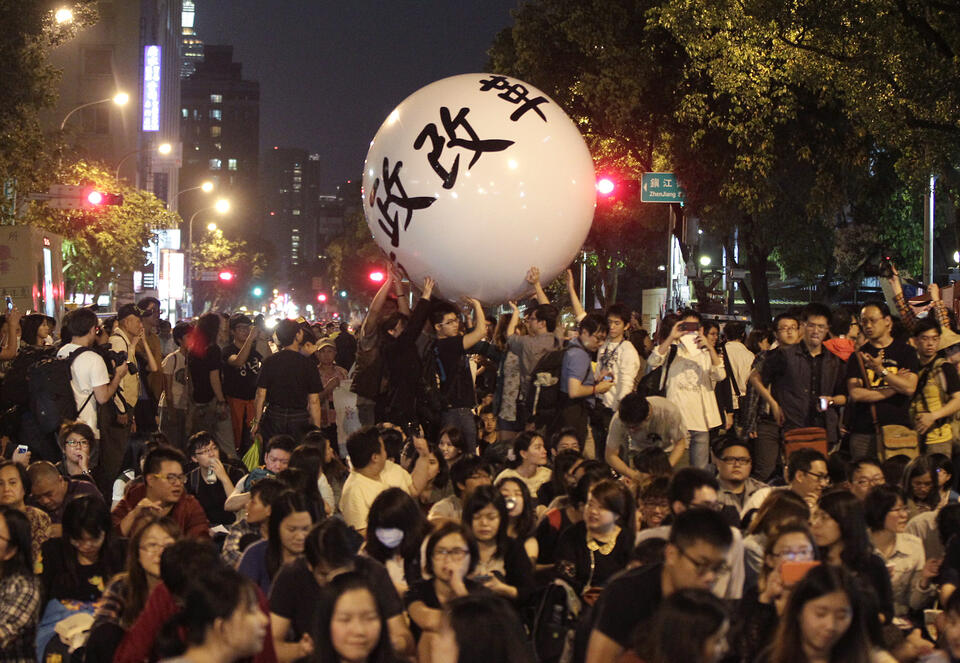 Activists push a ball reading "constitution reformation" during a sit-in to mark the one-year anniversary of the start of the Sunflower Movement outside the Legislative Yuan in Taipei March 18, 2015.
Activists push a ball reading "constitutional reform" during a sit-in to mark the one-year anniversary of the start of the Sunflower Movement outside the Legislative Yuan in Taipei March 18, 2015. Reuters/Pichi Chuang
These are unsettled times in Taiwanese politics. In recent months, prominent voices from across the spectrum have called for fundamental changes to the structure of Taiwan’s political system, ranging from simple reforms such as lowering the voting age to 18 to fundamental ones such as adopting a full presidential or parliamentary regime.
The impetus for constitutional reform has multiple sources. But at its core is a deeply problematic relationship between the executive and the legislature. When different parties controlled the two branches during the final years of the Chen Shui-bian administration, cooperation came to a standstill and governance suffered.
More surprisingly, executive-legislative confrontation returned with a vengeance in President Ma Ying-jeou’s second term, even though the ruling Kuomintang (KMT) held both the executive and a majority in the legislature. The prolonged struggle over cross-Strait agreements is only the most prominent of a series of political conflicts that have blocked the adoption of new policies and threatened the legitimacy of those that do pass. And it is not clear that the next administration and legislature will fare any better than previous ones.
For the 10th Annual Conference on Taiwan Democracy, we will consider proposals for reforms in the context of the strengths and weaknesses of Taiwan’s current constitutional structure. Among the topics to be considered at the conference are:
- Diagnosing the problems: What have been the sources and implications of political strife in Taiwan in recent years, both under divided and unified one-party control? What reforms, if any, might make these conflicts easier to resolve and increase the legitimacy of government policy-making?
- Executive type: Would switching to a different type of executive—presidential, parliamentary, or another form of semi-presidentialism—mitigate some of the disadvantages of Taiwan’s current system?
- Electoral systems: What are the problems with Taiwan’s current electoral system? What changes might mitigate some of the disadvantages?
- Direct democracy: What functions do Taiwan’s referendum and recall laws serve in practice? How would changes to these laws affect Taiwan’s democracy?
- Accountability institutions: How have Taiwan’s judiciary, Control Yuan, and prosecutorial agencies performed during periods of partisan conflict between the executive and legislative branches? How might their effectiveness be improved?
- Comparative perspectives: How does Taiwan’s recent experience with divided government and institutional reform compare to other Third Wave democracies in the region (e.g. South Korea, SE Asia) and more broadly (e.g. Latin America, Eastern Europe)?
Conference participants will help to develop a set of recommendations for a non-partisan reform agenda for Taiwan, one that is informed by a clear understanding of both the most pressing challenges facing Taiwan’s democracy and of best practices in other successful young democracies.
Conference Resources
Participant Bios
Small Parties in Taiwan's Party System
Decentralization in the Taiwanese Legislature
