Conference to examine Taiwan’s political polarization
On October 17-18, the Taiwan Democracy Project at CDDRL, with the generous support of the Taipei Economic and Culture Office, will host its annual conference at Stanford University to examine the politics of polarization in Taiwan. The conference will focus on a variety of topics, including the recent Trade in Services Agreement with China that triggered this past year’s protests, an overview of the politics of trade liberalization in Taiwan, prospects for Taiwan’s integration into the Trans-Pacific Partnership and other regional trade agreements, and a consideration of the implications for Taiwan’s long-term democratic future.
For registration and a conference agenda, please visit the event site.
The Politics of Polarization: Taiwan in Comparative Perspective
[[{"fid":"209960","view_mode":"crop_870xauto","fields":{"format":"crop_870xauto","field_file_image_description[und][0][value]":"","field_file_image_alt_text[und][0][value]":false,"field_file_image_title_text[und][0][value]":false,"field_credit[und][0][value]":"Arlene Hsu","field_caption[und][0][value]":"Taipei at night with Taipei 101. 28 February 2009.","field_related_image_aspect[und][0][value]":"0","thumbnails":"crop_870xauto"},"type":"media","field_deltas":{"1":{"format":"crop_870xauto","field_file_image_description[und][0][value]":"","field_file_image_alt_text[und][0][value]":false,"field_file_image_title_text[und][0][value]":false,"field_credit[und][0][value]":"Arlene Hsu","field_caption[und][0][value]":"Taipei at night with Taipei 101. 28 February 2009.","field_related_image_aspect[und][0][value]":"0","thumbnails":"crop_870xauto"}},"link_text":null,"attributes":{"width":"870","class":"media-element file-crop-870xauto","data-delta":"1"}}]]
Over the past year and more, Taiwan’s political elite has been deadlocked over the question of deepening economic relations with the People’s Republic of China. This controversial issue has led to a standoff between the executive and legislative branches, sparked a frenzy of social activism and a student occupation of the legislature, and contributed to President Ma Ying-jeou’s deep unpopularity.
On October 17-18, the Taiwan Democracy Project at CDDRL, with the generous support of the Taipei Economic and Culture Office, will host its annual conference at Stanford University to examine the politics of polarization in Taiwan.
This conference will bring together specialists from Taiwan, the U.S., and elsewhere in Asia to examine the sources and implications of this political polarization in comparative perspective. It will include a special case study of the Trade in Services Agreement with China that triggered this past year’s protests, as well as a more general overview of the politics of trade liberalization in Taiwan, prospects for Taiwan’s integration into the Trans-Pacific Partnership and other regional trade agreements, and a consideration of the implications for Taiwan’s long-term democratic future.
Conference speakers will include: Chung-shu Wu, the president of the Chung-hwa Institute of Economic Research (CIER) in Taipei; Steve Chan of the University of Colorado; Roselyn Hsueh of Temple University; Yun-han Chu, the president of the Chiang Ching-kuo Foundation; and Thitinan Pongsudhirak of Chulalongkorn University in Bangkok.
Panels will examine the following questions:
1. What are the sources and implications of political polarization in Taiwan, and how have these changed in recent years?
2. How does Taiwan’s recent experience compare to political polarization in other countries in Asia (e.g. South Korea, Thailand) and elsewhere (the US)?
3. To what extent does the latest political deadlock in Taiwan reflect concern over the specific issue of trade with the People’s Republic of China, versus a deeper, systemic set of problems with Taiwan’s democracy?
4. How are globalization and trade liberalization reshaping Taiwan’s domestic political economy, and what are the prospects for forging a stronger pro-trade coalition in Taiwan that transcends the current partisan divide?
The conference will take place October 17-18 in the Bechtel Conference Room in Encina Hall at Stanford University. It is free and open to the public.
Conference Resources
Conference Papers
How Cross-Strait Trade and Investment Is Affecting Income and Wealth Inequality in Taiwan by Chien-Fu Lin, National Taiwan University
Generational Differences in Attitudes towards Cross-Straits Trade by Ping-Yin Kuan, Department of Sociology & International Program in Asia-Pacific Studies, National Chengchi University
Change and the Unchanged of Polarized Politics in Taiwan by Min-Hua Huang, National Taiwan University; Center for East Asia Policy Studies, The Brookings Institution
Social Media, Social Movements and the Challenge of Democratic Governability by Boyu Chen, National Sun Yat-sen University, Institute of Political Science
Coping with the Challenge of Democratic Governance under Ma Ying-jeou by Yun-han Chu, National Taiwan University
Taiwan’s Bid for TPP Membership and the Potential Impact on Taiwan-U.S. Relations by Kwei-Bo Huang, National Chengchi University, Department of Diplomacy
In the Wake of the Sunflower Movement: Exploring the Political Consequences of Cross-Strait Integration by Pei-shan Lee, National Chung Cheng University, Political Science Department
The Roots of Thailand’s Political Polarization in Comparative Perspective by Thitinan Pongsudhirak, Chulalongkorn University; The Institute of Security and International Studies
The Role of the United States in Cross-Strait Economic Integration by Chen-Dong Tso, National Taiwan University
The China Factor and the Generational Shift over National Identity by Mark Weatherall, Taiwan Foundation for Democracy
Taiwan’s Strategy for Regional Economic Integration by Chung-Shu Wu, Chung-Hua Institution for Economic Research
Polarized Electorates in South Korea and Taiwan: The Role of Political Trust under Conservative Governments by Hyunji Lee, Institute of Asian Research, University of British Columbia
Polarization in Taiwan Politics by Steve Chan, University of Colorado, Boulder
European Union can overcome extremism vote, Stanford faculty say
Appeared in Stanford Report, May 29, 2014
By Clifton B. Parker
The electoral eruption of anti-European Union populism is a reflection of structural flaws in that body but does not represent a fatal political blow, according to Stanford scholars.
In the May 25 elections for the European Parliament, anti-immigration parties won 140 of the 751 seats, well short of control, but enough to rattle supporters of the EU, which has 28 member nations. In Britain, Denmark, France and Greece, the political fringe vote totals stunned the political establishments.
Stanford political scientist Francis Fukuyama said the rise of extremism and anti-elitism is not surprising in the wake of the 2008 economic downturn and subsequent high levels of unemployment throughout Europe. In one sense, the EU elites have themselves to blame, he said.
"The elites who designed the EU and the eurozone failed in a major way," he said. "There was a structural flaw in the design of the euro (monetary union absent fiscal union, and the method of disciplining countries once in the zone)," said Fukuyama, the Olivier Nomellini Senior Fellow at Stanford's Freeman Spogli Institute for International Studies and the Center for Democracy, Development and the Rule of Law, and Research Afflilate at The Europe Center.
Some have argued that the European Union should adopt a form of fiscal union because without one, decisions about taxes and spending remain at the national level.
As Fukuyama points out, this becomes a problem, as in the case of a debt-ridden Greece, which he believes should not have qualified for EU membership in the first place. In fact, he said, it would have been better for Greece itself to leave the euro at the outset of the 2008 crisis.
Still, Fukuyama said the big picture behind the recent election is clear – it was a confluence of issues and timing.
"It is a bit like an off-year election in the U.S., where activists are more likely to vote than ordinary citizens," he said.
Fukuyama believes the EU will survive this electoral crisis. "I think the EU will be resilient. It has weathered other rejections in the past. The costs of really exiting the EU are too high in the end, and the elites will adjust, having been given this message," he said.
Meanwhile, the populist parties in the different countries are not unified or intent on building coalitions with each other.
"Other than being anti-EU, most of them have little in common," Fukuyama said. "They differ with regard to specific positions on immigration, economic policy, and they respond to different social bases."
Ongoing anger
Dan Edelstein, a professor of French, said the largest factor for success by extremist candidates was "ongoing anger toward the austerity policy imposed by the EU," primarily by Germany.
Edelstein estimates that a large majority of French voters are still generally supportive of the EU. For the time being, the anti-EU faction does not have a majority, though they now have much more representation in the European Parliament.
Edelstein noted existing strains among the anti-EU parties – for example, the UK Independence Party in Britain has stated that it would not form an alliance with the National Front party in France.
Immigration remains a thorny issue for some Europeans, Edelstein said.
"'Immigration' in most European political debates, tends to be a synonym for 'Islam.' While there are some countries, such as Britain, that are primarily worried about the economic costs of immigration, in most continental European countries, the fears are cultural," he said.
As Edelstein put it, Muslims are perceived as a "demographic threat" to white or Christian Europe. However, he is optimistic in the long run.
"It seems a little early to be writing the obituary of the EU. Should economic conditions improve over the next few years, as they are predicted to, we will likely see this high-water mark of populist anger recede," said Edelstein.
Cécile Alduy, an associate professor of French, writes in the May 28 issue of The Nation about how the ultra-right-wing National Front came in first place in France's election.
"This outcome was also the logical conclusion of a string of political betrayals, scandals and mismanagement that were only compounded by the persistent economic and social morass that has plunged France into perpetual gloom," she wrote.
Historian J.P. Daughton said that like elsewhere in the world, immigration often becomes a contentious issue in Europe in times of economic difficulties.
"High unemployment and painful austerity measures in many parts of Europe have led extremist parties to blame immigrants for taking jobs and sapping already limited social programs," he said.
Anti-immigration rhetoric plays particularly well in EU elections, Daughton said. "Extremist parties portray European integration as a threat not only to national sovereignty, but also to national identity.
Edelstein, Alduy and Daughton are all Faculty Affiliates of The Europe Center.
Wake-up call
Russell A. Berman, a professor of German studies and comparative literature, said many Europeans perceive the EU as "somehow impenetrable, far from the civic politics of the nation states."
As a result, people resent regulations issued by an "intangible bureaucracy," and have come to believe that the European Parliament has not grappled with major issues such as mustering a coherent foreign policy voice, he said.
"The EU can be great on details but pretty weak on the big picture," said Berman, who is the Walter A. Haas Professor in the Humanities, Senior Fellow at the Hoover Institution, and Faculty Affiliate of The Europe Center. "It is this discrepancy that feeds the dissatisfaction."
Yet he points out that the extremist vote surged in only 14 nations of the EU – in the other 14, there was "negligible extremism," as he describes it.
"We're a long way from talking about a fatal blow, but the vote is indeed a wake-up call to the centrists that they have to make a better case for Europe," Berman said.
Contemporary Challenges in Global Public Health: A Discussion on How Health is an Integral Aspect of the Overall Development and Sustainability Landscape
For nearly 70 years, CARE has been serving individuals and families in the world's poorest communities. Today, they work in 84 countries around the world, with projects addressing issues from education and healthcare to agriculture and climate change to education and women's empowerment. Helene Gayle, president and CEO of CARE USA, will discuss her work with CARE and her experiences in the field of international development. Dr. Gayle will discuss how access to global health is integral to CARE's effort in addressing the underlying causes of extreme global poverty.
Dr. Michele Barry, director of the Center for Innovation in Global Health, will moderate a conversation between CARE President and CEO, Dr. Helene Gayle and former Prime Minister of Norway and United Nations Special Envoy, Dr. Gro Brundtland.
This event is sponsoredy by CARE USA, the Center on Democracy, Development and the Rule of Law and the Haas Center for Public Service.
A reception will follow the event.
Dr. Gro Brundtland Bio:
Dr. Gro Harlem Brundtland is the former prime minister of Norway and the current deputy chair of The Elders, a group of world leaders convened by Nelson Mandela and others to tackle the world’s toughest issues. She was recently appointed as the Mimi and Peter E. Haas Distinguished Visitor for spring 2014 at the Haas Center for Public Service at Stanford University. Dr. Brundtland has dedicated over 40 years to public service as a doctor, policymaker and international leader. She was the first woman and youngest person to serve as Norway’s prime minister, and has also served as the former director-general of the World Health Organization and a UN special envoy on climate change.
Her special interest is in promoting health as a basic human right, and her background as a stateswoman as well as a physician and scientist gives her a unique perspective on the impact of economic development, global interdependence, environmental issues and medicine on public health.
Dr. Helene Gayle Bio:
Helene D. Gayle joined CARE USA as president and CEO in 2006. Born and raised in Buffalo, New York, she received her B.A. from Barnard College of Columbia University, her M.D. from the University of Pennsylvania and her M.P.H. from Johns Hopkins University. After completing her residency in pediatric medicine at the Children's Hospital National Medical Center in Washington, D.C., she entered the Epidemic Intelligence Service at the Centers for Disease Control and Prevention, followed by a residency in preventive medicine, and then remained at CDC as a staff epidemiologist.
At CDC, she studied problems of malnutrition in children in the United States and abroad, evaluating and implementing child survival programs in Africa and working on HIV/AIDS research, programs and policy. Dr. Gayle also served as the AIDS coordinator and chief of the HIV/AIDS division for the U.S. Agency for International Development; director for the National Center for HIV, STD, and TB Prevention, CDC; director of CDC's Washington office; and health consultant to international agencies including the World Health Organization, UNICEF, the World Bank and UNAIDS. Prior to her current position, she was the director of the HIV, TB and reproductive health program for the Bill and Melinda Gates Foundation.
Hewlett 201
Hewlett Teaching Center
370 Serra Mall
Stanford, CA 94305
Zandanshatar Gombojav
Encina Hall
616 Serra Street
Stanford, CA 94305-6055
Zandanshatar Gombojav comes to Stanford as a Visiting Scholar at CDDRL, having recently served as the General Secretary of the Mongolian People's Party, Mongolia's largest party by membership. From 2004 until 2012, he was a Member of the Parliament of Mongolia, and from 2009 to 2012, he was Mongolia's Minister of Foreign Affairs and Trade.
Before his appointment as Foreign Minister, during which he had many foreign policy accomplishments from renewing the country's foreign policy concept to adopting new trade agreements with several partners, he had a successful career in Mongolia's banking sector, working at the Agricultural Bank, Khan Bank, and the Central Bank of Mongolia. He also served as the Deputy Minister of Agriculture, before being elected to Parliament. After graduating from the State Institute of Finance in Russia, he began his career as a Lecturer on Economics and Finance at Mongolia's Institute of Commerce and Industry.
His current research interest focuses on issues related to the democratic and political development of Mongolia given its geostrategic situation. At Stanford, he will be working on a larger research project encompassing regional democratic and political development from Mongolia's unique perspective.
He has published extensively on various banking issues and also on topics regarding the international relations process in refereed journals and different conference proceedings. He has been a strong supporter of the reform process, being actively involved in the organisation of youth development.
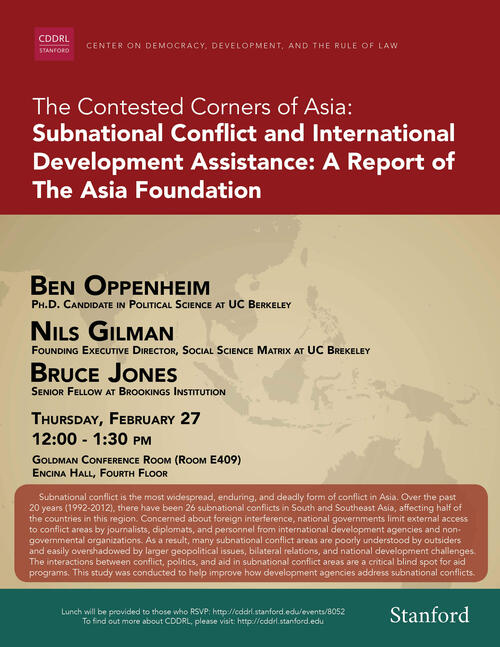
The Contested Corners of Asia: Subnational Conflict and International Development Assistance: A Report of The Asia Foundation
Abstract:
Subnational conflict is the most widespread, enduring, and deadly form of conflict in Asia. Over the past 20 years (1992-2012), there have been 26 subnational conflicts in South and Southeast Asia, affecting half of the countries in this region. Concerned about foreign interference, national governments limit external access to conflict areas by journalists, diplomats, and personnel from international development agencies and non-governmental organizations. As a result, many subnational conflict areas are poorly understood by outsiders and easily overshadowed by larger geopolitical issues, bilateral relations, and national development challenges. The interactions between conflict, politics, and aid in subnational conflict areas are a critical blind spot for aid programs. This study was conducted to help improve how development agencies address subnational conflicts.
Speaker Bios:
Ben Oppenheim is a Fellow (non-resident) at the Center on International Cooperation at New York University. His research spans a diverse set of topics, including fragile states, transnational threats (including pandemic disease risks and terrorism), and the strategic coherence and effectiveness of international assistance in fragile and conflict-affected areas.
Oppenheim has consulted for organizations including the World Bank, the United Nations, the Asia Foundation, the Institute for the Future, and the Fritz Institute, on issues including organizational learning, strategy, program design, foresight, and facilitation. In 2009, he served as Advisor to the first global congress on disarmament, demobilization, and reintegration, supported by the World Bank and the UN.
In 2013, Oppenheim was a visiting fellow at the Uppsala University Forum on Democracy, Peace, and Justice. His research has been supported by a Simpson Fellowship, and a fellowship with the Institute on Global Conflict and Cooperation. He was also a research fellow with UC Berkeley's Institute of International Studies, affiliated with the New Era Foreign Policy Project.
Nils Gilman is the Executive Director of Social Science Matrix. He holds a B.A., M.A. and Ph.D. in History from the University of California, Berkeley. Gilman’s first scholarly interest was in American and European intellectual history, with a particular focus on the institutional development of the social sciences, the lateral transfer and translation of ideas across disciplinary boundaries, and the impact of social scientific ideas on politics and policy.
Gilman is the author of Mandarins of the Future: Modernization Theory in Cold War America (Johns Hopkins University Press, 2004), the co-editor of Staging Growth: Modernization, Development, and the Global Cold War (University of Massachusetts Press, 2003) and Deviant Globalization: Black Market Economy in the 21st Century (Continuum Press, 2011), as well as the founding Co-editor of Humanity: An International Journal of Human Rights, Humanitarianism, and Development. He also blogs and tweets.
Prior to joining Social Science Matrix in September 2013, Gilman was research director at Monitor 360, a San Francisco consultancy that addresses complex, cross-disciplinary global strategic challenges for governments, multinational businesses, and NGOs. He has also worked at a variety of enterprise software companies, including Salesforce.com, BEA Systems, and Plumtree Software. Gilman has taught and lectured at a wide variety of venues, from the Harvard University, Columbia University, and National Defense University, to PopTech, the European Futurists Conference, and the Long Now Foundation.
Bruce Jones is a senior fellow and the director of the Project on International Order and Strategy in the Foreign Policy program at the Brookings Institution. He is also the director of the Center on International Cooperation at New York University.
Jones served as the senior external advisor for the World Bank’s 2011 World Development Report, Conflict, Security and Development, and in March 2010 was appointed by the United Nations secretary-general as a member of the senior advisory group to guide the Review of International Civilian Capacities. He is also consulting professor at the Center for International Security and Cooperation at Stanford University and professor (by courtesy) at New York University’s department of politics.
Jones holds a Ph.D. from the London School of Economics, and was Hamburg fellow in conflict prevention at Stanford University.
He is co-author with Carlos Pascual and Stephen Stedman of Power and Responsibility: Building International Order in an Era of Transnational Threats (Brookings Press, 2009); co-editor with Shepard Forman and Richard Gowan of Cooperating for Peace and Security (Cambridge University Press, 2009); and author of Peacemaking in Rwanda: The Dynamics of Failures(Lynne Reinner, 2001).
Jones served as senior advisor in the office of the secretary-general during the U.N. reform effort leading up to the World Summit 2005, and in the same period was acting secretary of the Secretary-General’s Policy Committee. In 2004-2005, he was deputy research director of the High-level Panel on Threats, Challenges and Change. From 2000-2002 he was special assistant to and acting chief of staff at the office of the U.N. special coordinator for the Middle East peace process.
Richard and Rhoda Goldman Conference Room
Imagining Global Health with Justice
Abstract
The scope and complexity of global health can be overwhelming, making it difficult to form an inspiring and unified vision for the future. Mired in this complexity, the international community defines success disease by disease‹without a clear picture of what fundamental reform would actually look like. If the aspiration of global health with justice is the right goal, then answering three simple questions may pierce the haze.
First, what would global health look like? That is, given optimal priority-setting, funding, and implementation, to what level of health should we aspire, and with what provision of health-related services? Posing these three elementary questions, of course, oversimplifies a field that is fraught with tensions and trade offs. But I want to imagine a more ideal future for world health, with bold proposals to get there. After thinking about these three basic questions, I turn to an idea for innovative global governance for health‹a Framework Convention on Global Health.
Second, what would global health with justice look like? Global health seeks to improve all the major indicators of health, such as infant and maternal mortality and longevity. Global health with justice, however, requires that we look beyond improved health outcomes for the population as a whole. Although overall population health is vitally important, justice requires a significant reduction in health disparities between the well-off and the poor. Societies that achieve high levels of health and longevity for most, while the poor and marginalized die young, do not comport with social justice.
Third, what would it take to achieve global health with justice? That is, once we clearly state the goal, and meaning, of global health with justice, what concrete steps are required to reach this ambitious objective? This raises fundamental challenges, intellectually and operationally, as the response cannot be limited to ever-greater resources, but must also involve improved governance‹at the country and international level and across multiple sectors.
Lawrence O. Gostin is University Professor, Georgetown University’s highest academic rank conferred by the University President. Prof. Gostin directs the O’Neill Institute for National and Global Health Law and was the Founding O’Neill Chair in Global Health Law. He served as Associate Dean for Research at Georgetown Law from 2004 to 2008. He is Professor of Medicine at Georgetown University, Professor of Public Health at the Johns Hopkins University, and Director of the Center for Law & the Public’s Health at Johns Hopkins and Georgetown Universities.
Prof. Gostin holds a number of international academic professorial appointments: Visiting Professor (Faculty of Medical Sciences) and Research Fellow (Centre for Socio-Legal Studies) at the University of Oxford, United Kingdom; the Claude Leon Foundation Distinguished Scholar and Visiting Professor at the University of Witwatersrand, Johannesburg, South Africa; and the Miegunyah Distinguished Visiting Fellow and Founding Fellow of the Centre for Advanced Studies (Trinity College), University of Melbourne. Prof. Gostin serves as Secretary and a member of the Governing Board of Directors of the Consortium of Universities for Global Health.
Building 200 (History Corner)
Room 205
Stanford University
Health and Human Rights in Burma/Myanmar
Abstract:
The peoples of Burma/Myanmar have faced military rule, human rights violations, and poor health outcomes for decades. The country Is now undergoing a political liberalization, and multiple changes in political, social and economic life. The human rights and health situation of the country's many ethnic nationalities remain challenging, and represent one of the clearest threats to the prospect of successful transition to peace, and to democracy. We will explore the current health and human rights situation in the country, the ongoing threats to peace, and ways forward for this least developed nation as it emerges from 5 decades of military rule.
Chris Beyrer MD, MPH, is a professor of Epidemiology, International Health, and Health, Behavior, and Society at the Johns Hopkins University Bloomberg School of Public Health. He is the founding Director of the University¹s Center for Public Health and Human Rights, which seeks to bring the tools of population-based sciences to bear on Health and rights threats. Dr. Beyrer also serves as Associate Director of the Johns Hopkins Centers for AIDS Research (CFAR) and of the Center for Global Health. He has been involved in health and human rights work with Burmese populations since 1993. Prof. Beyrer is the author of more than 200 scientific papers, and author or editor of six books, including War in the Blood: Sex, Politics and AIDS in Southeast Asia, and Public Health and Human Rights: Evidence-Based Approaches. He has served as a consultant and adviser to numerous national and international institutions, including the National Institutes of Health, the World Bank, WHO, UNAIDS, the Open Society Foundations, the Walter Reed Army Institute for Research, amfAR The Foundation for AIDS Research, Physicians for Human Rights and Human Rights Watch. Dr. Beyrer received a BA in History from Hobart and Wm. Smith Colleges, his MD from SUNY Downstate in Brooklyn, NY, and completed his residency in Preventive Medicine, public health training, an MPH and a Infectious Diseases Fellowship at Johns Hopkins University in Baltimore. He received an honorary Doctorate (PhD) in Health Sciences from Chiang Mai University in Thailand, in 2012, in recognition of his 20 years of public health service in Thailand
Building 200 (History Corner)
Room 205
Stanford University
Are Crowdsourced Maps the Future of Community Self-Governance? Food, Land, and Water
Abstract
Earlier generations of radicals understood themselves to be in an ongoing battle against the privatization of land and water. They instrumentalized maps in the court system as a tool for battling for native sovereignty over traditional lands, protecting the rights of squatters, and securing access to water by poor farmers in the developing world. Wherever battles for the commons take the form of a war for access to particular spaces, maps can help, whether activists are striking against high rents in the city, or protecting rivers from pollution. Today, crowdsourced maps of land, food, and water present an opportunity for makers who want to work in support of a movement. My talk will highlight some of the most and least promising frontiers ahead.
Professor Jo Guldi is presently Assistant Professor in the History of Britain and its Empire at Brown, where I teach courses related to capitalism, empire, land use, and computation. Born in Dallas, Texas, I received my AB from Harvard University, and then studied at Trinity College, Cambridge before completing my PhD in History at the University of California, Berkeley, after which I continued on to postdocs at the University of Chicago and the Harvard Society of Fellows. My first book, Roads to Power: Britain Invents the Infrastructure State (Harvard University Press, 2011), tells the story of how Britain built the first nation connected by infrastructure and technology caused strangers to stop speaking on the public street. My next monograph, The Long Land War, will tell the story of international land reform movements from the Irish land war to Movimiento sin Tierra, lingering on legal reformers and civil servants, London's dredlocked squatters and their accidental influence on World Bank Policy, and the genesis of participatory mapping from Marxist development economists in the 1970s through radical coders in contemporary Chennai.
Wallenberg Theater