Trade
-

This talk will be based on Professor Lin's new book, Taiwan's China Dilemma: Contested Identities and Multiple Interests in Taiwan's Cross-Strait Economic Policy, Stanford University Press (2016). 


Abstract

China and Taiwan share one of the world's most complex international relationships. Although their similar cultures and complementary economies promoted an explosion of commercial ties since the late 1980s, they have not led to a stable political relationship, let alone progress toward the unification that both governments once claimed to seek. In addition, Taiwan’s economic policy toward China has alternated between liberalization and restriction. Most recently, Taiwan's Sunflower Movement succeeded in obstructing deeper economic ties with China. Why has Taiwan's policy toward China been so controversial and inconsistent?

Author Syaru Shirley Lin explains the divergence between the development of economic and political relations across the Taiwan Strait and the oscillation of Taiwan’s cross-Strait economic policy through the interplay of national identity and economic interests. She shows how the debate over Taiwanese national identity has been intimately linked to Taiwan’s economic policy during a turbulent time in cross-Strait relations. Using primary sources, opinion surveys, and interviews with Taiwanese opinion leaders, she paints a vivid picture of one of the most unsettled and dangerous relationships in the contemporary world.

As Taiwan grapples with the growing importance of the Chinese economy, it also experiences the uneven socio-economic consequences of globalization. This has produced a reconsideration of the desired degree of further integration with China, especially among the younger generations. Taiwan’s China Dilemma illustrates the growing backlash against economic liberalization and regional economic integration around the world.


Biography

Image
Shirley Lin

Syaru Shirley Lin teaches political science at the University of Virginia and is a member of the founding faculty of the master’s program in global political economy at the Chinese University of Hong Kong. Her book, Taiwan’s China Dilemma: Contested Identities and Multiple Interests in Taiwan's Cross-Strait Economic Policy, was published by Stanford University Press in 2016. She graduated from Harvard College and earned her masters and Ph.D. from the University of Hong Kong. Before starting her academic career, Prof. Lin was a partner at Goldman Sachs, where she was responsible for direct investment in Asia and spearheaded the firm’s investments in many technology start-ups such as Alibaba and Semiconductor Manufacturing International Corp. Previously, she specialized in the privatization of state-owned enterprises in Singapore and China. Prof. Lin’s present board service includes Goldman Sachs Asia Bank, Langham Hospitality Investments and Mercuries Life Insurance. She also advises Crestview Partners and the Focused Ultrasound Foundation and is a member of the Hong Kong Committee for Pacific Economic Cooperation.


This event is sponsored by the Taiwan Democracy Project in the Center on Democracy, Development, and the Rule of Law. It is free and open to the public, and lunch will be served. Please RSVP by October 17.

CISAC Central Conference Room, Encina Hall, 2nd Floor

Syaru Shirley Lin Professor of Political Economy Chinese University of Hong Kong and the University of Virginia
Lectures
-

Abstract

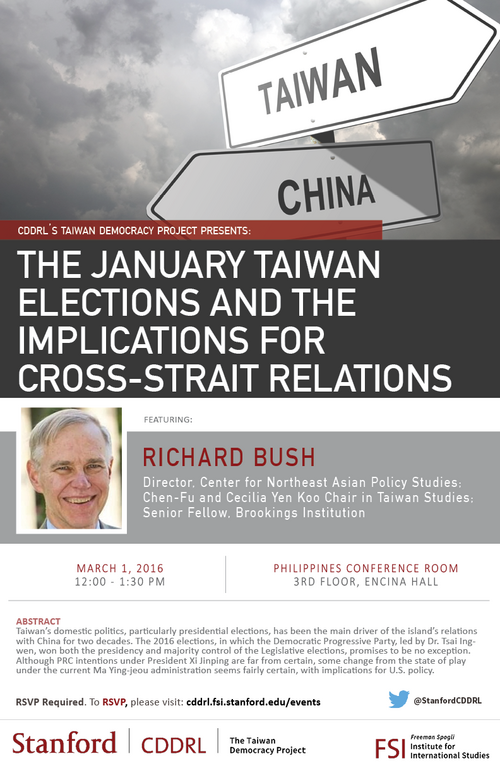
Taiwan’s domestic politics, particularly presidential elections, has been the main driver of the island’s relations with China for two decades. The 2016 elections, in which the Democratic Progressive Party, led by Dr. Tsai Ing-wen, won both the presidency and majority control of the Legislative elections, promises to be no exception. Although PRC intentions under President Xi Jinping are far from certain, some change from the state of play under the current Ma Ying-jeou administration seems fairly certain, with implications for U.S. policy.


Bio

Richard Bush is a Senior Fellow at the Brookings Institution and Director of its Center for Northeast Asian Policy Studies, and the Chen-Fu and Cecilia Yen Koo Chair in Taiwan Studies. He came to Brookings in July 2002 after nineteen years working in the US government, including five years as the Chairman and Managing Director of the American Institute in Taiwan. He is the author of a number of articles on U.S. relations with China and Taiwan, and of At Cross Purposes, a book of essays on the history of America’s relations with Taiwan, published in March 2004 by M. E. Sharpe. In the spring of 2005, Brookings published his study on cross-Strait relations, entitled Untying the Knot: Making Peace in the Taiwan Strait. In 2013, Brookings published his Uncharted Strait: The Future of China-Taiwan Relations.


This talk is co-sponsored by the Taiwan Democracy Project in the Center on Democracy, Development, and the Rule of Law and the U.S.-Asia Security Initiative in the Walter H. Shorenstein Asia-Pacific Research Center.

Image
richard bush taiwan talk flyer


Richard C. Bush Senior Fellow and Director, Center for East Asian Policy Studies Brookings Institution
Seminars
-

This half-day symposium will bring together scholars and practitioners to reconsider Taiwan's prospects for entry into the Trans-Pacific Partnership in light of the conclusion of negotiations in October 2015 and the election of a new president and legislature in Taiwan in January 2016. It will revisit the themes and conclusions of the Taiwan Democracy Project's 2013 annual conference.

9:00-9:15am: Introductions

9:15-11:00am. Panel 1: The Politics of Trade and Development in Taiwan

Stephen Tan, Vice President of the Cross-Strait Policy Association, Taipei

Kristy Hsu, Director, Taiwan ASEAN Studies Center, Chung Hua Institution for Economic Research, Taipei

Chung-ming Kuan, Chair Professor, Department of Finance and Director of CRETA at National Taiwan University, and former Minister of the National Development Council

Hung-mao Tien, President of the Institute for National Policy Research, and former Minister of Foreign Affairs, Taiwan

11:00-11:15. Break

11:15-12:45. Panel 2: International Perspectives on the TPP: Implications for Regional Development and Geopolitics

Vinod Aggarwal, Professor of Political Science and Faculty Affiliate of the Center for East Asian Studies, UC Berkeley

Nicholas Hope, Director of the China Program at the Stanford Center for International Development

Thomas Gold, Professor of Sociology and Faculty Affiliate of the Center for East Asian Studies, UC Berkeley


Audio Recording


CISAC Central Conference Room

Conferences
Authors
News Type
Blogs
Date
Paragraphs

With the announcement on Monday that an agreement has been reached on the Trans-Pacific Partnership (TPP), the controversial trade accord is in the news all across Asia this week. Taiwan is not one of the founding participants, but its leaders have reiterated their determination to join the next round of negotiations if the agreement is ratified and comes into effect. Taiwan's prospects for entry remain uncertain, however, and will depend to a great degree on the attitudes of decision-makers in the United States and the People's Republic of China.

The Taiwan Democracy Project (TDP) at the Center on Democracy, Development, and the Rule of Law has been at the forefront of research and discussion on this topic. In the fall of 2013, the TDP held a conference to explore the prospects for Taiwan’s participation in the TPP that brought together policymakers and scholars from Taiwan along with with leading specialists from other Asian countries and the U.S. The key findings of the conference are summarized in a conference report. The key conclusions of the conference remain valid today: it is in Taiwan's national interest to join the TPP; external obstacles to Taiwan's accession to the partnership are signficant but not insurmountable; and Taiwanese policy-makers need to worry about domestic obstacles as much as international ones in seeking TPP membership. 

The Taiwan Democracy Project will continue to monitor TPP-related developments over the coming months and plans to revisit Taiwan's prospects for TPP entry in a symposium in February 2016. 


Hero Image
shipping container kaohsiung harbour 1
Container ship, Hyundai Freedom, at the Port of Kaohsiung.
Tommy Ian
All News button
1
-
Abstract 
Based on first-hand participant-observation, this talk will examine the culture, politics, and spatiality of the Sunflower Movement. Taiwan's most significant social movement in decades, the Sunflower Movement not only blocked the passage of a major trade deal with China, but reshaped popular discourse and redirected Taiwan's political and cultural trajectory. It re-energized student and civil society, precipitated the historic defeat of the KMT in the 2014 local elections, and prefigured the DPP's strong position coming into the 2016 presidential and legislative election season.
 
The primary spatial tactic of the Sunflowers-- occupation of a government building-- was so successful that a series of protests in the summer of 2015 by high school students was partly conceived and represented as a "second Sunflower Movement". These students, protesting "China-centric" curriculum changes, attempted to occupy the Ministry of Education building. Thwarted by police, these students settled for the front courtyard, where a Sunflower-style pattern of encampments and performances emerged. While this movement did not galvanize the wider public as dramatically as its predecessor, it did demonstrate the staying power of the Sunflower Movement and its occupation tactics for an even younger cohort of activists.
 
The Sunflower Movement showed that contingent, street-level, grassroots action can have a major impact on Taiwan's cross-Strait policies, and inspired and trained a new generation of youth activists. But with the likely 2016 presidential win of the DPP, which has attempted to draw support from student activists while presenting a less radical vision to mainstream voters, what's in store for the future of Taiwanese student and civic activism? And with strong evidence of growing Taiwanese national identification and pro-independence sentiment, particularly among youth, what's in store for the future of Taiwan's political culture? 
 

Speaker Bio

Ian Rowen in Legislative Yuan Ian Rowen in Taiwan's Legislative Yuan during the Sunflower Student Movement protest.

Ian Rowen is PhD Candidate in Geography at the University of Colorado, Boulder, and recent Visiting Fellow at the European Research Center on Contemporary Taiwan, Academia Sinica’s Institute of Sociology, and Fudan University. He participated in both the Sunflower and Umbrella Movements and has written about them for The Journal of Asian StudiesThe Guardian, and The BBC (Chinese), among other outlets. He has also published about Asian politics and protest in the Annals of the Association of American Geographers (forthcoming) and the Annals of Tourism Research. His PhD research, funded by the US National Science Foundation, the Fulbright Program, and the Taiwan Foundation for Democracy, has focused on the political geography of tourism and protest in China, Taiwan, and Hong Kong. 


Presentation Slides

Ian Rowen Doctoral Candidate University of Colorado Dept of Geography
Seminars
-

Abstract

The Trans-Pacific Partnership (TPP) is widely regarded as the economic component of the US strategy of “rebalance” to Asia. As a major trading partner of many of the founding members, Taiwan has obvious economic and security interests at stake and is therefore seeking to join the TPP in the next round. But an overlooked aspect of the TPP for Taiwan is its potential impact on sovereignty. Trade agreements provide a revealing window into the evolving conceptions of modern sovereignty. The way Taiwan’s unique form of statehood and international status is defined in trade agreements could strengthen its position under international law and contribute to its national security. This talk will consider how Taiwan was defined as a sui generis legal entity in its application to join the World Trade Organization (WTO) and as a party to the Cross-Straits Economic Cooperation Framework Agreement (ECFA), with lessons for future negotiations to join the TPP.   


Speaker Bio

Image
Joseph Yen-ching Chao
Joseph Yen-ching Chao is an Executive Officer in the Department of International Cooperation and Economic Affairs. A member of Taiwan’s Ministry of Foreign Affairs (MOFA) diplomatic corps since 2005, he has previously served as a German-language interpreter for the Presidential Office, an officer in the Department of Treaty and Legal Affairs, and as a deputy secretary of Taiwan’s permanent mission to the World Trade Organization in Geneva, Switzerland.  He holds an LL.M. from Ruprecht-Karls University in Heidelberg and a Doctor juris from Albert-Ludwige University, Frieberg, Germany. Dr. Chao is in residence at Stanford from May-July 2015, where his research examines Taiwan’s prospects for entry into the Trans-Pacific Partnership (TPP).


This event is hosted by the Taiwan Democracy Project.

TPP and Taiwan
Download pdf
Joseph Yen-ching Chao Visiting Fellow Ministry of Foreign Affairs, Republic of China (Taiwan)
Seminars
Paragraphs

Abstract:

The levels of violence in Mexico have dramatically increased in the last few years due to structural changes in the drug trafficking business. The increase in the number of drug trafficking organizations (DTOs) fighting over the control of territory and trafficking routes has resulted in a substantial increase in the rates of homicides and other crimes. This study evaluates the economic costs of drug-related violence. We propose electricity consumption as an indicator of the level of municipal economic activity and use two different empirical strategies to test this. We utilize an instrumental variable regression using as exogenous variation the instrument proposed by Castillo, Mejía, and Restrepo (2013) based on historical seizures of cocaine in Colombia interacted with the distance of the Mexican border towns to the United States. We find that marginal increases of violence have negative effects on labor participation and the proportion of unemployed in an area. The marginal effect of the increase in homicides is substantive for earned income and the proportion of business owners, but not for energy consumption. We also employ the methodology of synthetic controls to evaluate the effect that inter-narco wars have on local economies. These wars in general begin with a wave of executions between rival criminal organizations and are accompanied by the deterioration of order and a significant increase in extortion, kidnappings, robberies, murders, and threats affecting the general population. To evaluate the effect that these wars between different drug trafficking organizations have on economic performance, we define the beginning of a conflict as the moment when we observe an increase from historical violence rates at the municipal level beyond a certain threshold, and construct counterfactual scenarios as an optimal weighted average from potential control units. The analysis indicates that the drug wars in those municipalities that saw dramatic increases in violence between 2006 and 2010 significantly reduced their energy consumption in the years after the change occurred.

All Publications button
1
Publication Date
Authors
Beatriz Magaloni
Gabriela Calderón
Subscribe to Trade