Democracy promotion
Paragraphs

The year was 1909, and Gifford Pinchot, Chief Forester of the United States, faced a terrible personal dilemma.  He had discovered a pattern of corruption in the sale of public lands to developers and other private interests. But the new president, William Howard Taft, depended on support from western Republicans and had placed a gag order on the whole affair. Pinchot was outraged at this evidence of corruption reaching the White House, but he wanted to give Taft a fair hearing.  The new president had, after all, vowed to support conservation and strong control over federal lands. Taft invited Pinchot to the White House, where he alternately implored Pinchot not to go public with the matter and threatened him with dismissal if he violated the gag order. Pinchot had in his pocket a letter that could expose the scandal. This case explores the dilemma of Pinchot, a mid-level bureaucrat dependent on a president’s good will, and the strategies available to him. It shows the power of a single leader and the similarities the United States once had with many developing nations struggling with widespread corruption. 


Case studies are integral teaching tools for the Leadership Academy for Development workshops conducted around the world.

All Publications button
1
Publication Type
Case Studies
Publication Date
Authors
Francis Fukuyama
News Type
News
Date
Paragraphs

The Center on Democracy, Development and the Rule of Law (CDDRL), in partnership with Chatham House and the United States Institute of Peace (USIP), recently held a conference on state-strengthening in Afghanistan. Bringing together leading specialists from government, NGOs and academia, the conference examined lessons from state-strengthening efforts in Afghanistan over the past fourteen years and identified best practices that could help support the country’s future development and inform other international interventions. The conference was held at the USIP headquarters in Washington, D.C., from March 16-17.

CDDRL Affiliated Scholar Karl Eikenberry delivered a keynote address at the conference, reflecting on his experiences both as U.S. ambassador and military commander in Afghanistan.  He emphasized the importance of building national security forces in ways that will ensure their political reliability and coherence, and he contrasted the U.S. experience in Afghanistan with Iraq. Amb. Eikenberry also discussed the failure of the U.S. military to designate the training of the Afghan security forces as its main effort. Instead, it spent far more resources conducting its own unilateral combat and civil-military operations. To view a video of Eikenberry's address, please see below.

The conference was also attended by CDDRL Affiliated Faculty Member Erik Jensen, who presented a paper on lessons learned from attempts to build the rule of law in Afghanistan. Jensen is a professor of the practice of law at Stanford Law School, where he also directs the school's Rule of Law Program. He currently serves as faculty advisor to the Afghanistan Legal Education Project, an ongoing student-driven project aimed at establishing a legal curriculum at the American University of Afghanistan. To read more on Jensen's work and his commentary on the conference, please see this Q&A published in the April 2015 edition of the Stanford Lawyer.

Conference speakers advised that in order to secure sustained peace in Afghanistan, the international community must commit to long-term projects aimed at developing critical government institutions and civil society, promoting long-term sustainable economic growth, and improving the performance of the army and police.

Both Eikenberry and Jensen contributed to the policy statement sent to American and Afghan policy makers on the eve of Afghan President Mohammad Ashraf Ghani's visit to the U.S. They are currently working on a co-authored policy piece with colleagues from the United States Institute of Peace and Chatham House that will be published later this month.


Hero Image
20150316 state strengthening afghanistan event
Karl Eikenberry with Dr. Ali Jalali on a panel on stabilizing Afghanistan.
USIP Staff
All News button
1
Authors
News Type
Commentary
Date
Paragraphs

As part of the Arab Reform and Democracy Program's speaker series, University of Richmond Political Scientist Sheila Carapico discussed findings from her ground-breaking study Political Aid and Arab Activism: Democracy Promotion, Justice, and Representation (Cambridge University Press, 2013) which explores two decades’ worth of projects sponsored by American, European, and other transnational agencies in four key sub-fields: the rule of law, electoral design and monitoring, female empowerment, and civil society. European and US-based scholars and practitioners have debated the purposes and sometimes the (limited) macro-effects of programs designed to promote transitions from authoritarianism to democracy in Middle East countries. Yet this discussion often lacks analysis of on-the-ground experiences or ignores the cumulative wisdom of local counterparts and intermediaries. Carapico discussed controversies and contradictions surrounding projects in Egypt, Palestine, and Iraq (the three main cases) and Jordan, Morocco, Yemen, Algeria, Tunisia, and Lebanon (where democracy brokers also work) to help explain why so many feminists and other advocates for justice, free elections, and civic agency concluded that foreign funding is inherently political and paradoxical.


Hero Image
sheila shot
All News button
1
-

Abstract

In 2010-2011, the "Arab Spring" brought unexpected revolutions to many Middle Eastern and North African countries. Why did these seemingly invincible regimes fall, while China remained durably authoritarian? Many observers credited global media for the political transformations. While the hopes of Arab Spring democracy have proven to be fragile or short-lived, we can effectively explore the relationship between political communication and regime stability by turning our attention to Taiwan’s remarkable democratization, which remains under-appreciated by the international community.

This talk considers political communication in Taiwan from the martial law era to the heady days of democratic activism beginning in the late 1970s and lasting till the 1990s. Professor Esarey argues that the Chiang Ching-kuo administration’s diminishing capacity to control a small but influential opposition (dangwai) media, and even mainstream newspapers, gradually permitted reformers to reframe debates, reset the political agenda, and challenge state narratives and legitimacy claims. 

When viewed in comparative perspective, Taiwan’s successful democratization suggests that seeking regime change is impracticable, and even perilous, without considerable and sustainable media freedom as well as opportunities for the public to advocate, evaluate, and internalize alternative political views. A balance of “communication power” between state and societal actors facilitates a negotiated and peaceful transition from authoritarianism.


Bio

Professor Ashley Esarey received his PhD in Political Science from Columbia University and was awarded the An Wang Postdoctoral Fellowship by Harvard University. He has held academic appointments at Middlebury College, Whitman College, and the University of Alberta, where he is an instructor in the departments of East Asian Studies and Political Science and a research associate of the China Institute. Esarey has written on democratization and authoritarian resilience, digital media and politics, and information control and propaganda. His recent publications include My Fight for a New Taiwan: One Woman’s Journey from Prison to Power (with Lu Hsiu-lien) and The Internet in China: Cultural, Political, and Social Dimensions (with Randolph Kluver).


Communication Power and Taiwan's Democratization
Download pdf
Ashley Esarey Research Associate, China Institute University of Alberta
Seminars
-

Is communication technology conducive to collective violence? Recent studies have provided conflicting answers to the same question. While some see the introduction of cellular communication as a contributing factor to civil conflict in Africa (Pierskalla and Hollenbach APSR 2013), others ascribe an opposite effect to mobile communications in Iraq (Shapiro and Weidmann IO forthcoming). During the talk, I will further explore the logic behind "Why the revolution will not be tweeted", and argue that the answer lies in contagion processes of collective action at the periphery, not the hierarchical schemes of central coordination as was argued before. To provide evidence, I will draw on historical accounts of social revolutions, a GIS study of the Syrian Civil War, a convenience survey sample from the 2011 Egyptian Revolution, as well as network experiments of collective risk-taking in a controlled setting.

Speaker Bio

photo 26 Navid Hassanpour
Navid Hassanpour (Ph.D.s in Political Science from Yale'14, and Electrical Engineering from Stanford'06) studies political contestation, in its contentious and electoral forms. Following an inquiry into collective and relational dimensions of contentious politics, currently he is working on a project that examines the history, emergence, and the dynamics of representative democracy outside the Western World. This year he is a Niehaus postdoctoral fellow at Princeton's Woodrow Wilson School of public and International Affairs. His work has appeared in Political Communication as well as IEEE Transactions on Information Theory. His book project, Leading from the Periphery, is under consideration at Cambridge University Press' Structural Analysis in the Social Sciences Series.

This event is part of the Liberation Technology Seminar Series

NEW LOCATION

School of Education 

Room 128

Navid Hassanpour Postdoctoral Research Associate, Niehaus Center for Globalization and Governance (NCGG)
Seminars
-

Three years ago, world leaders from 8 countries came together to launch the Open Government Partnership (OGP) - a multi-stakeholder initiative that brings together domestic reformers committed to making their governments more open, accountable and responsive to citizens. Since then, the partnership has rapidly grown from 8 to 65 countries. In this talk, Linda Frey speaks about OGP's new approach to multilateralism, and how the uniqueness of its model is helping to spur progress on concrete open government reforms in a diverse group of countries.  Frey will draw on the findings of OGP's Independent Reporting Mechanism to speak to early successes, as well as implementation challenges and areas for further study.  


Speaker Bio

Image
Munyema Hasan

Munyema Hasan

Program Officer
Open Government Partnership, Support Unit

Munyema joined the OGP Support Unit in January 2014 as Program Officer. She has spent the past four years working in the field of transparent and accountable governance, with organizations like the World Bank, International Budget Partnership, Stanford University and the Affiliated Network for Social Accountability. Munyema holds a M.Sc. in Development Studies from the London School of Economics and a B.A. in Economics and Political Science from the American University in Cairo, Egypt and the University of California, Berkeley.

This event is part of the Liberation Technology Seminar Series

PLEASE NOTE: NEW ROOM

School of Education 

Room 128


Munyema Hasan Open Government Partnership
Seminars
Date Label
Authors
News Type
Q&As
Date
Paragraphs

Massive pro-democracy protests in Hong Kong reflect a direct challenge to the Chinese government, according to Stanford professor Larry Diamond. The younger Hong Kong generation has greater expectations of democratic freedoms, and Communist Party rule in China may be in its final decade, he said.

The street demonstrators in Hong Kong could have serious implications for political stability in China and the future of its Communist Party, a Stanford scholar says.

In an interview with Stanford News Service, Larry Diamond, a senior fellow at the Hoover Institution and the director of the Center on Democracy, Development and the Rule of Law at the Freeman Spogli Institute, discussed the Hong Kong situation.

In 2007, China promised that Hong Kong residents could vote for the chief executive of Hong Kong in a 2017 popular vote. However, on Aug. 31, China's legislature proposed changes that in effect closed the voting process – igniting widespread protests in the streets of Hong Kong. A former British colony of 7.2 million people, Hong Kong was handed over to China in 1997.


What rights do Hong Kong citizens have that are different from people on mainland China?

Under the principle of "one country, two systems" – known as the Basic Law – Hong Kong was promised the right to keep its capitalist way of life and its political autonomy, with civil freedoms and a rule of law, at least through 2047, 50 years after the handover of power in 1997.

But under pressure from Beijing, there has been gradual subtle erosion of academic freedom and press freedom, and increasing political control from Beijing. Still, as of today, Hong Kong has a level of civil freedom – freedom of speech, press and association – that people in mainland China can only dream of, and it has democratic elections for about half of its legislative seats.


How do you describe the Chinese government's reaction to the protests?

I think the Beijing authorities have been stunned by the intensity and scope of the protests, and quite unprepared. They are in a dilemma. They do not want to perpetrate another bloodbath like the crackdown on Tiananmen Square in 1989. Yet neither do they want to allow the protests to just continue to occupy large parts of central Hong Kong and press democratic demands.

Finally, they do not want to do what they should have done months ago – negotiate on some compromise formula to at least allow "gradual and orderly progress," as envisioned in the Basic Law, toward democracy in Hong Kong. They are in a bind, which could have serious implications ultimately for political stability in China itself.


Are the Chinese authorities surprised at the magnitude of the protests, and if so, why?

Yes, they thought that the people of Hong Kong would just swallow hard and surrender their dreams of democratic self-governance, just as they have accepted previous impositions by Beijing essentially blocking or deferring democratic progress. But Hong Kongers are fed up by now; they have been waiting for 17 years for China to deliver on the implicit promise in the Basic Law for democratic elections through universal suffrage to choose their chief executive.

And this is a new, more tech-savvy and democratically self-conscious generation of young Hong Kongers who have higher expectations, worse job prospects and more social media tools at their disposal. This emerging generation in Hong Kong is mad as hell, and they are not going to take it anymore.


Will this challenge Beijing's typical strategy for dealing with dissent and protests?

I think the Beijing authorities are really in a serious bind. Their frequent strategy in dealing with local-level protests is to try to grant some specific demands to mollify protestors and then isolate and arrest some of the harder-line protest elements. But the Hong Kong protests are so big and so visible, and the demands of the protestors – essentially, for democratic elections in Hong Kong – so risk the democratic "virus" spreading to the rest of China that the Beijing authorities do not feel they can make significant concessions.

If they crack down with brutal force, it will be Tiananmen all over again, and their international reputation will be badly damaged, along with any prospect of closer integration with Taiwan. If they negotiate under pressure, they fear setting a dangerous and highly visible precedent. If they do nothing, they may hope it just blows over as demonstrators get tired. I think that will be their initial strategy. If it does not work, they may dump Hong Kong Chief Executive C.Y. Leung to serve up a sacrificial lamb. Then, if that does not work, they are really in trouble.


What do you envision as the likely outcome of the protests?

I really do not know. They could gradually subside from exhaustion, but I think this is a new generation of Hong Kongers that is not going to simply melt away into passivity again. They could recur periodically, or just keep growing, while paralyzing normal business and governance in Hong Kong. If the latter happens, Beijing may decide it has to use force. I hope they don't do that. If the Beijing leadership was smart, they would negotiate a compromise agreement to allow gradual progress toward democratic self-governance. But I think they are too gripped with political fear of the future to risk that.

This could well mutate into a larger if more incremental challenge to the overall legitimacy of Communist Party rule. And if the increasingly vulnerable Chinese economy should slip into crisis before stability is returned to Hong Kong, then all bets are off. I think the profundity of this crisis in Hong Kong and the blunt and clumsy intransigence of China's leadership in responding to it are two more signs that Communist Party rule in China may be in its final decade.

The system is too politically rigid and the leadership is too conservative to respond creatively to a fundamental political crisis. I hope I am wrong about that, because it would be much better for China and the world if political change were to happen there through incremental reform rather than another massive societal upheaval.

To paraphrase John F. Kennedy, those who make peaceful reform impossible make sudden revolutionary change inevitable.


Media Mentions

Larry Diamond writes in Time, "Xi Jinping Could Be China's Last Communist Ruler" -Time (Oct. 1, 2014)

Larry Diamond in an interview with Fox Business News, "Why Xi Jinping won't repeat the Tiananmen Square incident in Hong Kong" (Oct. 1, 2014)

Larry Diamond mentioned in The New York Times for China, "Limited Tools to Quell Unrest in Hong Kong" -The New York Times (China) (Sept. 30, 2014)


Hero Image
rtr48f93
Paul Zimmerman, a district councillor, raises a yellow umbrella as Hong Kong Chief Executive Leung Chun-ying (5th R) and other officials make a toast to guests at a reception following a flag raising ceremony in Hong Kong October 1, 2014.
REUTERS/Bobby Yip
All News button
1
0
erin_baggot_carter_2025.jpg

Erin Baggott Carter (赵雅芬) is an Associate Professor at the Department of Political Science and International Relations at the University of Southern California and a Hoover Fellow at Stanford University's Hoover Institution. She is also a non-resident scholar at the UCSD 21st Century China Center. She has previously held fellowships at Stanford's Center on Democracy, Development and the Rule of Law and the Center for International Security and Cooperation. She received a Ph.D. in Political Science from Harvard University.

Dr. Carter's research focuses on Chinese politics and propaganda. Her first book, Propaganda in Autocracies (Cambridge University Press), explores how political institutions determine propaganda strategies with an original dataset of eight million articles in six languages drawn from state-run newspapers in nearly 70 countries. She is currently working on a book on how domestic politics influence US-China relations. Her other work has appeared in the British Journal of Political ScienceJournal of Conflict ResolutionSecurity Studies, and International Interactions. Her work has been featured by a number of media platforms, including the New York Times and the Little Red Podcast.

Her research has been supported by the Chiang Ching-kuo Foundation, the Smith Richardson Foundation, the Center for International Studies at the University of Southern California, the Weatherhead Center for International Affairs at Harvard University, the Fairbank Center for Chinese Studies at Harvard University, and the Institute for Quantitative Social Science at Harvard University.

Dr. Carter regularly tweets about Chinese politics and propaganda at @baggottcarter. She can be reached via email at baggott [at] usc.edu or ebaggott [at] stanford.edu.

Hoover Fellow
CDDRL Affiliated Scholar
CDDRL Visiting Scholar, 2020-2021
CISAC Affiliate
Date Label
-

Speaker bio:

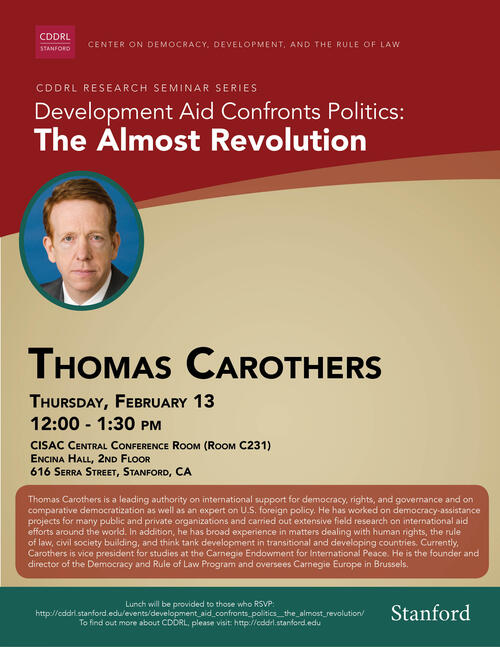
Thomas Carothers is vice president for studies at the Carnegie Endowment for International Peace. He is the founder and director of the Democracy and Rule of Law Program and oversees Carnegie Europe in Brussels.

Carothers is a leading authority on international support for democracy, rights, and governance and on comparative democratization as well as an expert on U.S. foreign policy. He has worked on democracy-assistance projects for many public and private organizations and carried out extensive field research on international aid efforts around the world. In addition, he has broad experience in matters dealing with human rights, the rule of law, civil society building, and think tank development in transitional and developing countries.

He is the author of six critically acclaimed books as well as many articles in prominent journals and newspapers. Carothers has also worked extensively with the Open Society Foundations (OSF), including currently as chair of the OSF Think Tank Fund and previously as chair of the OSF Global Advisory Board. He is an adjunct professor at the Central European University in Budapest and was previously a visiting faculty member at Nuffield College, Oxford University, and Johns Hopkins SAIS.

Prior to joining the Endowment, Carothers practiced international and financial law at Arnold & Porter and served as an attorney adviser in the Office of the Legal Adviser of the U.S. Department of State.

Carothers is the co-author (with Diane de Gramont) of Development Aid Confronts Politics: The Almost Revolution (Carnegie, 2013) and author of Confronting the Weakest Link: Aiding Political Parties in New Democracies (Carnegie, 2006); Promoting the Rule of Law Abroad: In Search of Knowledge (Carnegie, 2006); Uncharted Journey: Promoting Democracy in the Middle East, co-edited with Marina Ottaway (Carnegie, 2005); Critical Mission: Essays on Democracy Promotion (Carnegie, 2004); Funding Virtue: Civil Society Aid and Democracy Promotion, co-edited with Marina Ottaway (Carnegie, 2000); Aiding Democracy Abroad: The Learning Curve (Carnegie, 1999); and Assessing Democracy Assistance: The Case of Romania (Carnegie, 1996).

Image

CISAC Conference Room

Thomas Carothers Vice President for Studies Speaker Carnegie Endownment for International Peace
Seminars
-

Abstract:

The U.S. and the E.U. are often seen as fundamentally different democracy promoters. It has been argued that the U.S. has a more political approach, which is confrontational vis-à-vis host governments and promotes democracy bottom-up via civil society. The E.U., on the other hand, is perceived as more developmental, focusing on non-confrontational projects that are mostly top-down or focused on civil society organizations not critical of the government. The U.S.’s political approach has been criticized for being too donor-led, unilateral, and hardly respecting country ownership. But should American democracy assistance become more European?

Based on research on E.U. and U.S. democracy assistance programs in Ethiopia, CDDRL Postdoctoral Fellow Karen Del Biondo explains the causes and consequences of a political and developmental approach to democracy assistance. She argues that the E.U. has indeed taken a more developmental approach, which can be explained by the European Commission’s commitment to the Paris Declaration principles on aid effectiveness, including ownership, alignment and, harmonization. This was possible because of the relatively autonomous position of the Commission vis-à-vis the Member States and the European Parliament. In contrast, USAID does not enjoy this bureaucratic autonomy, and has therefore paid lip service to aid effectiveness. Del Biondo discusses the advantages and disadvantages of a political and developmental approach in a semi-authoritarian regime such as Ethiopia. She finds that, although the impact of E.U. democracy assistance in Ethiopia can be questioned, the E.U.’s developmental approach has made the government of Ethiopia more open to E.U. democracy assistance, while the U.S.’s political approach led to a backlash.

Speaker Bio:

Karen Del Biondo is a 2012-2013 postdoctoral fellow at the CDDRL. Her research is funded with a Fulbright-Schuman award and a postdoctoral grant from the Belgian-American Educational Foundation (BAEF). She holds an MA in Political Science (International Relations) from Ghent University and an MA in European Studies from the Université Libre de Bruxelles. In 2007-2008 she obtained a Bernheim fellowship for an internship in European affairs at the Belgian Ministry of Foreign Affairs and Permanent Representation to the EU. 

Karen Del Biondo obtained her PhD at the Centre for EU Studies, Ghent University in September 2012 with a dissertation entitled ‘Norms, self-interest and effectiveness: Explaining double standards in EU reactions to violations of democratic principles in sub-Saharan Africa’. Her PhD research was funded by the Flemish Fund for Scientific Research (FWO). Apart from her PhD research, she has been involved in the research project ‘The Substance of EU Democracy Promotion’ (Ghent University/University of Mannheim/Centre of European Policy Studies) and has published on the securitisation of EU development policies. In January 2011 she conducted field research in Addis Ababa, Ethiopia. Her postdoctoral research will focus on the comparison between EU and US democracy assistance in sub-Saharan Africa.

Philippines Conference Room

Encina Hall
616 Serra Street
Stanford, CA 94305-6055

0
Fulbright and BAEF postdoctoral fellow 2012-2013
del_biondo.jpg

Karen Del Biondo is a 2012-2013 postdoctoral scholar at CDDRL. Her research is funded with a Fulbright-Schuman award and a postdoctoral grant from the Belgian-American Educational Foundation (BAEF). She holds an MA in Political Science (International Relations) from Ghent University and an MA in European Studies from the Université Libre de Bruxelles. In 2007-2008 she obtained a Bernheim fellowship for an internship in European affairs at the Belgian Ministry of Foreign Affairs and Permanent Representation to the EU. 

Karen Del Biondo obtained her PhD at the Centre for EU Studies, Ghent University in September 2012 with a dissertation entitled ‘Norms, self-interest and effectiveness: Explaining double standards in EU reactions to violations of democratic principles in sub-Saharan Africa’. Her PhD research was funded by the Flemish Fund for Scientific Research (FWO). Apart from her PhD research, she has been involved in the research project ‘The Substance of EU Democracy Promotion’ (Ghent University/University of Mannheim/Centre of European Policy Studies) and has published on the securitisation of EU development policies. In January 2011 she conducted field research in Addis Ababa, Ethiopia. Her postdoctoral research will focus on the comparison between EU and US democracy assistance in sub-Saharan Africa.

Karen Del Biondo’s recent publications include: ‘Security and Development in EU External Relations: Converging, but in which direction?’ (with Stefan Oltsch and Jan Orbie), in S. Biscop & R. Whitman (eds.) Handbook of European Union Security, Routledge (2012); ‘Democracy Promotion Meets Development Cooperation: The EU as a Promoter of Democratic Governance in Sub-Saharan Africa’, European Foreign Affairs Review, Vol. 16, N°5, 2011, 659-672; and ‘EU Aid Conditionality in ACP Countries. Explaining Inconsistency in EU Sanctions Practice’, Journal of Contemporary European Research, Vol. 7, N°3, 2011, 380-395.

Karen Del Biondo Postdoctoral fellow 2012-13 Speaker CDDRL
Seminars
Subscribe to Democracy promotion