Democracy
Authors
News Type
News
Date
Paragraphs

When Michael McFaul steps down from his post as Washington’s ambassador to Moscow later this month, he will return to Stanford where he is a senior fellow at the Freeman Spogli Institute for International Studies (FSI) and a former director of the institute’s Center on Democracy, Development, and the Rule of Law (CDDRL).

Announcing his decision this week to leave Russia following the Winter Olympics, McFaul wrote on his blog that "it is time to come home."

"We are immensely proud of the service Michael McFaul has rendered in these past five years of steering U.S. policy toward Russia, first at the National Security Council and then for the past two years as U.S. Ambassador to Russia," said CDDRL Director Larry Diamond. "During this time, he has navigated skillfully through some of the toughest challenges in U.S. foreign policy, showing that it is possible for the United States to advance its strategic interests while also standing up for its values of freedom, democracy and an open society."  

At Stanford, McFaul will resume his academic activities as a professor in the department of political science, a resident faculty member at CDDRL and the Peter and Helen Bing Senior Fellow at the Hoover Institution.

"Ambassador McFaul's return is a sterling opportunity for Stanford and FSI," said FSI Director Mariano-Florentino Cuéllar. "His unique experience as a diplomat and a leading scholar are enormous assets to our centers and educational programs, and to the entire university."

McFaul has worked in the Obama administration for the past five years, and was tapped as ambassador in 2011. He arrived in Russia with the mandate to reset relations with Moscow, which proved to be challenging in a political climate marked by increasing tensions between the two countries. From the ban on U.S. adoptions to the Edward Snowden affair, McFaul faced many setbacks as he embarked on his political mandate.

Nevertheless, McFaul leaves Moscow citing major gains in improving trade and tourism between the two countries, having worked to secure Russia's membership to the World Trade Organization and a new visa regime. He was also integral to negotiating the historic agreement with Russia to eliminate Syrian chemical weapons.

U.S. Secretary of State John Kerry praised McFaul's service in a statement released by the U.S. State Department, "From the New START Treaty to securing Russian cooperation on Iran’s nuclear program, to resupplying our troops in Afghanistan and expanding our trade, there’s scarcely an issue in our bilateral agenda that didn’t benefit from Mike’s steady hand and good old fashioned willpower."

Kerry continued to commend McFaul's deep commitment and engagement with Russian civil society on human rights and the independent media, which often invoked tension with the Russian government.

McFaul was a trailblazer in public diplomacy, using the social media platforms Twitter and Facebook to connect to audiences in Russia and beyond. In his blog, McFaul admits to never having sent a tweet before his time as ambassador but now reaches over 60,000 followers through his Twitter account.

"He grasped the importance of social media in an information age, but he also grasped a much more essential truth: that all people everywhere should be able to express themselves and, ultimately, determine how they are governed," said Kerry. "That’s an enduring conviction, and Mike leaves behind an enduring legacy."

Hero Image
Feb 14 McFaul Logo
McFaul is seen here with President Barack Obama outside Air Force One. McFaul's departure will mark the end of over five-years of work for President Obama's administration.
Michael McFaul
All News button
1
-

*This event is free and open to the public.*


PANELISTS

Don Emmerson - Director of the Southeast Asia Forum, Shorenstein Asia-Pacific Research Center; Affiliated Scholar, Abbasi Program in Islamic Studies; Affiliated Faculty, CDDRL

Erik Jensen - Professor of the Practice of Law, Stanford Law School; Senior Advisor for Governance and Law, The Asia Foundation; Senior Research Scholar, CDDRL; Director, Rule of Law Program, Stanford Law School

Norman Naimark - Director of the Stanford Global Studies Division; Professor of History

Diane H. Steinberg (Panel Chair) - Visiting Scholar at Stanford's Program on Human Rights, Center on Democracy, Development, and the Rule of Law (CDDRL)


Image

 
The Act of Killing visits former Indonesian death squad killers who wreaked havoc in 1965 and 1966 in the aftermath of Indonesia's military coup and yet have never been held accountable for slaughtering between 200,000 to 2 million people in a genocide often forgotten.  The dramatic reenactments of the murders in the documentary catalyze an unexpected emotional journey for Anwar Congo from arrogance to regret as he confronts for the first time in his life the full implications of what he has done.
 
The Act of Killing is an award-winning documentary film directed by Joshua Oppenheimer with co-director Christine Cynn and and an anonymous co-director from Indonesia. It is a Danish-British-Norwegian co-production, presented by Final Cut for Real in Denmark and produced by Signe Byrge Sørensen. It was recently nominated for an Academy Award for Best Documentary Feature.

"Director Joshua Oppenheimer has made a documentary in which he interviews the leaders of Indonesian death squads, who were responsible, collectively, for the deaths of millions of Communists, leftists and ethnic Chinese in 1965 and 1966. But he doesn't just interview them. He has them re-enact their crimes and even invites them to write, perform and film skits dramatizing their murders." Mick LaSalle, San Francisco Chronicle, 8/8/2013
 
"The Act of Killing is a bold reinvention of the documentary form, as well as an astounding illustration of man's infinite capacity for evil." Rene Rodriguez, The Miami Herald, 8/15/2013
 
After the screening of the  Director's Cut of The Act of Killing (160 minutes), there will be a thirty-minute panel discussion.
 
For more information regarding the film, please visit: http://theactofkilling.com/.
 
This event is presented and sponsored by Stanford Global Studies, CDDRL's Program on Human Rights, and the Vice Provost of Undergraduate Education.

Cubberley Auditorium

Conferences
-

Abstract
Social media and new technology are being harnessed for social benefit in contexts from healthcare, economic development, and sustainable energy to civic engagement and government transparency in California and worldwide. The Center for Information Technology Research in the Interest of Society (CITRIS) takes an interdisciplinary approach to addressing these problems and promoting innovation for students, faculty and entrepreneurs. In this talk, I will give a short overview of CITRIS's programs and initiatives, before diving into specific projects in the areas I lead: the Data and Democracy Initiative and the Social Apps Lab.

Camille Crittenden joined the Data and Democracy Initiative as Director in May 2012 and was named Deputy Director of CITRIS in May 2013. Prior to this appointment, she served as Executive Director of the Human Rights Center at Berkeley Law, where she was responsible for overall administration of the Center, including fundraising, communications, and outreach, and helped to develop its program in human rights, technology, and new media. She held previous positions as Assistant Dean for Development in the division of International and Area Studies at UC Berkeley and in development and public relations at University of California Press and San Francisco Opera. She holds a Ph.D. from Duke University.


Wallenberg Theater

Camille Crittenden Deputy Director, CITRIS & Director, Data and Democracy, CITRIS Speaker UC Berkeley
UC Berkeley


Speaker
Speaker


Speaker
Seminars
Date Label
Paragraphs

On Oct. 11-12, 2013, the Taiwan Democracy Project convened a conference on “The Trans-Pacific Partnership and Taiwan’s Future Development Strategy” at Stanford. The meeting was sponsored by the Center on Democracy, Development, and the Rule of Law (CDDRL) and the Shorenstein Asia-Pacific Research Center (APARC) at Stanford University, and supported with generous funding from the Taipei Economic and Cultural Office in San Francisco.

The conference brought together an impressive collection of academics, government officials, and policy-makers from Taiwan, the U.S., and many other countries in the Asia-Pacific region for a frank, wide-ranging set of discussions of the Trans-Pacific Partnership and its potential impact on Taiwan.

All Publications button
1
Publication Type
Policy Briefs
Publication Date
Authors
Paragraphs

In an article published in the January 2014 issue of Current History, Larry Diamond urges civil society and policy leaders to stay optimistic about democracy’s future, arguing that its historical moment has not passed. Despite recent examples of democratic breakdowns, particularly in the Middle East and North Africa, Diamond claims that values are shifting, giving way to an empowered and vocal citizenry, which may pressure governments toward more accountable and democratic forms of rule. 

All Publications button
1
Publication Type
Journal Articles
Publication Date
Journal Publisher
Current History
Authors
Larry Diamond
Paragraphs

New Challenges for Maturing Democracies in Korea and Taiwan takes a creative and comparative view of the new challenges and dynamics confronting these maturing democracies.

Numerous works deal with political change in the two societies individually, but few adopt a comparative approach—and most focus mainly on the emergence of democracy or the politics of the democratization processes. This book, utilizing a broad, interdisciplinary approach, pays careful attention to post-democratization phenomena and the key issues that arise in maturing democracies.

“As two paradigmatic cases of democratic development, Korea and Taiwan are often seen as exemplars of both modernization and democratization. This volume both contributes and moves beyond this focus, looking forward to assess the maturation but also the risks to democracy in both countries. With its strong comparative focus and a sober appreciation of how hard it can be not to just to attain but to sustain democracy, it represents a major contribution."  

     — Benjamin Reilly, Dean, Sir Walter Murdoch School of Public Policy and International Affairs, Murdoch University

What emerges is a picture of two evolving democracies, now secure, but still imperfect and at times disappointing to their citizens—a common feature and challenge of democratic maturation. The book demonstrates that it will fall to the elected political leaders of these two countries to rise above narrow and immediate party interests to mobilize consensus and craft policies that will guide the structural adaptation and reinvigoration of the society and economy in an era that clearly presents for both countries not only steep challenges but also new opportunities.

_________________________________________________________________________

Larry Diamond is a Senior Fellow at the Hoover Institution and the Freeman Spogli Institute for International Studies at Stanford. He is also Director of Stanford's Center on Democracy, Development, and the Rule of Law. Gi-Wook Shin is Director of the Walter H. Shorenstein Asia-Pacific Research Center, the Tong Yang, Korea Foundation, and Korea Stanford Alumni Chair of Korean Studies, and Professor of Sociology at Stanford.

All Publications button
1
Publication Type
Books
Publication Date
Journal Publisher
Stanford University Press
Authors
Larry Diamond
Number
9780804787437
Paragraphs

We study the governance of public good provision in poor communities in Oaxaca, Mexico. We estimate the effect of usos y costumbres—a form of participatory democracy prevalent in indigenous communities—on the provision of local public goods. Because governance is endogenous, we address selection effects by matching on municipal characteristics and long-term settlement patterns. Using a first-differences design we show that these municipalities increase access to electricity, sewerage, and education faster than communities ruled by political parties. We also show they are places of vibrant political participation, not authoritarian enclaves protecting the political monopoly of local bosses.

All Publications button
1
Publication Type
Journal Articles
Publication Date
Journal Publisher
World Development
Authors
Alberto Díaz-Cayeros
Beatriz Magaloni
Alexander Ruiz Euler
-

Abstract:

The Performance of Democracies is a research project that will start in May 2014. The project is funded by the European Research Council, the budget is 4.2 mil. Euro. The problems this project will address are the following. While more countries than ever are now considered to be democratic, there is only a very weak, or none, correlation between standard measures of human well-being and measures of democracy. A second problem is that a large number of democracies turn out to have severe difficulties managing their public finances in a sustainable way. The third problem is that democracy seems not to be a cure against pervasive corruption. Empirical research shows that these problems have severe consequences for citizens’ perception of the legitimacy of their political system. The project intends to use an institutional approach to answer the question why some democracies perform better than others.


Speaker Bio:

Bo Rothstein holds the August Röhss Chair in Political Science at University of Gothenburg in Sweden where he is head of the Quality of Government (QoG) Institute. The QoG Institute consists of about twenty researchers studying the importance of trustworthy, reliable, competent and non-corrupt government institutions.

Rothstein took is PhD at Lund University in 1986 and served as assistant and associate professor at Uppsala University 1986 to 1994. He has been a visiting scholar at the Russell Sage Foundation in New York, Cornell University, Harvard University, Collegium Budapest Institute for Advanced Study, the Australian National University and the University of Washington in Seattle. In 2006, he served as Visiting Professor at Harvard University.

Image

Encina Ground Floor Conference Room

Bo Rothstein August Röhss Chair in Political Science Speaker University of Gothenburg
Seminars
-

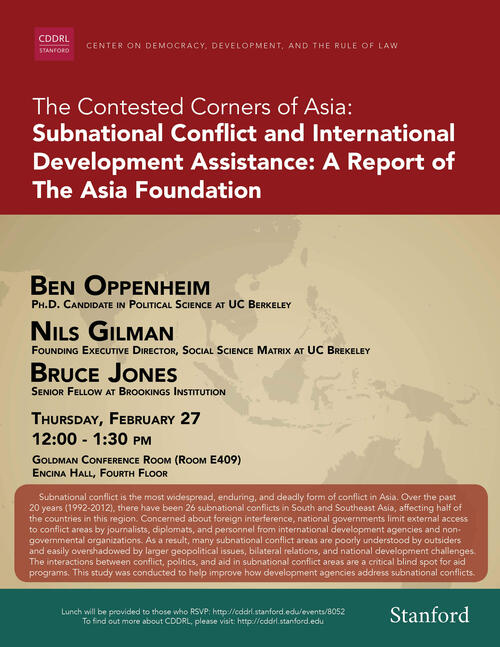
Image


Abstract:

Subnational conflict is the most widespread, enduring, and deadly form of conflict in Asia. Over the past 20 years (1992-2012), there have been 26 subnational conflicts in South and Southeast Asia, affecting half of the countries in this region. Concerned about foreign interference, national governments limit external access to conflict areas by journalists, diplomats, and personnel from international development agencies and non-governmental organizations. As a result, many subnational conflict areas are poorly understood by outsiders and easily overshadowed by larger geopolitical issues, bilateral relations, and national development challenges. The interactions between conflict, politics, and aid in subnational conflict areas are a critical blind spot for aid programs. This study was conducted to help improve how development agencies address subnational conflicts.


Speaker Bios:

Ben Oppenheim is a Fellow (non-resident) at the Center on International Cooperation at New York University. His research spans a diverse set of topics, including fragile states, transnational threats (including pandemic disease risks and terrorism), and the strategic coherence and effectiveness of international assistance in fragile and conflict-affected areas.

Oppenheim has consulted for organizations including the World Bank, the United Nations, the Asia Foundation, the Institute for the Future, and the Fritz Institute, on issues including organizational learning, strategy, program design, foresight, and facilitation. In 2009, he served as Advisor to the first global congress on disarmament, demobilization, and reintegration, supported by the World Bank and the UN.

In 2013, Oppenheim was a visiting fellow at the Uppsala University Forum on Democracy, Peace, and Justice. His research has been supported by a Simpson Fellowship, and a fellowship with the Institute on Global Conflict and Cooperation. He was also a research fellow with UC Berkeley's Institute of International Studies, affiliated with the New Era Foreign Policy Project.


Nils Gilman is the Executive Director of Social Science Matrix. He holds a B.A., M.A. and Ph.D. in History from the University of California, Berkeley. Gilman’s first scholarly interest was in American and European intellectual history, with a particular focus on the institutional development of the social sciences, the lateral transfer and translation of ideas across disciplinary boundaries, and the impact of social scientific ideas on politics and policy.

Gilman is the author of Mandarins of the Future: Modernization Theory in Cold War America (Johns Hopkins University Press, 2004), the co-editor of Staging Growth: Modernization, Development, and the Global Cold War (University of Massachusetts Press, 2003) and Deviant Globalization: Black Market Economy in the 21st Century (Continuum Press, 2011), as well as the founding Co-editor of Humanity: An International Journal of Human Rights, Humanitarianism, and Development. He also blogs and tweets.

Prior to joining Social Science Matrix in September 2013, Gilman was research director at Monitor 360, a San Francisco consultancy that addresses complex, cross-disciplinary global strategic challenges for governments, multinational businesses, and NGOs. He has also worked at a variety of enterprise software companies, including Salesforce.com, BEA Systems, and Plumtree Software. Gilman has taught and lectured at a wide variety of venues, from the Harvard University, Columbia University, and National Defense University, to PopTech, the European Futurists Conference, and the Long Now Foundation.


Bruce Jones is a senior fellow and the director of the Project on International Order and Strategy in the Foreign Policy program at the Brookings Institution. He is also the director of the Center on International Cooperation at New York University.

Jones served as the senior external advisor for the World Bank’s 2011 World Development Report, Conflict, Security and Development, and in March 2010 was appointed by the United Nations secretary-general as a member of the senior advisory group to guide the Review of International Civilian Capacities. He is also consulting professor at the Center for International Security and Cooperation at Stanford University and professor (by courtesy) at New York University’s department of politics.

Jones holds a Ph.D. from the London School of Economics, and was Hamburg fellow in conflict prevention at Stanford University.

He is co-author with Carlos Pascual and Stephen Stedman of Power and Responsibility: Building International Order in an Era of Transnational Threats (Brookings Press, 2009); co-editor with Shepard Forman and Richard Gowan of Cooperating for Peace and Security (Cambridge University Press, 2009); and author of Peacemaking in Rwanda: The Dynamics of Failures(Lynne Reinner, 2001).

Jones served as senior advisor in the office of the secretary-general during the U.N. reform effort leading up to the World Summit 2005, and in the same period was acting secretary of the Secretary-General’s Policy Committee. In 2004-2005, he was deputy research director of the High-level Panel on Threats, Challenges and Change. From 2000-2002 he was special assistant to and acting chief of staff at the office of the U.N. special coordinator for the Middle East peace process. 

Richard and Rhoda Goldman Conference Room

Ben Oppenheim Ph.D. Candidate in Political Science Speaker UC Berkeley
Nils Gilman Founding Executive Director, Social Science Matrix Speaker UC Berkeley
Bruce Jones Senior Fellow Speaker Brookings Institution
Seminars
-

Abstract:

We design an original laboratory experiment to investigate whether redistributive actions hinder the formation of Pareto-improving groups. We test, in an anonymous setting with no feedback, whether people choose to destroy or steal the endowment of others and whether they choose to give to others, when granted the option. We then test whether subjects join a group that increases their endowment but exposes them to redistribution. We conduct the experiment in three very different settings with a priori different norms of pro-social behavior: a university town in the UK, the largest slum in Nairobi, Kenya and rural Uganda. We find a lot of commonality but also large differences between sites. UK subjects behave in a more selfish and strategic way -- giving less, stealing more. Kenyan and Ugandan subjects behave in a more altruistic and less strategic manner. However, pro-social norms are not always predictive of joining behavior. African subjects are less likely to join a group when destruction or stealing is permitted. It is as if they are less trusting even though they are more trustworthy. These findings contradict the view that African underdevelopment is due to a failure of generalized morality. 


Speaker Bio:

Marcel Fafchamps is senior fellow at the Freeman Spogli Institute for International Studies and member of the Center on Democracy, Development and the Rule of Law. Before joining FSI, he served as Professor of Development Economics at Oxford University and as Deputy Director of the Center for the Study of African Economies. Before that he taught at Stanford University. He also worked for the International Labour Organization in Africa. His research focuses on market institutions and social networks, writ large. Fafchamps holds a PhD from UC Berkeley and degrees in Law and in Economics from the Catholic University of Louvain.


Encina Ground Floor Conference Room

Encina Hall
616 Jane Stanford Way
Stanford, CA 94305-6055

0
Senior Fellow Emeritus at the Freeman Spogli Institute for International Studies
Professor, by courtesy, of Economics
marcel_fafchamps_2025.jpg

Marcel Fafchamps is a Senior Fellow Emeritus at the Freeman Spogli Institute for International Studies (FSI) and a member of the Center on Democracy, Development and the Rule of Law. Previously, he was the Satre Family Senior Fellow at FSI. Fafchamps is a professor (by courtesy) for the Department of Economics at Stanford University. His research interests include economic development, market institutions, social networks, and behavioral economics — with a special focus on Africa and South Asia.

Prior to joining FSI, from 1999-2013, Fafchamps served as professor of development economics in the Department of Economics at Oxford University. He also served as deputy director and then co-director of the Center for the Study of African Economies. From 1989 to 1996, Fafchamps was an assistant professor with the Food Research Institute at Stanford University. Following the closure of the Institute, he taught for two years at the Department of Economics. For the 1998-1999 academic year, Fafchamps was on sabbatical leave at the research department of the World Bank. Before pursuing his PhD in 1986, Fafchamps was based in Addis Ababa, Ethiopia, for 5 years during his employment with the International Labour Organization, a United Nations agency that oversees employment, income distribution, and vocational training in Africa.

He has authored two books: Market Institutions in Sub-Saharan Africa: Theory and Evidence (MIT Press, 2004) and Rural Poverty, Risk, and Development (Elgar Press, 2003), and has published numerous articles in academic journals.

Fafchamps served as the editor-in-chief of Economic Development and Cultural Change until 2020. Previously, he had served as chief editor of the Journal of African Economies from 2000 to 2013, and as associate editor of the Economic Journal, the Journal of Development Economics, Economic Development and Cultural Change, the American Journal of Agricultural Economics, and the Revue d'Economie du Développement.

He is a research associate of the National Bureau of Economic Research, an affiliated professor with J-PAL, a senior fellow with the Bureau for Research and Economic Analysis of Development, a research fellow with IZA, Germany, and with the Center for Economic and Policy Research, UK, and an affiliate with the University of California’s Center for Effective Global Action.

Fafchamps has degrees in Law and in Economics from the Université Catholique de Louvain. He holds a PhD in Agricultural and Resource Economics from the University of California, Berkeley. 

Curriculum Vitae

Publications 

Working Papers

Date Label
Marcel Fafchamps Senior Fellow Speaker Freeman Spogli Institute for International Studies
Seminars
Subscribe to Democracy