Governance

FSI's research on the origins, character and consequences of government institutions spans continents and academic disciplines. The institute’s senior fellows and their colleagues across Stanford examine the principles of public administration and implementation. Their work focuses on how maternal health care is delivered in rural China, how public action can create wealth and eliminate poverty, and why U.S. immigration reform keeps stalling. 

FSI’s work includes comparative studies of how institutions help resolve policy and societal issues. Scholars aim to clearly define and make sense of the rule of law, examining how it is invoked and applied around the world. 

FSI researchers also investigate government services – trying to understand and measure how they work, whom they serve and how good they are. They assess energy services aimed at helping the poorest people around the world and explore public opinion on torture policies. The Children in Crisis project addresses how child health interventions interact with political reform. Specific research on governance, organizations and security capitalizes on FSI's longstanding interests and looks at how governance and organizational issues affect a nation’s ability to address security and international cooperation.

-

Abstract:

This talk will present an account of long-run institutional development in Latin America that emphasizes the social and political foundations of state-building processes. The argument focuses on societal dynamics that have path-dependent consequences at two critical points: the initial consolidation of national institutions in the wake of independence, and at the time when the "social question" of mass political incorporation forced its way into the national political agenda across the region during the Great Depression. Dynamics set into motion at these points in time have produced widely varying, but highly stable distributions of state capacity in the region.

About the speaker:

Marcus Kurtz is an Associate Professor at Ohio State University. His research and teaching interests are in the areas of comparative politics, democratization, political economy and development, with a focus on Latin America. His publications have appeared in such journals as American Journal of Political Science, World Politics, Comparative Politics, Comparative Political Studies, International Organization, Journal of Politics, and Politics & Society. He has written two books, Free Market Democracy and the Chilean and Mexican Countryside (Cambridge, 2004) and Latin American State Building in Comparative Perspective (forthcoming, Cambridge 2013).

Encina Ground Floor Conference Room

Marcus Kurtz Associate Professor, Department of Political Science Speaker Ohio State University

Encina Hall, C148
616 Jane Stanford Way
Stanford, CA 94305

0
Olivier Nomellini Senior Fellow at the Freeman Spogli Institute for International Studies
Director of the Ford Dorsey Master's in International Policy
Research Affiliate at The Europe Center
Professor by Courtesy, Department of Political Science
yff-2021-14290_6500x4500_square.jpg

Francis Fukuyama is the Olivier Nomellini Senior Fellow at Stanford University's Freeman Spogli Institute for International Studies (FSI), and a faculty member of FSI's Center on Democracy, Development and the Rule of Law (CDDRL). He is also Director of Stanford's Ford Dorsey Master's in International Policy, and a professor (by courtesy) of Political Science.

Dr. Fukuyama has written widely on issues in development and international politics. His 1992 book, The End of History and the Last Man, has appeared in over twenty foreign editions. His book In the Realm of the Last Man: A Memoir will be published in fall 2026.

Francis Fukuyama received his B.A. from Cornell University in classics, and his Ph.D. from Harvard in Political Science. He was a member of the Political Science Department of the RAND Corporation, and of the Policy Planning Staff of the US Department of State. From 1996-2000 he was Omer L. and Nancy Hirst Professor of Public Policy at the School of Public Policy at George Mason University, and from 2001-2010 he was Bernard L. Schwartz Professor of International Political Economy at the Paul H. Nitze School of Advanced International Studies, Johns Hopkins University. He served as a member of the President’s Council on Bioethics from 2001-2004. He is editor-in-chief of American Purpose, an online journal.

Dr. Fukuyama holds honorary doctorates from Connecticut College, Doane College, Doshisha University (Japan), Kansai University (Japan), Aarhus University (Denmark), the Pardee Rand Graduate School, and Adam Mickiewicz University (Poland). He is a non-resident fellow at the Carnegie Endowment for International Peace. He is a member of the Board of Trustees of the Rand Corporation, the Board of Trustees of Freedom House, and the Board of the Volcker Alliance. He is a fellow of the National Academy for Public Administration, a member of the American Political Science Association, and of the Council on Foreign Relations. He is married to Laura Holmgren and has three children.

(October 2025)
CV
Date Label
Francis Fukuyama Olivier Nomellini Senior Fellow Moderator CDDRL, Stanford University
Seminars
-

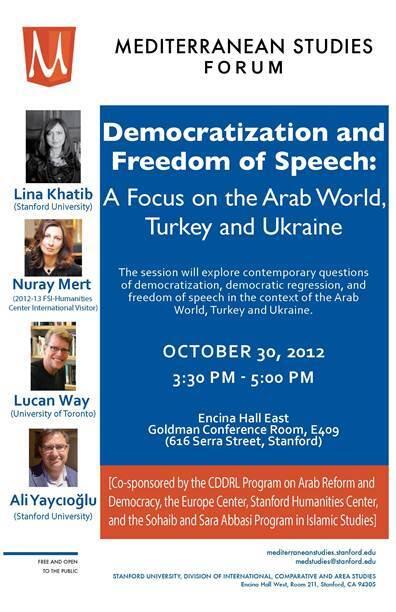
Co-sponsored by CDDRL Program on Arab Reform and Democracy, the Europe Center, Stanford Humanities Center, and the Abbasi Program in Islamic Studies

More info: http://www.stanford.edu/group/mediterranean/cgi-bin/web/2012/08/democratization-and-freedom-of-speech-a-focus-on-turkey-arab-world-and-ukraine/

Image

Richard and Rhoda Goldman Conference Room

Nuray Mert FSI-Humanities Center International Visitor Panelist
Lina Khatib Program Manager for the Program on Arab Reform and Democracy Panelist CDDRL
Lucan Way Associate Professor of Political Science Panelist University of Toronto
Ali Yaycioğlu Assistant Professor of Middle East History Moderator Stanford
Panel Discussions
-

Co-sponsored by the Abbasi Program on Islamic Studies, CDDRL Program on Arab Reform and Democracy, the Europe Center, Stanford Humanities Center, the Mediterranean Studies Forum, and the Center for Russian, East European and Eurasian Studies.

Reuben W. Hills Conference Room

Nuray Mert 2012-13 FSI-Humanities International Visitor Speaker
Lina Khatib Speaker
0
Visiting Associate Professor, Fall 2012
lucan_way-book_-_lucan_way.jpg

Lucan Way’s research focuses on global patterns of democracy and dictatorship. His most recent book (with Steven Levitsky), Revolution and Dictatorship: The Violent Origins of Durable Authoritarianism (forthcoming Princeton University Press), provides a comparative historical explanation for the extraordinary durability of autocracies (China, Cuba, USSR) born of violent social revolution. Way’s solo-authored book, Pluralism by Default: Weak Autocrats and the Rise of Competitive Politics (Johns Hopkins, 2015), examines the sources of political competition in the former Soviet Union. Way argues that pluralism in the developing world often emerges out of authoritarian weakness: governments are too fragmented and states too weak to monopolize political control. His first book, Competitive Authoritarianism: Hybrid Regimes after the Cold War (with Steven Levitsky), was published in 2010 by Cambridge University Press. Way’s work on competitive authoritarianism has been cited thousands of times and helped stimulate new and wide-ranging research into the dynamics of hybrid democratic-authoritarian rule.

Lucan Way Speaker
Ali Yaycioğlu Speaker
Panel Discussions
-

Abstract:

Nearly two years after the Tunisian uprisings launched a massive wave of regional protest across the Arab world, many important and highly contested questions remain. How has the protest wave affected the dynamics of regional politics? Has the protest wave ended, or is it likely to recur? What explains the timing, the accomplishments and the limitations of that protest wave? What does the survival of many Arab regimes, the frustration of revolutionaries, the rise of Islamist movements in electoral politics, and the spiraling conflict in Syria mean for hopes of democratization and peaceful political change?

About the speaker:

Marc Lynch is associate professor of political science and international affairs at The George Washington University, where he directs the Institute for Middle East Studies. He also directs the Project on Middle East Political Science, edits the Middle East Channel for ForeignPolicy.com and the Columbia University Press book series Columbia Studies on Middle East Politics, and is a non-resident senior fellow at the Center for a New American Security. His most recent publications include The Arab Uprising (PublicAffairs 2012), Islamists in a Changing Middle East (ForeignPolicy 2012), and Blogs and Bullets II: New Media and the Arab Spring (US Institute for Peace).

CISAC Conference Room

Marc Lynch Director, Institute for Middle East Studies Speaker George Washington University
Seminars
-

Stephen Stedman is Freeman Spogli senior fellow at the Center on Democracy, Development, and the Rule of Law and FSI, an affiliated faculty member at CISAC, and professor of political science (by courtesy) at Stanford University. He currently serves as the Director for the Global Commission on Elections, Democracy, and Security, a body of eminent persons tasked with developing recommendations on promoting and protecting the integrity of elections and international electoral assistance. The Commission is a joint project of the Kofi Annan Foundation and International IDEA, an intergovernmental organization that works on international democracy and electoral assistance.

In 2003-04 Professor Stedman was Research Director of the United Nations High-level Panel on Threats, Challenges and Change and was a principal drafter of the Panel’s report, A More Secure World: Our Shared Responsibility. In 2005 he served as Assistant Secretary-General and Special Advisor to the Secretary- General of the United Nations, with responsibility for working with governments to adopt the Panel’s recommendations for strengthening collective security and for implementing changes within the United Nations Secretariat, including the creation of a Peacebuilding Support Office, a Counter Terrorism Task Force, and a Policy Committee to act as a cabinet to the Secretary-General. His most recent book, with Bruce Jones and Carlos Pascual, is Power and Responsibility: Creating International Order in an Era of Transnational Threats (Washington DC: Brookings Institution, 2009).

Encina Ground Floor Conference Room

CDDRL
Encina Hall, C152
616 Jane Stanford Way
Stanford, CA 94305-6055

(650) 725-2705 (650) 724-2996
0
Senior Fellow at the Freeman Spogli Institute for International Studies
Professor, by courtesy, of Political Science
Stedman_Steve.jpg PhD

Stephen Stedman is a Senior Fellow at the Freeman Spogli Institute for International Studies (FSI) and the Center on Democracy, Development and the Rule of Law (CDDRL), an affiliated faculty member at CISAC, and professor of political science (by courtesy) at Stanford University. He is director of CDDRL's Fisher Family Honors Program in Democracy, Development and Rule of Law, and will be faculty director of the Program on International Relations in the School of Humanities and Sciences effective Fall 2025.

In 2011-12 Professor Stedman served as the Director for the Global Commission on Elections, Democracy, and Security, a body of eminent persons tasked with developing recommendations on promoting and protecting the integrity of elections and international electoral assistance. The Commission is a joint project of the Kofi Annan Foundation and International IDEA, an intergovernmental organization that works on international democracy and electoral assistance.

In 2003-04 Professor Stedman was Research Director of the United Nations High-level Panel on Threats, Challenges and Change and was a principal drafter of the Panel’s report, A More Secure World: Our Shared Responsibility.

In 2005 he served as Assistant Secretary-General and Special Advisor to the Secretary- General of the United Nations, with responsibility for working with governments to adopt the Panel’s recommendations for strengthening collective security and for implementing changes within the United Nations Secretariat, including the creation of a Peacebuilding Support Office, a Counter Terrorism Task Force, and a Policy Committee to act as a cabinet to the Secretary-General.

His most recent book, with Bruce Jones and Carlos Pascual, is Power and Responsibility: Creating International Order in an Era of Transnational Threats (Washington DC: Brookings Institution, 2009).

Director, Fisher Family Honors Program in Democracy, Development and Rule of Law
Director, Program in International Relations
Affiliated faculty at the Center for International Security and Cooperation
Date Label
Stephen J. Stedman Freeman Spogli Senior Fellow at the Center on Democracy, Development, and the Rule of Law and FSI; CISAC Affiliated Faculty Member; Professor (by courtesy) of Political Science Speaker
Seminars
-

Abstract:

Marking the publication of Lina Khatib's latest book Image Politics in the Middle East: The Role of the Visual in Political Struggle, this seminar focuses on the evolution of political expression in the Middle East over the past decade, highlighting the visual dimension of power struggles between citizens and leaders in Lebanon, Iran, Egypt, Libya, and Syria.

About the speaker:

Lina Khatib is a co-founder and Program Manager of the Program on Arab Reform and Democracy at the Center on Democracy, Development, and the Rule of Law at Stanford University. She joined Stanford University in 2010 from the University of London where she was an Associate Professor. Her research is firmly interdisciplinary and focuses on the intersections of politics, media, and social factors in relation to the politics of the Middle East. She is also a consultant on Middle East politics and media and has published widely on topics such as new media and Islamism, US public diplomacy towards the Middle East, and political media and conflict in the Arab world, as well as on the political dynamics in Lebanon and Iran. She has an active interest in the link between track two dialogue and democratization policy. She is also a Research Associate at SOAS, University of London, and, from 2010-2012, a Research Fellow at the USC Center on Public Diplomacy at the Annenberg School.

Lina is a founding co-editor of the Middle East Journal of Culture and Communication, a multidisciplinary journal concerned with politics, culture and communication in the region, and in 2009 co-edited (with Klaus Dodds) a special issue of the journal on geopolitics, public diplomacy and soft power in the Middle East. She also edited the Journal of Media Practice from 2007-2010. She is one of the core authors of the forthcoming Arab Human Development Report (2012) published by the UNDP.

She has written two books, Filming the Modern Middle East: Politics in the Cinemas of Hollywood and the Arab World (IB Tauris 2006), which is a study of the link between international relations and film, focusing on 25 years of cinematic representation of politics in the region (1980-2005), from the Arab-Israeli conflict to the Gulf War to Islamic fundamentalism, and Lebanese Cinema: Imagining the Civil War and Beyond (IB Tauris 2008). The book takes a socio-political approach to the study of Lebanese cinema over the last thirty years, focusing on the issues of Lebanese national identity, history, sectarian conflict, and memory of the Civil War.

Lina has recently finished writing a book titled Image Politics in the Middle East: The Role of the Visual in Political Struggle for IB Tauris. The book examines the power struggles among states, other political actors, and citizens in the region that are expressed through visuals, and focuses on case studies from Lebanon, Egypt, Syria, Libya, and Iran, with a focus on the role of the image as a political tool in the Arab Spring. She has also recently led a multidisciplinary research project on US public diplomacy in the digital age, in collaboration with the University of Oxford and the University of Wolverhampton, the outcome of which will appear in the Middle East Journal in 2012.

Before joining the academic field, Lina worked in broadcast journalism in Lebanon. She is a frequent commentator on the Middle East in the media with appearances on Al-Jazeera (Arabic and English), CNN, BBC, Sky News and other media outlets across the globe

CISAC Conference Room

Lina Khatib Program Manager for the Program on Arab Reform and Democracy Speaker CDDRL
Seminars
-

Image

Min Zin is a Burmese journalist, and a regular contributor to The Foreign Policy’s Transition. He also serves as Burma’s country analyst for several research foundations including Freedom House. He took part in Burma’s democracy movement in 1988 as a high school student activist, and went into hiding in 1989 to avoid arrest by the junta. His underground activist-cum-writer life lasted for nine years until he fled to the Thai-Burma border in August 1997. His writings appear in The Journal of Democracy, The Foreign Policy, The Irrawaddy, The Bangkok Post, Far Eastern Economic Review, Wall Street Journal, and other publications. He is now  pursuing a PhD in the political science department at UC Berkeley.

Image
Larry Diamond is a senior fellow at the Hoover Institution and at the Freeman Spogli Institute for International Studies, where he directs the Center on Democracy, Development, and the Rule of Law. Diamond also serves as the Peter E. Haas Faculty Co-Director of the Haas Center for Public Service at Stanford. He is the founding co-editor of the Journal of Democracy and also serves as Senior Consultant (and previously was co-director) at the International Forum for Democratic Studies of the National Endowment for Democracy. During 2002-3, he served as a consultant to the U.S. Agency for International Development (USAID) and was a contributing author of its report Foreign Aid in the National Interest. He has also advised and lectured to the World Bank, the United Nations, the State Department, and other governmental and nongovernmental agencies dealing with governance and development. His latest book, The Spirit of Democracy: The Struggle to Build Free Societies Throughout the World (Times Books, 2008), explores the sources of global democratic progress and stress and the prospects for future democratic expansion.

At Stanford University, Diamond is also professor by courtesy of political science and sociology. He teaches courses on comparative democratic development and post-conflict democracy building, and advises many Stanford students. In May 2007, he was named "Teacher of the Year" by the Associated Students of Stanford University for teaching that "transcends political and ideological barriers." At the June 2007 Commencement ceremony, Diamond was honored by Stanford University with the Dinkelspiel Award for Distinctive Contributions to Undergraduate Education. He was cited, inter alia, for fostering dialogue between Jewish and Muslim students; for "his inspired teaching and commitment to undergraduate education; for the example he sets as a scholar and public intellectual, sharing his passion for democratization, peaceful transitions, and the idea that each of us can contribute to making the world a better place; and for helping make Stanford an ideal place for undergraduates."

During the first three months of 2004, Diamond served as a senior adviser on governance to the Coalition Provisional Authority in Baghdad. Since then, he has lectured and written extensively on U.S. policy in Iraq and the wider challenges of post-conflict stabilization and reconstruction, and was one of the advisors to the Iraq Study Group. His 2005 book, Squandered Victory: The American Occupation and the Bungled Effort to Bring Democracy to Iraq, was one of the first books to critically analyze America's postwar engagement in Iraq. He has also participated in several working groups on the Middle East. During 2004-5, was a member of the Council on Foreign Relations' Independent Task Force on United States Policy toward Arab Reform. With Abbas Milani, he coordinates the Hoover Institution Project on Democracy in Iran.

CISAC Conference Room

Larry Diamond Director, CDDRL Commentator Senior Fellow at the Freeman Spogli Institute and the Hoover Institution and Professor of Political Science and Sociology, by courtesy
Min Zin Burmese journalist and political activist Speaker
Seminars

Encina Hall
616 Serra Street
Stanford, CA 94305-6055

0
Fulbright Visiting Scholar 2012-13
Maclennan_HS.jpg

Christopher MacLennan is currently the Director General of Thematic and Sectoral Policy at the Canadian International Development Agency (CIDA).  He is responsible for leading the Agency’s policy development related to various sectors of international development programming including democracy promotion, food security, economic growth, governance and human rights.  Dr. MacLennan led the team that built the policy framework for the G8 Muskoka Initiative on Maternal, Newborn and Child Health in 2010 and represented Canada’s contribution to the 2012 G8 New Alliance on Food and Nutrition Security at Camp David.  Previous to working at CIDA, Christopher has held various positions in the Government of Canada, including at the Privy Council Office, the arm of the Canadian government that directly supports the Prime Minister and Cabinet.  Research interests include donor approaches to democratic assistance, international human rights development and federalism in multinational states.  Dr. MacLennan holds a Ph.D. from the University of Western Ontario specializing in constitutional development and international human rights and has numerous publications including Toward the Charter:  Canadians and the Demand for a National Bill of Rights, 1929-1960.

Encina Hall
616 Serra Street
Stanford, CA 94305-6055

0
Visiting Assistant Professor 2012-13
Linzer_HS.jpg

Drew A. Linzer (PhD, UCLA Political Science, 2008) is an Assistant Professor of Political Science at Emory University in Atlanta, GA. He specializes in comparative political behavior, with a focus on public opinion and democratic representation. Dr. Linzer's research and teaching also emphasize quantitative research methods - especially latent variable modeling and multilevel analysis. His publications have appeared in The American Political Science Review, The Journal of Politics, Political Analysis, World Politics, Social Science & Medicine, and the Journal of Statistical Software. At CDDRL, Dr. Linzer will be working on a new project investigating the pace and nature of global cultural change through attitude shifts and the process of generational replacement.

CV

Encina Hall
616 Serra Street
Stanford, CA 94305-6055

0
The Governance Project Postdoctoral Fellow, 2013-15
Boittin_HS.jpg

Margaret Boittin has a JD from Stanford, and is completing her PhD in Political Science at UC Berkeley. Her dissertation is on the regulation of prostitution in China. She is also conducting research on criminal law policy and local enforcement in the United States, and human trafficking in Nepal.

The Governance Project Postdoctoral Fellow, 2013-15
CV
Subscribe to Governance