Governance

FSI's research on the origins, character and consequences of government institutions spans continents and academic disciplines. The institute’s senior fellows and their colleagues across Stanford examine the principles of public administration and implementation. Their work focuses on how maternal health care is delivered in rural China, how public action can create wealth and eliminate poverty, and why U.S. immigration reform keeps stalling. 

FSI’s work includes comparative studies of how institutions help resolve policy and societal issues. Scholars aim to clearly define and make sense of the rule of law, examining how it is invoked and applied around the world. 

FSI researchers also investigate government services – trying to understand and measure how they work, whom they serve and how good they are. They assess energy services aimed at helping the poorest people around the world and explore public opinion on torture policies. The Children in Crisis project addresses how child health interventions interact with political reform. Specific research on governance, organizations and security capitalizes on FSI's longstanding interests and looks at how governance and organizational issues affect a nation’s ability to address security and international cooperation.

Paragraphs

Abstract: This paper discusses several issues regarding innovations in Chinese local governments in the past 10 years, through analyzing past applications of the Chinese Local Governance Innovations Awards since its establishment, as well as complementary surveys. These issues include the current state, distribution, types, motivations, sustainability and impacts of local governance innovations. The research concludes that local innovations must be evaluated and analyzed against the backdrop of social and political development in China. Most innovations are incident-driven, and are enrichments and improvements to the existing system. However, innovations are distributed at different levels of the administration as well as at different departments, thus, its impact on the overall system may be weakened due to the conflicts among different levels of administration, or among different departments.

All Publications button
1
Publication Type
Working Papers
Publication Date
Journal Publisher
CDDRL Working Paper
Authors

Encina Hall
616 Serra Street
Stanford, CA 94305-6055

0
PHR Assistant
Jessie_headshot.jpg

Following her undergraduate studies in journalism and Spanish at U.C. Berkeley, Brunner spent six years in the professional arena, first as a reporter for the Los Angeles Times and then in public relations/marketing for two nonprofit organizations. She came to Stanford University this fall to undertake her master’s degree in international policy studies, concentrating in global justice. Her professional pursuits have long been coupled with passionate activism in the arenas of human rights advocacy, conflict resolution in Israel, and the Occupied Palestinian Territories, and poverty reduction. Brunner was an active participant in the winter quarter’s Sanela Diana Jenkins Human Rights Speaker Series: The International Criminal Court: The Next Decade. Brunner recently returned from a study trip to Rwanda where she delved into issues of human rights, governance, and economic development through meetings with government officials, NGOs, and the business community.

-

Abstract: Dr. Wang will be discussing some of the formal governmental and non-governmental collaborative mechanisms between Taiwan, China, Hong Kong, and other countries (including the US) on survaillance and reporting for flu. He will also discuss lessons learned from SARS, including the development of specific policies, protocols, or procedures, and new technologies deployed for public health preparedness.


C. Jason Wang, M.D., Ph.D. is an Associate Professor of Pediatrics at the Center for Policy, Outcomes, and Prevention at Stanford University.  He received his B.S. from MIT, M.D. from Harvard, and Ph.D. in policy analysis from RAND.  After completing his pediatric residency training at UCSF, he worked in Greater China with McKinsey and Company, during which time he performed multiple studies in the Asian healthcare market. In 2000, he was recruited to serve as the project manager for the Taskforce on Reforming Taiwan's National Health Insurance System. His fellowship training in health services research included the Robert Wood Johnson Clinical Scholars Program and the National Research Service Award Fellowship at UCLA. Prior to coming to Stanford in 2011, he was an Assistant Professor of Pediatrics and Public Health (2006-2010) and Associate Professor (2010-2011) at Boston University and Boston Medical Center. 

Among his accomplishments, he was selected as the student speaker for Harvard Medical School Commencement (1996).  He received the Overseas Chinese Outstanding Achievement Medal (1996), the Robert Wood Johnson Physician Faculty Scholars Career Development Award (2007), the CIMIT Young Clinician Research Award for Transformative Innovation in Healthcare Research (2010), and the NIH Director’s New Innovator Award (2011). He was recently named a “Viewpoints” editor and a regular contributor for theJournal of the American Medical Association (JAMA).  He served as an external reviewer for the 2011 IOM Report “Child and Adolescent Health and Health Care Quality: Measuring What Matters” and as a reviewer for AHRQ study sections.

Dr. Wang has written two bestselling Chinese books published in Taiwan and co-authored an English book “Analysis of Healthcare Interventions that Change Patient Trajectories”.  His essay, "Time is Ripe for Increased U.S.-China Cooperation in Health," was selected as the first-place American essay in the 2003 A. Doak Barnett Memorial Essay Contest sponsored by the National Committee on United States-China Relations.

Currently he is the principal investigator on a number of quality improvement and quality assessment projects funded by the Robert Wood Johnson Foundation, the National Institutes of Health (USA), Health Resources and Services Administration (HRSA), and the Andrew T. Huang Medical Education Promotion Fund (Taiwan).

Dr. Wang’s research interests include: 1) developing tools for assessing and improving the quality of healthcare; 2) facilitating the use of innovative consumer technology in improving quality of care and health outcomes; 3) studying competency-based medical education curriculum, and 4) improving health systems performance.

CISAC Conference Room

C. Jason Wang Speaker
Seminars
Paragraphs

Stanford's Karl Eikenberry and David Kennedy discuss the implications of America's switch to an all-volunteer force. The consequences go beyond the military itself, impacting Congress, Presidents, and the general public. They conclude that the growing civil-military divide threatens the health of the American democracy.

All Publications button
1
Publication Type
Commentary
Publication Date
Journal Publisher
The New York Times
Authors
-

Abstract: Taiwan (the Republic of China) has been changing with the times. So has its diplomacy. Having served his country for more than 40 years in various important diplomatic posts under different administrations, Ambassador Chen is one of Taiwan’s most seasoned diplomats. He joins us to share his personal experience and perspectives of Taiwan’s diplomacy. It is a historical review, but also an attempt to explore the future. Ambassador Chen believes that the diplomacy of Taiwan is unique because of its unique background. Although it should be defined by its own people, the country has been heavily influenced by the Chinese Mainland and the United States of America. How to promote Taiwan’s interests while preserving its identity and dignity, and conducting the balancing exercises in an asymmetric international environment has always been the crux of diplomacy in Taiwan. Ambassador Chen’s insights will allow us a better understanding of diplomacy in Taiwan, its successes and frustrations and presenting a possible roadmap for the future.

C.J. Chen is the former Minister of Foreign Affairs of the Republic of China (1999-2000). He has also served as Taiwan’s de facto Ambassador to the United States (2000-2004) and European Union (2004-2006). Having spent most of his career in the Foreign Ministry, Mr. Chen is regarded as one of Taiwan’s most accomplished diplomats and an expert on U.S./Taiwan relations. He was educated in Taiwan, Britain, Spain and the US, and has extensive experience representing his nation in the United States. He began his first tour of duty in Washington, D.C. in 1971 and was later a key member of the team that negotiated with the United States government for the future relations between Taiwan and the U.S. after the U.S. switched diplomatic ties from the Republic of China (ROC) to the People’s Republic of China) in 1979. Mr. Chen was heavily involved in communicating with the U.S. Congress during the implementation of the Taiwan Relations Act (TRA) which still serves as the back bone and framework for U.S./ Taiwan relations. In addition to Mr. Chen’s diplomatic experience, he was also selected by the Kuomintang (KMT), to be a member of the Legislative Yuan, where served under both the blue (KMT) and green (DPP) administrations.

CISAC Conference Room

Ambassador C.J. Chen Founder, Taipei Forum and Minister of Foreign Affairs, Republic of China (1999-2000) Speaker
Seminars
Authors
News Type
News
Date
Paragraphs

On March 18, Congolese militia leader Bosco Ntaganda surrendered himself unexpectedly to the U.S. Embassy in Kigali, Rwanda asking for transfer to the International Criminal Court (ICC) at The Hague, where he was wanted for allegedly committing crimes against humanity. The apprehension of ICC indictees was one of the main challenges raised during the Program on Human Right's (PHR) Sanela Diana Jenkins Human Rights Speaker Series last quarter. Ntaganda’s voluntary surrender provoked reflection on the lessons learned from the seminar’s evaluation of the ICC’s impact on international justice as it marked its first decade and exploration of its mandate moving forward.

Featuring lectures from international experts, academics, and activists, the seminar addressed many of the current challenges and future hopes of the ICC, including competing notions of justice and peace, budgetary constraints, and victims’ rights.

The series was led by PHR Director Helen Stacy and UCLA Law Professor Richard Steinberg, also a visiting scholar at Stanford's department of political science. They both kicked off the series by presenting the history and structure of the ICC and concluded with a discussion on its impact, commenting on how the ICC has helped shape the narrative on mass atrocities.

“Reflecting Diana Jenkins' personal commitment to restoring dignity, prosperity, justice and hope to those who most need it, the human rights speaker series aims to engage students on the most pressing human rights issues of our time,” said Stacy. “The International Criminal Court's 10th anniversary invites careful thought about its role so far, and its future. Our speakers brought an extensive range of opinions on the Court, but everyone agreed that the very existence of the Court has advanced the dialogue on international justice.”

A wide array of positions were offered by the speakers, representing the nonprofit, academic and policymaking arenas. Citing some of the limitations facing the ICC, Human Rights Watch’s Director of International Justice Program Richard Dicker made a compelling case for the Court, highlighting the role of civil society in promoting the adoption of the Rome Statute - the treaty that established the ICC - by its 122 current signatories.

William Pace, convener of the Coalition for the International Criminal Court described the Rome Statute as “among the greatest advancements ever in international human rights law.”

Stanford political science Professor James Fearon questioned whether the Court can be effective in deterring mass atrocities while relying on states parties to turn over suspects without a police force of its own. He argued that the Court may in fact limit the liability of human rights abusers because it gives them a choice of whether (or not) to turn themselves over to the ICC for trial. This could potentially contribute to prolonged civil conflict if governments’ hands are tied in offering backdoor deals in exchange for an end to the conflict.

Many speakers proposed modifications to the current ICC structure and suggested the following measures to enhance the work of the Court:

  • Cherif Bassiouni, who led the drafting committee to launch the ICC, emphasized the need for the Court to appoint well-trained judges;
  • David Scheffer, former U.S. Ambassador at Large for War Crimes Issues, highlighted the tremendous diplomatic challenge of not having instruments of arrest or enforcement under ICC control and limited to pressuring states parties to follow through on their obligation to detain indictees of the Court;
  • Carla Ferstman, director of REDRESS, a human rights organization that helps torture survivors obtain justice and reparations, focused on the challenges presented by the ICC's distance from the home countries of those on trial and how victims might have a more significant role in the justice process.

Recognizing the ICC’s inevitable growing pains, Shamila Batohi, a senior legal advisor to the Office of the Prosecutor, offered a hopeful conclusion to the series, reminding students of the Court’s commitment to protecting the rights of the more than 2.3 billion people represented by the statute’s 122 states parties and ending impunity for war crimes, genocide and crimes against humanity.

“Over the course of these nine weeks, students, faculty, and our guest speakers collaborated to develop a range of policies that could potentially improve the ICC system,” said Richard Steinberg. “Though the colloquium took place here on the Stanford campus, the broader collaboration engaged 19,000 users in a fruitful discussion via an online forum.”

Following each lecture, Dr. Diane Steinberg led a dinner discussion for interested students to distill the speaker’s main points into a thought-provoking question to be debated by a global audience on the Human Rights & International Criminal Law Online Forum. Stanford students joined forum participants from around the world to discuss vital questions, such as: “How should the relationship between the International Criminal Court and the United Nations Security Council be changed, if at all, to advance international justice?” and “Assuming that the ICC chooses to retain victim participation in its processes, how can victims’ representation at the ICC be improved and victims’ rights be protected?”

The seminar left students with these provocative questions – and many more – to ponder while tracking the Ntaganda case and the future trial of Uhuru Kenyatta, Kenya’s newly elected president wanted by the ICC for crimes against humanity following the 2007 presidential elections.

Stay tuned for more information on the 2014 Sanela Diana Jenkins Speakers Series, which will focus on the right to health and healthcare delivery.

Hero Image
RTR236IP logo
All News button
1
-

Abstract:

For the past several years, and especially since the beginning of the "Arab Spring" in December 2010, Arab regimes have experienced sweeping processes of political decay, disintegration, reform, and revolution. While these are far from finished and clear in their impacts, they have already begun to transform the political parameters affecting peace and stability in the Middle East. The prevailing assumption is that destabilization of the neighborhood has made Israel even more reluctant to take any new initiatives or assume any new risks for a peace agreement with the Palestinians. But the changing regional parameters also generate new opportunities and especially new urgency for obtaining a two-state solution while it is still possible.

CISAC Conference Room

CDDRL
Stanford University
Encina Hall, C147
616 Jane Stanford Way
Stanford, CA 94305-6055

(650) 724-6448 (650) 723-1928
0
Mosbacher Senior Fellow in Global Democracy at the Freeman Spogli Institute for International Studies
William L. Clayton Senior Fellow at the Hoover Institution
Professor, by courtesy, of Political Science and Sociology
diamond_encina_hall.png MA, PhD

Larry Diamond is the William L. Clayton Senior Fellow at the Hoover Institution, the Mosbacher Senior Fellow in Global Democracy at the Freeman Spogli Institute for International Studies (FSI), and a Bass University Fellow in Undergraduate Education at Stanford University. He is also professor by courtesy of Political Science and Sociology at Stanford, where he lectures and teaches courses on democracy (including an online course on EdX). At the Hoover Institution, he co-leads the Project on Taiwan in the Indo-Pacific Region and participates in the Project on the U.S., China, and the World. At FSI, he is among the core faculty of the Center on Democracy, Development and the Rule of Law, which he directed for six and a half years. He leads FSI’s Israel Studies Program and is a member of the Program on Arab Reform and Development. He also co-leads the Global Digital Policy Incubator, based at FSI’s Cyber Policy Center. He served for 32 years as founding co-editor of the Journal of Democracy.

Diamond’s research focuses on global trends affecting freedom and democracy and on U.S. and international policies to defend and advance democracy. His book, Ill Winds: Saving Democracy from Russian Rage, Chinese Ambition, and American Complacency, analyzes the challenges confronting liberal democracy in the United States and around the world at this potential “hinge in history,” and offers an agenda for strengthening and defending democracy at home and abroad.  A paperback edition with a new preface was released by Penguin in April 2020. His other books include: In Search of Democracy (2016), The Spirit of Democracy (2008), Developing Democracy: Toward Consolidation (1999), Promoting Democracy in the 1990s (1995), and Class, Ethnicity, and Democracy in Nigeria (1989). He has edited or coedited more than fifty books, including China’s Influence and American Interests (2019, with Orville Schell), Silicon Triangle: The United States, China, Taiwan the Global Semiconductor Security (2023, with James O. Ellis Jr. and Orville Schell), and The Troubling State of India’s Democracy (2024, with Sumit Ganguly and Dinsha Mistree).

During 2002–03, Diamond served as a consultant to the US Agency for International Development (USAID) and was a contributing author of its report, Foreign Aid in the National Interest. He has advised and lectured to universities and think tanks around the world, and to the World Bank, the United Nations, the State Department, and other organizations dealing with governance and development. During the first three months of 2004, Diamond served as a senior adviser on governance to the Coalition Provisional Authority in Baghdad. His 2005 book, Squandered Victory: The American Occupation and the Bungled Effort to Bring Democracy to Iraq, was one of the first books to critically analyze America's postwar engagement in Iraq.

Among Diamond’s other edited books are Democracy in Decline?; Democratization and Authoritarianism in the Arab WorldWill China Democratize?; and Liberation Technology: Social Media and the Struggle for Democracy, all edited with Marc F. Plattner; and Politics and Culture in Contemporary Iran, with Abbas Milani. With Juan J. Linz and Seymour Martin Lipset, he edited the series, Democracy in Developing Countries, which helped to shape a new generation of comparative study of democratic development.

Download full-resolution headshot; photo credit: Rod Searcey.

Former Director of the Center on Democracy, Development and the Rule of Law
Faculty Chair, Jan Koum Israel Studies Program
Date Label
Larry Diamond Director, Center on Democracy, Development and the Rule of Law Speaker CDDRL
Seminars
-

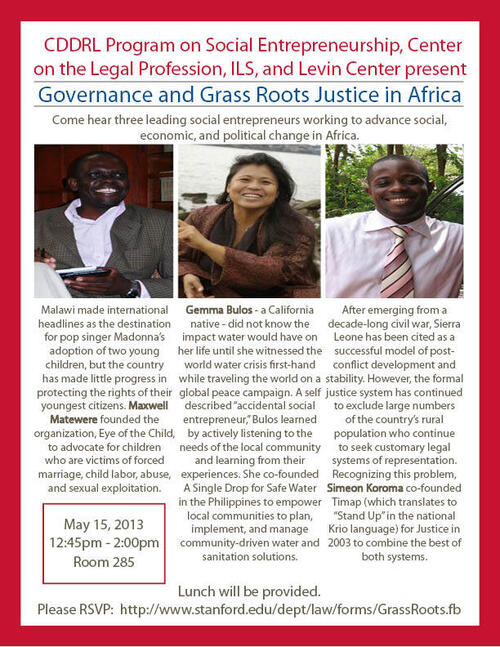
Special Seminar at Stanford Law School in partnership with the Levin Center

Image

Room 285 in the Classroom Building of the Stanford Law School

Gemma Bulos Social Entrepreneur-in-Residence Speaker CDDRL
Simeon Koroma Social Entrepreneur-in-Residence Speaker CDDRL
Maxwell Matewere Social Entrepreneur-in-Residence Speaker CDDRL
Seminars
-

Abstract
Since the early years of her career working with children in some of the direst situations in Sri Lanka and Bangladesh, Susan Bissell, UNICEF’s Chief of Child Protection, has witnessed children being targeted for such exploitative practices as human trafficking, recruitment into armed forces, and child labor. Violations of the child’s right to protection take place in every country and are massive, under-recognized, and under-reported barriers to child survival and development, in addition to being human rights violations. Children subjected to violence, exploitation, abuse and neglect are at risk of death, poor physical and mental health, HIV/AIDS infection, educational problems, displacement, and vagrancy.

 Protecting children from violence, exploitation and abuse is an integral component of protecting their rights to survival, growth, and development. UNICEF advocates and supports the creation of a protective environment for children in partnership with governments, national and international partners including the private sector, and civil society.  Bissell guides UNICEF’s Child Protection program in 170 countries, working with government officials and other partners to shape child protection policies. During this discussion, she will provide an overview of her role at UNICEF and the work she does to help ensure that governments honor their commitments to strengthen child protection systems and protect children.

In 2009, Susan Bissell was appointed to her current position in New York, heading all of UNICEF’s Child Protection work.  She oversees a team of professionals guiding efforts for children affected by armed conflict, child protection systems strengthening to prevent and respond to all forms of violence against children, and a range of other matters.

Richard and Rhoda Goldman Conference Room

Susan Bissell Chief of Child Protection Speaker UNICEF
Seminars
Subscribe to Governance