Foreign Policy

Image


Summit Schedule


Day 1: Wednesday 11 April  

     
  2:00 – 5:30 PM
Paul Brest Hall

“Technology, Social Media, and Innovation”

AMENDS Talks Speakers:Aymen Abderrahman, Selma Chirouf, Rawan Da’as, Elizabeth Harmon, Sonya Kassis, Heather Libbe, Ifrah Magan, Sherif Maktabi, Brian Pellot, George Somi

     
  6:30 – 8:30 PM

Innovation and Entrepreneurial Leadership Dinner

Co-Sponsored by TechWadi

By Invitation Only


Day 2: Thursday 12 April

     
  2:00 – 5:30 PM
Paul Brest Hall

“Building Civil Society”

AMENDS Talks Speakers: Firas Al-Dabagh, Abdullah Al-Fakharany, Marwan Alabed, Cole Bockenfeld, Nadir Ijaz, Selma Maarouf, Matthew Morantz, Alaa Mufleh, Fadi Quran, Nada Ramadan


Day 3: Friday 13 April

     
  9:00 AM- 12:00
Gunn-SIEPR Building

“Peace and Conflict Resolution”

AMENDS Talks Speakers: Sherihan Abdel-Rahman, Sam Adelsberg, Mohammad Al-Jishi, Abdulla Al-Misnad, Yahya Bensliman, Ilyes El-Ouarzadi, Sandie Hanna, Priya Knudson, Megan McConaughey, Gavin Schalliol

     
  1:30 – 5:00 PM
Gunn-SIEPR Building

Speakers and Panelists

Sami Ben Gharbia Tunisian political activist, Foreign Policy Top 100 Thinker

Professor Allen Weiner Co-Director of Stanford Univeristy Center on International Conflict and Negotiation
Thomas T. Riley Former Ambassador to Morocco

Radwan Masmoudi Founder and President of the Center of the Study of Islam & Democracy

     
  6:30 – 8:30 PM
Paul Brest Hall

Networking Dinner

By Invitation Only 


Day 4: Saturday 14 April

     
  9:00 AM- 12:00
Bechtel Conference Center, Encina Hall
“The New Middle East”  

AMENDS Talks Speakers: Firyal Abdulaziz, Lubna Alzaroo, Hoor Al-Khaja, Ali Al-Murtadha, Jessica Anderson, Seif Elkhawanky, Micah Hendler, Salmon Hossein, Ram Sachs, Rana Sharif

     
  1:30 – 5:00 PM
Bechtel Conference Center, Encina Hall

Speakers and Panelists

Rami Khouri Director of the Issam Fares Institute for Public Policy and International Affairs at the American University of Beirut

Ahmed Benchemsi Moroccan journalist and pro-democracy activist

Professor Aaron Hahn Tapper Founder of Abraham’s Vision

Nasser Weddady Civil Rights Outreach Director, American Islamic Congress


Day 1 - Paul Brest Hall
Day 2 - Paul Brest Hall
Day 3 - Gunn-SIEPR Building
Day 4 - Bechtel Conference Center, Encina Hall
Conferences
Authors
News Type
News
Date
Paragraphs

The Program on Human Rights concluded its ninth and final installment of the Sanela Diana Jenkins International Speakers Series on March 13 with presentations with Dr. Mohammed Mattar, executive director of the Protection Project and professor at Johns Hopkins University and Professor Alison Brysk, chair of Global Governance, Global and International Studies at UC Santa Barbara.

Dr. Mattar noted that while effective anti-trafficking laws depend on law enforcement and survivor protection, the key intellectual and ethical rationale of such laws is the concept of the exploitation of vulnerable people in vulnerable circumstances. Dr. Mattar explained the legal distinction between “human trafficking” and “slavery,” emphasizing that the latter is based on twin ideas of human beings as commodities to be bought and sold, as well as the exercise of ownership of one person over another. “There is no doubt that human trafficking is a degrading and severe violation of basic human rights and fundamental freedoms, but it is unnecessary to label human trafficking as slavery because to do so we would need to identify the exercise of powers attached to the right of ownership,” Mattar said.

Among the challenges for a more effective anti-trafficking effort, Dr. Mattar listed the need to hold corporations responsible for their acts, to provide access to justice that allows for victim compensation, the engagement of civil society, and criminal enforcement and accountability under existing national and international law.

Professor Brysk explained that globalization has produced pernicious side effects.  The acceleration of migration, especially of women, increases the incidence of gender violence and the commodification of “disposable people.” All these factors enable the increase of human trafficking. Brysk observed that international recognition of trafficking as a form of contemporary slavery has been helpful in influencing policy change. “There is a slavery spectrum,” Brysk said. “We need to work to guarantee physical integrity of people, migration rights and children’s rights.”

She also noted that the focus on sex slavery has high costs because it is based on “protection and not empowerment,” and “rescue over rights.” The individualistic emphasis and sexual focus of anti-trafficking efforts fails to recognize many forms of exploitative globalized labor. Women and children are put in dangerous and debilitating non-sexual jobs. There are also many forms of sexual and gender violence in other forms of exploitative globalized labor, such as in sweatshops.

Together, the speakers in the final session of the Program on Human Rights speaker series made a strong plea for more sophisticated understanding of the dynamics of human trafficking in the 21st century. Sustained research that accounts for contemporary conditions, they told the Stanford audience, is needed to give policy makers and legislators the information and tools they need to combat the alarming global acceleration of human trafficking.

All News button
1
-

This event is co-sponsored with The Europe Center

Abstract:

Ruby Gropas is a lecturer in international relations at the law faculty of the Democritus University of Thrace (Komotini) and research fellow at the Hellenic Foundation for European and Foreign Policy (ELIAMEP). Gropas was in residence at CDDRL in 2011 as a visiting scholar. In this seminar she will discuss the ongoing Greek economic and political crisis, and what it means for the future of the European Union and monetary system. Is the crisis in Greece ‘internal’ or is it symptomatic of a wider European failure? Is the Greek crisis the result of failed modernity, or rather a precursor of things to come? Why has Greece become so important and why has it dominated global politics and world news for the past two years?  Are its malignancies purely domestic or are they representative of a wider malaise within Europe and possibly beyond? The collapse and orderly default of a eurozone country at the heart of the Western financial system arguably marks the end of an era. It has brought with it the deepest social and political crisis that modern Greecehas faced since the restoration of democracy and it has also led to Europe's deepest existential crisis. With the EU struggling to effectively managing the eurozone crisis and the burst of recent movements opposing neo-liberal orthodoxy and the “Occupy” movements – what does this mean for Europe? And what is next?

Speaker Bio: 

Ruby Gropas has worked on asylum and migration issues for UNHCR in Brussels and worked for McKinsey & Co. in Zurich and Athens (2000-2002). As part of the ELIAMEP team, her research concentrates on European integration and foreign policy, Transatlantic relations, human rights, migration and multiculturalism. She was Managing Editor of the Journal of Southeast European and Black Sea Studies (Taylor & Francis) between January 2006 and October 2009. Ruby has taught at the University of Athens and at College Year in Athens. She was Southeast Europe Policy Scholar at the Woodrow Wilson International Center for Scholars in Washington DC in 2007 and again in 2009. She is Vice-President of the Alexander S. Onassis Public Benefit Foundation Scholars' Association since June 2009, and was Member of the Academic Organisation Committee of the Global Forum for Migration and Development, Civil Society Days, Athens 2009.

Ruby studied Political Science at the Université Libre de Bruxelles (1994) and undertook graduate studies at the University of Leuven (MA in European Studies) and at Cambridge University (MPhil in International Relations). She holds a PhD in History from Cambridge University (New Hall, 2000).

Encina Ground Floor Conference Room

Encina Hall
Stanford, CA 94305-6055

0
R_Gropas.jpg PhD

Ruby Gropas is Lecturer in International Relations at the Law Faculty of the Democritus University of Thrace (Komotini) and Research Fellow at the Hellenic Foundation for European and Foreign Policy (ELIAMEP).

Ruby has worked on asylum and migration issues for UNHCR in Brussels and worked for McKinsey & Co. in Zurich and Athens (2000-2002). As part of the ELIAMEP team, her research concentrates on European integration and foreign policy, Transatlantic relations, human rights, migration and multiculturalism. She was Managing Editor of the Journal of Southeast European and Black Sea Studies (Taylor & Francis) between January 2006 and October 2009. Ruby has taught at the University of Athens and at College Year in Athens. She was Southeast Europe Policy Scholar at the Woodrow Wilson International Center for Scholars in Washington DC in 2007 and again in 2009. She is Vice-President of the Alexander S. Onassis Public Benefit Foundation Scholars' Association since June 2009, and was Member of the Academic Organisation Committee of the Global Forum for Migration and Development, Civil Society Days, Athens 2009.

Ruby studied Political Science at the Université Libre de Bruxelles (1994) and undertook graduate studies at the University of Leuven (MA in European Studies) and at Cambridge University (MPhil in International Relations). She holds a PhD in History from Cambridge University (New Hall, 2000).

CV
Ruby Gropas Lecturer in International Relations at the Law Faculty of the Speaker Democritus University of Thrance (Komotini)
Seminars
-

Abstract: 

This talk draws on case study evidence from Princeton University’s Innovations for Successful Societies to reflect on some current theories about building accountable government.  The focus is on settings where geography, insecurity, and limited resources render conventional management strategies unworkable.

Speaker Bio:

Jennifer Widner is professor of politics and international affairs and director of the Mamdouha S.Bobst Center for Peace & Justice at Princeton University. She runs a research program on institution building and institutional reform called Innovations for Successful Societies, a joint initiative of the Bobst Center and  the Woodrow Wilson School. Before joining the Princeton faculty in 2004-5, she taught at Harvard and the University of Michigan.  Her current research focuses on the political economy of institutional reform, government accountability, and service delivery.  She also remains interested in constitution writing, constitutional design, and fair dealing—topics of earlier research. She is author of Building the Rule of Law (W. W. Norton), a study of courts and law in Africa, and she has published articles on a variety of topics in Democratization, Comparative Politics, Comparative Political Studies, Journal of Development Studies, The William & Mary Law Review, Daedalus, the American Journal of International Law, and other publications.  She is completing work on a book about making government work in challenging settings, drawing on experiences in Africa, Asia, and parts of Latin America. 

Reuben W. Hills Conference Room

Jennifer Widner Professor of Politics and International Affairs, Woodrow Wilson School Speaker Princeton University
Seminars
-

 Abstract:

Systemic corruption undermines state capacity, imperils socio-economic development, and diminishes democracy. In his Nairobi speech as a U.S. senator in August 2006, Barack Obama described the struggle to reduce corruption as "the fight of our time". An international conference in Lagos, Nigeria, in September 2011 was devoted to Richard Joseph's influential 1987 book, Democracy and Prebendal Politics in Nigeria: The Rise and Fall of the Second Republic.Transforming prebendalist systems must be at the center of strategies to strengthen democracy and achieve poverty-reducing economic growth in Africa and other regions.

 Speaker Bio: 

Richard Joseph is John Evans Professor of International History and Politics at Northwestern University and Non resident Senior Fellow in Global Economy and Development at the Brookings Institution. As a Fellow of The Carter Center, he participated in democracy and peace initiatives in Ghana, Zambia, Ethiopia, Liberiaand Sudan. He has written extensively on issues of democracy, governance and political economy. His books include Radical Nationalism in Cameroun (1977), Democracy and Prebendal Politics in Nigeria (1987) and edited books, Gaullist Africa: Cameroon under Ahmadu Ahidjo (1978), State, Conflict and Democracy in Africa (1999), and (with Alexandra Gillies), Smart Aid for African Development (2009). He served as Principal Investigator of the Research Alliance to Combat HIV/AIDS (REACH), a collaborative program in Nigeria, 2006–2011. His current writing and policy projects concern growth, democracy and security. To address these issues, he is designing a collaborative project, AfricaPlus (http://africaplus.wordpress.com/), whose first focus country is Nigeria.

Here is the link to Richard Joseph remarks and the PowerPoint for the talk.

http://africaplus.wordpress.com/author/africaplus/

CISAC Conference Room

Richard Joseph John Evans Professor of International History and Politics Speaker Northwestern University
Seminars
-

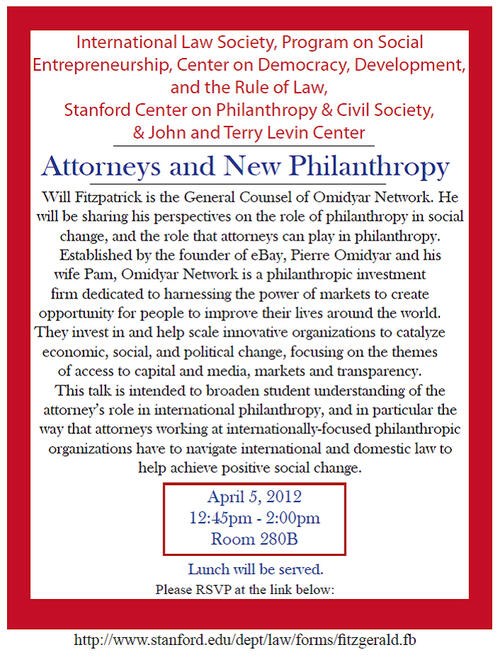
Will Fitzpatrick is the General Counsel of Omidyar Network.  He will be sharing his perspectives on the role of philanthropy in social change, and the role that attorneys can play in philanthropy.  Established by the founder of eBay, Pierre Omidyar and his wife Pam, Omidyar Network is a philanthropic investment firm dedicated to harnessing the power of markets to create opportunity for people to improve their lives around the world.  They invest in and help scale innovative organizations to catalyze economic, social, and political change, focusing on the themes of access to capital and media, markets and transparency.  This talk is intended to broaden student understanding of the attorney's role in international philanthropy, and in particular the way that attorneys working at internationally-focused philanthropic organizations have to navigate international and domestic law to achieve positive social change.

Please RSVP to the link below:

http://www.stanford.edu/dept/law/forms/fitzgerald.fb

Lunch will be provided

Image

Room 280B

Will Fitzpatrick General Counsel Speaker Omidyar Network
Conferences
Paragraphs

Abstract

The brief war between Georgia and Russia in August 2008 provoked vigorous international reactions among the European states as consequence of the sudden shift in the strategic balance. This article argues for a focus on the great powers France, Germany and Britain as crucial actors for understanding the policy reactions towards Russia. It argues furthermore that reactions must be explained from the perspective of experience based on past geopolitics which translate the external pressures into concrete foreign policy: France oriented towards the creation of a strong EU as global actor, Germany influenced by her self-imposed restraint in foreign affairs and Britain influenced by Atlanticist commitments in her balancing behaviour. Beyond the Russo-Georgian war, the article points to an interest-based foreign policy approach towards Russia in the longer term driven by a great power concert with the Franco-German axis as stable element but increasingly with backing from Britain, thus contributing to transatlantic foreign policy convergence on the issue.

All Publications button
1
Publication Type
Journal Articles
Publication Date
Journal Publisher
Routledge: European Security
Authors
Henrik Larsen
Authors
News Type
Commentary
Date
Paragraphs

One year after the Arab Spring, American public diplomacy is still facing the now-established conundrum of linking words and actions. The rise of Islamist political parties as the new leaders in the Arab world is the latest challenge for U.S. public diplomacy, but it is also an opportunity.

Since the attacks of September 11, the United States has been matching its military activity in the Middle East with outreach to Muslim and Arab communities. By and large, this outreach has not been successful. As several public diplomacy experts have been arguing for a number of years now, the limited impact of this outreach is due to the negative perception of U.S. foreign policy towards the Middle East by citizens in the region. When actions and words do not match, words are perceived with a hefty dose of suspicion.

When the Egyptian revolution began on January 25, 2011, U.S. foreign policy took some time to catch up with sentiment on the Egyptian street. To make matters worse, the “Made in USA” tear gas canisters that protesters in Tahrir Square angrily displayed to the cameras of the international media were a further reminder of the United States’ cozy relationship with the Mubarak regime.

Since then, the U.S. has improved its words and actions by declaring both rhetorical and policy support for the Arab world’s revolutionaries (albeit in varying degrees), and as a result, public opinion about the U.S. in the region has improved. The 2011 Arab Public Opinion Pollshows a significant increase in favorability towards the U.S., compared with the 2010 poll, from 10% to 26%. The U.S. must continue to enhance this record.

Back in 2006, after much hype by the U.S. about the importance of free and fair elections in Palestine, the U.S. backtracked when Hamas swept the Palestinian Legislative Council elections in Gaza,withdrawing aid and boycotting the elected Gaza government. As Islamist parties sweep free and fair elections in one country after another in the region—starting with Tunisia, then Egypt—it is fairly safe to declare that in the immediate aftermath of the Arab Spring, the Arab world will be led by Islamists. So far, the U.S. has not repeated the mistake of 2006 with Hamas’ election in Gaza, accepting the results of the elections as democratic and as representing the will of the people.

But this is not enough. Of course, the United States currently has an easier task, since none of the groups that have been elected to-date in the Arab region are on the U.S.’s “terrorist” list. However, merely accepting election results will not cause a significant change in the perception of the U.S. on the Arab street.

The U.S. recognizes the current period as one of opportunity: it is the time to reinvigorate U.S. assistance with civil society, economic aid, and cultural outreach in the Arab world. But the most important “action” of all remains how foreign policy will play out. The Islamist groups that have assumed leadership positions in Tunisia and Egypt, namely Ennahda and the Muslim Brotherhood, have one very old dream: to be recognized as statesmen nationally and internationally. If U.S. foreign policy in this new era is going to be successful, it must be based on treating those leaders as such.

This is not just important on the traditional diplomatic level; it is also important for the success of U.S. public diplomacy. The Islamist leaders now assuming positions as Prime Ministers or House Speakers (and who knows, perhaps also presidents in the near future) reached power through having been elected by their constituents. The U.S. cannot reach out to those constituents while treating their leaders differently. In the past, U.S. public diplomacy towards Egypt appeared insincere because the U.S. attempted to engage the Egyptian people while taking a soft stance towards the Mubarak regime, which had been jailing, harassing, and—as in the case of Khaled Said—killing those same people.

For the first time in the Arab world’s history, there is a real opportunity for the U.S. to match its words and actions towards the region, and to have foreign policy become the basis upon which to formulate a truly engaging public diplomacy.

All News button
1
Subscribe to Foreign Policy