
FSI scholars produce research aimed at creating a safer world and examing the consequences of security policies on institutions and society. They look at longstanding issues including nuclear nonproliferation and the conflicts between countries like North and South Korea. But their research also examines new and emerging areas that transcend traditional borders – the drug war in Mexico and expanding terrorism networks. FSI researchers look at the changing methods of warfare with a focus on biosecurity and nuclear risk. They tackle cybersecurity with an eye toward privacy concerns and explore the implications of new actors like hackers.
Along with the changing face of conflict, terrorism and crime, FSI researchers study food security. They tackle the global problems of hunger, poverty and environmental degradation by generating knowledge and policy-relevant solutions.


In Rio’s slums, Stanford researchers study police reform
News Type
News
Date
Paragraphs
Working in the slums of Rio de Janeiro, a team of Stanford researchers led by Beatriz Magaloni, are partnering with the Brazilian government and civil society to better understand how recent security policy has impacted violence and insecurity amongst the urban poor.
 Policemen chat during their break at Rocinha favela.
Magaloni, an associate professor of political science and senior fellow at the Freeman Spogli Institute, leads the Program on Poverty and Governance (PovGov) at Stanford’s Center on Democracy, Development and the Rule of Law, which works to uncover what policies work – and do not – so they can help make improvements to curb violence in Latin America’s largest cities.
PovGov’s evaluations of programs in Brazil and Mexico have uncovered findings to make security policy and policing more effective and introduced new initiatives, such as body worn cameras for the police in Brazil, to help monitor policy activity and reduce excessive violence.
The PovGov team also works to evaluate government and grassroots programs serving at-risk youth in poor communities to evaluate which initiatives have been most effective in providing alternatives to violence for urban youth.
Magaloni, who also serves as an academic expert to the World Bank on urban violence, hopes that the findings from their current project in Rio will help to influence interventions in other areas of Latin America that are gripped by violence, fear and insecurity.
For more information on the Program on Poverty and Governance’s work in Brazil, please click here.
Hero Image

Policemen chat during their break at Rocinha favela.
Beatriz Magaloni
All News button
1


Special Event: Videoconference with President Ma Ying-jeou of the Republic of China (Taiwan)
-
**LIVE WEBCAST WILL BE AVAILABLE HERE IMMEDIATELY PRIOR TO THE EVENT.**
[[{"fid":"219129","view_mode":"crop_870xauto","fields":{"format":"crop_870xauto","field_file_image_description[und][0][value]":"","field_file_image_alt_text[und][0][value]":"","field_file_image_title_text[und][0][value]":"","field_credit[und][0][value]":"","field_caption[und][0][value]":"","field_related_image_aspect[und][0][value]":"","thumbnails":"crop_870xauto","pp_lightbox":false,"pp_description":false},"type":"media","attributes":{"width":"870","class":"media-element file-crop-870xauto"}}]]
On June 2, 2015, the Taiwan Democracy Project at Stanford's Center on Democracy, Development and the Rule of Law (CDDRL) will host a special panel session featuring the President of the Republic of China (Taiwan), Ma Ying-jeou. President Ma will speak via live video feed to commemorate the 70th anniversary of the end of World War II and the long history of the U.S.-R.O.C. relationship. Following his prepared remarks, the president will engage in a question-and-answer session with the audience and a distinguished panel of leading Stanford faculty and fellows, chaired and moderated by the former Secretary of Defense of the United States, William J. Perry.
About the Speaker
Ma Ying-jeou has served as the President of the Republic of China (Taiwan) since May 2008. As president, Ma Ying-jeou has worked to address the repercussions of the global financial crisis, stepping up efforts to bring about a more diversified industrial structure and to jump-start new engines for economic growth in Taiwan. President Ma has also attached great importance to promoting energy conservation and carbon reduction, which has helped Taiwan’s energy efficiency to exceed two percent. In addition, his administration worked to craft a response to regional economic integration, successfully negotiating the landmark Economic Cooperation Framework Agreement (ECFA) with the People's Republic of China in 2010. President Ma's creative diplomacy has brought a significant improvement in cross-Strait relations while putting an end to a long and vituperative standoff between the two sides in the diplomatic sphere.
About the Panelists
William J. Perry is the Michael and Barbara Berberian Professor (emeritus) and a senior fellow at the Freeman Spogli Institute and the Hoover Institution, and serves as the director of the Preventive Defense Project at Stanford University. He was the Secretary of Defense for the United States from 1994-1997.
Lanhee J. Chen is the David and Diane Steffy Research Fellow at the Hoover Institution, as well as Lecturer in Public Policy and Law at Stanford University. He served as the chief policy adviser to 2012 U.S. presidential candidate Mitt Romney.
Karl Eikenberry is the William J. Perry Fellow in International Security at the Center for International Security and Cooperation at Stanford University. He served as the U.S. Ambassador to Afghanistan and is a Lieutenant General, Retired, U.S. Army.
Thomas Fingar is the Oksenberg-Rohlen Distinguished Fellow in the Freeman Spogli Institute for International Studies at Stanford University. He served as the first deputy director of national intelligence for analysis and as chairman of the National Intelligence Council from 2005-2008.
Event Details
The live panel will take place in the Bechtel Conference Room of the Freeman Spogli Institute at Stanford University, at 616 Serra Street, from 5:45-7:00pm on June 2, 2015. An informal reception in the lobby of Encina Hall will follow.
This event is co-sponsored with the Taipei Economic and Cultural Office, San Francisco and the Office of the President of the Republic of China (Taiwan). It is free and open to the public. RSVP is required.
President Ma Ying-jeou
Lanhee J. Chen
Thomas Fingar
William J. Perry
Panel Discussions
Noura Erakat analyzes the political and legal contexts of the 2014 Gaza war [VIDEO]
News Type
Commentary
Date
Paragraphs
As part of the Arab Reform and Democracy Program's speaker series, George Mason University scholar Noura Erakat examined the political and legal contexts for the 2014 Gaza war. In July and August of 2014, hostilities in the Gaza Strip left 2,131 Palestinians and 71 Israelis dead, including 501 Palestinian children and one Israeli child. Of Gaza’s 1.8 million residents, 475,000 are living in temporary shelters or with other families because their homes have been severely damaged. The extent of destruction has raised questions around culpability for war crimes on all sides of the conflict.
Hero Image

All News button
1
Gifford Pinchot and Sustainable Forest Management
Paragraphs
The year was 1909, and Gifford Pinchot, Chief Forester of the United States, faced a terrible personal dilemma. He had discovered a pattern of corruption in the sale of public lands to developers and other private interests. But the new president, William Howard Taft, depended on support from western Republicans and had placed a gag order on the whole affair. Pinchot was outraged at this evidence of corruption reaching the White House, but he wanted to give Taft a fair hearing. The new president had, after all, vowed to support conservation and strong control over federal lands. Taft invited Pinchot to the White House, where he alternately implored Pinchot not to go public with the matter and threatened him with dismissal if he violated the gag order. Pinchot had in his pocket a letter that could expose the scandal. This case explores the dilemma of Pinchot, a mid-level bureaucrat dependent on a president’s good will, and the strategies available to him. It shows the power of a single leader and the similarities the United States once had with many developing nations struggling with widespread corruption.
Case studies are integral teaching tools for the Leadership Academy for Development workshops conducted around the world.
All Publications button
1
Publication Type
Case Studies
Publication Date
Why Taiwan's Defense Spending Has Fallen as China's Has Risen
-
ABSTRACT
Over the past 20 years, the military balance between the People’s Republic of China and Taiwan has rapidly shifted. As China’s defense budget has grown annually at double-digit rates, Taiwan’s has shrunk. These trends are puzzling, because China’s rise as a military power poses a serious threat to Taiwan’s security. Existing theories suggest that states will choose one of three strategies when faced with an external threat: bargaining, arming, or allying. Yet for most of this period, Taiwan’s leaders have done none of these things. In this talk, I explain this apparent paradox as a consequence of Taiwan’s transition to democracy. Democracy has worked in three distinct ways to constrain rises in defense spending: by intensifying popular demands for non-defense spending, introducing additional veto players into the political system, and increasing the incentives of political elites to shift Taiwan’s security burden onto its primary ally, the United States. Together, these domestic political factors have driven a net decline in defense spending despite the rising threat posed by China’s rapid military modernization program. Put simply, in Taiwan the democratization effect has swamped the external threat effect.
SPEAKER BIO
Kharis Templeman is the Program Manager for the Taiwan Democracy Project in the Center on Democracy, Development, and the Rule of Law, in the Freeman Spogli Institute at Stanford University.
[[{"fid":"218942","view_mode":"crop_870xauto","fields":{"format":"crop_870xauto","field_file_image_description[und][0][value]":"Taiwan Templeman talk","field_file_image_alt_text[und][0][value]":"Templeman talk","field_file_image_title_text[und][0][value]":"Taiwan Defense Spending","field_credit[und][0][value]":"","field_caption[und][0][value]":"","field_related_image_aspect[und][0][value]":"","thumbnails":"crop_870xauto","pp_lightbox":false,"pp_description":false},"type":"media","attributes":{"alt":"Templeman talk","title":"Taiwan Defense Spending","height":960,"width":870,"class":"media-element file-crop-870xauto"}}]]
Why Taiwan's Defense Spending Has Fallen
Download pdf
Seminars
Dancing in Jaffa: Film screening and Q&A with Pierre Dulaine
-
Abstract:
Screening of the award winning documentary 'Dancing in Jaffa' starring Pierre Dulaine who will be in attendance and will participate in a Q&A session following the film. Free and open to the public. Dinner provided. Preceded by short performance by the Stanford Middle East Ensemble.
Speaker Bio:
Image
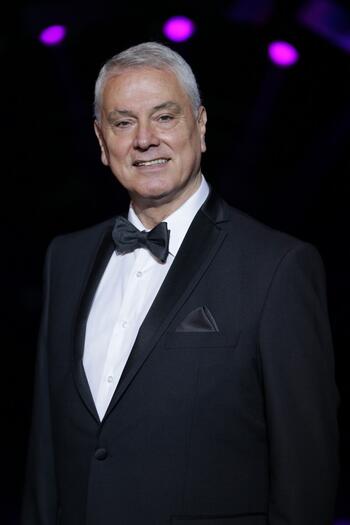
Pierre Dulaine was born in Jaffa, Palestine in 1944 to an Irish father and a Palestinian mother--both of whom fled the area in 1948. After eight months of moving several times, Dulaine's family settled in Amman, Jordan. In 1956, the Suez Crisis forced Dulaine's parents to flee the country, eventually resettling in Birmingham, England. In 1994 Dulaine founded the Dancing Classrooms program in New York City's public schools in which he encouraged children from various backgrounds to dance together. He later traveled to the city of his birth, Jaffa, to visit his childhood home and to make a film, 'Dancing in Jaffa,' where he brought Israeli Arabs and Jews together through dance and music. His life was also fictionalized in the film Take the Lead starring Antonio Banderas. More recently, Pierre Duaine has gained much acclaim in the Arab world for his role as Judge on the Arabic version of the TV show 'So You Think You Can Dance' where he encouraged young Arab men and women to pursue dance as way of dealing with difficult circumstances and certain outdated social
(See flyer for list of co-sponsors)
Note: Pierre Dulaine will give a lunchtime lecture on campus on May 29. For more information, click here.
Watch 'Dancing in Jaffa' trailer
[[{"fid":"218684","view_mode":"crop_870xauto","fields":{"format":"crop_870xauto","field_file_image_description[und][0][value]":"PD flyer","field_file_image_alt_text[und][0][value]":"","field_file_image_title_text[und][0][value]":"","field_credit[und][0][value]":"","field_caption[und][0][value]":"","field_related_image_aspect[und][0][value]":"","thumbnails":"crop_870xauto","pp_lightbox":false,"pp_description":false},"type":"media","attributes":{"height":1344,"width":870,"class":"media-element file-crop-870xauto"}}]]
Building 206-113
Stanford, CA
Pierre Dulaine
Film Screenings
Paul Amar examines social militarization in Egypt and Brazil [VIDEO]
News Type
Commentary
Date
Paragraphs
As part of the Arab Reform and Democracy Program's speaker series, UC Santa Barbara Political Scientist Paul Amar discussed his book The Security Archipelago, winner of the 2014 Charles Taylor Book Award of the American Political Science Association. The book provides an alternative historical and theoretical framing of the refashioning of free-market states and the rise of humanitarian security regimes in the Global South by examining the pivotal, trendsetting cases of Brazil and Egypt. Addressing gaps in the study of neoliberalism and biopolitics, Amar describes how coercive security operations and cultural rescue campaigns confronting waves of resistance have appropriated progressive, antimarket discourses around morality, sexuality, and labor. Homing in on Cairo and Rio de Janeiro, Amar reveals the innovative resistances and unexpected alliances that have coalesced in new polities emerging from the Arab Spring and South America's Pink Tide. These have generated a shared modern governance model that he terms the "human-security state."
Hero Image

All News button
1