International Relations

FSI researchers strive to understand how countries relate to one another, and what policies are needed to achieve global stability and prosperity. International relations experts focus on the challenging U.S.-Russian relationship, the alliance between the U.S. and Japan and the limitations of America’s counterinsurgency strategy in Afghanistan.

Foreign aid is also examined by scholars trying to understand whether money earmarked for health improvements reaches those who need it most. And FSI’s Walter H. Shorenstein Asia-Pacific Research Center has published on the need for strong South Korean leadership in dealing with its northern neighbor.

FSI researchers also look at the citizens who drive international relations, studying the effects of migration and how borders shape people’s lives. Meanwhile FSI students are very much involved in this area, working with the United Nations in Ethiopia to rethink refugee communities.

Trade is also a key component of international relations, with FSI approaching the topic from a slew of angles and states. The economy of trade is rife for study, with an APARC event on the implications of more open trade policies in Japan, and FSI researchers making sense of who would benefit from a free trade zone between the European Union and the United States.

-

Abstract: 

This talk draws on case study evidence from Princeton University’s Innovations for Successful Societies to reflect on some current theories about building accountable government.  The focus is on settings where geography, insecurity, and limited resources render conventional management strategies unworkable.

Speaker Bio:

Jennifer Widner is professor of politics and international affairs and director of the Mamdouha S.Bobst Center for Peace & Justice at Princeton University. She runs a research program on institution building and institutional reform called Innovations for Successful Societies, a joint initiative of the Bobst Center and  the Woodrow Wilson School. Before joining the Princeton faculty in 2004-5, she taught at Harvard and the University of Michigan.  Her current research focuses on the political economy of institutional reform, government accountability, and service delivery.  She also remains interested in constitution writing, constitutional design, and fair dealing—topics of earlier research. She is author of Building the Rule of Law (W. W. Norton), a study of courts and law in Africa, and she has published articles on a variety of topics in Democratization, Comparative Politics, Comparative Political Studies, Journal of Development Studies, The William & Mary Law Review, Daedalus, the American Journal of International Law, and other publications.  She is completing work on a book about making government work in challenging settings, drawing on experiences in Africa, Asia, and parts of Latin America. 

Reuben W. Hills Conference Room

Jennifer Widner Professor of Politics and International Affairs, Woodrow Wilson School Speaker Princeton University
Seminars
-

Abstract:

Tamara Cofman Wittes, who helped manage the State Department's response to the Arab Awakening and now directs the Saban Center for Middle East Policy at the Brookings Institution, will reflect on the US government's reactions to the dramatic change underway in the Arab world -- how the Obama Administration viewed the uprisings, and how its policy evolved over time as different cases emerged from Tunisia to Libya and Syria. What were the key concerns shaping the US policy response to events? How much difference did American policy make to outcomes on the ground? And, given the complex variety of outcomes now visible in the region, where is American policy toward Arab political change headed over time? 

Speaker Bio:

Tamara Cofman Wittes directs the Middle East Democracy and Development (MEDD) Project at the Saban Center for Middle East Policy, a regional policy center at The Brookings Institution. The MEDD Project conducts research into political and economic reform in the region and US efforts to promote democracy there. It also hosts visiting fellows from the Middle East.


Before joining the Saban Center in December 2003, Dr. Wittes served as Middle East specialist at the US Institute of Peace and previously as director of programs at the Middle East Institute in Washington. She has also taught courses in International Relations and Security Studies at Georgetown University. Dr. Wittes was one of the first recipients of the Rabin-Peres Peace Award, established by President Bill Clinton in 1997.

 
Dr. Wittes’s latest book is Freedom’s Unsteady March: America’s Role in Building Arab Democracy (Brookings Press). She is also editor of How Israelis and Palestinians Negotiate: A Cross-Cultural Analysis of the Oslo Peace Process (USIP, 2005). Her recent work includes “What Price Freedom? Assessing the Bush Administration’s Freedom Agenda,” and “Back to Balancing in the Middle East,” co-authored with Martin Indyk.

 Her analyses of US democracy promotion, Arab politics, the Middle East peace process, and other policy topics have been published in the Washington Post, Policy Review, Political Science Quarterly, the American Interest, the Weekly Standard, and the Chronicle of Higher Education, among others. Dr. Wittes holds a B.A. in Judaic and Near Eastern Studies from Oberlin College; her M.A. and Ph.D. in Government are from Georgetown University. She is a member of the Council on Foreign Relations.

CISAC Conference Room

Tamara Wittes Director, Middle East Democracy and Development (MEDD) Project Speaker Saban Center for Middle East Policy at the Brookings Institution
Seminars
-

 Abstract:

Systemic corruption undermines state capacity, imperils socio-economic development, and diminishes democracy. In his Nairobi speech as a U.S. senator in August 2006, Barack Obama described the struggle to reduce corruption as "the fight of our time". An international conference in Lagos, Nigeria, in September 2011 was devoted to Richard Joseph's influential 1987 book, Democracy and Prebendal Politics in Nigeria: The Rise and Fall of the Second Republic.Transforming prebendalist systems must be at the center of strategies to strengthen democracy and achieve poverty-reducing economic growth in Africa and other regions.

 Speaker Bio: 

Richard Joseph is John Evans Professor of International History and Politics at Northwestern University and Non resident Senior Fellow in Global Economy and Development at the Brookings Institution. As a Fellow of The Carter Center, he participated in democracy and peace initiatives in Ghana, Zambia, Ethiopia, Liberiaand Sudan. He has written extensively on issues of democracy, governance and political economy. His books include Radical Nationalism in Cameroun (1977), Democracy and Prebendal Politics in Nigeria (1987) and edited books, Gaullist Africa: Cameroon under Ahmadu Ahidjo (1978), State, Conflict and Democracy in Africa (1999), and (with Alexandra Gillies), Smart Aid for African Development (2009). He served as Principal Investigator of the Research Alliance to Combat HIV/AIDS (REACH), a collaborative program in Nigeria, 2006–2011. His current writing and policy projects concern growth, democracy and security. To address these issues, he is designing a collaborative project, AfricaPlus (http://africaplus.wordpress.com/), whose first focus country is Nigeria.

Here is the link to Richard Joseph remarks and the PowerPoint for the talk.

http://africaplus.wordpress.com/author/africaplus/

CISAC Conference Room

Richard Joseph John Evans Professor of International History and Politics Speaker Northwestern University
Seminars
-

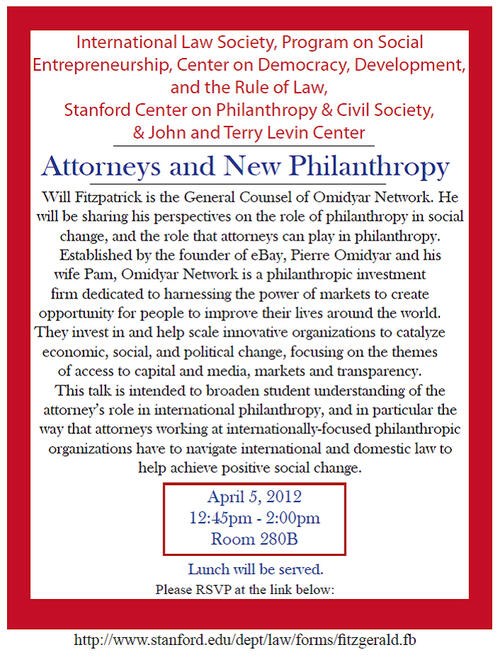
Will Fitzpatrick is the General Counsel of Omidyar Network.  He will be sharing his perspectives on the role of philanthropy in social change, and the role that attorneys can play in philanthropy.  Established by the founder of eBay, Pierre Omidyar and his wife Pam, Omidyar Network is a philanthropic investment firm dedicated to harnessing the power of markets to create opportunity for people to improve their lives around the world.  They invest in and help scale innovative organizations to catalyze economic, social, and political change, focusing on the themes of access to capital and media, markets and transparency.  This talk is intended to broaden student understanding of the attorney's role in international philanthropy, and in particular the way that attorneys working at internationally-focused philanthropic organizations have to navigate international and domestic law to achieve positive social change.

Please RSVP to the link below:

http://www.stanford.edu/dept/law/forms/fitzgerald.fb

Lunch will be provided

Image

Room 280B

Will Fitzpatrick General Counsel Speaker Omidyar Network
Conferences
News Type
News
Date
Paragraphs

Steve Hilton, senior advisor to British Prime Minister David Cameron, will join Stanford as a visiting scholar at the university’s Freeman Spogli Institute for International Studies.

Hilton, who will also be a visiting fellow at Stanford’s Hoover Institution, will arrive in May and spend his year on campus teaching, researching and writing.

“We look forward to having Steve Hilton in residence at FSI starting later this spring,” said Coit Blacker, FSI’s director. “Lively and engaging, Steve is certain to bring a fresh perspective to many of the issues and challenges that are of ongoing concern to our faculty, fellows and students.”

As Cameron’s top advisor, Hilton’s primary responsibility is the development and implementation of domestic policy. He specializes in the promotion of enterprise and economic growth, public service reform, family policy, decentralization, and government transparency and accountability.

Hilton will focus on innovation in government, public services and communities around the world while at Stanford. He will work with a wide range of centers and organizations across the university, including FSI’s Center on Democracy, Development and the Rule of Law and The Europe Center; the Graduate School of Business' Center for Social Innovation; the Center on Philanthropy and Civil Society; and the Hasso Plattner Institute of Design.

"I'm delighted to be joining the academic community at Stanford and greatly look forward to an exhilarating and productive year,” Hilton said. “It will be a huge pleasure to be able to focus on our most pressing social and governmental challenges."

Before Cameron’s election as prime minister in 2010, Hilton served as his chief strategist and developed the ideas associated with the modernization of the British Conservative Party.

Hilton previously ran Good Business, a corporate responsibility consulting firm, and is the author of Good Business: Your World Needs You. The book makes the case for businesses to play a more direct and active role in advancing social progress.

Hero Image
Hilton SQUARE
All News button
1
Paragraphs

Abstract

The brief war between Georgia and Russia in August 2008 provoked vigorous international reactions among the European states as consequence of the sudden shift in the strategic balance. This article argues for a focus on the great powers France, Germany and Britain as crucial actors for understanding the policy reactions towards Russia. It argues furthermore that reactions must be explained from the perspective of experience based on past geopolitics which translate the external pressures into concrete foreign policy: France oriented towards the creation of a strong EU as global actor, Germany influenced by her self-imposed restraint in foreign affairs and Britain influenced by Atlanticist commitments in her balancing behaviour. Beyond the Russo-Georgian war, the article points to an interest-based foreign policy approach towards Russia in the longer term driven by a great power concert with the Franco-German axis as stable element but increasingly with backing from Britain, thus contributing to transatlantic foreign policy convergence on the issue.

All Publications button
1
Publication Type
Journal Articles
Publication Date
Journal Publisher
Routledge: European Security
Authors
Henrik Larsen
-

Life expectancy at aged 65 is remarkably similar in the three Chinese cities of Hong Kong, Shanghai, and Taipei, even though the cities differ in levels of socioeconomic development, health systems, and other factors. Edward Jow-Ching Tu will discuss research that aims to understand this phenomenon. Despite unprecedented increases in life expectancy and attainment of similar current levels of life expectancy, the cities differ in the contributions of changes in major causes of death to the improvements in life expectancy among the elderly. Tu and colleagues have explored several possible determinants of these different patterns and trends in the three cities, including socioeconomic development, health service delivery systems, cause-of-death classification systems, and competing risks from cardiovascular disease and other diseases. Their analysis suggests that the effect of equity of health service delivery has become more important over time.

Edward Jow-Ching Tu is a senior lecturer of demography in the Division of Social Science at Hong Kong University of Science and Technology. His work is focused on the impact of fertility, mortality, and migration on socio-economic changes in East Asia countries with special emphasis on nations experiencing a transition from planned economy to market economy; on causes and impacts of mortality changes and health transition on aging societies; and on the causes of lowest-low fertility in many East Asia countries. He has several active research projects ongoing in China, Japan, Taiwan, Hong Kong, and Singapore. He holds graduate degress from West Virginia University, the University of Pennsylvania, and the University of Tennessee (Knoxville). Tu has worked extensively in Asia, and has served as an adjunct professor and taught in many universities in China, including Peking University, Peoples University, Nankai Univerity, and Fudan University. He had served as a senior research scientist at the New York State Health Department and as a research fellow (full professor) at the Institute for Social Sciences and Philosophy at Academia Sinica. Tu has also taught at the State University of New York in Albany.

Philippines Conference Room

Edward Jow-Ching Tu Senior Lecturer of Demography at the Division of Social Science Speaker Hong Kong University of Science and Technology
Seminars
-

Abstract:

Nunn's paper examines the effect of U.S. food aid on conflict in recipient countries. To establish a causal relationship, he and Nancy Qian exploit time variation in food aid caused by fluctuationsin U.S. wheat production together with cross-sectional variation in a country's tendency to receive any food aid from the United States. Their estimates show that an increase in U.S. food aid increases the incidence, onset and duration of civil conflicts in recipient countries. The results suggest that the effects are larger for smaller scale civil conflicts. No effect is found on interstate warfare.

Speaker Bio: 

Professor Nunn was born in Canada, where he received his PhD from the University of Toronto in 2005.  In 2009, Professor Nunn was selected as an Alfred P. Sloan Research Fellow and grant recepient.

Professor Nunn’s primary research interests are in economic history, economic development, political economy and international trade. One stream of Nunn’s research focuses on the long-term impact that historic events can have on current economic development. In “Historical Legacies: A Model Linking Africa’s Past to its Current Underdevelopment”, published in the Journal of Development Economics in 2007, Nunn develops a game-theoretic model showing how the slave trade and colonial rule could have had permanent long-term effects on economic performance. In “The Long-Term Effects of Africa’s Slave Trades” (Quarterly Journal of Economics, 2008), Nunn documents the long-term adverse economic effects of Africa’s slave trades. His current research continues to examine the specific channels through which the slave trade affects current development within Africa. In "The Slave Trade and the Origins of Mistrust in Africa" (American Economic Review, forthcoming), coauthored with Leonard Wantchekon, he empirically documents how the slave trade engendered a culture of mistrust amongst the descendants of those heavily threatened by the slave trade.

A second stream of Professor Nunn’s research focuses on the importance of hold-up and incomplete contracting in international trade. He has published research showing that a country’s ability to enforce written contracts is a key determinant of comparative advantage (“Relationship-Specificity, Incomplete Contracts and the Pattern of Trade,” Quarterly Journal of Economics, 2007). Other work, coauthored with Daniel Trefler, examines the relationship between the cross-industry structure of a country's tariffs and its long-term economic growth (“The Structure of Tariffs and Long-Term Growth,” American Economic Journal: Macroeconomics, 2010). The study identifies growth-promoting benefits of a tariff structure focused in skill-intensive industries. It also shows how and why governments that succumb to political influence and rent-seeking are unable to focus tariffs in these key industries.


Philippines Conference Room

Nathan Nunn Paul Sack Associate Professor of Political Economy, Department of Economics Speaker Harvard University
Seminars
Subscribe to International Relations