
 FSI researchers strive to understand how countries relate to one another, and what policies are needed to achieve global stability and prosperity. International relations experts focus on the challenging U.S.-Russian relationship, the alliance between the U.S. and Japan and the limitations of America’s counterinsurgency strategy in Afghanistan.
Foreign aid is also examined by scholars trying to understand whether money earmarked for health improvements reaches those who need it most. And FSI’s Walter H. Shorenstein Asia-Pacific Research Center has published on the need for strong South Korean leadership in dealing with its northern neighbor.
FSI researchers also look at the citizens who drive international relations, studying the effects of migration and how borders shape people’s lives. Meanwhile FSI students are very much involved in this area, working with the United Nations in Ethiopia to rethink refugee communities.
Trade is also a key component of international relations, with FSI approaching the topic from a slew of angles and states. The economy of trade is rife for study, with an APARC event on the implications of more open trade policies in Japan, and FSI researchers making sense of who would benefit from a free trade zone between the European Union and the United States.


Graduating seniors recognized for outstanding theses on democratic development
News Type
News
Date
Paragraphs
The Center on Democracy, Development, and the Rule of Law proudly congratulates its graduating class of honors students for their outstanding original research conducted under the CDDRL Interdisciplinary Undergraduate Honors Program. Among those graduating includes Garima Sharma who was awarded the Firestone Medal for her thesis entitled "Factors Shaping Mothers' Aspirations for their Daughters in India: A Case Study of Forbesganj, Bihar." Sharma's project used both quantitative and qualitative methods to explore cultural, social and economic factors that shape female expectations in one of the poorest parts of India.
The Firestone Medal for Excellence in Undergraduate Research recognizes Stanford's top ten percent of honors theses in social science, science and engineering among the graduating senior class.
Initially struck by the high rates of early marriage upon her visit to northern India, Sharma conducted field interviews and surveys last summer, finding that exposure to educated and employed female role models produced an increase in mothers’ aspirations for their daughters.
 Cara Reichard (left) and Garima Sharma (right) both received awards under CDDRL for their outstanding theses projects.
Sharma's research was conducted under the advisement of Associate Professor of Education and CDDRL Affiliated Faculty Member Christine Min Wotipka. In addition to the Firestone Award, Sharma received the 2015 Michelle Zimbalist Rosaldo Prize in the Social Sciences under the Program in Feminist, Gender, and Sexuality Studies.
Among other award winners, CDDRL honors student Cara Reichard received the CDDRL Best Thesis Award for her honors thesis "The Logic of International Courts: An Exploration of the East African Court of Justice," which analyzed the impact and legitimacy of rulings under the East African Court of Justice. Stefan Norgaard received a Firestone Medal under the Urban Studies program for his thesis entitled "Rainbow Junction: South Africa’s Born Free Generation and the Future of Democracy," which assessed democratic consolidation in South Africa via hyper-local civic interactions among the country's active youth.
"The CDDRL honors program has allowed us to write theses around issues that really matter," said Norgaard. "What sets the program apart is that it pushes us to pursue projects aimed at changing things and making an active contribution to scholarship around the world."
Norgaard, Sharma and Reichard are part of a cohort of ten graduating CDDRL honors students who have spent the past year working in consultation with CDDRL affiliated faculty members and attending honors research workshops to develop their theses projects. Many traveled abroad to collect data, conduct interviews, and spend time in the country they were researching. Collectively, their topics documented some of the most pressing issues impacting democracy today in South Africa, India, North Korea, Swaziland, Cuba and Uganda, among others.
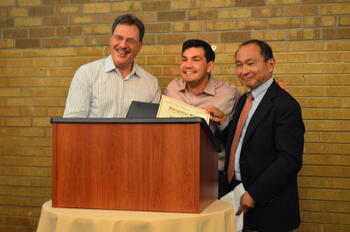 Stefan Norgaard with CDDRL Director Larry Diamond (left) and FSI Olivier Nomellini Senior Fellow Francis Fukuyama (right).
In the upcoming 2015-2016 academic year, the program will bring in the new leadership of CDDRL Deputy Director Stephen Stedman who will advise a cohort of 15 honors students, one of the program's largest and most diverse classes to date.
The CDDRL Interdisciplinary Undergraduate Honors Program trains students from any academic department at Stanford to prepare them to write a policy-relevant research thesis with global impact on a subject touching on democracy, development, and the rule of law. Honors students participate in research methods workshops; attend honors college in Washington, D.C.; connect to the CDDRL research community; and write their thesis in close consultation with a faculty advisor to graduate with a certificate of honors in democracy, development, and the rule of law.
A list of the 2015 graduating class of CDDRL honors students, their theses advisors, and a link to their theses can be found below:
| Name | Major | Thesis |
|---|---|---|
| Monica Dey | Human Biology | |
| Selamile Dlamini | Management Science & Engineering | “Political parties cause divisions”: Exploring Support for Democracy in Swaziland Advisors: Larry Diamond and Joel Samoff |
| Max Johnson | International Relations | |
| Hamin Kim | Human Biology | NGOs and Effective Aid Delivery in the Democratic People's Republic of Korea (Thesis not available for public.) Advisor: Gary Schoolnik |
| Stefan Norgaard | Public Policy | Rainbow Junction: South Africa’s Born Free Generation and the Future of Democracy Advisor: Larry Diamond |
| Cara Reichard | Political Science | The Logic of International Courts: An Exploration of the East African Court of Justice Advisor: Stephen Krasner |
| Ashley Semanskee | Human Biology | Community Engagement and Accountability in US Urban Public School Districts (Thesis not available.) Advisor: Martin Carnoy and Susanna Loeb |
Garima Sharma | Economics | Factors Shaping Mothers’ Aspirations for their Daughters in India: A Case Study of Forbesganj, Bihar Advisor: Christine Min Wotipka |
| Thuy Tran | Economics | Corporate Social Responsibility and Profits: A Tradeoff or a Balance? Advisor: Stephen Krasner |
| Shawn Tuteja | Mathematics | Why Groups Divide: Understanding the Mechanisms that Lead to Polarization in Deliberative Polling™ Advisor: James Fishkin and Alice Siu |
Hero Image

The graduating class of 2014-2015 CDDRL senior honors students take a group photo with CDDRL Director Larry Diamond and FSI Oliver Nomellini Senior Fellow and CDDRL Honors Program Advisor Francis Fukuyama. From left to right: Didi Kuo (CDDRL honors program teaching assistant); Stefan Norgaard; Monica Dey; Hamin Kim; Garima Sharma; Larry Diamond; Ashley Semanskee; Selamile Dlamini; Max Johnson; Cara Reichard; Thuy Tran; Shawn Tuteja; and Francis Fukuyama.
Lauren Weitzman
All News button
1
Leadership Academy for Development Workshops
The Leadership Academy for Development (LAD) trains government officials and business leaders from developing countries to help the private sector be a constructive force for economic growth and development. The LAD course is designed as an intensive, off-site, executive-level training program that occurs in partnership with a collaborating host institutions around the world.
Special Event: Videoconference with President Ma Ying-jeou of the Republic of China (Taiwan)
-
**LIVE WEBCAST WILL BE AVAILABLE HERE IMMEDIATELY PRIOR TO THE EVENT.**
[[{"fid":"219129","view_mode":"crop_870xauto","fields":{"format":"crop_870xauto","field_file_image_description[und][0][value]":"","field_file_image_alt_text[und][0][value]":"","field_file_image_title_text[und][0][value]":"","field_credit[und][0][value]":"","field_caption[und][0][value]":"","field_related_image_aspect[und][0][value]":"","thumbnails":"crop_870xauto","pp_lightbox":false,"pp_description":false},"type":"media","attributes":{"width":"870","class":"media-element file-crop-870xauto"}}]]
On June 2, 2015, the Taiwan Democracy Project at Stanford's Center on Democracy, Development and the Rule of Law (CDDRL) will host a special panel session featuring the President of the Republic of China (Taiwan), Ma Ying-jeou. President Ma will speak via live video feed to commemorate the 70th anniversary of the end of World War II and the long history of the U.S.-R.O.C. relationship. Following his prepared remarks, the president will engage in a question-and-answer session with the audience and a distinguished panel of leading Stanford faculty and fellows, chaired and moderated by the former Secretary of Defense of the United States, William J. Perry.
About the Speaker
Ma Ying-jeou has served as the President of the Republic of China (Taiwan) since May 2008. As president, Ma Ying-jeou has worked to address the repercussions of the global financial crisis, stepping up efforts to bring about a more diversified industrial structure and to jump-start new engines for economic growth in Taiwan. President Ma has also attached great importance to promoting energy conservation and carbon reduction, which has helped Taiwan’s energy efficiency to exceed two percent. In addition, his administration worked to craft a response to regional economic integration, successfully negotiating the landmark Economic Cooperation Framework Agreement (ECFA) with the People's Republic of China in 2010. President Ma's creative diplomacy has brought a significant improvement in cross-Strait relations while putting an end to a long and vituperative standoff between the two sides in the diplomatic sphere.
About the Panelists
William J. Perry is the Michael and Barbara Berberian Professor (emeritus) and a senior fellow at the Freeman Spogli Institute and the Hoover Institution, and serves as the director of the Preventive Defense Project at Stanford University. He was the Secretary of Defense for the United States from 1994-1997.
Lanhee J. Chen is the David and Diane Steffy Research Fellow at the Hoover Institution, as well as Lecturer in Public Policy and Law at Stanford University. He served as the chief policy adviser to 2012 U.S. presidential candidate Mitt Romney.
Karl Eikenberry is the William J. Perry Fellow in International Security at the Center for International Security and Cooperation at Stanford University. He served as the U.S. Ambassador to Afghanistan and is a Lieutenant General, Retired, U.S. Army.
Thomas Fingar is the Oksenberg-Rohlen Distinguished Fellow in the Freeman Spogli Institute for International Studies at Stanford University. He served as the first deputy director of national intelligence for analysis and as chairman of the National Intelligence Council from 2005-2008.
Event Details
The live panel will take place in the Bechtel Conference Room of the Freeman Spogli Institute at Stanford University, at 616 Serra Street, from 5:45-7:00pm on June 2, 2015. An informal reception in the lobby of Encina Hall will follow.
This event is co-sponsored with the Taipei Economic and Cultural Office, San Francisco and the Office of the President of the Republic of China (Taiwan). It is free and open to the public. RSVP is required.
President Ma Ying-jeou
Lanhee J. Chen
Thomas Fingar
William J. Perry
Panel Discussions
Noura Erakat analyzes the political and legal contexts of the 2014 Gaza war [VIDEO]
News Type
Commentary
Date
Paragraphs
As part of the Arab Reform and Democracy Program's speaker series, George Mason University scholar Noura Erakat examined the political and legal contexts for the 2014 Gaza war. In July and August of 2014, hostilities in the Gaza Strip left 2,131 Palestinians and 71 Israelis dead, including 501 Palestinian children and one Israeli child. Of Gaza’s 1.8 million residents, 475,000 are living in temporary shelters or with other families because their homes have been severely damaged. The extent of destruction has raised questions around culpability for war crimes on all sides of the conflict.
Hero Image

All News button
1


