Authors
News Type
News
Date
Paragraphs

Motivation & Overview:


The effects of the climate crisis are thought to be extremely far-reaching, from declining economic growth and agricultural productivity to housing displacement and job loss. An important set of consequences are psychological, relating to how climate change can exacerbate anxiety and one’s sense of hopelessness about an uninhabitable future. These psychological impacts are heightened for members of vulnerable and marginalized groups, as well as for those in poor and underdeveloped places that struggle to address climate change.

In “Adolescent psychological health, temporal discounting, and climate distress under increased flood exposure in Bangladesh,” Liza Goldberg and her coauthors examine the psychological well-being of 15 to 18-year-olds in two Bangladeshi cities that have been differentially affected by floods. The authors conduct surveys and focus groups with adolescents in the low-flood-risk capital city of Dhaka and the high-flood-risk city of Barisal. They find that although adolescents in both cities fear the personal impacts of climate change, rates of anxiety and depression are significantly higher in Barisal. In addition, those with anxiety and depression exhibit greater temporal discounting, meaning that short-term consequences are favored over longer-term ones. Discounting is an important — if neglected — consequence because adolescents will emerge as household decision-makers who must plan to adapt to climate change. The article is notable in increasing our knowledge of how floods harm members of an already vulnerable population.

Case Selection and Hypotheses:


Bangladesh is among the world’s most climate-vulnerable countries. This is due to its “deltaic” geography (i.e., its low, flat land, crossed by many rivers) and consequent flood exposure, extreme temperature and humidity, and poor air quality. Barisal — a city of over 500,000 that is roughly 115 kilometers from Dhaka — is highly vulnerable to flooding, as well as being poorer (relative to Dhaka) and limited in its “climate adaptation infrastructure.” Partly for these reasons, rates of migration from Barisal to Dhaka are the highest in Bangladesh. By contrast, Dhaka — the capital city of over 24 million — is less flood-exposed and is slightly wealthier. Respondents in Barisal and Dhaka reported around four floods and one flood per year, respectively.
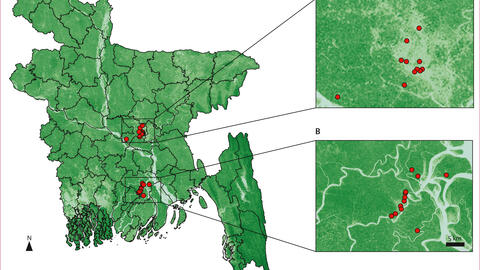


Figure. Study site locations in Bangladesh. Study sites at Dhaka (A) and Barisal (B) are shown in red.


Figure. Study site locations in Bangladesh. Study sites at Dhaka (A) and Barisal (B) are shown in red.


The authors hypothesize that Barisal’s greater flood exposure would be associated with more anxiety and depression among its adolescents, and that anxiety and depression would be associated with greater temporal discounting. (In other words, they do not expect that flood exposure would be directly associated with discounting.) In addition, the authors expect that these negative psychological effects would be especially pronounced among poor Bangladeshis, girls, and those with a greater awareness of the climate crisis.

Data and Findings:


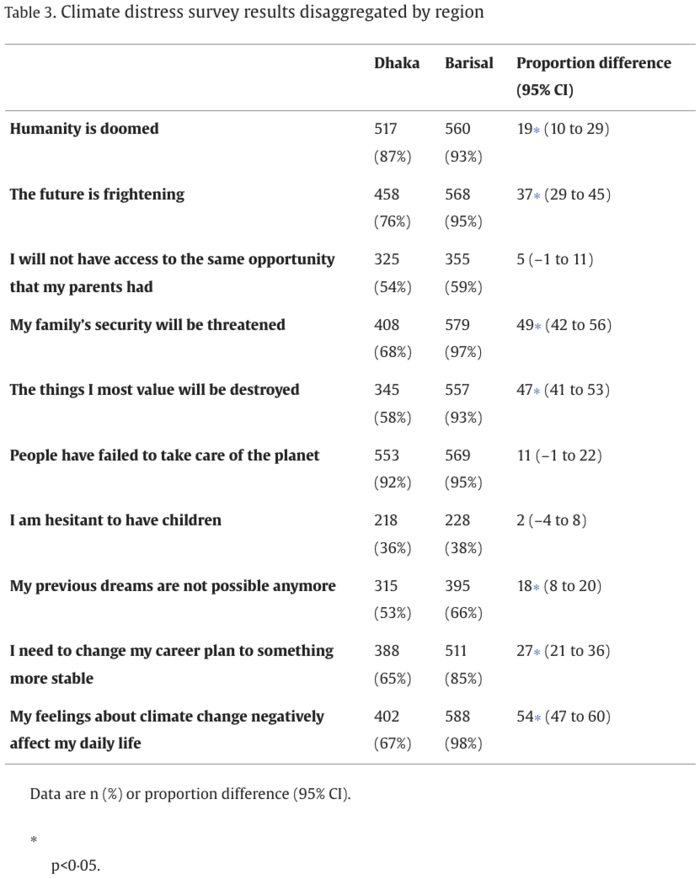
The authors surveyed 1200 Bangladeshi adolescents in 24 schools immediately after the flood season, which usually runs from May to September. In addition, 16 focus groups were conducted with around 160 total participants. Adolescents in both cities expressed a high familiarity with climate change. However, and consistent with the authors’ expectations, those in Barisal expressed significantly higher levels of agreement with statements about climate distress. For example 97% of those in Barisal compared to just 68% in Dhaka agreed that “My family’s security will be threatened,” 93% in Barisal and 58% in Dhaka agreed that “The things I most value will be destroyed,” and 98% in Barisal and 67% in Dhaka agreed that “My feelings about climate change negatively affect my daily life.” 


Image
Table 3. Climate distress survey results disaggregated by region.


Table 3. Climate distress survey results disaggregated by region.


The focus groups corroborated this unequal sense of despair, especially concerning the future and one’s educational and career goals. In Barisal, a boy said, “We expect that we will have to continue withstanding this [flooding] for many years to come,” while a girl said, “I used to want to become a teacher myself, but now I believe I will need to get married immediately after school because my father keeps losing his job during the floods.” By contrast, and because flooding in Dhaka is so infrequent, adolescents did not expect climate change to meaningfully threaten their life trajectories.

In terms of anxiety and depression, 86% of those in Barisal reported anxiety symptoms, compared to 71% in Dhaka, while 98% in Barisal and 88% in Dhaka reported depressive symptoms. After adjusting for factors like sex, wealth, and climate change awareness, the odds of being anxious and depressed in Barisal were nearly twice as high and more than 3.5 times as high, respectively. Across both cities, females were more than 1.75 times as likely to experience anxiety. And the odds of being depressed were over 1.85 times as high for those with a greater awareness of climate change.

I used to want to become a teacher myself, but now I believe I will need to get married immediately after school because my father keeps losing his job during the floods.

Girls in the Barisal focus groups revealed that flooding was linked to domestic violence. Fathers facing financial insecurity were reported to engage in violence against their mothers as a consequence of this stress. As one girl put it, “The floods keep getting worse and worse. So, I may experience even more violence than my mother does.” By contrast, few girls in Dhaka expressed worsening family dynamics, and none reported domestic violence owing to flooding. Adolescents in Dhaka believed that floods in their region were simply too fleeting to result in such abuse.

Finally, only 7% and 6% of adolescents in Barisal and Dhaka showed signs of temporal discounting. However, the odds of discounting were twice as high for those with anxiety and almost 2.5 times as high for those with depression. The authors find some evidence of discounting in the focus groups, but no meaningful differences across cities. This absence may be due to discounting behaviors emerging around adulthood, which is older than the adolescent study population. Taken together, the authors’ findings imply that mental health support will be essential for those affected by climate change — especially in impoverished areas — to help them manage stress and to improve their ability to plan for the future.

*Research-in-Brief prepared by Adam Fefer.

Hero Image
A woman stands on sandbags stacked to protect against flooding in Barisal, Bangladesh.
Liza Goldberg
All News button
1
Subtitle

CDDRL Research-in-Brief [4-minute read]

Date Label
Paragraphs

Chronic exposure to climate stress disproportionately affects low-income households; however, the psychological health and climate distress levels of climate-vulnerable adolescents in low-resource settings has rarely been explored. We investigated the association between increased flood exposure and adolescent psychological health, climate distress, and temporal discounting (long-term planning capacity).

All Publications button
1
Publication Type
Journal Articles
Publication Date
Journal Publisher
The Lancet Planetary Health
Authors
Liza Goldberg
Stephen P. Luby
Erik Jensen
Authors
News Type
News
Date
Paragraphs

A new Stanford-led study sheds light on “an emerging psychological health crisis” that disproportionately affects girls. Published July 30 in The Lancet Planetary Health, the study is among the first to quantify how repeated climate stressors impact the psychological well-being and future outlook of adolescents in low-resource settings. Researchers from Stanford’s schools of Medicine, Law, and Sustainability partnered with health experts in Bangladesh to survey more than 1,000 teenagers and conduct focus groups across two regions with starkly different flood exposure.

“What we found really lifts the voices of frontline adolescents — a group whose perspectives and health outcomes are so rarely investigated and communicated,” said lead author Liza Goldberg, an incoming Earth system science PhD student in the Stanford Doerr School of Sustainability.

Read the full release from The Woods Institute for the Environment.

Hero Image
Stanford researchers and others conducting focus group discussions in Barisal, Bangladesh.
Shahid Atonu Sarkar
All News button
1
Subtitle

Adolescents living in flood-prone areas of Bangladesh face dramatically higher rates of anxiety and depression than their peers in lower-risk regions, according to a Stanford-led study by CDDRL Fisher Family Honors Program alumna Liza Goldberg ('24) that highlights a hidden cost of climate change with potentially devastating long-term consequences.

Date Label
Authors
Nora Sulots
News Type
News
Date
Paragraphs

Congratulations to Liza Goldberg, a graduate of CDDRL's 2023-24 Fisher Family Honors Program, on her selection as a 2025 Knight-Hennessy Scholar. Knight-Hennessy Scholars cultivates and supports a multidisciplinary and multicultural community of graduate students from across Stanford University and delivers engaging experiences that prepare graduates to be visionary, courageous, and collaborative leaders who address complex challenges facing the world.

Originally from Columbia, Maryland, Liza “is pursuing a PhD in Earth System Science at Stanford’s Doerr School of Sustainability. She received a bachelor’s degree in Earth Systems at Stanford University and a master’s degree in climate change and planetary health at the London School of Hygiene and Tropical Medicine. Liza pairs satellite remote sensing and qualitative analysis to build climate change resilience in settings of poverty and humanitarian emergencies, especially across South Asia. She has worked as an earth scientist at NASA since age 14 and has presented her published research worldwide. As a National Geographic Explorer, Liza founded and directs a global initiative to build remote sensing capacity in low-resource institutions across climate front lines. She leads an international team leveraging space technology to monitor the Rohingya refugee crisis and preserve multigenerational refugee histories.”

Liza is a Marshall Scholar, a Google Developer Expert, and a Sigma Squared Fellow. In 2024, she was inducted into the academic honors society Phi Beta Kappa.

At CDDRL, Liza received the Firestone Medal for Excellence in Undergraduate Research for her honors thesis, “The Psychology of Adolescent Poverty Under Climate Change: Evidence from Bangladesh,” based on extensive fieldwork and groundbreaking research into gender and climate adaptation. When asked what initially attracted her to the Fisher Family Honors Program, she shared at the time: “I am excited to have the opportunity to formally cross my interests in climate science and development policy through this program. I have also been very fortunate to receive extensive mentorship from my two CDDRL advisors throughout my time at Stanford, and I very much look forward to continuing to work together, as well as with the entire outstanding CDDRL faculty group, throughout the course of writing my thesis.”

Regarding her future aspirations post-Stanford, Liza shared upon her acceptance into the Fisher Family Honors Program, "I seek to dedicate my education and career to applying groundbreaking satellite technology in aiding climate adaptation across low- and middle-income nations."

You can read the full Knight-Hennessy Scholars press release here.

Read More

CDDRL 2024 Honors Thesis Awardees Liza Goldberg and Melissa Severino de Oliveira
News

CDDRL Fisher Family Honors Program Graduates Recognized for Outstanding Theses

Liza Goldberg ('24) is a recipient of the 2024 Firestone Medal, and Melissa Severino de Oliveira ('24) has won CDDRL's Outstanding Thesis Award.
CDDRL Fisher Family Honors Program Graduates Recognized for Outstanding Theses
Phi Beta Kappa graduates
News

CDDRL Congratulates Newly Elected 2024 Phi Beta Kappa Members

Liza Goldberg and Melissa Severino de Oliveira (Fisher Family Honors Program class of 2024) are among the newest members of this prestigious academic honors society.
CDDRL Congratulates Newly Elected 2024 Phi Beta Kappa Members
Liza Goldberg
News

Senior Liza Goldberg named 2024 Marshall Scholar

The scholarship will support Goldberg’s graduate studies in climate change, planetary health, and environment and development.
Senior Liza Goldberg named 2024 Marshall Scholar
Hero Image
Liza Goldberg
Liza Goldberg
Courtesy of Knight-Hennessy Scholars
All News button
1
Subtitle

Liza Goldberg (Fisher Family Honors Program class of 2023-24) is among 84 scholars in the Knight-Hennessy Scholars' eighth cohort.

Date Label
Paragraphs

We present results from a randomized controlled trial in Bangladesh that introduced operational practices to improve energy efficiency and reduce emissions in 276 “zigzag” brick kilns. Of all intervention kilns, 65% adopted the improved practices. Treatment assignment reduced energy use by 10.5% (P-value <0.001) and decreased CO2 and PM2.5 emissions by 171 and 0.45 metric tons, respectively, per kiln per year. Valuing the CO2 reductions using a social cost of carbon of 185 USD per metric ton, we find that the social benefits outweigh costs by a factor of 65 to 1. The intervention, which required no new capital investment, also decreased fuel costs and increased brick quality. Our results demonstrate the potential for privately profitable, as well as publicly beneficial, improvements to address environmental problems in informal industries.

All Publications button
1
Publication Type
Journal Articles
Publication Date
Journal Publisher
Science
Authors
Stephen P. Luby
Number
No. 6747
Paragraphs

Food adulteration with toxic chemicals is a global public health threat. Lead chromate adulterated spices have been linked with lead poisoning in many countries, from Bangladesh to the United States. This study systematically assessed lead chromate adulteration in turmeric, a spice that is consumed daily across South Asia. Our study focused on four understudied countries that produce >80 % of the world's turmeric and collectively include 1.7 billion people, 22 % of the world's population. Turmeric samples were collected from wholesale and retail bazaars from 23 major cities across India, Pakistan, Sri Lanka, and Nepal between December 2020 and March 2021. Turmeric samples were analyzed for lead and chromium concentrations and maximum child blood lead levels were modeled in regions where samples had detectable lead. A total of 356 turmeric samples were collected, including 180 samples of dried turmeric roots and 176 samples of turmeric powder. In total, 14 % of the samples (n = 51) had detectable lead above 2 μg/g. Turmeric samples with lead levels greater than or equal to 18 μg/g had molar ratios of lead to chromium near 1:1, suggestive of lead chromate adulteration. Turmeric lead levels exceeded 1000 μg/g in Patna (Bihar, India) as well as Karachi and Peshawar (Pakistan), resulting in projected child blood lead levels up to 10 times higher than the CDC's threshold of concern. Given the overwhelmingly elevated lead levels in turmeric from these locations, urgent action is needed to halt the practice of lead chromate addition in the turmeric supply chain.

All Publications button
1
Publication Type
Journal Articles
Publication Date
Journal Publisher
Science of The Total Environment
Authors
Dinsha Mistree
Stephen P. Luby
Number
2024, 175003
Authors
News Type
News
Date
Paragraphs

When you think of the climate crisis and the major impact it will have upon all corners of the world, one nation stands out as the epicenter of the unfolding cataclysmic changes: Bangladesh.

When Stephen Luby, MD, began working there two decades ago, the South Asian country was facing tremendous climate stress brought on by intermittent floods, extreme heat, cyclones and drought that threatened human life.


Continue reading in Stanford Magazine

Hero Image
Beyond Climate Dread cover image Anuj Shrestha
All News button
1
Subtitle

Stephen Luby is among a growing number of Stanford Medicine community members dedicated to finding solutions to urgent problems of planetary and human health.

Paragraphs

We conducted a cluster-randomized trial to measure the effect of community-level mask distribution and promotion on symptomatic SARS-CoV-2 infections in rural Bangladesh from November 2020 to April 2021 (N = 600 villages, N = 342,183 adults). We cross-randomized mask type (cloth vs. surgical) and promotion strategies at the village and household level. Proper mask-wearing increased from 13.3% in the control group to 42.3% in the intervention arm (adjusted percentage point difference = 0.29 [0.26, 0.31]). The intervention reduced symptomatic seroprevalence (adjusted prevalence ratio (aPR) = 0.91 [0.82, 1.00]), especially among adults 60+ years in villages where surgical masks were distributed (aPR = 0.65 [0.45, 0.85]). Mask distribution and promotion was a scalable and effective method to reduce symptomatic SARS-CoV-2 infections.

All Publications button
1
Publication Type
Working Papers
Publication Date
Subtitle

A randomized trial of community-level mask promotion in rural Bangladesh during COVID-19 shows that the intervention increased mask-use and reduced symptomatic SARS-CoV-2 infections.

Journal Publisher
Innovations for Poverty Action
Authors
Stephen P. Luby
News Type
News
Date
Paragraphs

Fourteen Stanford researchers addressing global poverty through a range of academic disciplines are receiving a total of $4.6 million in awards from the university-wide Global Development and Poverty (GDP) initiative.

Their projects, which are the first to be funded by the GDP, deal with challenges of health, violence, economics, governance and education in the developing world.

“GDP seeks to transform scholarly activity and dialogue at Stanford around the topic of global poverty, so that the university may have a greater impact on poverty alleviation in developing economies,” said GDP faculty co-chair Jesper B. Sørensen. “By focusing on placing a small number of big bets, GDP encourages researchers to think big, and to move beyond the conventional way of doing things. We are thrilled by the inaugural set of awardees, as they demonstrate the creative, inter-disciplinary approaches that will make Stanford a leader in this area.”

The GDP initiative is part of the Stanford Institute for Innovation in Developing Economies (SEED) and is administered in partnership with Stanford's Freeman Spogli Institute for International Studies (FSI). The GDP is co-chaired by Sørensen, the faculty director for SEED and the Robert A. and Elizabeth R. Jeffe Professor of Organizational Behavior at the Graduate School of Business; and Mariano-Florentino Cuéllar, senior fellow and director of FSI and the Stanley Morrison Professor at Stanford Law School.

SEED, which seeks to alleviate poverty by stimulating the creation of economic opportunities through innovation, entrepreneurship and the growth of businesses, was established in 2011 through a generous gift from Robert King, MBA '60, and his wife, Dorothy.

Through complementary areas of focus, GDP funding and other SEED research initiatives will stimulate research, novel interdisciplinary collaborations and solutions to problems of global poverty and development. GDP research aims to pursue answers to crucial questions that are essential to an understanding of how to reduce global poverty and promote economic development. That includes governance and the rule of law, education, health, and food security – all of which are essential for entrepreneurship to thrive. By contrast, other SEED research focuses on innovation, entrepreneurship, and the growth of businesses in developing economies.

Since 2012, SEED’s Entrepreneurship and Innovation in Developing Economies Award program also has doled out 22 awards and seven PhD fellowships to help support and scale businesses in developing economies. Among the $1 million in funded projects were studies of how to improve the livelihoods of small-holder cacao farmers throughout the tropics; how to identify startups with high job- and wealth-creating potential in Chile; how political accountability affects the ability to attract investment in Sierra Leone; and how managerial practices affect trade entrepreneurship in China.

First GDP Awards

The first 14 GDP award recipients are professors of economics, political science, law, medicine, pediatrics, education and biology, and senior fellows from FSI, the Woods Institute, and the Stanford Institute for Economic Policy Research (SIEPR).

“Each of these projects cuts across disciplines, reflects innovative thinking, and has the potential to generate crucial knowledge about how to improve the lives of the poor around the world,” Cuéllar said. “These projects, along with a variety of workshops engaging the university and external stakeholders, will help us strengthen Stanford’s long-term capacity to address issues of global poverty through research, education and outreach.”

Among the award recipients is Pascaline Dupas, an associate professor of economics and senior fellow at SIEPR. Dupas, along with faculty from the Center for Health Policy and Center on Democracy, Development and the Rule of Law, will launch the Stanford Economic Development Research Initiative using GDP funds.  This initiative will focus on collecting high-quality institutional and individual-level data on economic activity in a number of developing countries over the long term, and making these data available to scholars around the world.

Beatriz Magaloni, an associate professor of political science and senior fellow at FSI, is receiving an award to lead a team focused on criminal violence and its effects on the poor in developing economies, and the practical solutions for increasing security in those regions.

Douglas K. Owens, a professor of medicine and FSI senior fellow, was awarded an award to help him lead a team that will develop models to estimate how alternative resource allocations for health interventions among the poor will influence health and economic outcomes.

Stephen Haber, a professor of political science and history and a senior fellow at the Hoover Institution, received an award to bring together Stanford researchers interested in examining the long-term institutional constraints on economic development. Their goal will be to provide policymakers with a framework for determining the conditions under which particular innovations are likely to have positive payoffs, and the conditions under which resources will likely be wasted.

Other projects will address the educational impacts of solar lighting systems in poor communities; identifying interventions to improve the profits and safety among poor, smallholder pig farmers in Bangladesh and China; the role of law and institutions in economic development and poverty reduction; and how to rethink worldwide refugee problems. Awards are also being provided to researchers focused on microfinance, online education and teacher training.

The project proposals were reviewed by an interdisciplinary faculty advisory council chaired by Cuéllar and Sørensen. 

“We were very encouraged by the impressive number of project proposals from a wide range of areas and are looking forward to introducing several new capacity and community-building activities in the fall,” Sørensen said.. “This wide range of research initiatives will form a vibrant nucleus for Stanford’s growing community of scholars of global development and poverty.”

All News button
1
Subscribe to Bangladesh