
Paul Wise Heads Up Global Initiative to Boost Humanitarian Health Response to Violent Conflict
Armed conflict continues its brutal march in Syria, Yemen, Southeast Asia and South Sudan — to name a few of the international hotspots that contributed to an 11% increase in political violence around the world in 2018.
Nearly 10 million Yemenis are facing famine this year; Syria was the deadliest place on earth for civilians last year, with more than 7,100 fatalities.
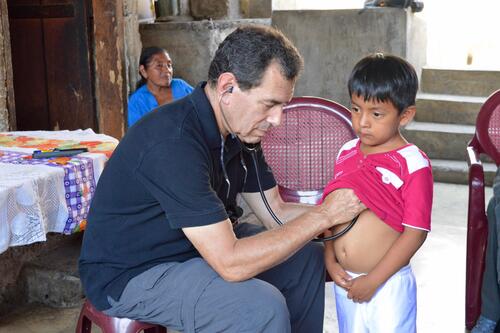
Many of those killed — and even more who face starvation — are children. And that’s when Stanford professor of pediatrics Paul Wise finds it hard to stand on the sidelines. Wise, who has traveled to Guatemala annually for the last 40 years to treat children in rural communities, also travels to the frontlines of global calamities.
As part of a small team of physicians, Wise went to Mosul, the northern city in Iraq once controlled by ISIS, in 2017 to evaluate the World Health Organization-led system to treat civilians injured in the brutal battle for the city.
Working with colleagues at the Freeman Spogli Institute for International Studies, Wise has collaborated with the U.S. military, non-governmental organizations and the United Nations on the interaction of humanitarian and security challenges.
So, it should come as no surprise that the American Academy of Arts & Sciences — of which he is a member — recently appointed him and two other global health experts to lead a new initiative to develop new strategies to protect civilians, health care and cultural heritage in areas of extreme violence.
The initiative, Rethinking the Humanitarian Health Response to Violence Conflict, will be a collaboration among political scientists, international human rights lawyers, physicians, academics and even the curators of major museums. They will develop strategies to prevent civilian harm and deliver critical health services in areas plagued by violent conflict, most notably in the Middle East, central and north Africa and parts of Asia.
“We also want to address the humanitarian and protective frameworks that operate in areas that are extremely violent but wouldn’t necessarily be defined as being in armed conflict, like in the northern triangle of Central America. The human toll in these areas is at least as great as some of these other more traditionally defined areas,” Wise said.
Another of those areas is Myanmar, where nearly 700,000 ethnic Rohingya Muslims have fled to neighboring Bangladesh amid sectarian violence in the northern Rakhine province, in what the United Nations calls a “textbook example of ethnic cleansing.”
Rethinking is also headed up by global health expert Jaime Sepulvedaof the University of California, San Francisco, and Jennifer M. Welsh, a global governance and security expert at McGill University in Canada. Their work will result in a series of publications, blog posts, videos, podcasts and op-eds as a means to reach not only a general audience but also local and field-based humanitarian health providers. The initiative will also seek the engagement of those directly victimized by violence in the areas of greatest concern.
“We will come up with new strategies to protect civilians and deal with their needs when protection fails in the real world,” Wise said. “The goal is to make a difference in the real world. That’s a much more ambitious goal of course, but it’s the only goal that’s worthy of this kind of initiative.”
A professor of pediatrics in the Medical School and core faculty member at Stanford Health Policy, Wise is also appointed in several international security programs at Stanford, including the Center on Democracy, Development and the Rule of Law,and the Center for International Security and Cooperation,and is a senior fellow at the Freeman Spogli Institute for International Studies.
Wise said he is particularly excited about the prospect of working with those who curate and protect cultural heritage sites and objects.
“The other thing about the American Academy of Arts & Sciences is that we are not just academics, but artists, musicians, novelists — and we expect to take full advantage of breaking out into these disciplines that aren’t normally part of these conversations,” Wise said.
When fire nearly toppled Notre Dame in Paris three months ago, Parisians gathered near the French Gothic cathedral to pray and to sing. When al-Qaida seized control of the North African country of Mali in 2012, a band of librarians undertook a dangerous mission to protect 350,000 centuries-old Arabic texts and smuggled them out of the library in Timbuktu.
At a recent meeting at the Getty Museum in Los Angeles, Wise met with museum directors, archeologists and political scientists about the preservation of cultural heritage.
“It was very clear that there were enormous areas of overlap between the efforts to protect cultural heritage and the efforts to protect people,” he said. “They’re just pragmatically connected because when you start destroying things of cultural importance, it tends to be associated ultimately with atrocities against people.”


