Migration and Citizenship (Society)
Authors
Surina Naran
News Type
News
Date
Paragraphs

On January 15, 2026, Emil Kamalov, CDDRL’s 2025-26 Stanford U.S.-Russia Forum (SURF) Postdoctoral Fellow, presented his team’s research on whether autocracies can draw citizens who have emigrated back to their country of origin. Historically, episodes of autocratization create huge migration waves. In recent times, countries such as Chile, Venezuela, Iran, Belarus, and Russia have experienced waves of emigration as a result of authoritarian leadership. When skilled professionals who are crucial to their country’s functioning leave, a phenomenon known as “brain drain,” a central question arises: if and how these individuals will return. This raises two key questions: can autocracies reverse such a brain drain and bring their citizens back, or can only democracies do so?

Kamalov turns to the case of Russian migration to explore these questions more directly. For many Russians, the 2022 war with Ukraine was an initial trigger for leaving the country. Kamalov explains that autocrats use emigration as a safety valve to manage dissent at home. In doing so, autocrats rely on several tools to maintain control. These include selective “valving,” which allows some citizens to emigrate while retaining enough workers critical to industry, as well as imprisonment to punish those who attempt to leave. For those who have already emigrated, autocrats may introduce special policies, such as financial or tax benefits for critical professions, in an attempt to attract them back to the country. 

Kamalov then discussed what motivates citizens to move into and out of countries. He outlines a list of push and pull factors, including economic conditions, integration and discrimination, and satisfaction with amenities and services. He identifies a gap in the literature, noting that there is relatively little focus on politics — specifically regime change, autocracy, and democracy. From this gap, Kamalov poses several questions: can autocrats lure emigrants back with incentives, will people return if democratization occurs, and does democratic backsliding in host countries push emigrants back home? For political emigrants in particular, political liberties are non-tradable in their decisions about return.

Turning fully to the case of Russian emigration, Kamalov notes that about one million Russians have left the country since the February 24, 2022, invasion of Ukraine. This represents the largest brain drain since the collapse of the USSR. Forty-one percent work in the IT sector, and the majority of emigrants are highly skilled and educated, with many working in science, media, and the arts. This emigration represents a significant share of opposition-minded Russian citizens: most of those who left had experience with protest and civic engagement in Russia, and roughly 80 percent cite political reasons for their departure. In response, the Kremlin introduced several policies aimed at discouraging professional emigration or attracting emigrants back. These include mobilization exemptions for highly skilled workers in critical industries such as math, architecture, and engineering, as well as economic support for IT workers, including subsidized mortgages. Because of these policies, Russia serves as a useful case study for understanding whether the strategies autocracies use to entice citizens back or prevent them from leaving are actually effective.

In March 2022, Kamalov and his team launched a panel survey of Russian migrants consisting of five waves. Approximately 21,000 post-2022 Russian emigrants across around 100 countries participated. As part of the survey, respondents were asked to imagine hypothetical political scenarios in Russia and indicate whether they would return if those scenarios became reality. These scenarios ranged from highly realistic but undesirable to unrealistic but highly desirable. They included continued war with Putin in power, continued war with family mobilization exemptions, an end to the war without regime change, an end to the war with political amnesty but no regime change, and full regime change with pro-democratic forces coming to power. The team also analyzed respondents’ host countries, focusing on economic conditions, citizenship opportunities, and political environments.

The results show that having a good job or a path to citizenship in the host country reduces the likelihood of returning to Russia, while democratic backsliding in the host country increases it. Draft exemptions do not increase return at all. Ending the war alone would attract only about 5 percent of emigrants, ending the war combined with political amnesty would attract about 15 percent, while democratization is by far the most attractive scenario, drawing around 40 percent back. When looking at subgroups, all professional categories studied — culture, IT, media, science, and education — were similarly unlikely to return under non-democratic conditions. During democratization, around half would return, though those working in culture, such as artists and musicians, were somewhat less likely to do so. Younger emigrants were more likely to return than older ones.

When asked why they would not return, respondents cited high migration costs, regime volatility, and distrust of Russian society. Some believed that even with political change, Russian society would take much longer to become progressive. Those who said they would return pointed to home, family, opportunities, quality of life, migration fatigue, and, in some cases, disillusionment with democracy in host countries.

The findings of Kamalov’s team demonstrate that even removing the initial trigger for emigration cannot attract many emigrants back. Job opportunities can draw certain subgroups, even during wartime, but broader political conditions matter far more. Autocratic spillovers and cooperation also matter, as democratic backsliding in host countries can motivate return. Importantly, even those who currently cannot envision retu

Read More

Neil Malhotra presented his research in a CDDRL seminar on January 8, 2026.
News

When the Supreme Court Diverges from Public Opinion

The GSB's Neil Malhotra examines how ideological distance from voters shapes approval, legitimacy, and political response.
When the Supreme Court Diverges from Public Opinion
Nate Persily presented his research in a CDDRL seminar on December 4, 2025.
News

Election Administration, 2024 to 2026: Lessons Learned and Causes for Concern

In a CDDRL research seminar, Nate Persily, the James B. McClatchy Professor of Law at Stanford Law School and Senior Fellow at the Freeman Spogli Institute, discussed revelations from the 2024 election and how the 2024 election can forecast the upcoming 2026 midterm election cycle.
Election Administration, 2024 to 2026: Lessons Learned and Causes for Concern
Kim Lane Sheppele presented her research in a REDS Seminar co-hosted by CDDRL and TEC on November 19, 2025.
News

Guarding Democracy from Within: The EU’s Struggle Against Internal Democratic Backsliding

Professor Kim Lane Scheppele offered a clear and urgent account of a growing crisis inside the European Union (EU) during a recent REDS Seminar: the erosion of democracy within some of its own member states.
Guarding Democracy from Within: The EU’s Struggle Against Internal Democratic Backsliding
Hero Image
Emil Kamalov presented his research in a CDDRL seminar on January 15, 2026.
Nora Sulots
All News button
1
Subtitle

SURF postdoctoral fellow Emil Kamalov explains why political freedoms outweigh material benefits for many Russian emigrants considering return.

Date Label
Authors
News Type
News
Date
Paragraphs

Introduction & Contribution:


The social and economic costs of climate change are significant, including damage to infrastructure, loss of agriculture, and disruptions to education. Hurricanes and storms, such as Hurricane Katrina or Myanmar’s Cyclone Nargis, are particularly visible and destructive manifestations of climate change. The incidence of these storms varies across places, suggesting that migration from more- to less-exposed areas could be an important form of climate adaptation, alongside, e.g., building more resilient infrastructure. However, our knowledge of climate migration, particularly its causes and frequency, is limited.

In “Understanding the migratory responses to hurricanes and tropical storms in the USA,” A. Patrick Behrer and Valentin Bolotnyy show — perhaps contrary to expectations — that Americans’ migratory response to storms is limited. Most storms do not result in meaningful out-migration from impacted counties. Meanwhile, when people do migrate, they do not necessarily move to areas with less storm exposure. The paper draws on a range of data sources to highlight the deeply economic drivers of migration, which stem from the concentration of economic opportunity in storm-exposed areas.

The paper highlights tensions between two commonplace assumptions: first, that “rational” migration should reduce the risks of climate change, and second, that migration is driven by economic opportunity. These assumptions are in tension precisely because, as Behrer and Bolotnyy show, hurricane risk and economic opportunity are highly correlated in America. One policy implication is that local governments must invest in storm-resilient infrastructure to prevent the destruction of physical capital and the flight of human capital. In addition, permitting more remote work could reduce the economic appeal of productive but vulnerable migration hubs.

A. Patrick Behrer and Valentin Bolotnyy show — perhaps contrary to expectations — that Americans’ migratory response to storms is limited. Most storms do not result in meaningful out-migration from impacted counties.

Prior Research:


Scholars have found evidence that hurricanes and storms both do and do not affect migration, which tends to vary based on the places studied and their levels of economic development. These contradictory findings would seem to call for a deeper investigation of the causal mechanisms underlying climate migration, but our understanding is also limited here. Do individuals and families migrate as a consequence of long-term factors (e.g., frequent, medium-intensity flooding) or short-term ones (e.g., a single severe flood)? Do they migrate on the basis of rational, cost-minimizing calculations, or are they influenced by cognitive biases that lead them to overestimate the true costs of one disaster? And what role do certain amenities (e.g., reliable infrastructure) or forms of protective insurance play in decreasing the incentives to migrate?

It is difficult to sustain a purely instrumental account of migration, which is largely driven by existing social networks and occurs over short distances. For example, many survivors of Hurricane Katrina moved to Houston, which is a similarly exposed city just over 300 miles away. Even long-distance migration tends to be driven by social networks and may offer little protection against storms. Finally, migration is costly, not only in terms of moving but because housing prices in less-exposed areas are often bid up for that very reason.

Data, Methods, and Results:


Behrer and Bolotnyy’s empirical analysis is guided by several questions. First, do we observe greater outmigration after storms? Second, do migrants move to less at-risk counties? And finally, has the overall population of high-risk areas declined over the last 25 years? To answer these questions, the authors utilize migration data from the Internal Revenue Service (IRS) as well as storm exposure data from the National Oceanic and Atmospheric Administration (NOAA), the National Hurricane Center, and the Federal Emergency Management Agency (FEMA). Their regression models estimate the extent of migratory change in storm years relative to non-storm years, including lagged models that estimate changes in the years following storms.


Image
Figures 1C, 1D, 1E, and 1F


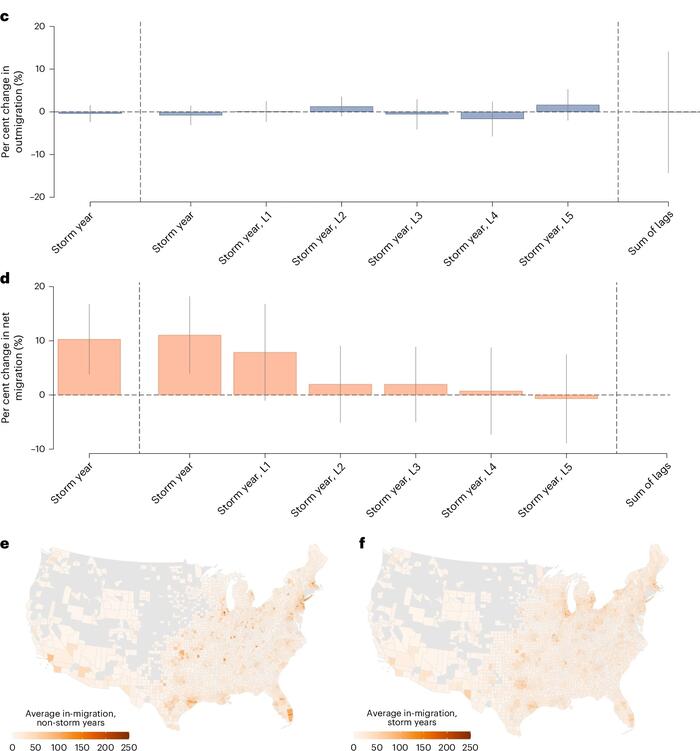
Fig. 1C-F: c,d, Coefficients from a panel fixed-effects regression of outmigration (c) and net migration (d) on whether a county experienced a storm. The first bar plots the coefficient from a regression with only contemporaneous storms. The next six bars show coefficients from a separate regression that includes contemporaneous storms and five year lags (L1–L5). The final bar shows the sum of the coefficients from the lags regression. The light grey lines show the 95% CIs. The sample size for these regressions was 52,514 for the outmigration results and 52,448 for the net migration results. e, Migrant-receiving counties in our sample period and the average number of migrants received in non-storm years. f, The same as e but in storm years.


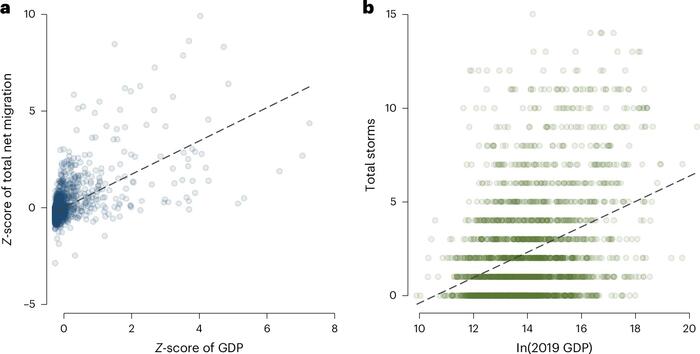
Their results indicate that American outmigration has not increased at statistically significant levels after storms. In addition, there is no evidence that migrants in storm years move to less exposed areas compared to migrants in non-storm years. The most damaging storms are indeed followed by increased outmigration, but there is no evidence that migrants move to low-risk areas. In fact, they often migrate to other high-risk areas and to places with high economic activity. This is because the majority of American GDP is generated in coastal areas where storms are more prevalent. The authors thus uncover a tradeoff, namely that places in the U.S. with more opportunity face more risk. GDP is substantially more predictive of migration than storm risk. The economic and social benefits of moving to high-risk areas appear to outweigh any incentives to reduce one’s storm exposure via relocation. Finally, the authors find that overall population exposure to storms has increased.


Image
Fig. 4: GDP versus net migration and number of storms.


Fig. 4: GDP versus net migration and number of storms. a, Correlation between net migration and GDP. The Z-score of total net migration is the Z-score across all counties of the sum of net migration (in-migration minus outmigration) for each county across all years in the sample. The Z-score of GDP is based on county GDP in 2019, as measured by the Bureau of Economic Analysis. All points are shaded equally, with darker areas on the graph indicating a greater density of counties. We omitted three outliers with GDP Z-scores >10. We show a version of this figure that includes the outliers in Supplementary Fig. 3. b, Correlation between the number of storms and GDP. Total storms is the sum of storms hitting each county across all years in our sample. ln(2019 GDP) is the natural log of county GDP in 2019, as measured by the Bureau of Economic Analysis. All points are shaded equally, with darker areas on the graph indicating a greater density of counties. The x-axis units are log points.
 

Image
Fig. 3: Trend in population-weighted exposure and correlation between net migration and total storms.


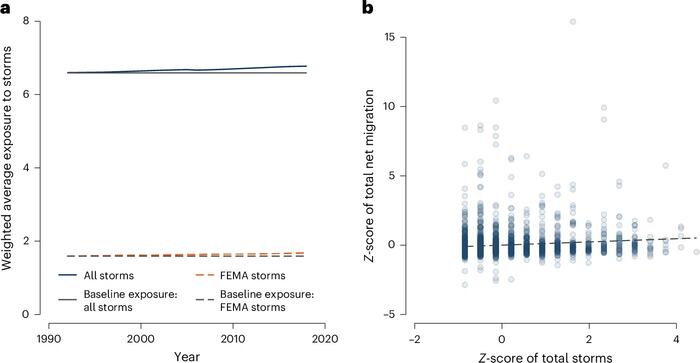
Fig. 3: Trend in population-weighted exposure and correlation between net migration and total storms. a, Trend in population-weighted exposure. We plotted the weighted average number of storms across all 2,387 counties in our sample. Weights are the county population in each year. The number of storms in each county is the sum over the sample and so remains constant across years. The change in the trend line is due to changes in where people live. The flat grey lines show the weighted average if populations had not changed from 1990 levels—that is, if no one had moved. The solid lines show all storms. The dashed lines show storms with at least US$10 million in damages according to FEMA. b, Correlation between net migration and total storms. The Z-score of total net migration is the Z-score across all counties of the sum of net migration (in-migration minus outmigration) in the county across all years in the sample. The Z-score of total storms is the Z-score across all counties of all storms over our sample period. All points are shaded equally; darker areas on the graph indicate a greater density of counties. The dashed line is the linear best fit line of the plotted data points.


The authors caution that these findings may be driven by (a) those Americans most impacted by storms being least able to move, this despite their preferences to do so, and (b) those with the means to insure themselves against climate risks having weaker preferences to move. In addition, migration within the same county — for example, moving from lower to higher sea level areas — may be a significant but hidden process that enables climate adaptation. The findings may also be less relevant to understanding migration dynamics in low- and middle-income countries, especially in places with less comprehensive insurance and less resilient infrastructure.

Behrer and Bolotnyy deepen our understanding of the importance and “stickiness” of geography. Indeed, many people do not or cannot move, even if they want to and even if staying in place puts them at risk. One wonders about how these processes interact with politics. For example, climate change has coincided with the powerful forces of climate change denial. Perhaps skepticism about storms as systemic phenomena is blunting migratory pressures, leading those affected to view them as one-off occurrences. Similarly, social scientists have coined the term “petro-masculinity” to describe an identity that views the climate change consensus as an attack on, e.g., driving large trucks or eating meat. It may be that when this identity is salient, people view climate migration as a form of weakness or betrayal.

*Brief prepared by Adam Fefer.

Hero Image
Barber shop located in the Ninth Ward, New Orleans, Louisiana, damaged by Hurricane Katrina in 2005.
Library of Congress
All News button
1
Subtitle

CDDRL Research-in-Brief [4-minute read]

Date Label
Authors
News Type
News
Date
Paragraphs

Introduction and Contribution:


Authoritarian regimes are often reluctant to let their citizens leave: 79% of autocracies restrict emigration compared to only 4% of democracies. This reluctance is understandable, as migration deprives rulers of talent, resources, and implied consent to the system. Yet autocracies do change their emigration laws. What are the consequences of these changes? 

In “A Little Lift in the Iron Curtain,” Hans Lueders examines how a 1983 emigration reform in socialist East Germany (German Democratic Republic, GDR) affected crime rates in the country. The reform permitted about 62,500 citizens to exit the GDR over a short period of time — mostly to reunite with their families in West Germany. Lueders asks how this emigration affected crime. This is a natural outcome to consider because the former GDR, like many autocracies, used the emigration system to filter out individuals seen as criminals or  “undesirables.” Unauthorized exit was criminalized, and some citizens committed crimes precisely to signal that they should be allowed to leave.


Image
Figure 1: Consequences of the 1983 Emigration Reform


Figure 1: Consequences of the 1983 Emigration Reform
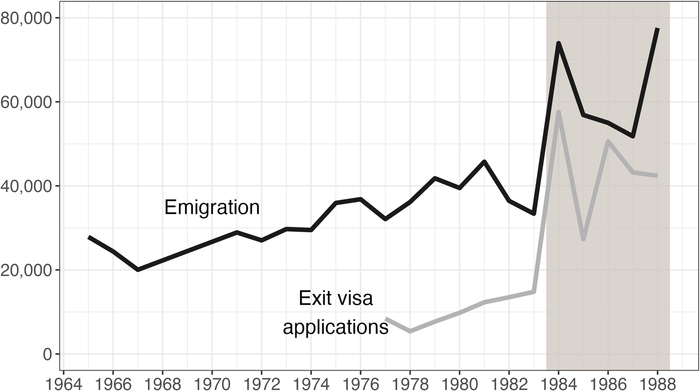
Note. This figure reports the number of first-time exit visa applications per year (gray line [Eisenfeld 1995, 202]) and annual emigration from the former GDR (black line; data collected by the author). The period after the emigration reform is emphasized.


Lueders shows that the effects of emigration following the 1983 reform on criminal activity depended on the type of crime. Ordinary kinds of crime — those not committed for political motifs — declined after the reform. However, border-related crimes increased sharply. This is ostensibly because those “left behind” (i.e., unable to take advantage of the 1983 reforms) resumed lawbreaking in order to pressure the regime to let them out as well. An analysis of petitions submitted to the state supports the idea that emigration raised demand for emigration.

The paper makes important contributions to our knowledge of authoritarianism and migration. For one, it shows how policies enacted to temporarily satisfy domestic or international audiences can backfire, later increasing the state’s burden. Autocrats may behave strategically in the short run, yet their choices can have powerful, unanticipated consequences in the years ahead. Otherwise, “strong” and repressive autocracies like the former GDR may struggle to address migratory pressures and be too inflexible to switch course after negative consequences become apparent. 

Safety Valves and Reform in East Germany:


Social scientists have argued that emigration policy under authoritarianism can serve as a “safety valve,” allowing or forcing the exit of those who threaten the stability of the regime. In addition, requiring citizens to apply for exit visas acts as a “screening mechanism” because applying is politically costly; those who keep applying reveal themselves to be potential troublemakers whose exit ought to be permitted. Lueders provides evidence that the costs of applying for exit visas were indeed high in the former GDR: applicants (and sometimes their families) were intimidated and harassed by secret police, expelled from universities, and demoted or fired. The state also tried to “win over” prospective emigrants, showing them reports about the allegedly dismal living conditions in West Germany or letters from East German refugees begging authorities to return to the GDR.

Importantly, officials considered how emigration would influence the GDR’s stability, looking for those who opposed the country and its socialist vision. Many applicants realized this and thus sought to publicly challenge the regime, for example, by leaving socialist mass organizations or abstaining from voting. Committing crimes thus raised one’s chances of successfully emigrating. East Germans watched peers and family members break the law to force their exit, learning that the system encouraged and rewarded criminality. 

After Germany’s division into two, many East Germans preferred the economic and political freedoms found in democratic West Germany. The government thus grew concerned: most émigrés were young and educated, and their exit undermined the GDR’s claims that it was popular and that socialism was the superior politico-economic system. Accordingly, emigration was criminalized in 1952, and the GDR began erecting physical barriers, culminating in the construction of the Berlin Wall in 1961. Emigration plummeted to between 25,000 and 40,000 per year thereafter.

Emigration remained severely limited until the early 1980s, when international pressure — from both West Germany and the Soviet Union — to reform its emigration system began to build. Ultimately, in September 1983, the GDR conceded and recognized the right of all citizens with family abroad to apply for an exit visa. 

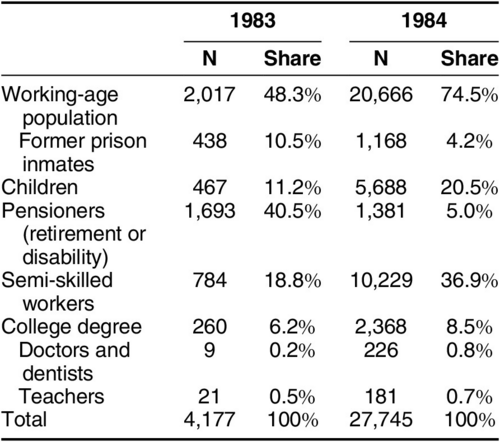
After the reform, exit visa applications and departures surged, the largest wave since the Berlin Wall’s construction. Emigration patterns evidenced a clear demographic shift: émigrés were less likely to be retired or to have formerly served in prison, while working-age East Germans made up 75% of emigrants, up from 49%. The state viewed this emigration wave as a welcome opportunity to get rid of criminals and political enemies. However, it underestimated the long-term consequences of offering some citizens a way out.


Image
Table 1: Comparison of Emigrants in 1983 and 1984 (January to June of each year)


Table 1: Comparison of Emigrants in 1983 and 1984 (January to June of each year)


Data and Findings:


To measure the effects of the 1983 policy on crime, Lueders presents crime data from 1976 to 89. He divides crime into “ordinary,” e.g., against state property or persons, and “political” crimes, e.g., the use of force against state officials, treason, and, importantly, illegal border crossings. Two of Lueders’ key hypotheses for our purposes are that emigration reform led to (1) a decline in ordinary crime, because the GDR effectively removed so-called troublemakers (the safety valve mechanism), and (2) a rise in border crimes, because those left behind were willing to break the law in order to exit (the demand mechanism).

The statistical analysis — consisting of comparing places with varying emigration rates — is consistent with both hypotheses. For the most part, ordinary crime declined after 1983. By contrast, border crime also initially declined, but this pattern dramatically reversed within two years. By 1987, border crimes began to rise significantly in places that had experienced a lot of emigration in the initial wave. Lueders thus provides evidence that in the short run, emigration indeed functioned as a safety valve (i.e., criminals were successfully identified). But thereafter, emigration had severe repercussions: rather than alleviating pressure on the regime, it created even greater demand for emigration — and thus more criminal activity.

A final piece of evidence comes from detailed data on petitions. The GDR encouraged citizens to communicate a range of demands and grievances to state officials, including the desire to emigrate. Lueders shows that in 1984, over 16,000 petitions were written specifically about emigration, which constituted nearly 28% of the total number of exit visa applications. And these petitions for exit visas increased substantially more in areas with above-average emigration during the initial emigration wave, suggesting that greater emigration in one period was associated with greater demand for it in subsequent periods. An understanding of East Germany illustrates how autocrats face a delicate balance between permitting migration and managing its consequences.

*Research-in-Brief prepared by Adam Fefer.

Hero Image
DDR Border, Germany
DDR Border, Germany.
Getty Images
All News button
1
Subtitle

CDDRL Research-in-Brief [4.5-minute read]

Date Label
Paragraphs

How do residential moves influence movers’ engagement? Drawing on German household panel data, I demonstrate that moving leads to a temporary decline in local engagement but leaves national engagement unchanged. I theorize that this drop stems from weaker attachments to place, reduced local political knowledge, and disrupted social ties. Consistent with this interpretation, longer-distance moves — which tend to exacerbate these barriers — are especially disruptive to movers’ local engagement. I then use comprehensive administrative data on all moves in Germany to rule out an alternative mechanism: most moves occur between socio-politically similar environments, limiting opportunities for moves to influence engagement through contextual change. These findings depart from the prevailing focus in related scholarship on the United States, national engagement, and partisanship. By documenting the political consequences of domestic migration for local engagement, this study contributes to research on residential mobility and local democratic accountability.

All Publications button
1
Publication Type
Journal Articles
Publication Date
Journal Publisher
Comparative Political Studies
Authors
Hans Lueders
Authors
Nensi Hayotsyan
News Type
Q&As
Date
Paragraphs

The "Meet Our Researchers" series showcases the incredible scholars at Stanford’s Center on Democracy, Development and the Rule of Law (CDDRL). Through engaging interviews conducted by our undergraduate research assistants, we explore the journeys, passions, and insights of CDDRL’s faculty and researchers.

Claire Adida is a Senior Fellow at the Freeman Spogli Institute’s Center on Democracy, Development and the Rule of Law (CDDRL), a Professor (by courtesy) of Political Science, and Faculty Co-Director of the Immigration Policy Lab at Stanford. Her research uses quantitative and field methods to investigate what weakens and strengthens social cohesion.

What is the most exciting or impactful finding from your research, and why do you think it matters for democracy, development, or the rule of law?


One of the most exciting findings from my work, and also from others in the field, is the role of empathy and perspective-taking in reducing prejudice and increasing inclusion. In one experiment during the height of the Syrian refugee crisis in 2016, we asked people to put themselves in the shoes of a refugee. We asked questions like, “What would you take with you? Where would you go?” When people engaged in that exercise, they became more open to refugees and more supportive of inclusion. And that was true across the political spectrum; Democrats and Republicans alike all showed greater openness after engaging in perspective-taking.

There is something really powerful about empathy. Other studies have shown the same pattern: when people imagine the perspective of someone different from them, whether it’s a refugee, a trans person, or an undocumented migrant, they become more understanding. It’s a simple but profound mechanism for building social cohesion.


There is something really powerful about empathy... It’s a simple but profound mechanism for building social cohesion.
Claire Adida


How can empathy and perspective-taking be implemented on a larger scale, and how can they be used to address the challenges we see in the world today? 


Well, this isn’t something you can legislate. You can’t tell politicians to force people to imagine someone else’s life. The real audience for this work is advocacy organizations like the United Nations High Commissioner for Refugees (UNHCR) or the International Rescue Committee (IRC), because they’re already doing it. They use storytelling and humanizing narratives in their campaigns all the time. 

It’s really hard, though, because we’re living in what people call the attention economy, which is driven by social media. Everything is about visibility, clicks, and headlines, and there’s always a new crisis. It becomes difficult for people to hold on to empathy for more than a moment because the focus is constantly shifting from one story to another. Even if a big influencer were to advocate for refugees or displaced communities, another could just as easily come along and dehumanize them or spread misinformation that undermines this. So it becomes this constant tug-of-war between empathy and fear, between humanizing and othering. 

With that being said, I think social media can also be used as a really powerful tool for sharing stories and reaching people who might not otherwise engage with these issues. It gives us a space to humanize experiences and make them visible at a scale that wasn’t possible before. The challenge is figuring out how to use these platforms not just to get attention for a moment, but to actually build connection and understanding that last beyond a single news cycle.

How does this translate into policy? 


Ultimately, I do think that public opinion matters for policy. The way people feel about migration or refugees — whether they see them as part of the community or as outsiders — shapes which policies are politically possible. And today, public opinion is shaped more than ever by social media. It’s not just voters who are influenced by online narratives; policymakers and donors are too. That’s why empathy and communication are central to policymaking, as social media now plays such a major role in shaping how both the public and those in power think and respond.

Can you tell me more about your work at the Immigration Policy Lab? 


I just joined as Faculty Co-Director and am currently leading two key projects focused on migration and development, particularly in the Global South. 

One major area is climate migration, understanding how environmental shocks affect migration decisions. The people most vulnerable to climate change are often the poorest. We’re trying to understand how they perceive risk, what strategies they use to survive, and when migration becomes an option. We’re currently raising funds to collect data in places like Colombia and rural Guatemala.

Another big project focuses on return migration, looking at people who have been expelled or deported, as well as those who self-deport. We’re building partnerships with organizations like Mercy Corps and the IRC to study how they reintegrate, what challenges they face, and whether existing programs are actually helping.

What have been some of the most challenging aspects of conducting research in this field, and how did you overcome them?


I would say interest and funding. Studying migrant integration is not popular these days; it feels like everyone is obsessed with AI or how technology can solve problems. That also creates challenges with funding and resources, especially from federal sources, because projects like ours require long-term fieldwork and collaboration, which are expensive and time-intensive. 

That said, I’ve been really fortunate to find a strong community and support system here at Stanford and at CDDRL. Being part of this environment has enabled me to connect with others who care about these issues and to find the resources needed to keep the work going.


I’ve been really fortunate to find a strong community and support system here at Stanford and at CDDRL. Being part of this environment has enabled me to connect with others who care about these issues and to find the resources needed to keep the work going.
Claire Adida


What gaps still need to be addressed in this research, and what do you hope to study in the future?


I think a big gap that hasn’t been studied enough is who actually engages with empathy-based initiatives in the first place. We know that when people are asked to imagine themselves in someone else’s shoes, they become more open and inclusive. But who is voluntarily clicking on those websites or reading those stories? Probably people who already care. That’s a limitation, because it means we might just be reinforcing empathy among those who already have it.

What I’d love to study next is how to reach people who don’t. People who avoid these stories or who hold more exclusionary views. What kinds of messages or media could reach them? Could framing, visuals, or certain messengers make a difference? Understanding that is crucial for figuring out how to scale empathy beyond its existing audiences.

If you had to give one piece of advice to students who want to get involved in this kind of research, what would it be?


Take my class next quarter! We talk about all sorts of issues related to migration and inclusion. But seriously, get involved early. Try to work as a research assistant, even on small projects. That’s how I got started, by working under a professor who brought me into areas and questions I didn’t think I’d be interested in. Those experiences can completely change your perspective and open doors you didn’t even know existed.

Lastly, what book would you recommend for students interested in a research career in your field?


I’ve heard very good things about The Truth About Immigration by Zeke Hernandez, which is more from an economist’s perspective, and I love Rafaela Dancygier’s Dilemmas of Inclusion, which looks at the challenges left-wing parties face in Europe. They’re the parties of inclusion, but they also have to navigate tensions when the groups they’re including hold more conservative social values. It’s a really interesting read for understanding how inclusion plays out in democratic politics.

Adida’s work highlights how understanding the human side of migration through empathy and perspective-taking can lead to more inclusive policies and stronger communities worldwide.

Read More

Claire Adida
News

Overcoming Barriers to Women’s Political Participation: Evidence from Nigeria

In Nigeria, women are far less likely than men to attend meetings or contact leaders. Claire Adida’s research reveals interventions that make a difference.
Overcoming Barriers to Women’s Political Participation: Evidence from Nigeria
Hero graphic showing Claire Adida, Senior Fellow at the Freeman Spogli Institute
News

Political Scientist Claire Adida to Become FSI’s Newest Senior Fellow

Professor Adida uses quantitative and field methods to study how countries manage new and existing forms of diversity.
Political Scientist Claire Adida to Become FSI’s Newest Senior Fellow
Hero Image
Meet Our Researchers: Dr. Claire Adida
All News button
1
Subtitle

Exploring how empathy and perspective-taking shape migration, inclusion, and public attitudes toward diversity with FSI Senior Fellow Claire Adida.

Date Label
Paragraphs

What are the consequences of selective emigration from a closed regime? To answer this question, I focus on socialist East Germany and leverage an emigration reform in 1983 that led to the departure of about 65,200 citizens. Analyzing panel data on criminal activity in a difference-in-differences framework, I demonstrate that emigration can be a double-edged sword in contexts where it is restricted. Emigration after the reform had benefits in the short run and came with an initial decline in crime. However, it created new challenges for the regime as time passed. Although the number of ordinary crimes remained lower, border-related political crimes rose sharply in later years. Analysis of emigration-related petitioning links this result to a rise in demand for emigration after the initial emigration wave. These findings highlight the complexities of managing migration flows in autocracies and reveal a key repercussion of using emigration as a safety valve.

All Publications button
1
Publication Type
Journal Articles
Publication Date
Journal Publisher
Perspectives on Politics
Authors
Hans Lueders
0
CDDRL Honors Student, 2025-26
img_5464_-_anagali_malloy_duncan.jpeg

Major: Comparative Studies in Race and Ethnicity
Minor: Political Science
Hometown: Stilwell, Cherokee Reservation
Thesis Advisor: Michael Wilcox

Tentative Thesis Title: Flames of Unity; Two Governments One People: Tracing ᎠᏂᎩᏚᏩᎩ Relocation and Reunification in Oklahoma: Economic, Political, and Social Transformations

Future aspirations post-Stanford: After Stanford, I hope to serve my community in whatever capacity they need. I plan to continue my education to deepen my understanding of law and public policy, equipping myself to advocate for my community in both political and legal spaces. Above all, I am committed to centering Indigenous voices in academia, politics, and popular culture, ensuring our perspectives shape the conversations that impact our future.

A fun fact about yourself: A fun fact about me is that in 2021, I retraced my community’s forced removal from North Carolina to Oklahoma on the 1,000-mile Remember the Removal bike ride, which took a month to complete. Along the route, I advocated for an honest retelling of our history — moving beyond sugar-coated narratives to recenter the truth about the Trail of Tears. I continue to support new cohorts in their training and hope to take part in the ride again someday.

Date Label

Encina Hall, E110
616 Jane Stanford Way
Stanford, CA 94305-6055

0
SURF Postdoctoral Fellow, 2025-26
emil-kamalov-2022.x1a300390_-_emil_kamalov.jpg

Emil Kamalov's research interests lie at the intersection of autocratic control, political behavior, migration, and repression, utilizing advanced quantitative methods complemented by qualitative data.

In his PhD thesis and papers, Emil develops an integrated account of extraterritorial opposition politics, examining how geopolitical tensions and host-country conditions shape emigrant activism, diaspora resilience, and migrant well-being. His findings demonstrate that under certain conditions, transnational repression by autocratic regimes can strengthen rather than weaken diaspora activism.

In collaboration with Ivetta Sergeeva, Emil co-founded and co-leads the OutRush project, the only ongoing multi-wave panel survey focusing on Russian political emigrants following Russia’s 2022 invasion of Ukraine. The OutRush project includes over 18,000 survey observations across four waves, covering respondents from more than 100 countries. The project has garnered substantial international media coverage and has drawn attention from policymakers and experts.

Emil is expected to receive his PhD in Political and Social Sciences from the European University Institute in September 2025.

Date Label
News Type
News
Date
Paragraphs

Argument & Key Findings


Global attention has periodically focused on Russia’s invasion of Ukraine, be it the security aspects of the war, the suffering experienced by Ukrainians, or forced conscription in Russia. Much less attention has been paid to those who have since emigrated from Russia.

The OutRush project, by Emil Kamalov, Karolina Nugumanova, and Ivetta Sergeeva, helpfully fills this gap. It presents results from surveys of thousands of Russian migrants, opening up the black box of who they are, where they have gone, how they have integrated into their new host countries, and their political beliefs. Readers come away with an enriched understanding of this population’s importance and diversity.

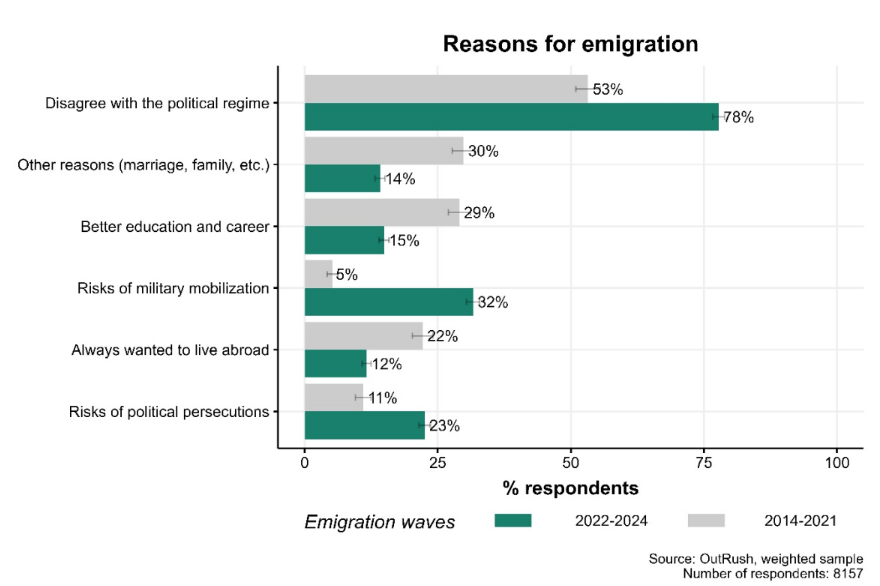
The authors present dozens of critical findings. Most Russian emigrants are unlikely to return in the short term, mainly because of the risks of military conscription and persecution by the Vladimir Putin regime. Migrants have become increasingly integrated into their host countries, speaking new languages, engaging with local politics and media, and making local acquaintances. At the same time, political engagement with Russia remains high. Secondary migration — i.e., from one host country to another — is also growing, owing to factors such as discrimination, legal barriers to residency, and others. Finally, the global environmental crisis has become a central political issue for many emigrants.

Data & Methods


OutRush is based on four waves of surveys. The report focuses on wave 4, conducted between July and November 2024. The nearly 8600 emigrants surveyed in wave 4 include prior respondents (i.e., to waves 1-3), those recruited through OutRush media partners like Telegram news channels, recipients of the link from friends, those who found the survey through social media, and emigrants who left Russia during an earlier period (2014-21). The survey work is complemented by interviews that add context and capture migrants’ lived experiences. Although survey respondents are not drawn at random, the study population is likely to be representative because Russian migrants across various demographics, such as gender, age, and education level, use social media or consume Telegram news.

The bulk of the report dives into specific issues:

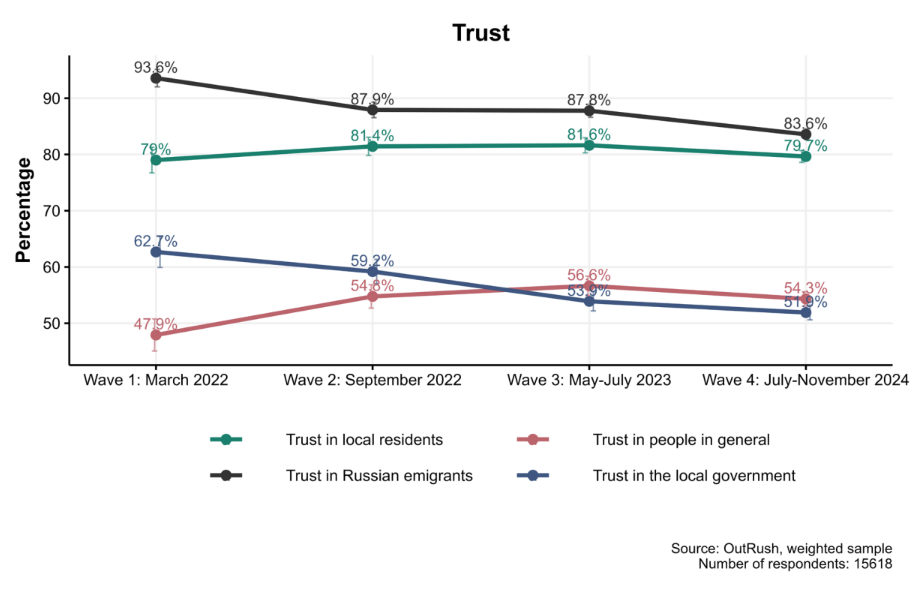
Integration Into and Work Within Host Countries: One of the most comprehensive sections presents data on respondents’ experiences integrating socially, occupationally, and otherwise. Emigrants’ economic stability has improved, and reports of discrimination have declined. Meanwhile, legal instability, such as difficulties opening bank accounts or being granted asylum, has improved slightly but remains a significant concern. By contrast, trust in their host country governments has declined, mainly driven by concerns about political persecution and bureaucratic hurdles. Yet, processes of social integration appear to be increasingly successful: majorities of respondents are learning local languages, have a high level of trust in the host population, are engaged in local politics, and have three or more local acquaintances, despite primarily socializing with other Russians. Finally, the subjective well-being of migrants is improving.

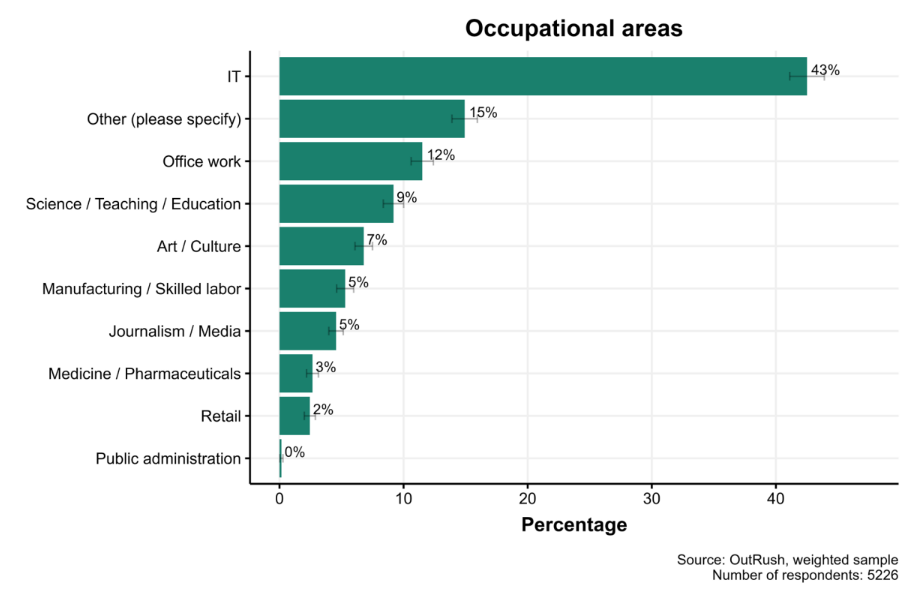
In terms of occupation, a plurality of migrants work in information technology, about a fifth work in the sphere of arts, education, and media, and a small but growing number plan to start their own businesses. Emigrants have found entrepreneurship challenging due to factors such as high taxes and complex bureaucracies in their host countries.


Figure 12. Professional composition of Russian emigration Figure 12. Professional composition of Russian emigration
Figure 18. Changes in trust levels Figure 18. Changes in trust levels
Figure 7. Key reasons for emigration. The question allowed for multiple selections if respondents had difficulty choosing one main reason. Figure 7. Key reasons for emigration. The question allowed for multiple selections if respondents had difficulty choosing one main reason.


Secondary Migration: Perhaps one of the most overlooked aspects of migration is its transient nature, as many individuals do not remain in the place where they first arrive. Indeed, over a fifth of respondents changed their country of residence, and nearly a third plan to do so within the next year. This is largely driven by discrimination or legal instability in their initial host countries. Serbia has become a key destination for secondary migration, attracting about a fifth of those who have left their initial destination. Much of this has to do with Serbia’s low levels of discrimination and its growing Russian-speaking community. 

Connections With and Plans to Return to Russia: Very few emigrants have returned or plan to do so in the short term. Of those who consider returning a possibility, doing so would largely depend upon military conscription becoming less likely and democratic reforms becoming more likely; as it stands, however, both of these scenarios appear quite distant. More than four out of five emigrants actively consume independent Russian media and stay in regular contact with their friends and family back home. Meanwhile, around two out of five consume English news, and about a quarter consume local media. Only a very small number are totally disengaged from politics or rely on Russian state propaganda. Yet large numbers of migrants fear persecution from the Russian government and their host states alike, especially given that many of their new homes are autocracies.

Political and Civic Activism: There continues to be high political interest in Russia. More than two out of five emigrants cast votes in the 2024 Russian presidential election. At the same time, overt political activism has declined, perhaps because of migrants’ perceived need to assimilate or because other challenges of migrant life have taken precedence. As mentioned above, large numbers are interested in the politics of their host countries. One of the most interesting findings concerns the large number of migrants — around three out of five — who are interested in the climate crisis. Their global focus overshadows their focus on environmental challenges specific to Russia or their host countries.

Implications & Prescriptions


The authors draw a number of conclusions from their interpretation of the survey data. Most centrally, Russian migrants are likely to remain in their host countries, that is, unless Russia undertakes meaningful change to its militarized, authoritarian status quo. As Russia pays a steep price, host countries gain considerably from one of the largest brain drains since the fall of the Soviet Union. At the same time, the authors call on host countries to rectify sources of legal and economic instability, including simplifying the process of legal emigration, encouraging entrepreneurship, and helping workers adapt to new labor markets. These prescriptions would not only ease the hardships faced by migrants but also create benefits for host countries.

*Research-in-Brief prepared by Adam Fefer.

 
Hero Image
Woman holding Russian passport with luggage Alexander Nrjwolf
All News button
0
Subtitle

CDDRL Research-in-Brief [6-minute read]

Date Label
Paragraphs

This report investigates the lives of Russians who emigrated after February 2022, based on longitudinal data from the OutRush project. The primary focus is on emigrants' adaptation processes, their political activity, and their connections with Russia. Findings indicate that emigrants—predominantly highly skilled specialists in IT, culture, and science—contribute to the economic and cultural life of their host countries, while simultaneously experiencing complex and ambivalent feelings toward Russia.

Despite reports about reverse migration, most emigrants do not plan to return to Russia without significant political changes. Host countries have varied approaches to managing the influx of emigrants: some provide stable conditions and low levels of discrimination, becoming hubs for secondary migration, while others are less successful in integrating new residents, prompting emigrants to seek alternative countries for relocation.

Despite progress in adaptation, many emigrants remain embedded in the Russian-speaking community, retaining political engagement and interest in Russia. However, an increasing concern for local environmental issues and domestic politics highlights a gradual shift in the relative importance of local events compared to those in Russia.

This study emphasizes:

  1. the "brain drain" from Russia is unlikely to be reversed without systemic political changes within the country;
  2. the necessity of simplifying legalization procedures for migrants to effectively leverage their potential in host societies.
All Publications button
1
Publication Type
Reports
Publication Date
Subtitle

A research report on the fourth wave of the survey conducted in 2024.

Authors
Ivetta Sergeeva
Subscribe to Migration and Citizenship (Society)