Society

FSI researchers work to understand continuity and change in societies as they confront their problems and opportunities. This includes the implications of migration and human trafficking. What happens to a society when young girls exit the sex trade? How do groups moving between locations impact societies, economies, self-identity and citizenship? What are the ethnic challenges faced by an increasingly diverse European Union? From a policy perspective, scholars also work to investigate the consequences of security-related measures for society and its values.

The Europe Center reflects much of FSI’s agenda of investigating societies, serving as a forum for experts to research the cultures, religions and people of Europe. The Center sponsors several seminars and lectures, as well as visiting scholars.

Societal research also addresses issues of demography and aging, such as the social and economic challenges of providing health care for an aging population. How do older adults make decisions, and what societal tools need to be in place to ensure the resulting decisions are well-informed? FSI regularly brings in international scholars to look at these issues. They discuss how adults care for their older parents in rural China as well as the economic aspects of aging populations in China and India.

-

ABSTRACT
My presentation will focus on how community-focused nonprofit newsrooms and data providers are reinventing the business model of journalism while focusing on the communities we serve.

SPEAKER BIO
Kevin Davis is CEO and Executive Director of the Investigative News Network (INN), a growing consortium of more than 80 nonprofit newsrooms producing nonpartisan investigative and public interest journalism. Davis oversees INN’s efforts to promote the sustainability of its member organizations, and increase the impact of their reporting through collaboration.

As a former digital publisher, Davis has more than 16 years of experience in strategic development and growth at news and media organizations. He was responsible for operations at Los Angeles-based news organizations Variety.com and TheWrap.com.

Since his appointment to INN, Davis has spoken and lectured about the nonprofit, investigative journalism sector at conferences and institutions across the United States, including the Online News Association, Investigative Reporters & Editors, the National Alliance for Media Arts + Culture, the National Federation of Community Broadcasters, USC Annenberg, Syracuse University, Ohio State University and the University of Colorado, Boulder, where he was the 2011 Hearst Professional-in-Residence.

Kevin Davis Investigative News Network
Seminars
Authors
News Type
News
Date
Paragraphs

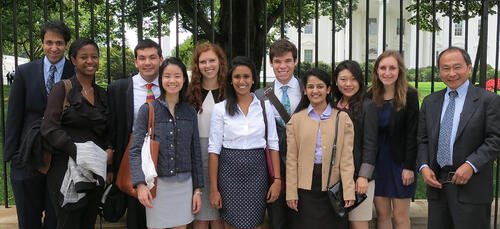
In August, CDDRL’s Draper Hills Summer Fellows program marked its 10-year anniversary by welcoming 20 of its alumni back to Stanford for a weeklong reunion.

Supported by Ingrid Hills and Bill and Phyllis Draper, the program brings practitioners from across the developing world to Stanford for a three-week intensive academic training program on democracy, good governance and rule of law reform. 

From Afghanistan to Venezuela, the program’s alumni form a network of over 250 leaders working under some of the most adverse conditions.

Fellows apply the academic lessons - taught by leading Stanford faculty - to practical problems in their countries. Many learn how to use technology to expose corruption, draw on case studies to improve the quality of public administration and borrow examples from history to build institutions in the aftermath of revolution.

An alumni network program - supported by the Omidyar Network - host’s global workshops, Stanford reunions and a robust communication platform to connect this global community of democratic leaders.

During the reunion, alumni attended sessions led by former Secretary of State Condoleezza Rice and Michael McFaul who has just returned back to Stanford after serving as U.S. ambassador to Russia.

While back on campus, some alumni found the occasion to reflect on the program and its impact on their professional and personal lives. Their inspiring stories are testament to the incredible work they are doing to build democratic systems in some of the most complex corners of the world.


Fighting for Democracy in Ukraine

When the EuroMaidan protests started in November 2013 in Kiev, Andriy Shevchenko (09’) was in Independence Square calling for the resignation of Ukraine’s President Viktor Yanukovych. It was there that he reflected on the lessons from the Draper Hills Summer Fellows Program on social mobilization as he helped translate the demands of protesters into political action.

Shevchenko, who was elected to parliament in 2006, is one of nine fellows from Ukraine who are part of a new generation of leadership working to move their country away from Russian influence and towards greater European integration. Working as journalists, civil society leaders and politicians, these fellows are pushing for democratic institutions and political accountability in a country transitioning towards democracy.

Before joining politics, Shevchenko was a journalist and founded the first independent 24-hour news channel – 5th Channel – which covered the events surrounding Ukraine’s 2004 Orange Revolution.

Shevchenko describes the program as “one of the greatest experiences of his life” because of the knowledge, friendships and inspiration he gained from his participation in the program. Leaving the program with an expanded interest in human rights, Shevchenko now serves as the first deputy chairman of the Human Rights Commission in Ukraine.

While the struggle for democracy continues in Ukraine, Shevchenko will draw on the program’s teachings and the strength of the peer community during these challenging times.


Empowering Women through Education in Afghanistan

Sakeena Yacoobi (08’) understands firsthand how education can change a life. After receiving her degree in the U.S., Yacoobi returned to Afghanistan with a mission to empower women and children through access to quality education. In 1995, Yacoobi founded the Afghan Institute of Learning (AIL) and set off to change the system of education – often operating underground due to threats from the Taliban – by training a network of teachers and opening women’s learning centers.

Yacoobi was overwhelmed with interest from women seeking education and in decades AIL has set up 300 learning centers in 12 provinces, serving over 11 million people in Afghanistan. Training is at the heart of AIL’s model and Yacoobi has applied much of what she has learned from the Draper Hills Summer Fellows Program to offer civic education to AIL’s students.

As the country emerges from over three decades of conflict, Yacoobi credits the Program and its curriculum in democracy and leadership for inspiring Afghan citizens to be more civic minded and involved in democratic processes - such as voting. Recognizing the current political struggles that Afghanistan faces, Yacoobi hopes that these important lessons will help to build a greater democratic culture for the country’s future generations. 


Building New Institutions of Democracy in Argentina

Laura Alonso (12’) never envisioned herself as a politician. With an esteemed career in civil society as the head of the Argentine chapter of Transparency International, she had always operated outside of the political system. But one day she realized that she might be more effective inside government. 

In 2009, Alonso was elected as a member of Congress for the city of Buenos Aires and began to advocate for greater transparency and reform Her push for better governance has often put her at odds with her party and the subject of attacks, but she continues to defend her reform agenda.

Re-elected to a second term of Congress in 2013, Alonso has set out to improve the quality of democracy in Argentina by strengthening institutions that deliver public services and to help steer the country in a different direction. From time to time, she has been able to reflect on the case studies taught in the Draper Hill’s Summer Fellows Program by Francis Fukuyama to inform her policymaking.   

While Alonso is unsure of what her future may hold - may it be in politics or elsewhere - she will continue to raise her voice when necessary to make the government more accountable to the people of Argentina.


Defending Civil Society in Russia

Anna Sevortian (06’) served as the Russian director for Human Rights Watch when the crackdown on civil society began in 2011. Non-profit organizations (NGO’s) receiving foreign funding were labeled as foreign spies and forced to register their operations with the Russian government.

Sevortian describes this repressive environment as reminiscent of Soviet times when propaganda and inspections were common practice. Cut off from funding, many NGO’s supporting important social needs have been forced to shut their doors.

A longtime journalist, Sevortian spent three years at Human Right’s Watch in the height of this crackdown documenting worsening conditions for civil society and also covering Belarus, Ukraine and the North Caucuses.

It was during this period that one of the Draper Hills Summer Fellows Program’s founding faculty members - Michael McFaul - was serving as U.S. ambassador to Russia and Sevortian was able to raise human rights concerns to him directly.

Sevortian now serves as the executive director for the newly launched EU-Russia Civil Society Forum in Berlin, a platform designed to amplify the voice of civil society. Despite the deteriorating situation in Russia, Sevortian hopes to use the forum to help encourage the growth and development of civil society in Russia and Europe. 

Hero Image
rsd14 056 0174a 1
2008 Draper Hills Summer Fellow Alumni Sakena Yacoobi from Afghanistan asks a question to one of the guest lecturers during the tenth anniversary reunion program.
Rod Searcey
All News button
1
News Type
News
Date
Paragraphs

Appeared in Stanford Report, May 29, 2014

By Clifton B. Parker

The electoral eruption of anti-European Union populism is a reflection of structural flaws in that body but does not represent a fatal political blow, according to Stanford scholars.

In the May 25 elections for the European Parliament, anti-immigration parties won 140 of the 751 seats, well short of control, but enough to rattle supporters of the EU, which has 28 member nations. In Britain, Denmark, France and Greece, the political fringe vote totals stunned the political establishments.

Stanford political scientist Francis Fukuyama said the rise of extremism and anti-elitism is not surprising in the wake of the 2008 economic downturn and subsequent high levels of unemployment throughout Europe. In one sense, the EU elites have themselves to blame, he said.

"The elites who designed the EU and the eurozone failed in a major way," he said. "There was a structural flaw in the design of the euro (monetary union absent fiscal union, and the method of disciplining countries once in the zone)," said Fukuyama, the Olivier Nomellini Senior Fellow at Stanford's Freeman Spogli Institute for International Studies and the Center for Democracy, Development and the Rule of Law, and Research Afflilate at The Europe Center.

Some have argued that the European Union should adopt a form of fiscal union because without one, decisions about taxes and spending remain at the national level.

As Fukuyama points out, this becomes a problem, as in the case of a debt-ridden Greece, which he believes should not have qualified for EU membership in the first place. In fact, he said, it would have been better for Greece itself to leave the euro at the outset of the 2008 crisis.

Still, Fukuyama said the big picture behind the recent election is clear – it was a confluence of issues and timing.

"It is a bit like an off-year election in the U.S., where activists are more likely to vote than ordinary citizens," he said.

Fukuyama believes the EU will survive this electoral crisis. "I think the EU will be resilient. It has weathered other rejections in the past. The costs of really exiting the EU are too high in the end, and the elites will adjust, having been given this message," he said.

Meanwhile, the populist parties in the different countries are not unified or intent on building coalitions with each other.

"Other than being anti-EU, most of them have little in common," Fukuyama said. "They differ with regard to specific positions on immigration, economic policy, and they respond to different social bases."

Ongoing anger

Dan Edelstein, a professor of French, said the largest factor for success by extremist candidates was "ongoing anger toward the austerity policy imposed by the EU," primarily by Germany.

Edelstein estimates that a large majority of French voters are still generally supportive of the EU. For the time being, the anti-EU faction does not have a majority, though they now have much more representation in the European Parliament.

Edelstein noted existing strains among the anti-EU parties – for example, the UK Independence Party in Britain has stated that it would not form an alliance with the National Front party in France.

Immigration remains a thorny issue for some Europeans, Edelstein said.

"'Immigration' in most European political debates, tends to be a synonym for 'Islam.' While there are some countries, such as Britain, that are primarily worried about the economic costs of immigration, in most continental European countries, the fears are cultural," he said.

As Edelstein put it, Muslims are perceived as a "demographic threat" to white or Christian Europe. However, he is optimistic in the long run.

"It seems a little early to be writing the obituary of the EU. Should economic conditions improve over the next few years, as they are predicted to, we will likely see this high-water mark of populist anger recede," said Edelstein.

Cécile Alduy, an associate professor of French, writes in the May 28 issue of The Nation about how the ultra-right-wing National Front came in first place in France's election.

"This outcome was also the logical conclusion of a string of political betrayals, scandals and mismanagement that were only compounded by the persistent economic and social morass that has plunged France into perpetual gloom," she wrote.

Historian J.P. Daughton said that like elsewhere in the world, immigration often becomes a contentious issue in Europe in times of economic difficulties.  

"High unemployment and painful austerity measures in many parts of Europe have led extremist parties to blame immigrants for taking jobs and sapping already limited social programs," he said.

Anti-immigration rhetoric plays particularly well in EU elections, Daughton said. "Extremist parties portray European integration as a threat not only to national sovereignty, but also to national identity.

Edelstein, Alduy and Daughton are all Faculty Affiliates of The Europe Center.

Wake-up call

Russell A. Berman, a professor of German studies and comparative literature, said many Europeans perceive the EU as "somehow impenetrable, far from the civic politics of the nation states."

As a result, people resent regulations issued by an "intangible bureaucracy," and have come to believe that the European Parliament has not grappled with major issues such as mustering a coherent foreign policy voice, he said.

"The EU can be great on details but pretty weak on the big picture," said Berman, who is the Walter A. Haas Professor in the Humanities, Senior Fellow at the Hoover Institution, and Faculty Affiliate of The Europe Center. "It is this discrepancy that feeds the dissatisfaction."

Yet he points out that the extremist vote surged in only 14 nations of the EU – in the other 14, there was "negligible extremism," as he describes it.

"We're a long way from talking about a fatal blow, but the vote is indeed a wake-up call to the centrists that they have to make a better case for Europe," Berman said.

Hero Image
A man walks past a board displaying provisional results of the European Parliament election at the EU Parliament in Brussels
A man walks past a board displaying provisional results of the European Parliament election at the EU Parliament in Brussels May 25, 2014.
REUTERS / Francois Lenoir
All News button
1
Date
Paragraphs
Twenty-five years after the release of his landmark essay, "The End of History?," FSI Olivier Nomellini Senior Fellow Francis Fukuyama stands by his initial arguments, offering some reflections and new insights in a recent article for The Wall Street Journal. Despite recent democratic shortcomings, Fukuyama reaffirms that liberal democracy still has no real competitors, emphasizing that the power of the democratic ideal remains immense.
All News button
1
Authors
Date
Paragraphs

The electoral eruption of anti-European Union populism is a reflection of structural flaws in that body but does not represent a fatal political blow, according to Stanford scholars.

In the May 25 elections for the European Parliament, anti-immigration parties won 140 of the 751 seats, well short of control, but enough to rattle supporters of the EU, which has 28 member nations. In Britain, Denmark, France and Greece, the political fringe vote totals stunned the political establishments.

Stanford political scientist Francis Fukuyama said the rise of extremism and anti-elitism is not surprising in the wake of the 2008 economic downturn and subsequent high levels of unemployment throughout Europe. In one sense, the EU elites have themselves to blame, he said.

"The elites who designed the EU and the eurozone failed in a major way," he said. "There was a structural flaw in the design of the euro (monetary union absent fiscal union, and the method of disciplining countries once in the zone)," said Fukuyama, the Olivier Nomellini Senior Fellow at Stanford's Freeman Spogli Institute for International Studies and the Center on Democracy, Development and the Rule of Law, and Research Afflilate at The Europe Center.

Some have argued that the European Union should adopt a form of fiscal union because without one, decisions about taxes and spending remain at the national level.

As Fukuyama points out, this becomes a problem, as in the case of a debt-ridden Greece, which he believes should not have qualified for EU membership in the first place. In fact, he said, it would have been better for Greece itself to leave the euro at the outset of the 2008 crisis.

Still, Fukuyama said the big picture behind the recent election is clear – it was a confluence of issues and timing.

"It is a bit like an off-year election in the U.S., where activists are more likely to vote than ordinary citizens," he said.

Fukuyama believes the EU will survive this electoral crisis. "I think the EU will be resilient. It has weathered other rejections in the past. The costs of really exiting the EU are too high in the end, and the elites will adjust, having been given this message," he said.

Meanwhile, the populist parties in the different countries are not unified or intent on building coalitions with each other.

"Other than being anti-EU, most of them have little in common," Fukuyama said. "They differ with regard to specific positions on immigration, economic policy, and they respond to different social bases."

Ongoing anger

Dan Edelstein, a professor of French, said the largest factor for success by extremist candidates was "ongoing anger toward the austerity policy imposed by the EU," primarily by Germany.

Edelstein estimates that a large majority of French voters are still generally supportive of the EU. For the time being, the anti-EU faction does not have a majority, though they now have much more representation in the European Parliament.

Edelstein noted existing strains among the anti-EU parties – for example, the UK Independence Party in Britain has stated that it would not form an alliance with the National Front party in France.

Immigration remains a thorny issue for some Europeans, Edelstein said.

"'Immigration' in most European political debates, tends to be a synonym for 'Islam.' While there are some countries, such as Britain, that are primarily worried about the economic costs of immigration, in most continental European countries, the fears are cultural," he said.

As Edelstein put it, Muslims are perceived as a "demographic threat" to white or Christian Europe. However, he is optimistic in the long run.

"It seems a little early to be writing the obituary of the EU. Should economic conditions improve over the next few years, as they are predicted to, we will likely see this high-water mark of populist anger recede," said Edelstein.

Cécile Alduy, an associate professor of French, writes in the May 28 issue of The Nation about how the ultra-right-wing National Front came in first place in France's election.

"This outcome was also the logical conclusion of a string of political betrayals, scandals and mismanagement that were only compounded by the persistent economic and social morass that has plunged France into perpetual gloom," she wrote.

Historian J.P. Daughton said that like elsewhere in the world, immigration often becomes a contentious issue in Europe in times of economic difficulties.  

"High unemployment and painful austerity measures in many parts of Europe have led extremist parties to blame immigrants for taking jobs and sapping already limited social programs," he said.

Anti-immigration rhetoric plays particularly well in EU elections, Daughton said. "Extremist parties portray European integration as a threat not only to national sovereignty, but also to national identity.

Edelstein, Alduy and Daughton are all Faculty Affiliates of The Europe Center.

Wake-up call

Russell A. Berman, a professor of German studies and comparative literature, said many Europeans perceive the EU as "somehow impenetrable, far from the civic politics of the nation states."

As a result, people resent regulations issued by an "intangible bureaucracy," and have come to believe that the European Parliament has not grappled with major issues such as mustering a coherent foreign policy voice, he said.

"The EU can be great on details but pretty weak on the big picture," said Berman, who is the Walter A. Haas Professor in the Humanities, Senior Fellow at the Hoover Institution, and Faculty Affiliate of The Europe Center. "It is this discrepancy that feeds the dissatisfaction."

Yet he points out that the extremist vote surged in only 14 nations of the EU – in the other 14, there was "negligible extremism," as he describes it.

"We're a long way from talking about a fatal blow, but the vote is indeed a wake-up call to the centrists that they have to make a better case for Europe," Berman said.


All News button
1
-


Abstract: 

The recently concluded 16th Lok Sabha elections in India was the biggest democratic election in history. It produced the first absolute majority in Indian national elections in thirty years and catapulted BJP and its leader Narendra Modi to power after a sustained presidential style campaign. The election decisively changed the political landscape in India and seemed to reverse a longstanding trend towards fragmentation of Indian politics along lines of region and caste.

What are the underlying dynamics that made this historic vote possible? Can BJP and Modi deliver the economic growth and employment that they promise? What are the necessary reforms and challenges that confront the new government? Will BJP remain focused on development, or will the older cultural and majoritarian agenda of the RSS and its associated organizations re-appear? What is the prospects for India’s multiple minorities in this new dispensation?

These and other questions will be debated by a panel of three Stanford based academics. 


Speaker Bios:

Thomas Blom Hansen (Moderator/Speaker) is the Reliance-Dhirubhai Ambani Professor of Anthropology at Stanford University. He is also the director of the Center for South Asia at Stanford. He has worked extensively on Hindu-Muslim relations, communal violence and the rise of Hindu nationalism in India. His books include The Saffron Wave. Hindu Nationalism and Democracy in Modern India (Princeton University Press 1999) and Wages of Violence, Naming and identity in postcolonial Bombay (Princeton University Press 2001).


Harish S. Wankhede (Speaker) research interest is to imagine theoretical spaces by interconnecting certain approaches and themes of social science mainly, Justice, politics of recognition and redistribution, secularism, nationalism and the Caste identity. The emphasis of his work is on the marginalized communities in India especially the Muslims, Dalits and the Tribals.

Currently, he is a visiting scholar at the Center for South Asia, Stanford University and working on a research project on the Dalit Panthers’ Movement in Maharashtra. He teaches at the Department of Political Science, University of Delhi.


Alexander Lee (Speaker) is a postdoctoral fellow at the Center on Democracy, Development, and the Rule of Law. In the fall of 2014 he will be an assistant professor of political science at the University of Rochester. His research focuses on the historical factors governing the success or failure of political institutions, particularly in South Asia and other areas of the developing world. His work has been published in World Politics and the Quarterly Journal of Political Science. Alex earned his PhD from Stanford in 2013. More information on his work can be found on his website.


This event is hosted by the Center for South Asia and the Center for Democracy, Development and the Rule of Law. 


CISAC Conference Room

Thomas Blom Hansen Director Moderator Center for South Asia
Harish S. Wankhede Visiting Scholar Speaker Center for South Asia

Encina Hall
616 Serra Street
Stanford, CA 94305-6055

0
CDDRL Postdoctoral Fellow, 2013-14
Lee_HS.jpg

Alexander Lee's research focuses on the historical factors governing the success or failure of political institutions, particularly in South Asia and other areas of the developing world. His dissertation examined the ways in which colonialism changed the distribution of wealth in Indian society, and the ways in which these changes affected the development of caste identities. Additional research areas include the study of colonialism and European expansion in a cross- national perspective, and the causes of political violence, especially terrorism. His work has been published in World Politics and the Quarterly Journal of Political Science. Alex earned his PhD from Stanford in 2013. More information on his work can be found on his website: https://people.stanford.edu/amlee/

Alexander Lee Postdoctoral Fellow Speaker Center on Democracy, Development, and the Rule of Law
Seminars
Authors
Christian E. Ollano
News Type
News
Date
Paragraphs

This summer Stanford’s Center on Democracy, Development, and the Rule of Law (CDDRL) is welcoming new leadership to oversee the growth and development of the Program on Arab Reform and Democracy (ARD), one of the Center's principal research programs examining contemporary issues of political development in the Arab world.

Lisa Blaydes, assistant professor of political science at Stanford, will assume the role of faculty co-director, working together with CDDRL Director Larry Diamond to help shape the program's research agenda. Blaydes will be joined by Hesham Sallam, currently a CDDRL pre-doctoral fellow completing his Ph.D. in government at Georgetown University. He will serve as the program's new associate director, assuming operational management and developing the program's research initiatives and activities at Stanford and throughout the Arab world, in partnership with the faculty co-directors. Sallam is also joining CDDRL as a research associate. In that capacity he will produce research and publications on questions related to political and economic reform in the Arab World.

Sallam is replacing ARD's founding director Lina Khatib, who left CDDRL last year to assume directorship of the Carnegie Endowment for Peace's Middle East office in Beirut.

"We are very excited to have Hesham Sallam assuming this leadership role in the ARD program, and joining the research staff of CDDRL,” said Diamond. “Hesham is not only a superb scholar of Arab politics and political economy, but has also been deeply engaged in analytic and public policy debates about the future of the region. His deep knowledge and broad credibility in the field will be strong and immediate assets to the program, and will help us build on the strong foundation laid by our founding program leader, Lina Khatib."

“I am extremely delighted to join the CDDRL and FSI family,” said Sallam. “I look forward to working closely with the Stanford community, faculty, students, and staff, to expand interdisciplinary discussions of Arab politics and society on campus.”

“By enhancing its intellectual engagement with scholars and activists in Arab world, ARD will continue to nuance our understanding of conflicts over political, social and economic rights in the region by supporting critical scholarship and by developing innovative research agendas,” he said.

Sallam’s dissertation examines how Islamist movements have impacted the politics of economic reform in Egypt before and after the Arab uprisings in 2011. His previous research has received the support of the United States Institute of Peace and the Social Science Research Council. Sallam also serves as co-editor of the Jadaliyya, a leading online magazine, which invites critical debate and analysis of current events in the Arab world from academics, activists and journalists. 

Diamond expressed great enthusiasm over the addition of Lisa Blaydes to the program’s faculty leadership. “Over the past several years, Lisa has rapidly emerged as one of the most original and influential scholars of politics and social change in the Arab world,” he said. “She brings to the program intense intellectual curiosity, scholarly distinction and a keen interest in advancing social science studies of the Arab world."

Blaydes, a specialist in comparative politics and politics in the Middle East, recently published the book, Elections and Distributive Politics in Mubarak’s Egypt, which examines the complex relationships among regimes, rent-seeking elites and citizens fostered by authoritarian elections.

“The Arab world is at a critical juncture,” said Blaydes. “Although mass protests have transformed public political consciousness, the long-term impact of the protest movement on more concrete forms of power has yet to be determined. Policy-relevant scholarly research such as that conducted by the Program on Arab Reform and Democracy may help us to identify pathways to political reform.”

Blaydes and Sallam, together with Diamond, participated in the most recent ARD Program conference on political change in the Arab world. Held in collaboration with the Center for Research on Globalization and Democratic Governance at Koc University in Turkey, the conference brought together leaders in policy, academia and government to address issues of violence and government transitions in the region following continuous civil unrest and political uncertainty.

Founded in 2010 with annual support from the Moulay Hicham Foundation, CDDRL's Program on Arab Reform and Democracy aims to be a hub for intellectual capital about issues related to good governance, social change and political reform in the region, producing rigorous and policy-relevant academic research. Conferences and seminars in the U.S. and the Arab world provide innovative forums for academics and policy-makers to advance new ideas and approaches to the most pressing issues facing the region today.

For more information on the Program on Arab Reform and Development, please visit: http://arabreform.stanford.edu/. 

Hero Image
encinaardimage
All News button
1
-

*Open only to Stanford students.* 

Speaker Bio: 

Zahera Harb is one of the six 2013-2014 FSI-Humanities Center International Visitors and will be in residence at Stanford in May 2014. She is Senior Lecturer in International Journalism at City University London. She received her M.A. and Ph.D. in journalism studies from Cardiff University (United Kingdom). As an expert on Arab media, she has published widely on journalism ethics, conflict and war reporting, political communication and representation of Muslims and Islam in western media. Her recent publications include Narrating Conflict in the Middle East: Discourse, Image and Communications Practices in Lebanon and Palestine (2013) and Channels of Resistance: Liberation Propaganda, Hezbollah and the Media (2011). Dr. Harb also has 11 years of experience as a journalist in Lebanon working for Lebanese and international media organizations.


This event is co-sponsored by the Sohaib and Sara Abbasi Program in Islamic Studies, CDDRL Program on Arab Reform and Democracy, the Mediterranean Studies Forum, Stanford Humanities Center, Arab Studies Table, Stanford Language Center. 

Building 30, Room 102

Zahera Harb Senior Lecturer in International Journalism Speaker City University London
Seminars
-

Abstract:

The United States spends over 17 percent of GDP on health care; the next six highest countries spend over 11 percent. This six percent differential indicates an excess spending of approximately one trillion dollars per year. Depending on the benefit from the extra spending, this suggests the possibility of a huge misallocation of resources. Also, because the federal government funds almost half of total health care spending, there are significant effects on the deficit and the debt. The main reasons for the excess are (1) the U.S. pays higher prices for drugs, devices, and equipment and higher fees to specialists and sub-specialists; (2) higher administrative costs; and (3) a more expensive mix of medical care. The seminar will focus on institutional and political explanations for the three proximate reasons.


Speaker Bio:

Victor R. Fuchs is the Henry J. Kaiser Jr Professor Emeritus at Stanford University, in the Departments of Economics and Health Research and Policy.  He is also a Research Associate of the National Bureau of Economic Research and a Senior Fellow at SIEPR.  He applies economic analysis to social problems of national concern, with special emphasis on health and medical care.  He is author of nine books, the editor of six others, and has published over two hundred papers and shorter pieces.  His current research focuses on male-female differences in mortality, reform of medical education, and the future of U.S. health care.

His best known work, Who Shall Live?  Health, Economics, and Social Choice (1974; expanded edition 1998, 2nd expanded edition 2011), helps health professionals and policy makers to understand the economic and policy problems in health that have emerged in recent decades.  Other books include The Service Economy (1968), How We Live (1983), The Health Economy (1986), Women’s Quest For Economic Equality (1988), and The Future of Health Policy (1993).  He is the editor of Individual and Social Responsibility: Child Care, Education, Medical Care, and Long-term Care in America (1996).

Professor Fuchs was elected president of the American Economic Association in 1995.  He has also been elected to the American Philosophical Society, the American Academy of Arts and Sciences, the Institute of Medicine of the National Academy of Sciences, and is an Honorary Member of Alpha Omega Alpha.  He has received the John R. Commons Award, Emily Mumford Medal for Distinguished Contributions to Social Science in Medicine, Distinguished Investigator Award (Association for Health Services Research), Baxter Foundation Health Services Research Prize, and Madden Distinguished Alumni Award (New York University).  ASHE’s (American Society of Health Economists) Career Award for Lifetime Contributions to the Field of Health Economics and the RAND Corporation prize for the Best Paper published in the Forum for Health Economics and Policy are named and awarded in honor of Professor Fuchs.

This event is sponsored by the Stanford Center on Democracy, Development and the Rule of Law and the Center for Health Policy/Center for Primary Care and Outcomes Research.


CISAC Conference Room

Victor Fuchs the Henry J. Kaiser Jr Professor Emeritus Speaker Stanford University
Seminars
Date
Paragraphs
CDDRL Director Larry Diamond addresses concerns of an intensifying democratic recession in a piece in The Atlantic. Despite recent turmoil in Ukraine and democratic breakdowns in Thailand and Turkey, among others, Diamond emphasizes the critical role economic development, globalization and the growth of civil society will play in the long-run inducement of democratic change worldwide.
Hero Image
democracy Logo
Protesters carry a large banner reading: ''Democracy'' as they participate in an anti-government protests organized by Bahrain's leading opposition Al Wefaq. Sept. 14, 2012.
Hamad I Mohammed / Reuters
All News button
1
Subscribe to Society