Human Rights
News Type
News
Date
Paragraphs

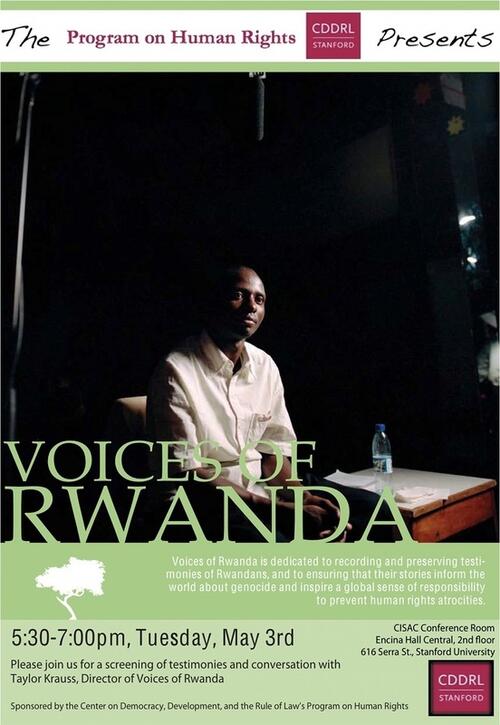
On May 3, 2011, the Program on Human Rights at CDDRL hosted Taylor Krauss, executive director of Voices of Rwanda and an award-winning video-journalist. Krauss screened a short film of testimonies from survivors of the Rwandan genocide to a rapt audience of 40 at the CISAC Central Conference room in Encina Hall. Learn more about Voices of Rwanda and view clips of testimony at http://www.voicesofrwanda.org.

All News button
1
-

The Stanford Students for Engagement and Activism in Microfinance (SEAM), together with the Program on Poverty and Governance at the Center on Democracy, Development, and the Rule of Law, and the Center for Latin America Studies present, The Inside Scoop on Latin America's Largest Microfinance Institution. This event will feature Carlos Danel, Co-founder and Vice President of Compartamos Banco with an introduction by Professor Beatriz Magaloni of the Political Science department.

COMPARTAMOS BANCO was founded in 1990 as an NGO to help create opportunities for development and to allow micro-businesses to grow. In 2006, it established itself as a commercial bank, and in 2008 opened for public investment. Its growth has been unprecedented, currently serving more than 1.6 million clients. Compartamos has been recognized numerous times as one of the best companies to work for in Mexico. Moreover, it is the largest microfinance institution in Latin America.

CARLOS DANEL has been with Compartamos from the beginning as Co-Founder and is the Co-CEO. At the World Economic Forum in 2003, Danel was named a Young Global Leader. He serves on the board of Progresso Financiero, Vista Desarrollos, Grupo CP, and VIFAC A.C. He holds a degree in architecture from the the Universidad Iberoamericana and an MBA from the Instituto Panamericano de Alta Dirección de Empresas.

Koret Pavilion
Ziff Center (Hillel)
Stanford University

Dept. of Political Science
Encina Hall, Room 436
Stanford University,
Stanford, CA

(650) 724-5949
0
Senior Fellow at the Freeman Spogli Institute for International Studies
Graham H. Stuart Professor of International Relations
Professor of Political Science
beatriz_magaloni_2024.jpg MA, PhD

Beatriz Magaloni Magaloni is the Graham Stuart Professor of International Relations at the Department of Political Science. Magaloni is also a Senior Fellow at the Freeman Spogli Institute, where she holds affiliations with the Center on Democracy, Development and the Rule of Law (CDDRL) and the Center for International Security and Cooperation (CISAC). She is also a Stanford’s King Center for Global Development faculty affiliate. Magaloni has taught at Stanford University for over two decades.

She leads the Poverty, Violence, and Governance Lab (Povgov). Founded by Magaloni in 2010, Povgov is one of Stanford University’s leading impact-driven knowledge production laboratories in the social sciences. Under her leadership, Povgov has innovated and advanced a host of cutting-edge research agendas to reduce violence and poverty and promote peace, security, and human rights.

Magaloni’s work has contributed to the study of authoritarian politics, poverty alleviation, indigenous governance, and, more recently, violence, crime, security institutions, and human rights. Her first book, Voting for Autocracy: Hegemonic Party Survival and its Demise in Mexico (Cambridge University Press, 2006) is widely recognized as a seminal study in the field of comparative politics. It received the 2007 Leon Epstein Award for the Best Book published in the previous two years in the area of political parties and organizations, as well as the Best Book Award from the American Political Science Association’s Comparative Democratization Section. Her second book The Politics of Poverty Relief: Strategies of Vote Buying and Social Policies in Mexico (with Alberto Diaz-Cayeros and Federico Estevez) (Cambridge University Press, 2016) explores how politics shapes poverty alleviation.

Magaloni’s work was published in leading journals, including the American Political Science Review, American Journal of Political Science, Criminology & Public Policy, World Development, Comparative Political Studies, Annual Review of Political Science, Cambridge Journal of Evidence-Based Policing, Latin American Research Review, and others.

Magaloni received wide international acclaim for identifying innovative solutions for salient societal problems through impact-driven research. In 2023, she was named winner of the world-renowned Stockholm Prize in Criminology, considered an equivalent of the Nobel Prize in the field of criminology. The award recognized her extensive research on crime, policing, and human rights in Mexico and Brazil. Magaloni’s research production in this area was also recognized by the American Political Science Association, which named her recipient of the 2021 Heinz I. Eulau Award for the best article published in the American Political Science Review, the leading journal in the discipline.

She received her Ph.D. in political science from Duke University and holds a law degree from the Instituto Tecnológico Autónomo de México.

Director, Poverty, Violence, and Governance Lab
Co-director, Democracy Action Lab
CV
Date Label
Beatriz Magaloni Associate Professor Moderator Department of Political Science, Stanford University
Carlos Danel Co-Founder and Vice President Speaker Compartamos Banco
Conferences
News Type
News
Date
Paragraphs

On March 8, Professor Larry May delivered a lecture entitled "Reparations, Restitution, and Transitional Justice" as part of the Program on Human Right's Sanela Diana Jenkins International Human Rights Speaker Series. May, a Professor of Philosophy and of Law at Vanderbilt University, presented his analysis of transitional justice and jus post bellum that has appeared in some of his 25 published books, as well as the many scholarly articles and essays he has written.

May began his lecture by explaining the historical origin of the idea of transitional justice, referencing the theory of distributive and compensatory justice as articulated by Aristotle. According to May, Aristotle's work could inform modern day thinking of how to achieve justice in transitional settings. Specifically, May argued that Aristotle's continuum of compensation to victims - ranging from excessive to deficient - reveals an unfortunate reality of transitional justice. This reality, according to May, is that in most instances the compensation to victims who suffer crimes against humanity is insufficient to rectify the injustices these individuals suffer.

After posing the rhetorical question of how the international community could even compensate the millions of individuals displaced or affected by the crisis in Darfur, May presented what he considers radical solution to this enduring problem. May suggested that the international community establish a worldwide fund out of which innocent and harmed citizens in war-torn countries would be compensated. While admitting that his solution may be logistically and politically problematic, May believed such a fund would be the only manner to provide true justice to affected people, as their governments may be themselves unable or unwilling to take such action.


All News button
1
News Type
News
Date
Paragraphs

Each year, CDDRL awards fellowships to four outstanding pre and post-doctoral students who are in the write-up stage or recent graduates from doctoral programs examining the fields of democracy, development, and the rule of law. Fellows spend the academic year at the Center completing their projects, participating in seminars, and interacting with the resident faculty and research staff.

The selection process was extremely competitive this year, as the Center received 95 applications to the program and awarded four fellowships to scholars whose research demonstrated significant depth and alignment with the mission and research programming at the Center. The scholarly community at CDDRL will be enriched and enhanced by the addition of two pre-doctoral and two post-doctoral scholars hailing from leading graduate programs in the United States. Fellows will be arriving in September to begin the nine month fellowship.

Please join CDDRL in welcoming:


Michael Albertus

Post-doctoral Fellow
Stanford University
Ph.D. In Political Science, expected June 2011
Research Interests: Political Regimes, Democratization, Autocratic Survival, Wealth Redistribution, Economic Inequality, Clientelism 
Dissertation: "Political Regimes and Redistribution"


Eric Kramon

Pre-doctoral Fellow
University of California Los Angeles 
Ph.D. In Political Science, expected June 2012
Research Interests: Clientelism, Distributive Politics, Democratization, Politics and Health, Political Economy of Development, Natural Resource Politics, African Politics, Experimental Methods
Dissertation: "Clientelism, Vote Buying and Democracy in Africa"


Reo Matsuzaki

Post-doctoral Fellow
Massachusetts Institute of Technology
Ph.D. In Political Science, expected June 2011
Research Interests: Civil War and Post-Conflict Reconstruction, Ethnic and Identity Politics, Comparative-Historical Analysis of Governance Institutions, East Asia
Dissertation: "Institutions by Imposition: Colonial Lessons for Contemporary State- Building"


Alexander Ruiz Euler

Pre-doctoral Fellow
University of California San Diego
Ph.D. In Political Science, expected September 2013
Research Interests: Inequality, Poverty, Democratization, Public Goods
Dissertation: "The Effects of Income Inequality in the Provision of Public Goods: The Case of Mexico"


Hero Image
books logo
All News button
1
News Type
News
Date
Paragraphs

 
Shadi Bushra
 
Colin Casey
 
Nicholas DugdaleContent-Disposition: form-data; name="preferredphoto3"

1
Nicholas Dugdale
 
Roxana Gharegozlou
Roxana Gharegozlou
 
Daniel Mattes

Daniel Mattes
 
Jack Mosbacher
Jack Mosbacher
 
Jenna Nicholas
Jenna Nicholas
 
Daniel Ong
Daniel Ong
 
Annamaria Prati
Annamaria Prati
 
Otis Reid

The Center on Democracy, Development, and the Rule of Law (CDDRL) at Stanford University is pleased to announce the 2012 class of Senior Honors Students. This marked the first year that CDDRL is officially an interdisciplinary honors program, allowing the Center to reach beyond the traditional international relations discipline and recruit students from computer science, economics, political science, history, and beyond.

The 2012 class is composed of 12 remarkable juniors with a global footprint and social conscious, who are interested in undertaking significant research in areas examining civil society in Sudan, Uganda's emerging oil economy, technology's impact on democracy, and transnational justice, among others. This diverse cohort was selected from among a competitive pool of applicants for the opportunity to join the CDDRL scholarly community for the 2011-12 academic year.

Honors students will spend four quarters participating in research seminars to refine their proposed thesis topic, while working in consultation with a CDDRL faculty advisor to supervise their project. In September, the group will travel to Washington DC for honors college where they will visit leading government and development organizations to witness policymaking in practice and consult with key decision-makers.

Please join CDDRL in congratulating the 2012 Senior Honors students and welcoming them to the Center.

Below are profiles of our 12 honors students highlighting their academic interests, what brought them to apply to CDDRL, and some fun facts.  


Mitul Bhat
Mitul Bhat

Major: Economics, International Relations

Hometown: New Delhi

Perspective thesis topic: Relationship between income inequality and corruption in Latin America

What interests you about the field of Democracy, Development, and Rule of Law? I was lucky enough to grow up in several different countries, which I think gave me a very real awareness of how different economic development is across and even within countries. I want to better understand why the discrepancies exist and what can be done to help the people who suffer most from global inequity. I recognize that this is a multifaceted issue, with obstacles and potential solutions in government, civil society, the business sector, and elsewhere, and this is why I am interested in the combined field of Democracy, Development and the Rule of Law.

Why you are excited about joining the CDDRL community? I am drawn to the interdisciplinary nature of the Center -- an issue like development, in which I am particularly interested, cannot be solved through Political Science or Economics methods alone and so I can learn about the topic in a more well-balanced way. The chance to interact with professors and fellow students who are engaged in interesting work across all aspects of the field of democracy, development, and the rule of law, appeals to me as well.

Future aspiration post-Stanford: Work in the field of development economics

Fun fact about yourself: I have never broken a bone.


Shadi Bushra
Shadi Bushra

Major: International Relations/ Human Biology

Hometown: Khartoum, Sudan; Savage, MN

Perspective thesis topic: How can youth movements in Sudan promote democracy and government accountability?

What interests you about the field of Democracy, Development, and Rule of Law? The process of democratization is one of the most studied and least uniform among any of political science's many subfields. It has been proven to be correlated with greater welfare, higher standards of living, peace and more responsive government. Yet despite these documented effects, a large portion of the world is living under faux-democratic or authoritarian governments.

More personally, my own family left Sudan in the early years of the Bashir regime because my father was a political activist, although we return for summers. Having seen the first-hand effects of such repression on individuals and communities I am very interested in how democracy can be spread to those places where it is least likely. I think my country of Sudan is a good place to start.

Why you are excited about joining the CDDRL community? CDDRL boasts some of the greatest scholars in the field of democracy. It will be an honor and a pleasure to tap the Center's resources and minds to further my own understanding and research in the field.

Future aspiration post-Stanford: Perhaps working in journalism in Africa or the Middle East. Other options include working with an NGO or the UN in the aforementioned regions.


Fun fact about yourself: I love watching and practicing boxing, Brazilian jiu-jitsu and mixed martial arts. I'm also a budding photography enthusiast.


Colin Casey
Colin Casey

Major: Political Science

Hometown: Annapolis, Maryland

Perspective thesis topic: Political Economy of Conflict and Transition in Sudan

What interests you about the field of Democracy, Development, and Rule of Law?Throughout my time at Stanford I have been moved by both the remarkable successes and dramatic failures of economic development and political transformation across the globe. My work both inside and outside the classroom has forced me to confront the fact that today newspapers are filled with stories of both healthy political discourse and nation-sweeping political upheaval, of civil stability and civil war, of fabulous wealth and stunning poverty. The field of Democracy, Development, and Rule of Law has captivated my interest, therefore, not only because it is intellectually challenging but also because the questions that define it are critical to the well-being of people all over the world. Having the chance to explore these questions with the CDDRL program is an honor and a privilege.

Why you are excited about joining the CDDRL community? The opportunity to write an honors thesis with at CDDRL is an opportunity to explore, to engage, and to grapple. It is an opportunity to build upon the work I have done and to deepen my understanding of the work I will do. It is an opportunity to apply my love for critical thinking and problem solving, to journey further into the fascinating complexities of the developing world, and to face off with the awesome challenges of political and economic transformation. And because it provides me the privilege of utilizing extensive resources, working hands-on with leaders of the academic world, and sharing thoughts and theories on issues of global importance with other smart and passionate students, it is an opportunity that thrills me.

Future aspiration post-Stanford: After I graduate, I hope to work in the international development field. There are a number of organizations that are finding new and creative ways to stimulate emerging markets through investment and micro-finance, but the industry as a whole still suffers from structural inefficiencies, and there is great progress to be made both in terms of identifying viable and profitable enterprises and unleashing the enormous potential of the developing world.

Fun fact about yourself: Last summer, I rode my bike across the country from New Jersey to  California to raise money for the Valentino Achak Deng Foundation, a San Francisco based organization that is building a school in Southern Sudan. 


Nicholas DugdaleContent-Disposition: form-data; name="preferredphoto3"

1
Nicholas Dugdale
Nick Dugdale

Major: Political Science and Classics

Hometown: Corte Madera, CA

Perspective thesis topic: Tax Evasion in Greece (more specifically: what social, political, and economic factors promote widespread tax evasion, particularly in the Greek context)

What interests you about the field of Democracy, Development, and Rule of Law?

Why you are excited about joining the CDDRL community? CDDRL provides an amazing  opportunity to work closely with the leading scholars in the field, as well as to collaborate with other students who share similar interests. 

Future aspiration post-Stanford: Work in the international development field for the UN or a similar organization 

Fun fact about yourself: I am a competitive sailor and have represented the US at 3 world championships.


Roxana Gharegozlou
Roxana Gharegozlou
Roxana Gharegozlou

Major: International Relations

Hometown: Tehran, Iran/ Vancouver, Canada

Prospective thesis topic: Transitional Justice: Assessing the Impact of Truth Commissions

What interests you about the field of Democracy, Development, and Rule of Law? The range of salient issues that the field encompasses and its potential to break new ground in theory, practice, and policy formation. I am particularly interested in the linkages between human rights and governance.

Why you are excited about joining the CDDRL community? I am looking forward to being part of a global network of talented scholars and practitioners whose insights and experiences will be an invaluable resource as I move forward with my research into democracy, development, and the rule of law.

Future aspiration post-Stanford: Fieldwork in human rights

Fun fact about yourself: I am originally from the Qashqa'i tribe of Iran.


Daniel Mattes

Daniel Mattes
Daniel Mattes

Major: International Relations (Minor in Modern Languages - Italian and Arabic)

Hometown: San Francisco, California

Perspective thesis topic: The International Criminal Court and Efforts at Localization of its Mission

What interests you about the field of Democracy, Development, and Rule of Law? My interests continue to center on the Middle East and Africa, two regions with the worst human rights records and most tragic histories of conflict, but ones that also offer clear opportunities for reform, growth, and inspirational transformation. The rule of law, most directly pertinent to my thesis topic, is and will continue to be a vital facet in encouraging domestic and global societies to respect the rights of their people. This field is filled with arduous challenges as well as tremendous opportunities that surface each day in the current events facing the world.


Why you are excited about joining the CDDRL community? The program at CDDRL offers a tremendous opportunity in the form of a smaller student group that is motivated for discussion, analysis, and research by the dynamic professors with whom they work, the great resources available to them by the Center, and their own personal desire to not only observe but also impact the world. I want a pragmatic and useful thesis that contributes to the creation of strong human rights protections and hope where there currently is none. CDDRL, its resources, and the faculty offer me such an opportunity.

Future aspiration post-Stanford: I would love to spend some more time in Italy (following my six months in Florence), but even more, I want to travel around the Middle East and Africa, both for personal interest and for career/academic opportunities. After that, I’m open to any opportunity that comes my way – whether that is law or graduate school, a job, or even the Peace Corps.


Fun fact about yourself: I live in a house called the Enchanted Broccoli Forest.


Hava Mirell

Major: History and the Law

Hometown: Los Angeles, CA

Perspective thesis topic: The Impact of International Diplomatic Pressure on Zimbabwe

What interests you about the field of Democracy, Development, and Rule of Law?  As a history major focusing on Southern Africa, I'm constantly studying successful and unsuccessful democracies, failed development projects, and the complete absence of the rule of law. After studying these topics for the past three years and spending six months in South Africa, I want to use the CDDRL Honors Program to finally understand from a political science perspective why it is that democracy has or has not succeeded in Southern Africa, why corruption is so prevalent, and how we can improve economic growth in the region. 

Why you are excited about joining the CDDRL community? I'm excited to join the CDDRL community because of the incredible resources, especially the brilliant faculty, that the Center offers. Nowhere else on campus can you ask a question about governance in Zimbabwe and receive a response from one of the leading experts on this topic. Just the opportunity to talk to the CDDRL faculty, let alone actually work with them and have them as advisors, is unbelievable. I'm beyond excited for the upcoming year.  

Future aspiration post-Stanford: International human rights lawyer

Fun fact about yourself: I've never seen The LIttle Mermaid.


Jack Mosbacher
Jack Mosbacher
Jack Mosbacher

Major: Political Science

Hometown: Woodside, CA

Perspective thesis topic: The Implications of Uganda's Emerging Oil Economy

What interests you about the field of Democracy, Development, and Rule of Law? I am most interested in the emphasis on policy-making and the constantly evolving scholarship in this very contemporary area of academia.


Why you are excited about joining the CDDRL community? I am so excited to have the opportunity to work one-on-one with the wonderful researchers in the CDDRL community and to be a part of the international effort to promote improved governance and substantive rule of law in some of the world's darkest places.

Future aspiration post-Stanford: Chaplain in US Army.


Fun fact about yourself: I play on the baseball team at Stanford - but I also love musical theater and opera.


Jenna Nicholas
Jenna Nicholas
Jenna Nicholas           

Major: International Relations

Hometown: London

Perspective thesis topic: What is the genesis, evolution and apparent trajectory of Chinese philanthropy, non-profits and social enterprise in China?

What interests you about the field of Democracy, Development, and Rule of Law? I think that often democracy, development and the rule of law are considered as independent entities but they are deeply interconnected with one another. As we promote any one of them, it is essential that we consider the causal effects on the other two.

Why you are excited about joining the CDDRL community? I am really excited about engaging with people who are all working on different areas of study and are willing and interested to share their research with each other. As we embark on trying to understand the complexities of democracy, development and the rule of law, it is fascinating to reflect upon cross-disciplinary approaches to issues, innovation of thoughts and ideas whilst at the same time appreciating consensus and respecting divergence of views.

Future aspiration post-Stanford: I am very interested in the integration of business with societal issues which leads to fields such as philanthro-capitalism, social entrepreneurship, micro-finance and venture philanthropy. I am particularly interested in models of organization which facilitate cooperative research and develop metrics of success in the developmental field. I intend to find a role for myself somewhere at the forefront of creative development which will have an impact on the world.


Fun fact about yourself: When I was 12 years old, I spoke on behalf of the Baha’i faith on the importance of protecting the environment for Commonwealth Day at Westminster Abbey. Before the event I was talking to Desmond Tutu and he gave me a high five for being cheeky! Recently I met him again at the Skoll World Forum and reminded him of our last encounter. This time he gave me two high fives and a hug!  


Daniel Ong
Daniel Ong
Daniel Ong

Major: Computer Science

Hometown: Facebook

Physical Hometown: Singapore

Perspective thesis topic: How technology (mobile phones, email, twitter/fb) is changing the way social consciousness is formed- and how that affects democratic processes.

What interests you about the field of Democracy, Development, and Rule of Law? I may be majoring in a very different field, but the issues and questions that DDRL constantly visits are ones which come up constantly in my mind. If there was more time, I would have double majored in Political Science and CS- but right now, I'm focused on learning all I can and seeing how I can use technology to make things better.


Why you are excited about joining the CDDRL community? The conversations, and the chance to bounce ideas and thoughts off people who have so much domain knowledge in these areas. Just the chance to learn from them, and refine my ideas is invaluable in itself.


Future aspiration post-Stanford: Entrepreneur-in-Government, or startup


Fun fact about yourself: I am a machine which turns coffee into code (and hopefully, a thesis paper)


Annamaria Prati
Annamaria Prati
Annamaria Prati

Major: International Relations

Hometown: Mountain View, California

Perspective thesis topic: United Nations Electoral Assistance

What interests you about the field of Democracy, Development, and Rule of Law? This field works to answer some of the most pertinent questions of our time and can have widespread implications for the greater world.

Why you are excited about joining the CDDRL community? It is a great community of scholars that is working on incredibly interesting projects. CDDRL has shown me that research does not mean looking down from an ivory tower, and I am looking forward to learning more.

Future aspiration post-Stanford: Going to grad school

Fun fact about yourself: I play the harp


Otis Reid
Otis Reid

Major: Public Policy and Economics

Hometown: Chapel Hill, NC

Perspective thesis topic:  Regulatory Development and Stock Market Effectiveness in Ghana

What interests you about the field of Democracy, Development, and Rule of Law?  Development is, in my opinion, the central challenge of our time. I'm very excited about having the chance to help contribute to our knowledge of this field and ultimately to help accelerate the development process, especially in Sub-Saharan Africa. Given the interconnections between development, governance, and accountability, being at a center that looks at all three is particularly interesting.

Why you are excited about joining the CDDRL community? Honestly, it was the T-shirt that really got me ("Democracy Never Looked So Good"). No, more seriously, I'm very excited to have a chance to build more relationships across the different disciplines of democracy, development, and governance and to see how research can help to drive policy.

Future aspiration post-Stanford: After Stanford, I want to enter the policy-making community around development. I'm interested in the intersection of development and security, so I'd ultimately love to have a position on the National Security Council helping to coordinate development policy. (Professor Jeremy Weinstein's current position on the NSC is a model for the type of position that I'd like to hold.)

Fun fact about yourself: I spent my seventh grade year living in Paris, France - the second most time I've spent outside the country is last summer, which I spent in Accra, Ghana.

Hero Image
encina 4x6
All News button
1
Authors
News Type
News
Date
Paragraphs

On April 13, Kenneth Roth, Executive Director of Human Rights Watch discussed Obama's human rights record to an audience of over 125 students and faculty, marking Roth's first speaking engagement at Stanford University. This event was hosted by the Program on Human Rights at the Center on Democracy, Development, and the Rule of Law, and was the final installment of the Sanela Diana Jenkins International Human Rights Speaker Series.

David Abernethy, Professor Emeritus of Political Science at Stanford University, introduced Roth and provided a detailed overview of his professional background and the stunning growth and impact Human Rights Watch has witnessed since Roth took the helm in 1993. Under Roth's leadership and strategic direction, Human Rights Watch tripled in size, expanding its reach to over 90 countries worldwide. 

"Human rights Watch does a remarkable job in combining carefully documented facts with advocacy for a better world, including naming and shaming egregious violators of universally accepted norms," said Abernethy, in emphasizing the courageous work Human Rights Watch pioneers on a global scale.

Abernethy noted that Human Rights Watch is a "is a north, south, east, west NGO, directed towards all points on the compass and operating from all those points, as a truly globalized institution."

At the outset of his comments, Roth framed President Obama's human rights record as a desire to abandon the principles of the George W. Bush administration and embrace an approach that is in stark contrast to the Bush years of unilateral diplomacy.

Obama has evolved -- it has been a journey from being not George Bush to being himself.
- Kenneth Roth

Since assuming office in 2009, Roth noted, "Obama has evolved -- it has been a journey from being not George Bush to being himself."

Roth highlighted the differences between both presidents, emphasizing the fact that, "most significantly in terms of contrast, Obama was going to lead by example," Roth said. "He was going to have a domestic policy that he and we could be proud of and that would persuade others just by virtue of what the US did itself."

In reflecting on the evolution of Obama's approach to human rights since assuming office, Roth saw Obama moving from rhetoric to practice. Roth cited a number of examples where the Obama administration delivered substantially on their commitment to defend these principles and others where they had fallen short.

In terms of multilateral promotion of human rights, Roth discussed how the Obama administration supported the efforts of the United Nation's Human Rights Council by successfully lobbying for the U.S. to become a member and helping to revive the Council into a more effective body in holding governments accountable. 

According to Roth, "the Council has introduced tough resolutions on Libya, the Ivory Coast, Iran, and revived this tool and the ability of a group of a government's peers to condemn it."

Roth also mentioned how the Obama administration has been a key player in supporting the International Criminal Court (ICC) by voting in favor of referring Libya to the ICC, arresting the leader of the Lord's Resistance Army in the Congo, and exerting pressure on Sudan to surrender President Bashir.

These actions, Roth maintained, "strengthened a key international institution designed to stop the impunity that lies behind so many of the world's worst atrocities."

While, Roth thought Obama had certainly struck a much more modest tone on the world stage than Bush, he did stress that Obama had retained the option of humanitarian intervention and is not afraid to use military force when necessary, highlighting the recent examples of Libya and Cote d'Ivoire.

Roth believed that Obama's biggest shift was towards China's human rights record. In 2009, Obama was hesitant to exert pressure on the Chinese concerning their human rights practice, which proved to be an ineffective strategy in advancing US interests. Since the January 2011 China summit in Washington, Obama dramatically reasserted himself, calling on China to expand human rights protections and realized "human rights is not a dangerous topic."

In surveying the Obama administration's policy in the Middle East and North Africa, Roth judged it as "inconsistent" toward the recent pro-democracy movements where strategic concerns have sometimes outweighed more ideological ones.

In Egypt, Roth believed the administration took too long to take an active stand against Mubarak in support of the protesters, but eventually came around to prove they were "better late than never."

Similarly in Yemen, Roth described the administration as hesitant to initially oppose President Saleh because it jeopardized their relationship with an important counter-terrorism ally.

In Bahrain, Roth explained that the administration refuses to take an active stance and continues to discuss the possibility of reconciliation in light of the flagrant human rights abuses committed at the hands of the Bahraini regime. Roth claimed that Obama is acting in the best interest of the US's Saudi partners who are "terrified" at the prospect of a Shiite revolution in Bahrain. 

Roth characterized the administration's position towards Israel as a "predictable disappointment," in that the US vetoed a UN Security Council resolution classifying the settlements as a violation of international law and rejected the Goldstone report, refusing to recognize the positive aspects of this comprehensive investigation of the war in Gaza.

On domestic policies, Roth commended Obama's immediate effort to end the Bush policy of torture and shutter the CIA secret detention facilities, but was disappointed that Obama refused to prosecute the Bush torturers and investigate where the torture took place. 

Roth described the issue of long-term detention without trial as a work in progress, believing that Obama's hesitation to release a core group of 48 prisoners in Guantanamo stemmed from his concerns about potential future acts of terrorism. 

In closing, Roth was optimistic about Obama's evolution over the past two years, noting the great strides he has taken to actively implement his values in US human rights policy. However, he was cautious in highlighting the tensions that exist between US interests and human rights, claiming that Obama still has a ways to go in striking a better balance between the two.

This event was a rare opportunity for the CDDRL community to hear from a leading investigator and critic of human rights abuses, committed to reducing human suffering on a global scale.

All News button
1
-

Thomas Christiano is Laurance S. Rockefeller Visiting Faculty Fellow at the Princeton University Center for Human Values and professor of philosophy and law at the University of Arizona and co-director of the Rogers Program in Law and Society at the University of Arizona. He is an editor of Politics, Philosophy and Economics, as well as the author of The Constitution of Equality: Democratic Authority and Its Limits (2008) and The Rule of the Many (1996). Christiano has published many papers, mainly in moral and political philosophy, with emphases on democratic theory, distributive justice, and global justice. He is now engaged in projects on the foundations of equality as a principle of distributive justice and on the bases of international justice, the legitimacy of international institutions, and human rights.

Graham Stuart Lounge

Thomas Christiano Professor of Philosophy and Law Speaker University of Arizona
Workshops
Subscribe to Human Rights