
How Police, Not Protesters, Shape Perceptions of Racial Justice Movements
How Police, Not Protesters, Shape Perceptions of Racial Justice Movements
CDDRL Research-in-Brief [3.5-minute read]

Motivation & Contribution
The Black Lives Matter (BLM) movement has sparked a domestic and global reckoning about racial injustice, especially with respect to police brutality. BLM mass protests — in particular, the misperception that these protests tend to be violent — have polarized much of American society, spawning pro-police countermovements like Blue Lives Matter. How can we understand the sources of public support for or opposition to racial justice movements like BLM?
One suggestion is to look at the tactics used by protesters themselves, with the implication that more “disruptive” or “radical” tactics — for example, blocking highways as opposed to holding silent vigils — are key in determining how the public perceives BLM. In “How Police Behavior Shapes Perceptions of Protests,” Jasmine English, Ariel White, and Laurel Eckhouse provide evidence for a different answer: police tactics — in particular, whether protests were met with a heavy police presence — better explain why onlookers have perceived BLM protests as violent. After presenting data on the determinants of different police responses to protests, the authors conduct a survey experiment to explore how the presence of police at BLM protests affects public perceptions.
The article deepens our understanding of the police as political actors who shape how Americans think about social movements. These perceptions are not solely determined by what protesters do or how the media portray them, but by how police respond. Worryingly for racial justice advocates, this means that violent police repression may fail to engender public sympathy for protesters; indeed, the mere presence of police leads onlookers to believe that protests are violent. Conversely, violent protest tactics are unnecessary for the public to perceive protesters as violent. The policy implications of these findings are that heavy police deployments at protests should be clearly justified and documented, given their potential to shape public opinion.
Data & Findings
The authors assemble a dataset from over 1,000 BLM protests that occurred between 2014 and 2017. This includes details on protest tactics, timing (i.e., whether it was before or after dark), and size, as well as police tactics, including whether police were present, made arrests, or deployed crowd-control measures. The reader learns that BLM protests varied considerably in terms of size and place. So too did police responses vary, even in the face of similar protest messages and tactics. Police were present at nearly ⅔ of BLM protests, while at least one arrest occurred, and crowd control measures were deployed around one-fifth of the time. More generally, police responses ranged from using military gear, police joining in and kneeling with demonstrators, pushing elderly people to the ground, and undercover officers pointing guns at protesters.
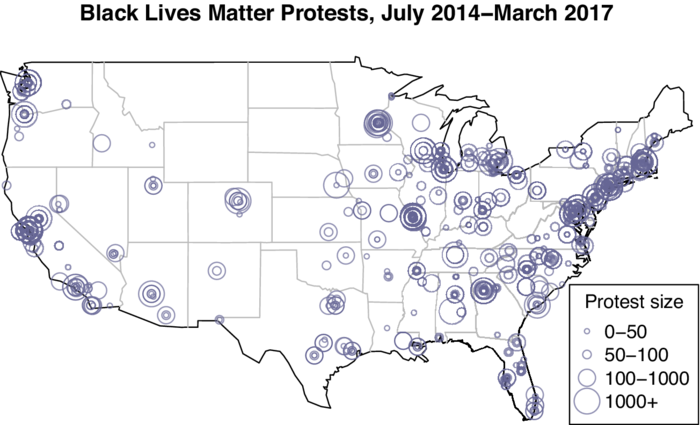
Protest Locations in the Contiguous United States
Note: Point sizes are scaled by approximate protest size.
The authors run a regression analysis where the three dependent variables (DVs) or outcomes of interest are police presence, arrests made, and crowd control. The following independent variables (IVs) are found to be statistically significant in affecting all three DVs: highway blockages, protests occurring after dark, disruptive tactics (e.g., protesters changing themselves to objects), and large protests (i.e., over 1000 participants). However, the low predictive value of these IVs (also known as their R²) means the authors must find another way to understand how protests, police responses, and mass perceptions are linked in a causal way.
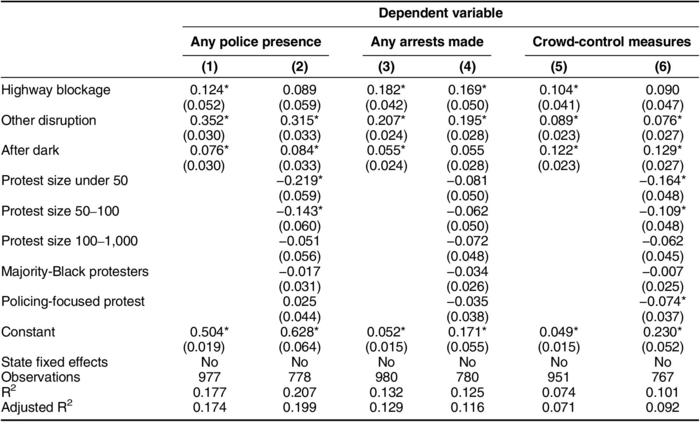
Table 1: Protest Characteristics and Police Response
Survey Experiment
The authors then conduct a survey experiment to test the following two hypotheses: H1: protests with a heavy police presence are more likely to be perceived by respondents as violent. H2: protests with a heavy police presence will yield less support for the overall movement from respondents. Over 2700 people participated in the experiment, which entailed respondents receiving two different “treatments”: one group read a “vignette” about a peaceful BLM protest, while the other read about a peaceful protest with a large police deployment. In other words, the only difference is whether police were present.

Figure 2: News Article Vignette
H1 is measured by asking respondents how much they agree or disagree — on a five-point “Likert” scale ranging from “strongly disagree” to “strongly agree” — with statements such as “the event was violent” or “protesters had violent intentions.” Similarly, H2 is measured by how much respondents agree with statements such as “I’d consider becoming involved in the protest,” “I support the protesters,” or “I’d post something positive about the protests on social media.”
The authors find positive support for H1 but null support for H2. In other words, respondents who receive the treatment about police presence are more likely to view the protesters as violent, but this does not translate into reduced support for the movement. Their explanation for the null finding is as follows: “support” is a more medium- or long-term attitude, shaped by repeated “exposure” to protests over time. As such, a single exposure — in the form of reading a vignette — is unlikely to shift respondents’ support. By contrast, “believing something is violent” may be more easily shaped by a single exposure. Finally, the authors present exploratory (i.e., non-preregistered) data showing that the effects for white respondents in H1 are higher.
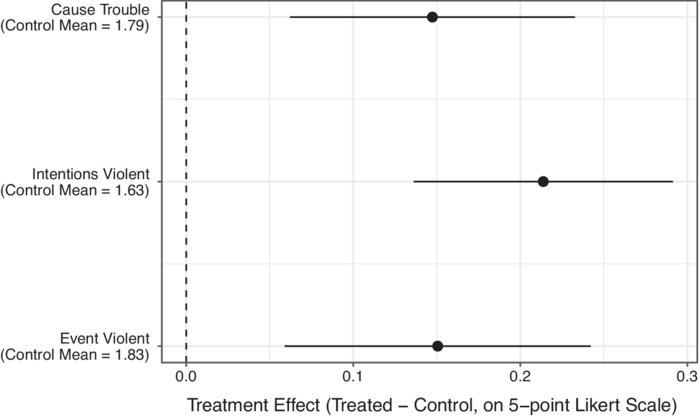
Figure 5: Effects of Heavy Police Presence on Violence Perception
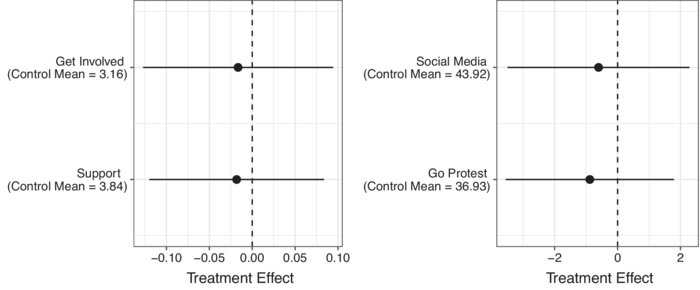
Figure 6: Effects of Police Presence on Support for BLM Protesters
Ultimately, the article shows how police behavior, more than protester tactics, can shape public perceptions of social justice movements like BLM. These findings invite a reevaluation of important mass movements across American history — such as the Civil Rights Movement — where police responses played a pivotal role. A heavy police presence at otherwise peaceful protests can distort how the American public perceives constitutionally protected behavior, potentially undermining the accuracy that is necessary for democratic participation.
*Research-in-Brief prepared by Adam Fefer.