
Resisting Authoritarianism in Turkey at the Local Level
Resisting Authoritarianism in Turkey at the Local Level
CDDRL Research-in-Brief [4-minute read]

Introduction and Contribution
Recep Tayyip Erdoğan and his Justice and Development Party (AKP) continue to deepen their decades-long authoritarian control over Turkish politics, economy, and society. Indeed, repressive tactics once reserved for Turkey’s marginalized Kurdish community have increasingly been applied to AKP’s opponents more generally, including journalists, business elites, and mayors. Key among these opponents is Istanbul mayor Ekrem İmamoğlu, viewed as the face of the opposition Republican People’s Party (CHP). İmamoğlu, seen as the frontrunner to challenge Erdoğan’s presidency in 2028, was arrested in March 2025 on spurious charges of terrorism and corruption.
At the same time, Turkey’s opposition is finding ways to resist Erdoğan’s autocratization. CHP — which traces its roots to Mustafa Kemal Atatürk and his vision for a secular Turkish nation — learned from its disappointing loss in Turkey’s 2023 national elections. By transforming its electoral strategy for the 2024 local elections, the CHP not only bested AKP’s vote share but also won in many areas that are historically AKP strongholds, which are often populated by conservative voters. What explains the CHP’s significant local turnaround under the constraints of Turkey’s ‘electoral authoritarian’ regime?
In “Turkey's Hard Road to Democratic Renewal,” Ayça Alemdaroğlu, Toygar Sinan Baykan, Ladin Bayurgil, and Aytuğ Şaşmaz caution against the received wisdom that broad, national-level coalitions offer the best hope of undermining authoritarian power. Such coalitions are difficult to sustain in countries like Turkey or Hungary, where authoritarian leaders control major political institutions and the public purse while muzzling their opponents and the media. Instead, the authors point to the surprising benefits of building alternatives to authoritarianism at the local level.
Argument
At first glance, the control of local governments in authoritarian political systems does not seem especially advantageous in terms of autonomy and influence. However, Turkish mayors control many of the policy domains that directly affect ordinary citizens, including transportation, sanitation, and housing. When local services and infrastructure are poor, voters may be willing to switch their partisan allegiance, even in places where the incumbent party works to distribute patronage and to propagandize them. Local governance enables opposition politicians to gain visibility and public support, as well as to demonstrate their administrative competence.
How exactly did the CHP pull off its impressive local showing in 2024? As noted above, the opposition built a national-level coalition in 2023, fractured by ideological divisions and disputes over its presidential candidate against Erdoğan, ultimately collapsing after the election. It was no match for Erdoğan’s unified messaging around threats to Turkey’s national security — portraying Kurds at home and in Syria as threats — and on nationalist pride in Turkey’s indigenous defense industry.
In 2024, by contrast, the CHP’s campaign strategy emerged from the bottom up: it employed electoral strategists and pollsters across Turkish municipalities, conducted fieldwork in competitive areas, selected mayoral candidates who could win, created local coalitions across ideological lines, and fine-tuned its messaging around service provision. Its flexible and pragmatic strategy appealed to both Turkey’s Sunni majority as well as its minority Alevis and Kurds. Meanwhile, the AKP was highly centralized in its reliance on Erdoğan’s popularity, failing to adapt to the demands of local residents whose support it believed was guaranteed.
Unpacking the CHP’s Victory
To understand how the CHP won and how it consolidated its electoral gains, the authors conducted interviews with newly elected mayors and vice mayors, CHP party officials, activists, journalists, and political observers. Interviewees were selected from six municipal districts where no opposition-controlled mayor had won an election for at least two decades and where the CHP improved its vote share by five or more points between 2019 and 2024. In these traditional AKP strongholds, voters complained a great deal about the high cost of living in Erdoğan’s Turkey. At the same time, they were becoming less religiously conservative and less supportive of a “majoritarian” style of politics.
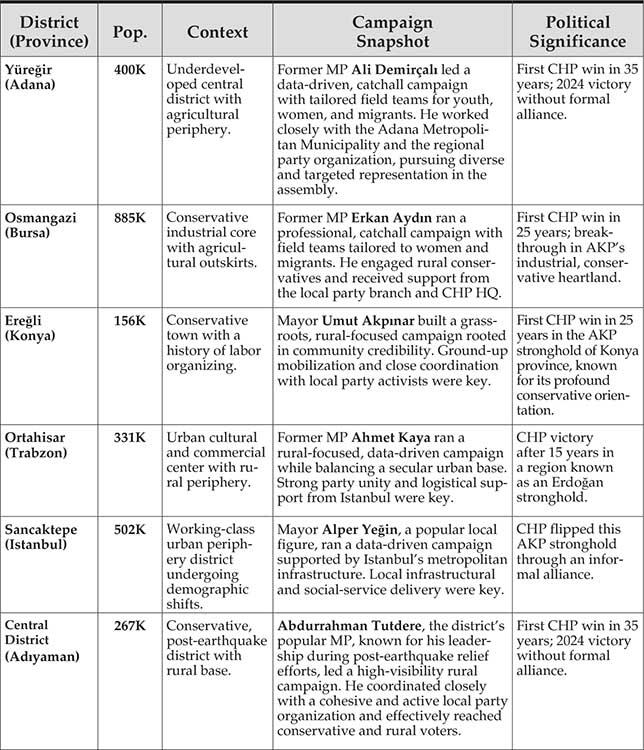
Table 1: Six Turkish districts in brief
During the campaign, the CHP worked to reverse its image as a party committed to Atatürk’s “aggressive” secularism, sometimes nominating conservative Sunni candidates in otherwise divided districts. It focused not on ideology but on service delivery and other issues that appealed across ethnic and sectarian lines. Incumbent CHP mayors advised prospective mayors, creating intra-party relationships that were complemented by the work of CHP grassroots organizations.
The authors introduce a number of the CHP’s successful mayoral candidates. Some of them were well-known national-level politicians who realized the benefits they could accrue by leaving Turkey’s toothless parliament and applying their skills to local government. Multiple mayors were of Kurdish and/or Alevi background, but they used these identities to appeal both inside and outside of their in-groups, for example, by attending Friday prayers with their Sunni constituents. One Alevi candidate gave municipal assembly list spots to conservative Sunnis and Kurds. By contrast, the AKP’s mayoral candidates — mainly nominated on the basis of their loyalty to Erdoğan — were perceived by their constituents as corrupt, aloof, and inefficient.
Challenges
Erdoğan’s opponents will likely struggle to reap the benefits of local governance, let alone to mount an effective challenge to AKP rule at the national level. These challenges will be heightened by AKP’s efforts to repress and arrest those whom it finds threatening. What’s more, CHP constituents expect not only the delivery of effective public services, but also patronage, especially public sector jobs, in exchange for their continued support. The AKP recognizes the challenge posed by its mayoral opponents and has responded by slashing municipal budgets. But the CHP is becoming more unified in the face of these common hardships posed by the AKP.
Ultimately, the growth of local-level CHP power opens up possibilities for democratic alternatives to AKP. The authors offer a novel perspective on how pragmatic local election campaigns, centered on service delivery, can serve as a means of undermining the influence of authoritarian leaders.
*Research-in-Brief prepared by Adam Fefer.