Unfinished Business: A Tribute to Marcel Fafchamps
Unfinished Business: A Tribute to Marcel Fafchamps
Friday, November 14, 20258:30 AM - 4:30 PM (Pacific)
In-person session open to invited guests; registration is required.
William J. Perry Conference Room, Encina Hall, Second floor, Central, S231
616 Jane Stanford Way, Stanford, CA 94305
Virtual participation available via Zoom using the link above. Zoom Meeting ID: 997 4878 4037, Passcode: 998456
We invite our virtual participants to join in celebrating Marcel Fafchamps' distinguished career. Following the keynote address, at 10:00 AM PST, there will be an opportunity for online attendees to offer brief remarks or words of appreciation to honor Professor Fafchamps and his many contributions to scholarship, mentorship, and our academic community. Your reflections are a valued part of this special occasion.

Join us for a full-day academic symposium celebrating the career and contributions of economist Marcel Fafchamps, Satre Family Senior Fellow at the Freeman Spogli Institute for International Studies, on the occasion of his retirement. Featuring a keynote by Marcel himself, this tribute brings together colleagues, collaborators, and students to engage with the themes and ideas that have shaped his influential work in development economics, labor markets, and social networks.
The day will feature in-depth paper presentations, rapid-fire research talks, and engaging discussions with scholars, including Stefano Caria (University of Warwick), Pascaline Dupas (Princeton University), and Simon Quinn (Imperial College London), with more speakers to be announced soon. Topics span management practices, persuasion and diffusion, strategic reasoning, and mutual aid—from field experiments to economic theory.
Come celebrate the distinguished research career of Marcel Fafchamps with us.
Lunch and refreshments will be provided.
The symposium will be held in person, by invitation only. Professor Fafchamps' keynote will be livestreamed via Zoom.
This event is co-sponsored by the Center on Democracy, Development and the Rule of Law and the King Center on Global Development.
8:30 AM — Continental Breakfast available in 2nd Floor Lobby, Encina Hall Central
8:45 AM — General Welcome, Kathryn Stoner
9:00 AM — Keynote Address, Marcel Fafchamps: Behavioral Markets
10:00 AM — Virtual Attendees may join to share brief remarks and words of appreciation
10:15 AM — Morning Break
10:45 AM — Session Speaker: Stefano Caria, Competition and Management
11:45 AM — Rapid Fire Speaker: Tom Schwantje, Management Style Under the Spotlight: Evidence from Studio Recordings
12:15 PM — Lunch Break
1:15 PM — Session Speaker Pascaline Dupas: Keeping Up Appearances: Socioeconomic Status Signaling to Avoid Discrimination
2:15 PM — Rapid Fire Speaker: Deivy Houeix, Eliciting Poverty Rankings from Urban or Rural Neighbors
2:45 PM — Afternoon Break
3:00 PM — Session Speaker: Simon Quinn, Matching, Management and Employment Outcomes: A Field Experiment with Firm Internships
4:00 PM — Special Presentation
4:15 PM — Concluding Remarks: Kathryn Stoner, Marcel Fafchamps
4:30 PM — Event Concludes
Marcel Fafchamps is a senior fellow at Stanford University’s Freeman Spogli Institute for International Studies (FSI) and a professor of economics. His research focuses on development economics, particularly how institutions, social networks, and market failures impact economic outcomes in low-income countries. He has published extensively on topics like agriculture, labor markets, and entrepreneurship, and has held academic positions at Oxford and Stanford. Fafchamps is known for combining rigorous empirical analysis with an understanding of real-world development challenges.
Stefano Caria is a Professor of Economics at the University of Warwick, affiliated with J‑PAL, CEPR, CAGE, and the IGC, serving as lead academic for Ethiopia. He earned his DPhil (and MPhil) in Economics from the University of Oxford and previously held positions at Oxford’s Department of International Development and the University of Bristol. He combines experimental and structural methods to study labor market frictions, refugee employment, childcare support, and firm-worker matching in low-income settings across Africa and the Middle East.
Tom Schwantje is a Postdoctoral Research Fellow at Bocconi University, where he is affiliated with IGIER and FINAFRICA. In his research, he focuses on the organizational economics and management of firms and banks in low-income countries. He is particularly interested in how managers operate in these settings, and how this is shaped by their environment. Most recently, he has started working on an exciting new research agenda on the organizational economics of banking in Ethiopia. Tom received his undergraduate and graduate degrees from Oxford University.
Deivy Houeix is a Prize Fellow at the Center for History and Economics at Harvard University. His primary field is Development Economics, with secondary interests in Organizational Economics. His research focuses on technology's role in lower-income countries, particularly in West Africa. Houeix explores how digital technologies reshape economic relationships and contract structures within and between firms, uncovering some key drivers and barriers to their adoption. Houeix is a graduate of the Massachusetts Institute of Technology, and has conducted research projects in Côte d'Ivoire, Ethiopia, Senegal, and Togo. In 2027, Houeix will join Columbia Business School as an Assistant Professor of Economics.
Pascaline Dupas is Professor of Economics and Public Affairs at Princeton University. She joined the Princeton faculty in July 2023. She was previously the Kleinheinz Family Professor of International Studies at Stanford University, where she spent 12 years on the faculty. She has also held faculty positions at Dartmouth College and UCLA. Dupas is a development economist studying the challenges facing poor households in lower-income countries and their root causes. Her goal is to identify interventions and policies that can help overcome these challenges and reduce global poverty. She conducts extensive fieldwork. Her ongoing research includes studies of education policy in Ghana, family planning policy in Burkina Faso, and government-subsidized health insurance in India, among others.
Simon Quinn is an Associate Professor of Economics at Imperial College Business School and Academic Director of its MSc in Economics & Strategy for Business. His research lies at the intersection of development and labor economics, with a focus on firms, markets, and institutions in low-income countries, especially in Africa. A Rhodes Scholar, he earned his MPhil and DPhil in Economics from Oxford, where he was also an Examination Fellow at All Souls College. Simon’s work includes field experiments on credit, management, and labor markets.
Kathryn Stoner is the Mosbacher Director of the Center on Democracy, Development and the Rule of Law (CDDRL), and a Senior Fellow at CDDRL and the Center on International Security and Cooperation at FSI. From 2017 to 2021, she served as FSI's Deputy Director. She is Professor of Political Science (by courtesy) at Stanford and she teaches in the Department of Political Science, and in the Program on International Relations, as well as in the Ford Dorsey Master's in International Policy Program. She is also a Senior Fellow (by courtesy) at the Hoover Institution.
Katherine Casey is a professor of political economy at the Stanford Graduate School of Business and Faculty Director of the King Center on Global Development. Her research explores the interactions between economic and political forces in developing countries, with particular interest in the role of information in enhancing political accountability and the influence of foreign aid on economic development. Her work has appeared in the American Economic Review, Journal of Political Economy and Quarterly Journal of Economics, among others. She teaches a course in the MBA program focused on firm strategy vis a vis government in emerging markets.
Melanie Morton, Faculty Affiliate, King Center on Global Development, is a development economist and associate professor in the department of economics at Stanford University. She is a senior fellow at the Stanford Institute for Economic Policy Research and the National Bureau for Economic Research. Dr. Morten is interested in how households respond to risk in developing countries, including using short term and temporary migration. Her work has been published in numerous journals including the Journal of Police Economy and the World Bank Economic Review. She received her PhD from Yale and was a postdoctoral fellow at the Minneapolis Federal Reserve.
The symposium will be held in the William J. Perry Conference Room, 2nd Floor, Encina Hall.
Event Location:
William J. Perry Conference Room
Encina Hall, 2nd Floor, C-231
616 Jane Stanford Way
Stanford, CA 94305-6165
Visitor Parking
There is no free parking on campus. Visitor and hourly parking permits are required through the ParkMobile app. Please download the app ahead of your visit and follow directions. Pay-by-space parking is available throughout campus; availability is limited. Please note that parking is monitored Monday - Friday, 8 am - 4 pm.
The parking areas closest to Encina Hall are located on surrounding streets and in the following parking garages:
Knight Management Center Parking Garage
Stanford Graduate School of Business (GSB), 655 Knight Way, Stanford, CA 94305
Manzanita Field Garage
742 Campus Drive, Stanford, CA 94305
For parking information, contact the Parking and Transportation Department's Visitor Parking page.
Rideshare Drop-off / Pick-up Address
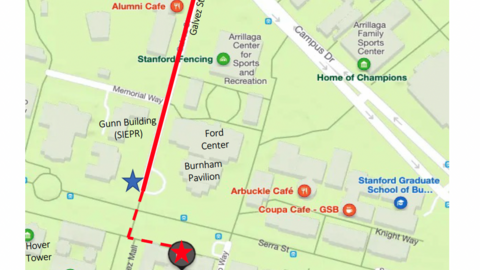
The closest drop-off location is: Gunn Building, 366 Galvez St., Stanford, CA 94305
From Galvez, walk South towards the Hoover Tower, and turn left at the intersection, onto Jane Stanford Way. Encina Hall is the large four-story building on your right. Enter through the main door, at the top of the stairs, and head up to the 2nd floor. An accessible entrance and ramp are located on the right side of Encina Hall, at the West Entrance.