Institutions and Organizations
-

Abstract:  

The "spirit of democracy" has recently been undermined in several African countries as authoritarian methods have been the preferred approach. In countries such as Kenya, Zimbabwe, Cote d'Ivoire, Niger and Gabon political change has come through the following means; military interventions ousting former presidents clinging to power after their terms; violently repressed popular unrests leading to power-sharing solutions, or former presidents being replaced by their sons. In few countries such as Guinea, free elections were organized after several decades of dictatorship.   

In this seminar, CDDRL Post-Doctoral Fellow Landry Signé will examine what makes certain countries adopt and consolidate liberal or electoral democracies when others stay authoritarian - whether competitive, hegemonic or politically closed. Signé will analyze the transformations of political regimes and democratization in the 48 Sub-Saharan African countries over the two last decades contrasting various political trajectories, comparing results between successful and failed countries, and exploring the conditions that create, maintain and sustain democracies. 

Speaker Bio:  

Landry Signé is a recipient of the 2011-2013 Banting Postdoctoral Fellowship Award from the Social Sciences and Humanities Research Council of Canada hosted by the Center on Democracy, Development and the Rule of Law at Stanford University. He is working on a project entitled “The Efficiency of the Political Responses to the Global Financial and Economic Crisis in Africa: Does the Political Regime and Economic Structure Matter?”. He completed his PhD in Political Science (2010), with the Award of Excellence, at the University of Montreal, and has been bestowed the Award for Best International PhD Dissertation of 2011 by the Center for International Studies and Research (CÉRIUM). His dissertation is entitled “Political Innovation: The Role of the International, Regional and National Actors in the Economic Development of Africa”. 

Prior to joining the CDDRL, Dr. Signé was a visiting scholar at the Stanford Center on African Studies, lecturer on Emerging African Markets: Strategies, Investments and Government Affairs at the Stanford Continuing Studies, founding president of a Canadian corporation specialized in public affairs and business development, part-time professor and lecturer in political science at Ottawa University and the University of Montreal, administrator at the United Nations Association of Canada-Greater Montréal, and president of the Political Commission of Montreal-CJ. He has worked or interned at the United Nations Department of Political Affairs, the Senate of France, the National Assembly of Cameroon, and the French Distributor, Casino Group. He studied Political Science, International Relations, Communication and Business at the University of Montreal, Lyon 3 University, Sciences Po Paris, Sandar Institute, Stanford Continuing Studies, and McGill University.

Reuben W. Hills Conference Room

Not in Residence

0
Visiting Scholar 2013; Postdoctoral Scholar 2011-2013
Landry Signé PhD

Professor Landry Signé is a distinguished fellow at Stanford University’s Center for African Studies, founding chairman of the award-winning Global Network for Africa’s Prosperity, special adviser to world leaders on international and African affairs, full professor and senior adviser on international affairs to the chancellor and provost at UAA, and partner and chief strategist at a small African-focused emerging markets strategic management, investment, and government affairs firm. He has been recognized as a World Economic Forum’s Young Global Leader, Andrew Carnegie fellow as one of the “most creative thinkers,” Woodrow Wilson Public Policy fellow, JCI Ten Outstanding Young Persons in the World, Private Investors for Africa Fellow, and Tutu Fellow who “drives the transformation of Africa,” among others. Previously, Landry was founding president of a business strategy and development firm based in Montreal and a visiting scholar at the University of Oxford. He has also served on the board of organizations such as AMPION Catalyst for Entrepreneurship and Innovation in Africa, Citizens Governance Initiative, and the United Nations Association of Canada–Montreal, and was appointed by a United Nations Under-Secretary-General to serve on the Global Network on Digital Technologies for Sustainable Urbanization. He is the author of numerous key academic and policy publications on African and global affairs, with a special interest in the political economy of growth, development and governance; the politics of economic reform, foreign aid, and regional integration; entrepreneurship, non-market and business strategies in emerging and frontier countries; institutional change, political regimes, and post-conflict reconstruction; state capacity and policy implementation. Professor Signé received the fastest tenure and promotion to the highest rank of full professor of political science in the history of United States universities, for a scholar who started at an entry-level position in the discipline. He is a highly sought-after keynote speaker and presenter at conferences worldwide, engaging a broad variety of business, policy, academic, and civil society audiences. He has won more than 60 prestigious awards and distinctions from four continents and his work has appeared in The New York TimesThe Washington Post, and the Harvard International Review. Professor Signé was educated in Cameroon (with honors and distinction), in France (valedictorian and salutatorian), earned his PhD in Political Science from the University of Montreal (Award of Excellence and Award for the Best International PhD Dissertation), and completed his Postdoctoral Studies at Stanford University (Banting fellowship for best and brightest researchers). He has also completed executive leadership programs at the University of Oxford Said School of Business (Tutu fellowship) and Harvard Kennedy School (World Economic Forum fellowship).

Landry Signé Postdoctoral Scholar 2011-2013 Speaker CDDRL
Seminars

On May 18-19, the Program on Poverty and Governance will host a two-day conference on the provision of public goods and good governance throughout the world. This conference, co-sponsored by the Center for Latin American Studies, will bring together an interdisciplinary group of economists, political scientists, policymakers, and public health researchers examining these questions. Public goods—goods and services such as education, healthcare, sanitation, potable water, and other benefits provided by the government—are intrinsically tied to issues of governance, which we broadly define as the exercise of political authority and the use of institutional resources to manage society’s problems and affairs. More specifically, factors such how political leaders get elected, the way in which government projects get funded, whether the community participates in decision-making, and the extent to which the distribution of government benefits is done through clientelistic networks, among others, play an important role in the quality and coverage of public goods that governments provide. Additionally, a critical question in large parts of the developing world relates to the role of international players and foreign aid in the provision of public goods –does external provision of public goods enable or hinder governmental capacity to deliver public services in poor communities? Through two days of presentations and panel discussions, the conference will explore how various facets of governance affect the provision of public goods and services throughout the world.

The conference will be held in Encina Hall at Stanford University May 18th and 19th, 2012. Guests are encouraged to RSVP by May 16th. Any questions may be addressed to the Program on Poverty and Governance program associate Elena Cryst.

Click Here for Papers

CISAC Conference Room

Dept. of Political Science
Encina Hall, Room 436
Stanford University,
Stanford, CA

(650) 724-5949
0
Senior Fellow at the Freeman Spogli Institute for International Studies
Graham H. Stuart Professor of International Relations
Professor of Political Science
beatriz_magaloni_2024.jpg MA, PhD

Beatriz Magaloni Magaloni is the Graham Stuart Professor of International Relations at the Department of Political Science. Magaloni is also a Senior Fellow at the Freeman Spogli Institute, where she holds affiliations with the Center on Democracy, Development and the Rule of Law (CDDRL) and the Center for International Security and Cooperation (CISAC). She is also a Stanford’s King Center for Global Development faculty affiliate. Magaloni has taught at Stanford University for over two decades.

She leads the Poverty, Violence, and Governance Lab (Povgov). Founded by Magaloni in 2010, Povgov is one of Stanford University’s leading impact-driven knowledge production laboratories in the social sciences. Under her leadership, Povgov has innovated and advanced a host of cutting-edge research agendas to reduce violence and poverty and promote peace, security, and human rights.

Magaloni’s work has contributed to the study of authoritarian politics, poverty alleviation, indigenous governance, and, more recently, violence, crime, security institutions, and human rights. Her first book, Voting for Autocracy: Hegemonic Party Survival and its Demise in Mexico (Cambridge University Press, 2006) is widely recognized as a seminal study in the field of comparative politics. It received the 2007 Leon Epstein Award for the Best Book published in the previous two years in the area of political parties and organizations, as well as the Best Book Award from the American Political Science Association’s Comparative Democratization Section. Her second book The Politics of Poverty Relief: Strategies of Vote Buying and Social Policies in Mexico (with Alberto Diaz-Cayeros and Federico Estevez) (Cambridge University Press, 2016) explores how politics shapes poverty alleviation.

Magaloni’s work was published in leading journals, including the American Political Science Review, American Journal of Political Science, Criminology & Public Policy, World Development, Comparative Political Studies, Annual Review of Political Science, Cambridge Journal of Evidence-Based Policing, Latin American Research Review, and others.

Magaloni received wide international acclaim for identifying innovative solutions for salient societal problems through impact-driven research. In 2023, she was named winner of the world-renowned Stockholm Prize in Criminology, considered an equivalent of the Nobel Prize in the field of criminology. The award recognized her extensive research on crime, policing, and human rights in Mexico and Brazil. Magaloni’s research production in this area was also recognized by the American Political Science Association, which named her recipient of the 2021 Heinz I. Eulau Award for the best article published in the American Political Science Review, the leading journal in the discipline.

She received her Ph.D. in political science from Duke University and holds a law degree from the Instituto Tecnológico Autónomo de México.

Director, Poverty, Violence, and Governance Lab
Co-director, Democracy Action Lab
CV
Date Label
Beatriz Magaloni Host
Conferences
-

This workshop will discuss key historical events that led to the emergence of humanitarianism and human rights as major ideological movements in the modern world.  In addition to a history of ideas, we will explore important moments – such as the abolition of slavery, episodes of colonial brutality, and the Cold War – when humanitarian ideals came under scrutiny. We will also examine shifting narratives and media strategies that missionaries, activists, governments, non-governmental organizations, and other “humanitarians” have employed to draw global attention to crises and abuses. 

Board Room
Stanford Humanities Center

Davide Rodogno Associate Professor, International History Commentator The Graduate Institute Geneva
Barbara Metzger Associate Speaker Center of International Studies in Cambridge
Keith David Watenpaugh Associate Professor, Religious Studies and Program Director, Minor Program in Human Rights Speaker UCDavis
J. P. Daughton Assistant Professor, Department of History Speaker Stanford
Joel Beinin Professor of History Commentator Stanford University
Priya Satia Associate Professor of History Commentator Stanford University
Workshops
Authors
News Type
News
Date
Paragraphs

The Program on Human Rights concluded its ninth and final installment of the Sanela Diana Jenkins International Speakers Series on March 13 with presentations with Dr. Mohammed Mattar, executive director of the Protection Project and professor at Johns Hopkins University and Professor Alison Brysk, chair of Global Governance, Global and International Studies at UC Santa Barbara.

Dr. Mattar noted that while effective anti-trafficking laws depend on law enforcement and survivor protection, the key intellectual and ethical rationale of such laws is the concept of the exploitation of vulnerable people in vulnerable circumstances. Dr. Mattar explained the legal distinction between “human trafficking” and “slavery,” emphasizing that the latter is based on twin ideas of human beings as commodities to be bought and sold, as well as the exercise of ownership of one person over another. “There is no doubt that human trafficking is a degrading and severe violation of basic human rights and fundamental freedoms, but it is unnecessary to label human trafficking as slavery because to do so we would need to identify the exercise of powers attached to the right of ownership,” Mattar said.

Among the challenges for a more effective anti-trafficking effort, Dr. Mattar listed the need to hold corporations responsible for their acts, to provide access to justice that allows for victim compensation, the engagement of civil society, and criminal enforcement and accountability under existing national and international law.

Professor Brysk explained that globalization has produced pernicious side effects.  The acceleration of migration, especially of women, increases the incidence of gender violence and the commodification of “disposable people.” All these factors enable the increase of human trafficking. Brysk observed that international recognition of trafficking as a form of contemporary slavery has been helpful in influencing policy change. “There is a slavery spectrum,” Brysk said. “We need to work to guarantee physical integrity of people, migration rights and children’s rights.”

She also noted that the focus on sex slavery has high costs because it is based on “protection and not empowerment,” and “rescue over rights.” The individualistic emphasis and sexual focus of anti-trafficking efforts fails to recognize many forms of exploitative globalized labor. Women and children are put in dangerous and debilitating non-sexual jobs. There are also many forms of sexual and gender violence in other forms of exploitative globalized labor, such as in sweatshops.

Together, the speakers in the final session of the Program on Human Rights speaker series made a strong plea for more sophisticated understanding of the dynamics of human trafficking in the 21st century. Sustained research that accounts for contemporary conditions, they told the Stanford audience, is needed to give policy makers and legislators the information and tools they need to combat the alarming global acceleration of human trafficking.

All News button
1
-

Abstract: 

This talk draws on case study evidence from Princeton University’s Innovations for Successful Societies to reflect on some current theories about building accountable government.  The focus is on settings where geography, insecurity, and limited resources render conventional management strategies unworkable.

Speaker Bio:

Jennifer Widner is professor of politics and international affairs and director of the Mamdouha S.Bobst Center for Peace & Justice at Princeton University. She runs a research program on institution building and institutional reform called Innovations for Successful Societies, a joint initiative of the Bobst Center and  the Woodrow Wilson School. Before joining the Princeton faculty in 2004-5, she taught at Harvard and the University of Michigan.  Her current research focuses on the political economy of institutional reform, government accountability, and service delivery.  She also remains interested in constitution writing, constitutional design, and fair dealing—topics of earlier research. She is author of Building the Rule of Law (W. W. Norton), a study of courts and law in Africa, and she has published articles on a variety of topics in Democratization, Comparative Politics, Comparative Political Studies, Journal of Development Studies, The William & Mary Law Review, Daedalus, the American Journal of International Law, and other publications.  She is completing work on a book about making government work in challenging settings, drawing on experiences in Africa, Asia, and parts of Latin America. 

Reuben W. Hills Conference Room

Jennifer Widner Professor of Politics and International Affairs, Woodrow Wilson School Speaker Princeton University
Seminars
Authors
News Type
News
Date
Paragraphs

On March 6, Justin Dillon, musician, film director and consultant to the State Department Office to combat human trafficking, spoke about open source activism and the work of slaveryfootprint.org to build a world free of slaves. Mr. Dillon presented at the eighth installment of the Program on Human Rights Sanela Diana Jenkins International Speakers Series at Stanford’s Bechtel Center.

Mr. Dillon recounted how he was deeply moved and decided to take action against trafficking after he and his band, Tremolo, toured Russia in the 90s and came across scores of young women lured abroad with the promise of a better life and bogus job offers. “As a musician, in the middle of chaos, I want to bring order,” he explained. “When I returned, I wanted people to feel what I feel,” Mr. Dillon added. He explained that the roots of his music, soul and jazz, are also products of slavery and the cry for recognition and help. He understood that it was natural to use music against modern day slavery.

Mr. Dillon explained that his first efforts were to help raise awareness of the problem and help organizations in the US that were addressing the issue of human trafficking. He hosted benefit concerts and came with the idea of a documentary that combined both critically acclaimed artists and social luminaries. “Although I am not a celebrity, I was impressed by the people that agreed to talk to me,” Mr. Dillon said. He also advised students “don’t ask for permission to change the world.” The result of this work, the film Call+ Response, was sold out in the theaters and widely acclaimed.

Explaining that open source activism is a thought and a value, Mr. Dillon suggested that organizations working against trafficking need to think more innovatively. They can learn from the environmental platform and adapt it to fight slavery. He reminded the audience that businesses spend a lot of money trying to work out what consumers want and that we live in a historically important time when consumers can tell companies what they want: a world free of slaves.

Hero Image
dillon Logo
Justin Dillon
NM
All News button
1
-

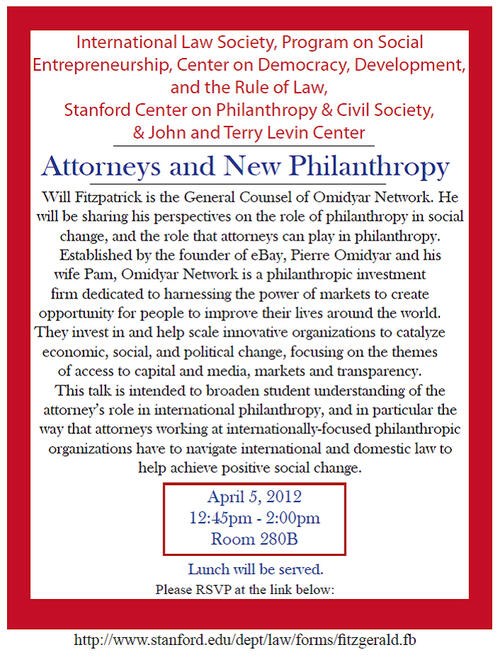
Will Fitzpatrick is the General Counsel of Omidyar Network.  He will be sharing his perspectives on the role of philanthropy in social change, and the role that attorneys can play in philanthropy.  Established by the founder of eBay, Pierre Omidyar and his wife Pam, Omidyar Network is a philanthropic investment firm dedicated to harnessing the power of markets to create opportunity for people to improve their lives around the world.  They invest in and help scale innovative organizations to catalyze economic, social, and political change, focusing on the themes of access to capital and media, markets and transparency.  This talk is intended to broaden student understanding of the attorney's role in international philanthropy, and in particular the way that attorneys working at internationally-focused philanthropic organizations have to navigate international and domestic law to achieve positive social change.

Please RSVP to the link below:

http://www.stanford.edu/dept/law/forms/fitzgerald.fb

Lunch will be provided

Image

Room 280B

Will Fitzpatrick General Counsel Speaker Omidyar Network
Conferences
News Type
News
Date
Paragraphs

Steve Hilton, senior advisor to British Prime Minister David Cameron, will join Stanford as a visiting scholar at the university’s Freeman Spogli Institute for International Studies.

Hilton, who will also be a visiting fellow at Stanford’s Hoover Institution, will arrive in May and spend his year on campus teaching, researching and writing.

“We look forward to having Steve Hilton in residence at FSI starting later this spring,” said Coit Blacker, FSI’s director. “Lively and engaging, Steve is certain to bring a fresh perspective to many of the issues and challenges that are of ongoing concern to our faculty, fellows and students.”

As Cameron’s top advisor, Hilton’s primary responsibility is the development and implementation of domestic policy. He specializes in the promotion of enterprise and economic growth, public service reform, family policy, decentralization, and government transparency and accountability.

Hilton will focus on innovation in government, public services and communities around the world while at Stanford. He will work with a wide range of centers and organizations across the university, including FSI’s Center on Democracy, Development and the Rule of Law and The Europe Center; the Graduate School of Business' Center for Social Innovation; the Center on Philanthropy and Civil Society; and the Hasso Plattner Institute of Design.

"I'm delighted to be joining the academic community at Stanford and greatly look forward to an exhilarating and productive year,” Hilton said. “It will be a huge pleasure to be able to focus on our most pressing social and governmental challenges."

Before Cameron’s election as prime minister in 2010, Hilton served as his chief strategist and developed the ideas associated with the modernization of the British Conservative Party.

Hilton previously ran Good Business, a corporate responsibility consulting firm, and is the author of Good Business: Your World Needs You. The book makes the case for businesses to play a more direct and active role in advancing social progress.

Hero Image
Hilton SQUARE
All News button
1
Paragraphs

Abstract

The brief war between Georgia and Russia in August 2008 provoked vigorous international reactions among the European states as consequence of the sudden shift in the strategic balance. This article argues for a focus on the great powers France, Germany and Britain as crucial actors for understanding the policy reactions towards Russia. It argues furthermore that reactions must be explained from the perspective of experience based on past geopolitics which translate the external pressures into concrete foreign policy: France oriented towards the creation of a strong EU as global actor, Germany influenced by her self-imposed restraint in foreign affairs and Britain influenced by Atlanticist commitments in her balancing behaviour. Beyond the Russo-Georgian war, the article points to an interest-based foreign policy approach towards Russia in the longer term driven by a great power concert with the Franco-German axis as stable element but increasingly with backing from Britain, thus contributing to transatlantic foreign policy convergence on the issue.

All Publications button
1
Publication Type
Journal Articles
Publication Date
Journal Publisher
Routledge: European Security
Authors
Henrik Larsen
Paragraphs

This is the first paper in the BDC-Stanford Project on Arab Transitions series, authored Dr. Tamir Moustafa of Simon Fraser University in Canada and entitled “Drafting Egypt’s New Constitution: Can a New Legal Framework Revive a Flawed Transition?”. Using Egypt as a case study, Moustafa, author of The Struggle for Constitutional Power: Law, Politics, and Economic Development in Egypt , highlights the deficiencies of the constitution-writing process there to serve as an example to other Arab countries as they embark on their own national projects. In addition, Moustafa offers key recommendations to the international community, as well as to Egypt’s Constituent Assembly on the various statutes, provisions, and conditions that should be included in the document to ensure that human rights protections, judicial independence, and institutions of governance are enforced.

All Publications button
1
Publication Type
Policy Briefs
Publication Date
Journal Publisher
BDC-Stanford Project on Arab Transitions
Authors
Subscribe to Institutions and Organizations