Ethnofederalism and the Mismanagement of Nationalism
Related Multimedia


Presentation

Center on Democracy, Development and the Rule of Law is part of the Freeman Spogli Institute for International Studies
Saad Eddin Ibrahim is an Egyptian American sociologist and human rights activist who was imprisoned in 2000 under suspicion of espionage and corruption. His defense team countered that the real motives behind the government's persecution of Ibrahim and his assistants was his blatant criticism of Egyptian President Hosni Mubarak and his government. He received a seven-year sentence, but was later released, some claim, because of external political pressure. Ibrahim is a contentious person who gained the respect and admiration of Egypt's human rights and civil society organization in the early the late 1980s for championing the cause of democracy in the Arab world in the immediate aftermath of the fall of the Soviet Union.
Ibrahim is credited for playing a leading role in the revival of Egypt's contemporary research-based civil society movement. He is the founder of the Ibn Khaldun Center for Development Studies in Cairo and the Arab Organization for Human Rights. Ibrahim also teaches at the American University in Cairo.
Bechtel Conference Center
Current theories of the rule of law argue that public officials respect rights if the citizens are coordinated on an equilibrium in which they collectively resist abuse. Constitutional rules are means to coordinate on this equilibrium. In past and present states, however, constitutional rules often have no effect on the rule of law. This paper suggests an alternative view of the origin and development of the rule of law. Instead of considering constitutional rules as coordination devices for citizens at large, history suggests considering them as manifestations of equilibria with rulers constrained by administrators required to implement policy. Analysis of the administrative foundations of self-enforcing constitutions may be the key to a theory and policy that would foster the rule of law in developing countries and those in transition. In particular, constitutional reforms might benefit from focusing on altering the equilibrium distribution of administrative capacity and power, providing incentives to the administratively powerful to check predation by each other and the central authorities, and to align administrators' interests with social welfare.
How might one think about Chinese power, its dimensions, its effects, and its implications for change in the United States and elsewhere? Dr. David M. Lampton will put China's current trajectory and its conceptions of power in their historical contexts, discuss how China's neighbors are responding to the PRC's growing strength, and explore the vulnerabilities and uncertainties that lie ahead not only for China but the outside world.
Dr. Lampton's work is based on interviews in China, in countries along the PRC's long periphery, and in the United States, as well as extensive documentary research. His book, The Three Faces of Chinese Power: Might, Money, and Minds, was just published by the University of California Press.
David M. Lampton, Dean of Faculty, is George and Sadie Hyman Professor and Director of China Studies at the Johns Hopkins School of Advanced International Studies and Senior International Advisor on China for the law firm of Akin Gump. Before assuming the post at SAIS in December 1997, he was president of the National Committee on United States-China Relations in New York City for a decade. Dr. Lampton is the author of numerous books and articles on Chinese domestic and foreign affairs. His most recent book is, The Three Faces of Chinese Power: Might, Money, and Minds (University of California Press, 2008), and his articles have appeared in the American Political Science Review, The China Quarterly, Foreign Affairs, Foreign Policy, The New York Times, The Washington Post, and other venues academic and popular. Earlier books and edited volumes include: Same Bed, Different Dreams: Managing U.S.-China Relations, 1989-2000 (University of California Press, 2001) and (editor) The Making of Chinese Foreign and Security Policy in the Era of Reform (Stanford University Press, 2001).
Lampton received his PhD and undergraduate degrees from Stanford University and has lived in the Peoples Republic of China, Taiwan, and Hong Kong. He has an honorary doctorate from the Russian Academy of Sciences' Institute of Far Eastern Studies and is consultant to the Aspen Institute's Congressional Program, the Kettering Foundation, and various corporations and government agencies.
Levinthal Hall
After the exhausting and dispiriting testimony of General David Petraeus and Ambassador Ryan Crocker to Congress this week, it is now even more starkly apparent that we are stuck in Iraq with no exit strategy. The plan of the Bush administration, and of these military and diplomatic leaders, is still to "stay the course" and hope things will finally take hold in Iraq: hope that the competing Iraqi parties and factions will finally settle their biggest political differences; hope that the Iraqi Army will finally show the ability to face down threats to security and hold the country together; hope that "strategic patience" will eventually allow us to draw down our forces to a level that will not stretch the U.S. Army to the breaking point. But as a group of mid-level American military officers who served in Iraq observed in a devastating edited volume of this name, "Hope is Not a Plan."
To be fair, the U.S. military surge in Iraq (and its attendant shift in strategy on the ground), has achieved many positive things. Iraqi and American casualties have fallen sharply (by more than two-thirds on some measures) from their peak levels in 2006 and early 2007. The Iraqi army and police have grown by roughly 100,000, in addition to some 80,000 local community militia forces ("concerned local citizens") armed and paid by the U.S. As a result of increased force levels and a dramatic change in strategy toward engaging the Sunni Arab communities (including forces once active in the resistance), Al Qaeda has been driven out of most Sunni Arab communities, particularly in Anbar province, and its fearful grip on that section of the country has been broken. This has been the most important achievement of the surge. In many Iraqi urban neighborhoods, both in Baghdad and in other cities, particularly in the once lawless Anbar province, Iraqis have been able to return to the streets and to something approaching normal commercial and social life.
One of the biggest blunders has been the analytical failure to see that the Shiite Islamist political party's political triumph in Iraq would bring a strategic bonanza to Iran--effective control of at least the southern half of Iraq. These are not small achievements. Unfortunately, in the absence of a larger and more tough-minded strategy, they are also not sustainable ones.
John McCain may have been right for the moment when he declared to the Kansas Veterans of Foreign Wars on April 7, "We are no longer staring into the abyss of defeat." Unfortunately, in the context of continued political stalemate in Baghdad and the absence of a viable political strategy for stabilizing Iraq, the second part of his sentence simply does not follow: "... and we can now look ahead to the genuine prospect of success." Rather, as Petraeus and Crocker unwittingly made clear, what we can look forward to is the indefinite commitment of 130,000 to 140,000 American troops, holding together a country that would otherwise shatter into much wider bloodshed. Hope is not a formula for success.
The truth is, we remain trapped in an awful quagmire. No less staunch a Republican than Senator Richard Lugar observed in the Senate hearings this week, "Simply appealing for more time to make progress is insufficient." Senator McCain lacks the candor or clarity of mind to recognize that absent a new political strategy, we are stuck in a holding pattern, propping up a badly divided and corrupt political class in Baghdad. At least he has had the candor, however, to acknowledge that, under these circumstances, American troops might have to be in Iraq for another 10, 20, or 100 years.
Senators Clinton and Obama, in turn, recognize that the United States cannot maintain large numbers of American troops in Iraq for anything like that long. Not only will Iraqi resistance forces rise up against it again, but these commitments are draining our fiscal and military vitality.
Even if we were to leave Iraq tomorrow, it would take years to rebuild, re-equip, and reset the American armed forces to their pre-war levels of capacity and readiness. In a survey of American military officers by the Center for a New American Security, 88 percent thought the war had stretched the US military dangerously thin. And then there is the question of what kind of Army we will be left with as we have to lower standards further and further to find the "recruits" to sustain this military quagmire. CNN reported on April 7 that one out of every eight new recruits requires a waiver because of past criminal behavior or other prior misconduct. The percentage of high school graduates among recruits has declined to 79%. Retired General Barry McCaffrey said recently that ten percent of Army recruits "should not be in uniform." And when the Vice-Chief of Staff of the Army testifies (as General Richard Cody did last week) that repeated deployments are placing "incredible stress on our soldiers and their families" and that "our readiness is being consumed as fast as we can build it," you know we have a serious problem.
Yet Clinton and Obama don't see the other side of this awful reality: that a swift, unconditional timetable for withdrawal of the kind they propose (on the order of one to two combat brigades per month) would likely see Iraq slip back into all-out civil war -- unless something dramatic changes in the political landscape there.
We urgently need an exit strategy from Iraq, but it cannot simply be to declare we are leaving by some fixed, early date -- and goodbye and good luck. Without the prospect of a substantial American military drawdown on the near horizon, Iraq's political factions will lack the incentive to make the hard choices for a sustainable compromise that might hold the country together. But in the absence of an intense diplomatic effort to broker this compromise, the prospect of imminent American withdrawal will not induce compromise, but rather rigidity and the psychology of preparing for an imminent civil war.
So what needs to be done?
To begin with, we need a more hard-headed analysis of our real interests. For years now, the Bush administration has leaned toward the Shiite Islamist political party, ISCI (the Islamic Supreme Council of Iraq, formerly the Supreme Council for the Islamic Revolution in Iraq, or SCIRI). ISCI and its militia, the Badr Organization, which has heavily penetrated the Iraqi army and police, were formed in exile in Iran in the 1980s and grew up under the heavy influence there of the Iranian Revolutionary Guards. They subscribe to the hard-core Khomeini of system "velayat al faqih" -- rule by the Islamic jurist. And they have welcomed numerous Iranian agents into Iraq to help them establish that system.
Of the many grand blunders of the Bush administration in Iraq, one of the biggest has been the analytical failure to see that ISCI"s political triumph in Iraq would bring a strategic bonanza to Iran -- effective control of at least the southern half of Iraq. To pave the way for this, ISCI and its leader, the ailing Islamist cleric, Abdul Aziz al-Hakim, have long sought to gather all nine provinces in the Shiite southern half of the country into a single super-region, which would enable ISCI to establish political hegemony over the entire Shiite region, control most of the country's oil resources (based mainly in the Basra area of the far south), and dominate the politics of the center.
Prime Minister Nuri al-Maliki's recent ill-fated crackdown on the Mahdi Army militia of Muqtada al-Sadr was not just about establishing order in the south. A more important subterranean motive (for which the United States allowed itself to be used) was to remove the chief obstacle to ISCI's bid for hegemony in the south. Sadr and his disparate political and militia forces oppose the creation of a Shiite super-region, and constitute the most significant political rival to ISCI (and its junior partner in Shiite politics, Nuri al-Maliki's Dawa party). ISCI's calculation has been that if Sadr could be neutralized, its path to victory in the coming provincial elections in October could be cleared, and then it could press forward with its aim of gathering all nine southern provinces into one.
We should have no illusions: Sadr is a nasty, deeply illiberal character. His militia forces, or those who swagger around, draped in weapons, seizing territory and imposing Islamic order in his name, often approximate the Taliban in their level of commitment to human rights, women's rights, religious freedom, and the rule of law. But Sadr's political movement is a broad tent that also includes more nationalist Shiite elements who share with one another (and with many Sunni Arab factions with whom they have been in contact) a determined resistance to ISCI's and Iran's bid to control southern Iraq, and through that region, the country as a whole. In other words, the participation of the Sadrist movement in electoral politics at least preserves political fluidity and pluralism. Its elimination, while leaving ISCI and its tightly knit militia network in control of much of the security apparatus and of existing provincial governments in the south, paves the way for Iranian domination.
One of the greatest and most bitter ironies of the Bush administration's posture in Iraq has been its persistent failure to see how it was handing the greatest threat to security in the region -- the Islamic Republic of Iran -- a grand strategic prize. So far, the Iranian regime has largely succeeded in its goals of bogging the U.S. down in a bleeding insurgency, draining its military and its treasure and sapping its will, until the point that Iraq (so they think) will fall into their hands like a ripe apple. No wonder the Iranian ruling elite so often seems to be smiling like a mafia gang on its way to eliminating its rivals. As one Iraqi recently observed to me, "The Iranians are more intellectual, more strategic, and more patient than the U.S. The Bush administration's approach in Iraq has been purely tactical. When the U.S. spends a billion dollars in Iraq, Iran spends $50 million and gets more."
It is not clear that this strategic victory for Iran in Iraq can be prevented at this point. Certainly it will not come from the Kurds, who have long since struck a cynical bargain with ISCI: they can have their Shiite super-region, and in return the Kurds want to absorb into their Kurdistan region the city and province of Kirkuk, whose vast oil resources would make eventual Kurdish independence a much more viable proposition.
It does not take much facility in political arithmetic to figure out who are the big losers in all of this: first of all the Sunni Arabs (about twenty percent of Iraq's population), who have no major oil producing assets in the provinces where they predominate, and who believe the creation of a Shiite super-region would be a formula for their own permanent marginalization and impoverishment. The other big loser would be all those Iraqis (surprisingly, a majority) who continue to believe in the idea of a united Iraq, and who are adamantly opposed to Iranian domination.
For this reason, the bargain between ISCI and the Kurds (codified in the 2005 constitution) cannot be the basis of a stable and democratic Iraq. It leaves out two crucial sections of the population: first, the Sunni Arabs, and second, a majority of Iraq's Shia as well, who fought Iran in a bloody eight-year war in the 1980s and do not want their territory to become a satellite of Iran's Islamic Republic. If the United States were to withdraw from an Iraq configured along these lines, civil war would almost certainly follow. It would pit an ISCI-dominated government in the south and in Baghdad, backed by Iran, against a loose coalition of Sunni Arab and Shiite nationalist resistance, backed by Jordan, Saudi Arabia, and other Sunni Arab states in the region alarmed by Iran's expanding power (which also includes a determined drive to acquire a nuclear weapons capacity). And in the chaos, there would also be a welter of more local-level fights for dominance.
The only way out of this nightmare scenario is a coherent, well-prepared, vigorous effort to broker a constitutional compromise before it is too late. The parameters of the necessary bargain have been clear for many years. ISCI would need to give up its ambition of a single, nine-province super-region, but could be granted a federal system with the eventual ability to lobby for creation of smaller regions (of up to three provinces each, as the interim Iraqi constitution had allowed for). The Kurds would get to keep their own region as part of a federal system, but the development of new oil fields would remain a prerogative mainly of the central government, not, as the Kurds and ISCI wish, regional governments. The Sunnis would have to reconcile themselves to being a minority political force in Iraq, but their provinces would be assured a fair and automatic distribution of the oil revenue, more or less in proportion to each province's share of the population.
There are a number of other issues to be worked out as well (including the reintegration of former Baathists below the top level into government, and the pruning of ISCI loyalists from the commanding ranks of the security forces, especially the police). But the pivotal elements of a deal involve the structure of the federal system and the control of oil production and distribution of its revenue.
The constitutional deal that is needed cannot be brokered by the United States alone. A "diplomatic surge" is urgently needed, in which the U.S. would partner with the UN and the European Union. For an administration that has been loathe to surrender control in Iraq, this is a difficult step, but without it, there will be no political breakthrough, and thus no exit from the quagmire.
In the context of such a grand bargain, the United States could draw down somewhat more gradually than Clinton and Obama now envision, perhaps getting down over the course of about three years to a small residual security force to protect American civilian operations in Iraq. If the provincial elections scheduled for this October can come off without massive intimidation and bloodshed, that will help, as it will likely deliver setbacks tin the south to ISCI and Dawa (who have governed poorly) and generate a more pluralistic political terrain, in which power in the Shiite south is shared by a more diverse set of actors.
It is far from clear that Iran, so close to winning its prize, would not sabotage such an outcome. Direct and intensive engagement with the Iranian regime would also be needed. This could offer the Iranians other incentives as part of a larger deal that would include verifiable suspension of their nuclear program. It could also play on the prospect of what they could themselves could face in an Iraq without the United States: a divided Shiite community, part of which is rising up in resistance to their dominance, allied with a united Sunni community with the broad backing of other Arab states in the region. And all of this before they had acquired the nuclear weapon they think will give a huge boost to their regional power.
A certain amount of brinksmanship would be needed to demonstrate to Iran that the alternative to compromise in Iraq is that they could wind up trading places with us, being bled and drained in an insurgent war while their enemies score opportunistic gains. In that case, the strategic prize could become an albatross around the neck of a regime that faces huge economic and political problems within Iran itself.
The above offers no sure path out of Iraq. Should diplomacy fail, we would be left with little choice but to prepare to withdraw, perhaps rapidly and in extremis, letting the regional actors and the Iraqis themselves pick up the pieces. It would be an ugly and costly scenario. But the credible threat of it might be the one thing that tips Iraq's polarized parties toward accommodation. And bad as it would be for a time, it could hardly be worse than having the United States bogged down in Iraq, desperately holding our military fingers in the dike for the decades that Senator McCain seems prepared to envision, while both our military capacity and our soft power drain away.
John Seffrin, Ph. D., will be speaking on the issues of tobacco, with his experience as CEO of America Cancer Society, and as the immediate past president of the International Union Against Cancer in Geneva, Switzerland.
Medical School Office Building (MSOB)
Room x303
251 Campus Drive
Stanford, CA 94305
Anthropology Building 50, Room 51A
(Inner Quad, next to the Memorial Church)
How did you get involved in diplomacy and inspection work?
I had originally intended to become a professor. I took a PhD at Cambridge and I also studied at Columbia University for two years. Then as I got back to Stockholm and did some teaching, I was asked to come in as a consultant to the Foreign Ministry, and gradually I got gobbled up by the ministry.
Can you describe the experience of doing inspections in Iraq?
My job was mainly to make sure that our inspectors had all their rights to do what they needed to do, that they were not stopped. Remember that in the '90s, Iraq frequently stopped inspectors and we suspected that they had something to hide. But in 2002-2003, we were never stopped for any inspection, not even the so-called palaces of Saddam Hussein. I thought that in the '90s sometimes the inspectors from New York had been a bit too Rambo-like, and of course inspectors from the teams often had people from the intelligence side, both from the U.S. and the U.K. We were determined to be completely independent. And I think we were. We were in nobody's pocket.
There were moments which were thrilling. At one point our inspectors found some munitions which had been for chemical weapons. There was no chemical in them, but they had not been declared. For a moment we thought maybe this is the tip of an iceberg, but gradually came to the conclusion that it was floes from an iceberg that had been there.
Preemption is where you see an attack coming, where an attack is imminent... You can take action when the airplanes or the missiles are approaching your territory. Another matter, however, is to attack a foreign country saying that we suspect that they will attack us.
From the beginning, like most people, our gut feelings were that there were weapons of mass destruction, although when we were asked about it we said, we are not here to tell you gut feelings, but to inspect. But as we inspected more and more cases, and did not find any weapons of mass destruction, the gut feeling changed, naturally.
There's a sad feeling about the whole thing that we were not able to have a greater impact. I was sometimes told, or it was assumed, that my phone had been bugged. And my reflection on that is simply that I wish that they had listened better to what I had to say.
There were also things that were amusing.
Do you have any amusing anecdotes you want to share?
Well, I remember that before we were admitted, Kofi Annan tried to bring me into discussions with Iraqis in the spring of 2002, and the Iraqis would have nothing to do with me, because they were negative to inspections, and they called me a spy. Before that they said I was a nonentity. Eventually when they accepted inspection, I was addressed as Your Excellency. So I thought when I became a spy I'd at least been promoted from a nonentity, and then when I was addressed as Your Excellency I'd really arrived.
What do you think is the key to being an effective diplomat?
You have to know your mandate first. In our case that was set by the resolutions, 1284 and 1441. As a lawyer I knew them very well. Our role was to inspect and report to the Security Council. We were not there to tell the Council what it should do. We were, as it were, the police investigation and they were the judges.
The second is that you must know your dossier. The facts. We spent lots of time going through what had happened in the '90s.
The third point I think is to exercise critical thinking, as police investigations do. They have a hypothesis, but you must collect and examine all the evidence. If you do not have the right diagnosis, how can [the] Security Council find the right therapy? This was the error, the big error, in the U.S. and the U.K. They did not have critical minds. They came, and they relied far too much on defectors. And the defectors were not interested in inspection, they were interested in invasion.
It also has to do something with--this is the fourth point--how inspectors behave. As I said I thought sometimes in the '90s the animosity and difficulty that they had in Iraq was due to the conduct of the inspectors--Rambo-style. I said when I took over that we intended to use all the rights that we had under the Security Council resolutions, but we were not there in order to provoke or harass or humiliate the Iraqis. When you ask what is important in diplomacy, I think that one of the most important things is always to avoid humiliation.
You say in your book that the climate for arms control has deteriorated, even as international cooperation has increased in some other areas like health and the environment. Why do you think that is?
The interdependence that results from more communication and transport and increased trade forces the world into a great deal of agreements, because it wouldn't function otherwise. SARS or avian flu or what have you--all this requires cooperation. The body of international law has increased tremendously, and most of it functions without any courts or any threats of sanctions.
We also have basic rules about how states conduct against each other, like diplomatic relations and the interpretation of treaties and consular relations, but also, nowadays, on the use of force. And that's an area, as I say in my book, where law is much less reliable. It's relatively new. Such rules did not exist before the U.N. Charter. The League of Nations did not prohibit states to go to war. It obliged them to try first with peaceful means. It's only in 1945 that people in San Francisco laid down the rule that states must not use armed force against each other unless they do it in self-defense against an armed attack or unless they do it under authorization of the Security Council. So that was a leap forward in 1945. Now, during the Cold War there were many violations of this. But what was new in 2002 was that the U.S. National Security Strategy declared that the rules of the Charter were too narrow for them, and they declared that they would take armed action regardless of these limitations in the Charter.
And this is no small point. This is a question of preventive war. Preemption is where you see an attack coming, where an attack is imminent. It is generally recognized that you can take action before the bombs fall. You can take action when the airplanes or the missiles are approaching your territory. Another matter, however, is to attack a foreign country saying that we suspect that they will attack us. In the case of Iran, that's taking armed action already at the sight of a few grams of uranium enriched to 4 percent. Now that's not an armed attack.
What do you think about the current prospects for disarmament?
I'm delighted to see that there's a strong body of American opinion, non-partisan, and led by former Secretary of State Shultz, and Kissinger, and Sam Nunn and Bill Perry. Many, including Colin Powell, side with them. They say, yes, the arsenal of nuclear weapons was needed during the Cold War, but no longer, and it can only damage and give ideas to other people; if the great powers need nuclear weapons maybe we also need them. So they urge the United States to take the initiative vis-a-vis Russia to move toward nuclear disarmament. They're not starry-eyed idealists. They know this is going to take time, but there are plenty of things that can be undertaken now.
And what are the most important steps to be taken now?
I have no hesitation that the most important signal would be a ratification and entry into force of the Comprehensive Test Ban Treaty. This was rejected by the U.S. Senate during the Clinton administration. Both Hillary Clinton and Barack Obama have said that they would want to have that treaty ratified. And I think the chances are that if the US ratifies it then China will, if China will, India will, if India does I think Pakistan will, then we will get the whole bunch. So this is at the top of the agenda. But taking nuclear weapons off hair-trigger alert--which really is a relic from the cold war--I think is also very high up on the agenda.
What do you think is the most worrisome development in terms of nuclear weapons today?
I think the most acute questions are the negotiations with North Korea and with Iran. I'm favorable to the approach that's been taken lately by the U.S. in relation to North Korea. I don't think that threatening the North Koreans with any military action is a defensible policy. Military pressure is more likely to be counterproductive and lead them to a hardening of their positions; that's what we have seen in the past. However, the six-power talks in Beijing have been looking much more for carrots, and including, notably, a guarantee against attack, and also a guarantee of diplomatic relations with the U.S. and with Japan, if the North Koreans go along with a nuclear settlement. I think this is much more likely to yield results.
In the case of Iran, I think that while the Europeans have a number of carrots on the table, they say that these carrots are only available to Iran if, first, Iran does its part. There's a precondition that Iran should suspend enrichment. I don't know any negotiations in which one party says, yes, I will do my part and then we'll discuss what you'll give me for it. But the two elements I mentioned in the case of North Korea are not, to my knowledge, on the table in the case of Iran. Namely, a guarantee against attack, and talk about diplomatic relations. So I think that playing these two cards would be enormously valuable.
What about the possibility of nuclear weapons falling into terrorist hands?
One can hardly exclude any risk, but most experts deem it highly unlikely that non-state actors would be able to master this. They have to put together the weapons; they also have to find some means of delivery. And we also know from the case of terrorists in Tokyo a number of years ago that they chose rather the chemical weapons in their attack in the subway. There's some talk about what they call dirty bombs, a way of using radioactive material and exploding it and contaminating an area. That would be a terror weapon, but can by no means be compared to a nuclear weapon.
What's your advice to U.S. voters who are concerned about nuclear weapons?
I certainly think that McCain is a respectable, upright person with integrity. But from the point of view of disarmament, and the need for a new wind in international relations, I think that both Hillary and Obama are far better placed.
What are you up to these days?
I give a lot of lectures around the world. I travel much too much.
Actually, what I would want to do and what I'm starting to do is write a book about the development of international law and disarmament. How can we move the world slowly towards more peaceful relations? Well, you'll find beginnings of my thinking in Why Disarmament Matters. This is something I should do, but all these engagements to speak at various conferences take a lot of my time.
Aside from the former U.S. statesmen who support disarmament, are there any other causes for optimism you can see?
We need, as I said, a new wind. And I think a change of leaders, perhaps, could give a chance to that. In Russia you have a change of leaders even though Putin hovers over the scene. In Washington you will have a new leader. In France it's new, in Germany relatively new, and in the U.K., the new government is much more pro-disarmament. So there are some glimmers of hope.
This is a CDDRL's Special Event within our Democracy in Taiwan Program. It is also co-sponsored by the Public Diplomacy/Emerging Publics Project of the Center for the Pacific Rim at University of San Francisco. In this seminar, Dr. Richard Madsen will talk about his new book that explores the religious renaissance that has reformed, revitalized, and renewed the practices of Buddhism and Daoism in Taiwan and how this religious renaissance embraces democracy modernity.
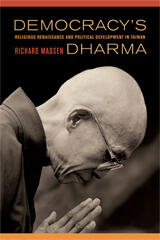
Richard Madsen received an MA in Asian studies and a Ph.D. in sociology from Harvard.
"Madsen is a genial and well-informed guide, both to social-political change in Taiwan and to the ins and outs of religious movements. His engaging writing skillfully interweaves profound insights and themes into the descriptive analytical narrative. Democracy's Dharma presents new material based on recent research while offering a fresh spin on thinking about Asian religions."–Thomas Gold, editor of Social Connections in China: Institutions, Culture, and the Changing Nature of Guanxi
Philippines Conference Room

