Authors
News Type
News
Date
Paragraphs

Introduction and Contribution:


Tax noncompliance — the withholding or underreporting of revenue from goods, services, and assets — may constitute as much as 30% of global GDP. Most people have no illusions about noncompliance: large majorities of Europeans believe that many or even most of their co-nationals cheat or “shirk” on paying taxes. Yet shirking deprives the state of crucial resources that fund the provision of public services, such as policing, education, or healthcare.

From a purely self-interested standpoint, tax cheating by some may well lead others to do the same, a cycle that can lead to the collapse of service provision. In “Filling the tax gap,” however, Simone Paci argues that this inference may be premature. It is true that individuals and businesses may not contribute to state provision efforts when others do not, yet this is not the only kind of provision. Instead, those who perceive tax cheating as prevalent can turn to nongovernmental organizations (NGOs) to fill the gap. These include religious organizations, human rights organizations, sports clubs, and many more.

Paci argues that those who donate to NGOs in the face of prevalent noncompliance can satisfy a range of interests. On the one hand, they may directly and materially benefit from donating, such as when police are more adequately funded, and security improves. On the other hand, donations can yield more indirect and symbolic benefits, such as when individuals see themselves as altruistic or bolster their status as community members. 

Marshalling a wide array of evidence, Paci shows that Slovaks exposed to information about tax cheating were more likely to donate to NGOs than those not exposed. This includes a natural experiment comparing Slovak municipalities in which the names of tax cheaters were released at different times, as well as a survey experiment in which online respondents receive similar information and donate accordingly.

The silver lining of these findings is that tax evasion needn’t spell the death of service provision. Paci challenges a key assumption in standard accounts of economic rationality, namely that free-riding begets free-riding. This may be true if we restrict our focus to the state, but not if we broaden it to all those entities that provide community services.

The silver lining of these findings is that tax evasion needn’t spell the death of service provision.

The Slovakia Experiments:


Paci collects data from Slovakia, a country where “name-and-shame” laws publicize information about taxpayers and businesses that have cheated on their value-added tax (VAT) obligations. In 2012 alone, Slovakia may have lost 40% of its VAT revenue due to tax noncompliance. Another significant aspect of Slovakia’s tax system is that individuals and firms can donate up to 2% of their income tax to local NGOs. In turn, the latter publishes data about their donation drives. Slovakia’s name-and-shame programs seem to have served some of their intended goals, as the noncompliance lists are well-known among Paci’s survey participants. 

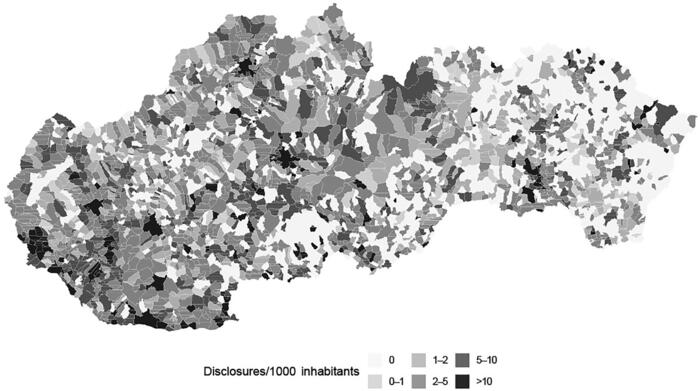
For experimental purposes, there are two important sources of variation as regards the name-and-shame data. First, it is not published in all municipalities. Second, some municipalities that do publish the data do so before the donation deadline. As Paci theorizes the connection between disclosures and donations, the natural experiment thus compares “treated” municipalities with “control” municipalities, whose disclosures were released after the deadline. The experiment’s validity depends on the assumption that name-and-shame data are released at random times, or rather by “nature.” This seems plausible in Slovakia.


Image
Figure 1: Noncompliance disclosures across Slovakian municipalities.


FIGURE 1: Noncompliance disclosures across Slovakian municipalities. Notes: The map visualizes the total number of unique firms involved in VAT noncompliance disclosures per 1,000 inhabitants between 2009 and 2021 for all Slovak municipalities, using the 2009 population.


The natural experiment supports Paci’s argument, as municipalities where disclosures are made prior to the donation deadline are 16% more likely to donate. This is not a small effect, corresponding to a difference of about 20,000 Euros. To reiterate, the intuition here is that pre-deadline disclosures provide critical information to taxpayers about how underfunded state-provided public services will be (due to noncompliance); this, in turn, motivates them to donate to nonstate providers.

Paci then fielded a survey experiment among over 2000 Slovakians online. This presented treated respondents with written “vignettes” that replicate the real-life disclosure lists. By contrast, control group respondents simply received an ordinary list of taxpayers. Afterwards, some respondents played a “dictator game” in which they could choose whether to donate Euros to NGOs. 

The results of these surveys provide additional evidence for Paci’s argument, as respondents exposed to information about noncompliance donated 10% more to NGOs than the control group. In terms of the motives underlying donations, Paci finds evidence for the importance of altruism and reputation. Regarding the former, those who believed their municipality was critically dependent on public services were more likely to donate. Reputation motives were important because survey respondents were less likely to donate if their contributions were kept anonymous.

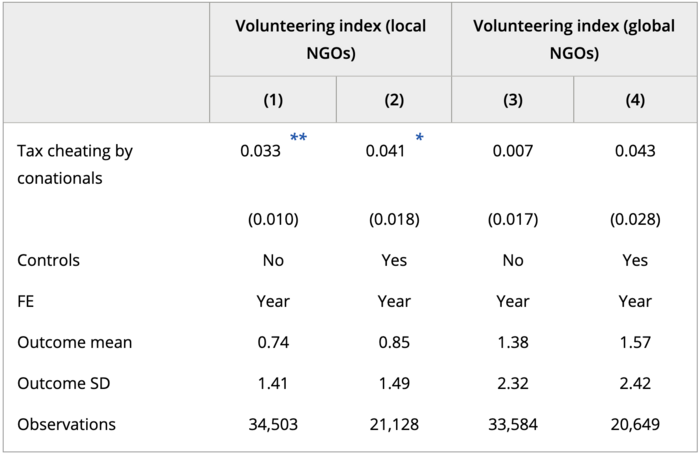
Finally, Paci presents evidence from Europe-wide value surveys conducted in 1999. These interviewed over 40,000 people from 33 countries. Consistent with the Slovakia-specific evidence, there is a strong correlation between respondents’ beliefs about perceived tax cheating and their propensity to volunteer for local NGOs.


Image
TABLE 7: Perceptions of tax cheating and volunteering.


TABLE 7: Perceptions of tax cheating and volunteering. Note: †p < .10; *p < .05; **p < .01.


In all, Paci’s findings caution against drawing simplistic and pessimistic conclusions about free-riding and taxation. Yet readers may wonder how much of a difference name-and-shame policies could really make. On one level, few countries have passed such laws, and few politicians will likely see name-and-shame legislation as a vehicle for advancing their careers. On another level, it is not clear that nonstate service provision can even come close to compensating for just how much the welfare state has retrenched across the Western democratic world. Voluntary donations, whether motivated by self- or other-centered concerns, simply cannot sustain the widening gaps in modern healthcare or mass education systems.

*Brief prepared by Adam Fefer.

Hero Image
A hand holding an iPhone in a yellow case displaying the iOS Calculator app with a black screen, orange operator buttons, and gray function buttons, resting over papers and documents on a dark desk.
Kelly Sikkema / Unsplash
All News button
1
Subtitle

CDDRL Research-in-Brief [4-minute read]

Date Label
Display Hero Image Wide (1320px)
No
Paragraphs

Do individuals contribute to public service provision when others in the community shirk on their taxes? The long-standing literature on conditional cooperation has widely documented a knock-on effect of freeriding. I argue that individuals may turn to civil society as an alternative way to fund public services. First, I leverage a natural experiment in Slovakia, based on the timing of a naming-and-shaming tax policy. Communities exposed to a public disclosure of noncompliance donate 16% more. Second, I replicate this via a survey experiment, showing an increase in charitable giving of 9% as well as eroding faith in the tax system. Highlighting the role of altruism, donations increase the most among respondents who believe their town relies on public services. In a conjoint, treated respondents also preferred public donations, suggesting an additional reputation mechanism. Finally, cross-country survey evidence bolsters external validity, showing a robust correlation between perceived tax cheating and local volunteering.

All Publications button
1
Publication Type
Journal Articles
Publication Date
Journal Publisher
American Journal of Political Science
Authors
Simone Paci
-

This Arab Reform and Democracy research seminar will examine Lebanon’s failure to reform the electricity sector against the background of elaborate networks of client-patron relations, failing state institutions, and governance issues. It will explain how the electricity services have become a major element feeding Lebanon’s political and social fragmentation.

The electricity sector reform has featured as a major priority for several consecutive governments in Lebanon. Despite declared attempts at reform and legislative commitments, the state-run Electricité du Liban (EDL) still fails to ensure a reliable electricity supply, and has become a longstanding symbol of the profound political crisis affecting the Lebanese state and its institutions. The consequences of a failing sector and unreliable electricity supplies presents a number of impediments, the most important of which are those affecting Lebanon’s economic and social development and its regional integration. The failure to provide a systematic distribution of electricity also exacerbates inequalities along geographic, socio-economic and confessional lines.  During the summer of 2011, the electricity issue was brought to the public attention due to a major controversy in the current Lebanese government headed by Prime Minister Mikati. A last-minute deal prevented the government's fall and earmarked $1.2 billion of state financing to support some investments in infrastructure. However, practical implementation on the ground is still hindered by the patronage networks benefitting from the current status quo.

Katarina Uherova Hasbani is the Safadi Scholar of the Year at Stanford's Program on Arab Reform and Democracy, and is an energy policy expert focusing on MENA countries and their policies of energy diversification. She has worked for the European Commission, where she held several positions dealing with internal and external aspects of European Union’s energy policy, including the Cabinet of EU’s Energy Commissioner. Previously, she worked for Edelman and Cambridge Energy Research Associates, both consulting companies. She holds a master’s degree from the Institute of Political Studies (Sciences Po) in Paris, a master’s degree in international relations and diplomacy and a bachelor’s degree in finance from Matej Bel University in Slovakia. She is currently based in Beirut where she lectures at the American University for Science and Technology.

 Read more about Katarina’s appointment as a Safadi Scholar of the Year here.

Encina Ground Floor Conference Room

Katarina Uherova Hasbani Safadi Scholar of the Year at Stanford's Program on Arab Reform and Democracy Speaker
Seminars
News Type
News
Date
Paragraphs

To begin his talk, Archon Fung poses the following question: why is there no "killer" ICT platform in politics? After all, there are highly disruptive platforms in social media, commerce and other realms. These so-called "killer" platforms tend to be characterized by three features: notably that many users adopt the ICT platform and abandon the old way of doing something; the new platform improves users' experience by changing how they do some activity; and the organizations using new killer platforms displace those that do not use them.

Fung proceeds to present explanations for this puzzle, following a brief clarification of the scope of his question. When Fung refers to politics, he is not referring to aspects like partisan mobilization, e-government or the public sphere; instead, he examines the potential for ICT platforms in the realms of decision-making, problem solving and accountability. While the typical level of resolution for discussion is on the macro effects of ICT as a social force, Fung's analysis stems from his narrowing in on ICT platforms (such as Facebook, Wikipedia, Ushahidi, and others) themselves.

The first argument Fung presents in answer to his initial question is that both the suppliers and the demanders are different in politics than in other areas (e.g. commerce). Politics is aggregative, characterized by collective action and results, not focused on "individual benefits and gratification" like commerce and social interaction might be.

Second, while it is possible to have parallel, collaborative production in some types of platforms (e.g. Wikipedia), production in politics is characterized by strategic action. Various examples can help illustrate that there are key differences between commerce and politics on the supply side. In commerce, Amazon's customers want books and Amazon wants to sell books. While citizens want influence in the public sphere, however, politicians and officials typically do not want to give citizens power to influence the public sphere. Although there are counterexamples, as in some cities (such as Belo Horizonte) in Brazil, where 10% of the electorate directly influences public spending online through the Participatory Budgeting process, these cases are few and far between.

Another important factor is that there are much more ambiguous benefits in politics than in other spheres. While it is well understood that amassing more Facebook, Amazon or Google users will result in more money or fame, it is less well know what the benefits of more public deliberation or accountability might be. Since the factors that explain platform success in other areas don't translate to politics, Fung concludes, there is less innovation in the supply side.

In order to understand cases in which ICT platforms have nevertheless become important on the local level, Fung and his colleagues carried out a large case study analysis of specific examples from Brazil, Chile, Kenya, India, and Slovakia. Through analyzing these cases, which include such examples as São Paolo's Cidade Democrática, Santiago's Reclamos, Nairobi's Budget Tracking Tool and others, the researchers arrive at three key conclusions.

  1. ICT platforms that have had success within the realm of politics that Fung is interested in have been characterized by the predominance of professionals and organizations among their users. The main users of Cidade Democratica, for example, are organizations and professionals.
  2. Second, ICTs do not necessarily act independently. Instead, journalism and media play an important role, and even make up the main base of users for platforms like Bratislava's Fair Play Alliance and Mumbai Votes. After all, ICT can help journalists reduce research costs and represents a neutral and credible source.
  3. ICT's do not go around or undermine traditional NGOs and government. Instead, at least in the cases examined, they are typically effective because they operate through these existing organizations. Kiirti in Bangalore is one example.

The bottom line from Fung's case study analysis is that getting context right can be more important for an ICT platform's success than getting the technology right. Typically, the uptake of a platform only occurs once all other pieces are in place.

In the final part of his talk, Fung addressed audience questions, many of which related to Fung's chosen standards for a killer platform. One audience member asked why Facebook could not be considered a killer platform, given its many uses for political purposes. After all, Facebook enables a kind of action to occur that would have occurred before, since it can often be accessed even in countries where public gatherings may be restricted. Another questioned why Wikileaks was not considered a killer platform. Fung replied that while Wikileaks does bring together people and information better, a killer platform would need to transform the nature of politics from group to individuals, which no existing platform has yet achieved.


Hero Image
Archon
All News button
1
-

Information and communication technology platforms have transformed many aspects of modern life for many individuals around the world. They have revolutionized the realms of commerce, sociability, and even production. The realm of politics and governance, however, is more resistant to ICT revolutions. In this paper, we argue that there are fundamental dis-analogies between politics and these other realms that make the pace of innovation, and to the incidence of transformative ICT platforms, much lower. Instead of looking for "the next big thing," those who wish to understand the positive contribution of ICT to political problems such as public accountability and public deliberation should focus on incremental rather than revolutionary dynamics. We examine these incremental dynamics at work in six important ICT-enabled political accountability efforts from low and middle-income countries (Kenya, Brazil, Chile, India, Slovakia).

Archon Fung is the Ford Foundation Professor of Democracy and Citizenship at the Harvard Kennedy School. His research examines the impacts of civic participation, public deliberation, and transparency upon governance. His books include Full Disclosure: The Perils and Promise of Transparency (Cambridge University Press, with Mary Graham and David Weil) and Empowered Participation: Reinventing Urban Democracy (Princeton University Press). Current projects examine democratic reform initiatives in regulation, public accountability, urban planning, and public services. He has authored five books, three edited collections, and over fifty articles appearing in journals including American Political Science Review, Public Administration Review, Political Theory, Journal of Political Philosophy, Politics and Society, Governance, Journal of Policy and Management, Environmental Management, American Behavioral Scientist, International Journal of Urban and Regional Research, and Boston Review.

Wallenberg Theater

Archon Fung Ford Foundation Professor of Democracy & Citizenship Speaker Harvard Kennedy School
Seminars
Paragraphs

This volume brings together a distinguished group of scholars working on Eastern Europe and the former Soviet Union to examine in depth three waves of democratic change that took place in eleven different former Communist nations. Its essays draw important conclusions about the rise, development, and breakdown of both democracy and dictatorship in each country and together provide a rich comparative perspective on the post-Communist world. The first democratic wave to sweep this region encompasses the rapid rise of democratic regimes from 1989 to 1992 from the ashes of Communism and Communist states. The second wave arose with accession to the European Union (from 2004 to 2007) and the third, with the electoral defeat of dictators (1996 to 2005) in Croatia, Serbia, Georgia, and Ukraine. Although these three waves took place in different countries and involved different strategies, they nonetheless shared several overarching commonalities. International factors played a role in all three waves, as did citizens demanding political change. Further, each wave revealed not just victorious democrats but also highly resourceful authoritarians. The authors of each chapter in this volume examine both internal and external dimensions of both democratic success and failure.

All Publications button
1
Publication Type
Books
Publication Date
Journal Publisher
Cambridge University Press
Authors
Michael A. McFaul
Kathryn Stoner
Number
978-0521133081
Authors
Michael A. McFaul
News Type
Commentary
Date
Paragraphs
%people1% - The celebration in Prague should have been more raucous. The most successful alliance in world history has extended to corners of Europe unimaginable just a few years ago. The military capacity gained for the North Atlantic Treaty Organization from expansion is minimal but the political returns will be fantastic. More than any other institution, NATO has helped make Europe democratic, peaceful and whole. What is particularly striking about the new members -- Slovenia, Lithuania, Estonia, Latvia, Bulgaria, Romania and Slovakia -- is how many of them emerged from Communist rule with no democratic traditions. The pull of NATO, the desire to join this Western club, created real incentives for democratic consolidation.
Hero Image
McFaul
All News button
1
Paragraphs

The transitions to democracy in the postcommunist region over the past decade and one-half share a common dynamic, featuring the interaction between two sets of factors. The first is the long-term development of both civil society and a liberal opposition. The second is more short-term: an expansion of international support for regime change, clear demonstration by mass publics that they reject incumbent illiberal regimes (through protests and voting), and the victory of the liberal opposition in competitive elections. Successful democratization in the postcommunist world, therefore, seems to rest upon mass mobilization, a supportive international environment, and a sharp break with the authoritarian past, rather than the model that emerged in Spain and parts of Latin America; that is, a largely domestic dynamic combining bargaining between incumbent and opposition elites and elections and policies in the early stages of transition that bridged the old and the new order.

This paper primarily deals with later postcommunist transitions to democracy. In particular, we compare the decisive turn to democratic politics in Slovakia in 1998 with a similar dramatic political turn in Serbia in 2000. Such a comparison is instructive because of the importance of the model of democratization that was developed and applied in these cases, and because of the insights these two countries offer as a consequence of variations in both political-economic context and the nature of their electoral revolutions.

All Publications button
1
Publication Type
Working Papers
Publication Date
Journal Publisher
CDDRL Working Papers
Authors
Paragraphs

The collapse of communism did not lead smoothly or quickly to the

consolidation of liberal democracy in Europe and the former Soviet

Union. At the time of regime change, from 1989 into the first few years

of the 1990s, popular democratic movements in the three Baltic states,

Hungary, Poland, Slovenia, Eastern Germany, and western Czechoslovakia

translated initial electoral victories into consolidated liberal

democracy. These quick and successful democratic breakthroughs were

the exception, however. Bulgaria, Croatia, Romania, and eastern

Czechoslovakia (after 1992 known simply as Slovakia) failed to consolidate

liberal democracy soon after communism collapsed. Yet in time,

the gravitational force of the European Union did much to draw these

countries onto a democratic path.

Expanded version published in Russian as " Path of Postcommunist Transformation: Comparative Analysis of Democratic Breakthroughs in Serbia, Georgia, and Ukraine,"

in Pro et Contra, No. 2 (29) 2005, pp. 92-107

All Publications button
1
Publication Type
Journal Articles
Publication Date
Journal Publisher
Journal of Democracy
Authors
Michael A. McFaul
Subscribe to Slovakia