News Type
News
Date
Paragraphs
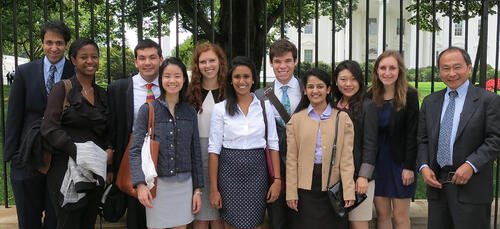
Stanford’s Center on Democracy, Development, and the Rule of Law (CDDRL) is pleased to introduce the incoming 2014-15 class of pre and post-doctoral fellows. Selected from over 100 applicants, these six scholars will spend the academic year in residence at CDDRL to advance their research, work closely with faculty and connect to an innovative and multidisciplinary learning community.
 
Hailing from Harvard, U.C. Berkeley, Yale and Stanford the fellows bring diverse backgrounds and expertise to enrich the ranks at CDDRL - researching topics such as the economics of crime in Mexico and authoritarianism in Africa and the Middle East. Many of them will be actively working with CDDRL’s core research programs on a range of research initiatives that intersect with their own work. 
 
Since its launch in 2004, the fellowship program has welcomed over fifty pre and post-doctoral fellows from leading universities who are selected for their policy-relevant research that contributes to new knowledge in the field of democratic development.
 
You can read more about the fellows, their research and some fun facts below. 

Brett Carter

Hometown: Virginia Beach, Virginia

Academic Institution: Harvard University

Discipline and date of graduation: Ph.D. in Government, Summer 2014

Research Interests: Politics and economics in non-democracies, political economy of development, political violence, food security

Manuscript working title: Political Survival and the Modern Prince

What attracted you to the CDDRL Pre/post-doctoral program? The opportunity to be surrounded by other scholars with similar substantive interests but diverse geographic expertise is extremely exciting to me. I think it's precisely what I need at the moment.

What do you hope to accomplish during your year-long residency at the Center? I will spend most of the year preparing the book manuscript for submission. The dissertation asked how modern African autocrats survive nominally democratic institutions. To focus on the elites who comprise the regime -- as well as their political parties and the elections in which they compete -- the dissertation focused exclusively on the Republic of Congo, ruled by President Denis Sassou Nguesso for all but five years since 1979. I expect to spend much of the year ascertaining to what extent the arguments are generalizable to other parts of autocratic Africa and beyond.

Please state a fun fact about yourself! I really enjoy cooking. A lot. I've cooked through most of The French Laundry Cookbook and am now cooking through the Eleven Madison Park Cookbook. Honestly, I spend way too much time cooking. It's sort of absurd.


Julia Choucair-Vizoso

Hometown: Beirut, Lebanon

Academic Institution: Yale University

Discipline and expected date of graduation: Ph.D. in Political Science, expected May 2015

Research Interests: Authoritarianism; Elite Networks; Coalitional Politics; Social Exclusion; Middle East Politics

Dissertation Topic/Title: The Ties that Bind: Making and Breaking Authoritarian Ruling Coalitions

What attracted you to the CDDRL Pre/post-doctoral program? My research fits well with CDDRL’s substantive focus on democratization. Opening the black box of authoritarian coalitional formation and evolution is essential for understanding how ruling coalitions may come apart. I am also eager to collaborate with scholars in The Program on Arab Reform and Democracy, especially at a time when the Arab uprisings and coalitional breakdowns have unfortunately moved towards reconfigured authoritarian arrangements.

What do you hope to accomplish during your year-long residency at the Center? As a fellow at CDDRL, I plan to complete my dissertation and begin revising it for publication. I also plan to produce an article on the methodological and ethical challenges of conducting archival research and elite interviews in authoritarian settings.

Please state a fun fact about yourself! I’m a catless cat lady.


Melissa Lee

Hometown: Thousand Oaks, CA

Academic Institution: Stanford University

Discipline and expected date of graduation: Ph.D. in Political Science, expected June 2015

Research Interests: statebuilding, state weakness, international security, conflict, political development

Dissertation Topic/Title: The International Sources of Sovereignty and State Weakness

What attracted you to the CDDRL Pre/post-doctoral program? My research is broadly focused on the understanding the causes of incomplete governance and political underdevelopment. These are among the core themes in CDDRL's research programs, and CDDRL brings together both rigorous scholarship and a sensitive to policy-relevant research in these thematic areas. For that reason, I am excited about joining CDDRL's community of researchers, particularly those engaged in scholarship in the Governance Project and in the Program on Poverty and Governance. I look forward to productive conversations around the Center, and to helpful guidance and advice.

What do you hope to accomplish during your year-long residency at the Center? During my residency at CDDRL, I plan to complete my dissertation writing. I am also eager to begin a new project with another CDDRL pre-doctoral fellow in which we examine the relationship between statebuilding and democracy in developing countries.

Please state a fun fact about yourself! I make an excellent cheesecake!


Ken Opalo

Hometown: Nairobi, Kenya

Academic Institution: Stanford University 

Discipline and expected date of graduation: PhD in Political Science, expected June 2015

Research Interests: Institutions, Legislative Studies, Political Economy of Development, Elections and Governance, Natural Resource Management and Regional Cooperation

Dissertation Topic/Title: Institutions and Political Change: The Case of African Legislatures

What attracted you to the CDDRL Pre/post-doctoral program? I was attracted to CDDRL because of the centers strong emphasis on the need to link academic research with policy. I am interested in the ways in which institutional change impact development outcomes through the evolution of better, accountable governance and public policies. My research on legislatures includes analyses of how levels legislative institutionalization impact public finance management in African states.

What do you hope to accomplish during your year-long residency at the Center? I hope to finish writing my dissertation, to publish at least two chapters of the dissertation as stand alone papers, and to continue contributing to the policy world through my writing and consultancies.

Please state a fun fact about yourself! I run half marathons. Because I am Kenyan.


Gustavo Robles

Hometown: Guadalajara, Mexico

Academic Institution: Stanford University

Discipline and expected date of graduation: PhD in Political Science, expected 2015 

Research Interests: Economics of Crime and Violence, Legislative Studies, Political Economy of Development.

Dissertation Topic/Title: Three Essays on the Political Economy Drug-Related Violence in Mexico

What attracted you to the CDDRL Pre/post-doctoral program? CDDRL is a great place for students doing comparative work since it has a unique and vibrant community of faculty, visiting scholars, and policy makers from all over the world, including an important number of specialists in Latin American politics.

Moreover, the Center’s research agenda substantially aligns with my work on the relationship between democracy, partisanship, and governments’ efforts to contain and reduce crime and violence.

Finally, the work of the Program on Poverty and Governance at CDDRL on criminal violence and citizen security throughout Latin America has significantly shaped my PhD dissertation and research agenda.

What do you hope to accomplish during your year-long residency at the Center? I would like to complete the part of my dissertation that explores the relationship between Mexico’s democratization, criminal violence, and the government’s enforcement of the rule of law. In addition, the pre-doctoral fellowship will facilitate the completion of different ongoing research projects I am involved with at the Center. 

Please state a fun fact about yourself! I’m a good salsa dancer, jigsaw puzzle enthusiast, and amateur beach volleyball player.


Suzanne E. Scoggins

Hometown: Bremen, GA

Academic Institution: University of California, Berkeley

Discipline and expected date of graduation: Ph.D. in Political Science, expected May 2015

Research Interests: Comparative Politics, Policing, Governance, Rule of Law, and Chinese Politics 

Dissertation Topic/Title: Policing China: Struggles of Law, Order, and Organization for Ground-Level Officers

What attracted you to the CDDRL Pre/post-doctoral program? CDDRL's mission to understand how the rule of law and government institutions operate speaks directly to my work on the police bureaucracy. The Center's multidisciplinary approach brings together.scholars and intellectuals, making it an excellent forum for grappling with issues of institutional reform and local state security. As one of the newest additions to CDDRL, I look forward to engaging this community as I continue to investigate the weaknesses and strengths of the institutional apparatus China employs to carry out state priorities of reform and control.  

What do you hope to accomplish during your year-long residency at the Center? While at CDDRL I will finish my dissertation and prepare two chapters for publication. I also plan to lay the groundwork for my next project on the rapidly evolving relationship between police and media.  

Please state a fun fact about yourself! I'm a terrible gardener.


Hero Image
27 small encina hall
All News button
1
-

ABSTRACT


How can and how should we govern a global resource like the online space? How can stakeholders (governments, businesses and civil society) participate on equal footing and “in their respective roles”? And how can democratic values inform all governance practices, when the constituency is potentially everybody, most decisions are highly complex and interdependent and when the shared resource is a conglomerate of private and public assets? These are the questions scholars and practitioners in the internet governance field explore and experiment with since the UN World Summit of the Information Society in 2003 brought internet governance to the attention of diplomates and governments around the world. In this seminar Max Senges will review the historic development of internet governance as well as discuss current challenges and opportunities in building an effective governance ecosystem for the transnational digital space.


SPEAKER BIO

Image
innovationconvention maxsenges
Max Senges (1978) works as Program Manager for Google Research and Education, where he leads an Internet of Things program and is also managing the Faculty Research Awards in the Policy & Standards field under Vint Cerf. He participates in the internet governance sphere since the first WSIS 2003 and bootstrapped the IGF Dynamic Coalition on Internet Rights and Principles between 2008 and 2010.

More recently he has published “Internet Governance as our shared responsibility” and “Ensuring that Forum Follows Function” in “The Roadmap for Institutional Improvements to the Global Internet Governance Ecosystem” jointly with Vint Cerf, Patrick Ryan and Rick Whitt.

Senges holds a PhD in philosophy from the Information and Knowledge Society Program at the Universitat Oberta de Catalunya (UOC) in Barcelona as well as a Masters in Business Information Systems from the University of Applied Sciences Wildau (Berlin).

Wallenberg Theater

Bldg 160, Room 124

Max Senges Program Manager, Research, Google
Seminars
-

ABSTRACT
My presentation will focus on how community-focused nonprofit newsrooms and data providers are reinventing the business model of journalism while focusing on the communities we serve.

SPEAKER BIO
Kevin Davis is CEO and Executive Director of the Investigative News Network (INN), a growing consortium of more than 80 nonprofit newsrooms producing nonpartisan investigative and public interest journalism. Davis oversees INN’s efforts to promote the sustainability of its member organizations, and increase the impact of their reporting through collaboration.

As a former digital publisher, Davis has more than 16 years of experience in strategic development and growth at news and media organizations. He was responsible for operations at Los Angeles-based news organizations Variety.com and TheWrap.com.

Since his appointment to INN, Davis has spoken and lectured about the nonprofit, investigative journalism sector at conferences and institutions across the United States, including the Online News Association, Investigative Reporters & Editors, the National Alliance for Media Arts + Culture, the National Federation of Community Broadcasters, USC Annenberg, Syracuse University, Ohio State University and the University of Colorado, Boulder, where he was the 2011 Hearst Professional-in-Residence.

Kevin Davis Investigative News Network
Seminars
-

ABSTRACT
The result of not preparing people and places to manipulate the productive function of network technology is ‘digital destitution’. As the ability to access the Internet becomes more crucial in daily life, those Americans who are not prepared to function with this technology are excluded and do find themselves in a state of disconnection from the vital economic, social, political, cultural and institutional processes that depend on broadband technology. In this presentation, Dr. Blanca Gordo will outline and ground her theoretical conceptual framework for understanding the impact of being offline.

SPEAKER BIO
Blanca Gordo, Ph.D., is a visiting scholar at the Institute for the Study of Societal Issues at the University of California at Berkeley where she is writing her book, Digital Destitution in the Digital Age. Most recently, she was the Academic Coordinator for the Center for Latino Policy Research at the University of California at Berkeley, where she directed public policy initiatives, program development, and the Technology and Development Research Group. Dr. Gordo holds a doctorate in City and Regional Planning from the University of California, Berkeley. She specializes in regional-local economic development, urban poverty, local technology development processes, organizational analysis and development, public policy, ethnic populations (African Americans and Latinos), demographics, and social inequality structures

Blanca Gordo International Computer Science Institute, UC Berkeley
Seminars
-

ABSTRACT

Collective intelligence is channeled to journalism by crowdsourcing and co-creation. While the crowd contributes to the journalistic process with its knowledge, the crowd also challenges journalistic norms and ideals. In her talk, Dr. Aitamurto shows how collective intelligence impacts knowledge search in journalism, alters power structures in society, and functions as a basis for value creation.

SPEAKER BIO

Dr. Tanja Aitamurto is a Brown Fellow and the Deputy Director at the Brown Institute for Media Innovation at the School of Engineering at Stanford, as well as a Liberation Technology alumna. Her research focuses on the applications of collective intelligence in journalism, governance, and new product design in media innovations. She is the author of the book "Crowdsourcing for Democracy: New Era in Policy-Making", and she has published in New Media & Society, Digital Journalism and Design Issues.

Encina Hall
616 Serra Street
Stanford, CA 94305-6055

0
Visiting Researcher
Aitamurto_HS1.jpg

Tanja Aitamurto was a visiting researcher at the Program on Liberation Technology at the Center on Democracy, Development and the Rule of Law at Stanford University. In her PhD project she examined how collective intelligence, whether harvested by crowdsourcing, co-creation or open innovation, impacts incumbent processes in journalism, public policy making and design process. Her work has been published in several academic publications, such as the New Media and Society. Related to her studies, she advises the Government and the Parliament of Finland about Open Government principles, for example about how open data and crowdsourcing can serve democratic processes. Aitamurto now works as a postdoctoral fellow at the Brown Institute for Media Innovation at Stanford.

Aitamurto has previously studied at the Center for Design Research and at the Innovation Journalism Program at Stanford University. She is a PhD Student at the Center for Journalism, Media and Communication Research at Tampere University in Finland, and she holds a Master’s Degree in Public Policy, and a Master of Arts in Humanities. Prior to returning to academia, she made a career in journalism in Finland specializing in foreign affairs, reporting in countries such as Afghanistan, Angola and Uganda. She has also taught journalism at the University of Zambia, in Lusaka, and worked at the Namibia Press Agency, Windhoek.

She also actively participates in the developments she is studying; she crowdfunded a reporting and research trip to Egypt in 2011 to investigate crowdsourcing in public deliberation. She also practices social entrepreneurship in the Virtual SafeBox (http://designinglibtech.tumblr.com/), a project, which sprang from Designing Liberation Technologies class at Stanford. Tanja blogs on the Huffington Post and writes about her research at PBS MediaShift. More about Tanja’s work at www.tanjaaitamurto.com and on Twitter @tanjaaita.


Publications:

Seminars
-

SPEAKER BIO
Andy Carvin was National Public Radio's senior product manager for online communities. He accepted a position at First Look Media in February, 2014. Carvin was the founding editor and former coordinator of the Digital Divide Network, an online community of more than 10,000 Internet activists in over 140 countries working to bridge the digital divide . He is also an active blogger as well as a field correspondent to the vlog Rocketboom.

Andy Carvin First Look
Seminars
-

Abstract:

Development organizations need tools capable of providing reliable and timely feedback on the efficacy of humanitarian interventions. Traditional surveys and surveying methodology lack interactivity as participants only provide data and may never see the survey results. In her talk, Brandie will describe an interactive assessment platform called CAFE, the Collaborative Assessment and Feedback Engine. CAFÉ was utilized to assess the performance of three Nutrition Education Centers in Uganda. The platform collected the opinions of 137 women who visited these centers for family planning training. We applied principal component analysis on the quantitative assessment questions. We learned that the top two factors that differentiated participants’ assessment of the effectiveness of the family planning trainings were: degree of female’s autonomy at home and degree of fear about contraception techniques. We applied a significance testing methodology to these factors and discovered the promising result that attending family planning trainings was correlated to reduced fears. 


Speaker Bio:

brandie nonnecke Brandie Nonnecke

Dr. Brandie Nonnecke is the Research & Development Manager of the CITRIS Data and Democracy Initiative at the University of California, Berkeley. Her research focuses on how information and communication technologies can be used as tools to support civic participation, to improve governance and accountability, and to foster economic and social development. She has published articles in Telecommunications Policy, Telematics & Informatics, Communications & Strategies, and Information Technologies & International Development.

Brandie has an M.S. in Journalism and Mass Communication from Iowa State University and a Ph.D. in Mass Communications from The Pennsylvania State University.


Wallenberg Hall

Brandie M. Nonnecke, PhD Research and Development Manager, Data and Democracy Initiative, CITRIS, UC Berkeley UC Berkeley
Seminars
News Type
News
Date
Paragraphs

CDDRL Senior Fellow Francis Fukuyama's new book "Political Order and Political Decay" was featured in a recent review in The New York Times. Tracing history from the industrial revolution to the globalization of democracy, Fukuyama argues that liberal democracy is still the best system of governance, although he warns that such systems must manage and combat institutional decay. The book will be released on September 30, 2014.

Hero Image
fukuyamatbilisi
Francis Fukuyama addresses a crowd during a conference in Tbilisi, Georgia. 1 Sept. 2014.
Government of Georgia
All News button
1
News Type
News
Date
Paragraphs

Olivier Nomellini Senior Fellow Francis Fukuyama shares a glimpse of his forthcoming volume of The Origins of Political Order in a recent journal article for Foreign Affairs. Referencing various historical accounts of public administration pitfalls and triumphs, Fukuyama dissects the intricate web of political gridlock confronting American government today. 

Hero Image
obama health care speech to joint session of congress
President Obama addresses Congress on September 9, 2009.
Lawrence Jackson; www.whitehouse.gov
All News button
1
Subscribe to The Americas