
Identifying With Versus Being Attached to a Place
Identifying With Versus Being Attached to a Place
CDDRL Research-in-Brief [4-minute read]

Introduction and Contribution
One cannot today talk about important political phenomena such as democratic backsliding. Indeed, political leaders and parties in both democracies and autocracies increasingly appeal to differences between places, especially the divide between urban and rural communities, to mobilize voters. Narratives that blame urbanites for the social and economic problems facing rural communities have become an important tool for justifying anti-democratic measures and polarizing electorates. At the same time, voters in many urban places feel increasingly resentful toward rural residents, arguing that these residents exert too much political control over their lives. Apart from these broader developments, however, much remains unknown about how places shape and are shaped by politics.
In “Place Attachments,” Elizabeth Mitchell Elder and Hans Lueders argue that social scientists have failed to make an important distinction between being attached to a place and identifying with groups that live in a place. Place attachments provide a sense of continuity and stability in one’s life. By contrast, place identities are tied to various “reference groups” that share attributes and values and provide members with a sense of self-esteem. This distinction matters: individuals can be attached to a specific place, such as rural Appalachia or New York City, while not identifying with rural or urban places or the people who inhabit them. The former — what the authors call “place attachment” — brings about a deep investment in one’s local community and strong local political engagement. The latter — what the authors call “place identity” — may bring about the same amount of local political engagement, but can also come with animosity toward individuals residing in other places or types of places — animosity that can be exploited by political leaders.
To understand the consequences of place attachments, Elder and Lueders conduct original surveys of voters in Germany, the United States, and the Appalachian region of the United States. Survey respondents with a strong sense of belonging and commitment to their place are more trusting of local governments, more engaged with local politics, and tend to prefer local candidates. “Place Attachments” makes an important contribution by conceptualizing and measuring a phenomenon that has often been conflated with identity and that shapes political behavior in consequential ways.
The Importance of American and German Place-Based Attachments
Elder and Lueders leverage original surveys of voters in the United States and Germany because they differ considerably in terms of mobility and the role that place and geographic identity have played in each country’s history. An additional survey run among residents of Appalachia draws attention to a region where place attachments are strong despite the region’s poor socioeconomic outcomes; many residents remain strongly attached to it.
The authors operationalize place attachments in terms of respondents’ agreement with five statements about their current place of residence: that they feel like they belong there, that it is an important part of who they are, that they feel at home there, that it reminds them of their past, and that they would like to remain there for the rest of their lives. Respondents varied significantly in terms of the strength of their place attachments: about 25% agreed with all five statements, 15% disagreed with all five, and the remainder were evenly distributed across the other combinations (e.g., agreeing with two, agreeing with three). However, distributions were similar across all three geographic samples.
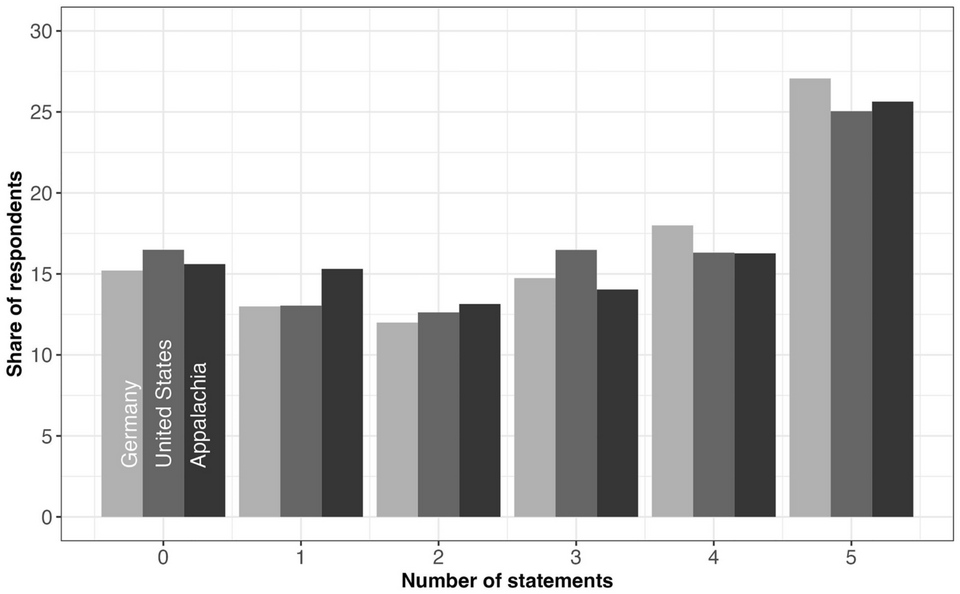
Fig. 1: Distribution of strength of local attachments in all three samples: share of respondents who agree somewhat or strongly with the number of statements reported on the horizontal axis.
Two main demographic correlates of place attachments are found to be of importance: older people and those who have resided for longer in a place have stronger attachments. In terms of politics, Germans who support the Social Democratic Party and the center-right Christian Democratic Union have stronger place attachments than do supporters of the far-right Alternative for Germany. In the United States, by contrast, the strength of one’s partisan identity matters more than party affiliation: Democrats and Republicans both score higher, especially as they identify more strongly with either party, than Independents.
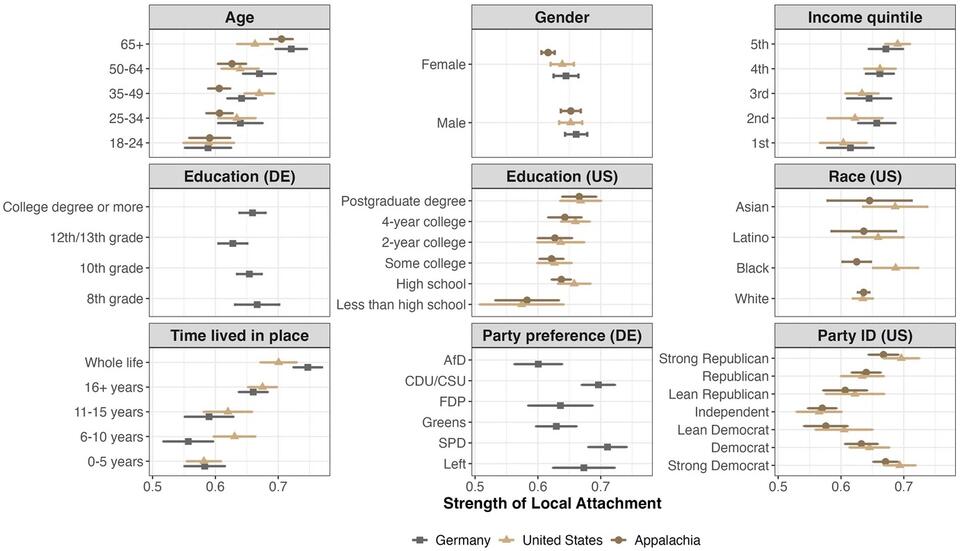
Fig. 2: Demographic correlates of local attachments. Estimated strength of local attachments by select demographic groups.
Local attachments are weakly related to measures of a place’s “objective” quality, such as life expectancy or unemployment rates, and they also vary little across urbanites and ruralites. The latter is surprising given the common assumption that rural residents have especially strong attachments to place. When asked to describe what they like most about a place, respondents rarely mentioned their co-residents’ physical attributes or values. This provides evidence for the authors’ claim that place attachments are conceptually distinct from place identities.
The authors then analyze how place attachments relate to political behavior. They find that respondents with stronger place attachments are relatively more engaged in their local communities: they are more trusting of their local governments, spend more time reading and talking about local politics, and are more likely to believe that they can influence political outcomes in their local communities. Individuals with strong local attachments are also more likely to participate in local elections or local voluntary organizations.
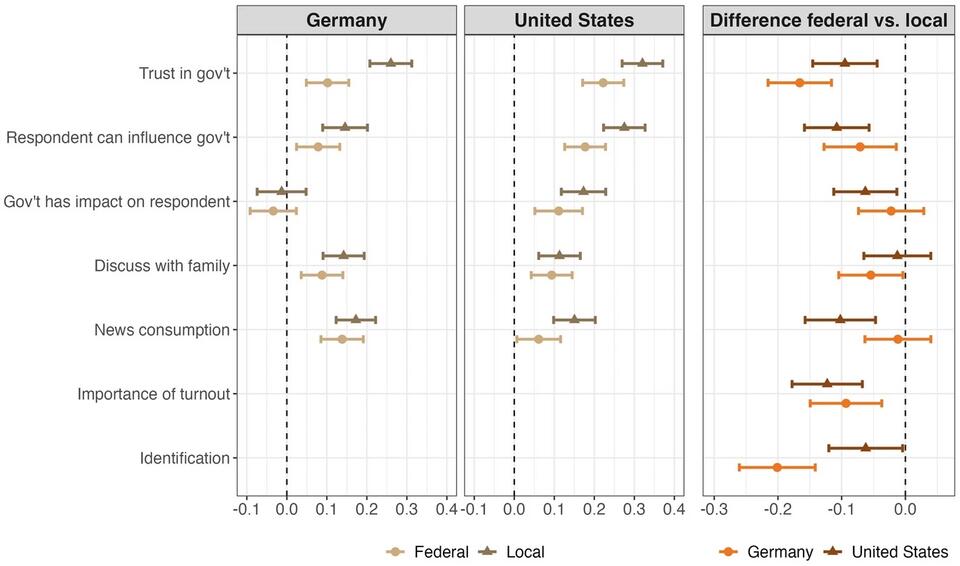
Fig. 5: Correlations between local attachments and engagement in national and local politics. Left and center panels: estimated relationship between local attachments and various measures of political engagement at the national and local levels. Right panel: estimated relationship between local attachments and the difference in national vs. local engagement (negative values here mean relatively more local than national engagement).
Finally, respondents participated in a “forced-choice conjoint experiment,” which involved choosing between pairs of hypothetical candidates. Candidate profiles included their position on the importance of local autonomy, their experience in local politics, and length of residence in the community. Respondents with higher place attachments were significantly more likely to choose hypothetical candidates with stronger local orientations or connections — that is, candidates who supported autonomy, had local experience, and had lived in the community. Place attachments thus seem to shape not only how individuals perceive their communities but the criteria they use to evaluate politicians.
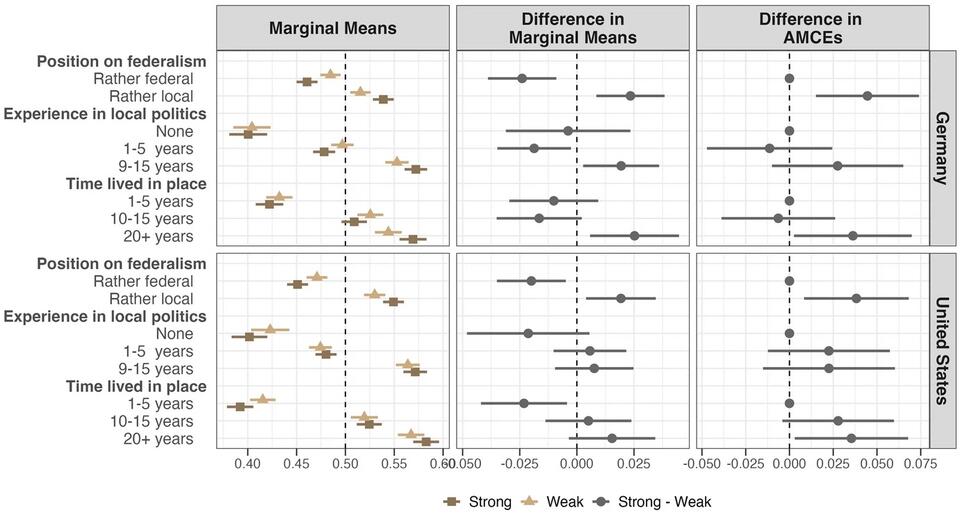
Fig. 6: Local considerations have a stronger effect on candidate choice among voters with strong local attachments. Left panel: propensity that a candidate with the attribute on the y axis is selected (marginal means), estimated separately for voters with strong and weak local attachments. Center panel: difference in marginal means between voters with strong and weak local attachments. Right panel: differences in average marginal component effects (AMCEs) between respondents with strong and weak local attachments for a particular attribute level compared to the baseline. See Figure A4 in appendix B.3 full results. See Figure A5 in appendix B.4 for AMCEs.
*Brief prepared by Adam Fefer.