
When Does Infrastructure Investment Pay Off?
When Does Infrastructure Investment Pay Off?
CDDRL Research-in-Brief [3.5-minute read]

Introduction and Contribution
Economies depend on infrastructure: roads enable the movement of goods and workers, electricity powers businesses and factories, and communications technologies allow for the exchange of information and services. Yet in our connected world, roughly 1 billion people live more than two kilometers from an all-season road, and approximately 1.2 billion have no access to electricity.1
For decades, institutions such as the World Bank and McKinsey Global Institute have promoted the idea that closing a trillion-dollar gap between planned global infrastructure investment and the estimated level of investment needed to drive growth will alleviate poverty, harness the potential of developing nations to increase global GDP, and enrich foreign investors. But despite the fact that unrealized gains from greater infrastructure investment in emerging market and developing economies (EMDEs) outstrip those in the rich world, comparatively little capital flows into the infrastructure of poor countries.
In “The Global Infrastructure Gap: Potential, Perils, and a Framework for Distinction,” Camille Gardner and Peter Blair Henry reject the received narrative that flooding poor countries with capital simply to reach a target level of infrastructure investment will yield the desired gains. Instead, they urge investors and policymakers to move from thinking about infrastructure “gaps” to prioritizing infrastructure returns. Specifically, they propose the first “dual hurdle” framework. The framework uses cross-country differences in returns to identify efficiency in cross-country investments, incorporating the incentives that suppliers and allocators of capital must have to finance productive projects.
Applying the framework to historical data, Gardner and Henry debunk the notion that poor countries offer ubiquitous opportunities for productive investment. Only 13 percent of countries in the data set cleared the dual-hurdle tests of efficiency for projects in both roads and electricity. But for countries that did clear the hurdles, the return on infrastructure was large: more than 10 times greater in some cases than the return on rich-country private capital.
This underscores the need for updated and more accessible data to drive decisions and prioritize projects. Differences across countries, sectors (e.g., roads vs. electricity), and locations (urban vs. rural) must be taken seriously to avoid a wasteful allocation of global infrastructure capital.
Gardner and Henry expand our understanding of when cross-country infrastructure investments are efficient and why poor countries have struggled to catch up. And as labor forces in poor countries grow rapidly, the problems associated with infrastructure scarcity are likely to become more acute, increasing migration pressures. Effective investment can mitigate risks while generating mutual gains for poor and rich countries alike.
When Infrastructure Investment Pays Off
The authors’ dual hurdle framework reveals that public infrastructure investment in a poor country is efficient only if it yields higher returns than the social rate of return on private capital (a) within the country and (b) in rich countries. Countries that clear both hurdles are deemed strong candidates for more investment.
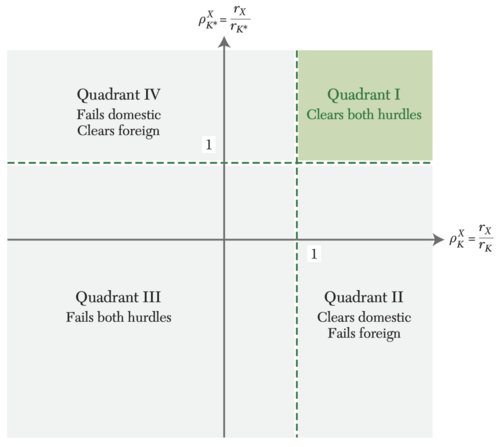
Figure 4. The Dual-Hurdle Framework
Note: For a given poor country and type of infrastructure, the dual-hurdle framework sorts each country-infrastructure observation into one of four quadrants according to whether it clears the hurdle for efficient: (a) domestic investment, and (b) foreign investment.
Gardner and Henry apply their framework to 53 countries that belong to the only known data set of comprehensive cross-country estimates of the social rates of return on infrastructure (roads and electricity) in poor countries, found in a paper commissioned by the World Bank that is based on data from 1985.2 In their analysis, Gardner and Henry show that while some countries have opportunities for high returns (especially for paved roads), many others do not. In very few countries can the case be made for investing across multiple kinds of infrastructure (only 7 of 53 countries cleared the dual hurdles for both roads and electricity), and for some countries there is no case to be made.
To be clear, infrastructure investment is not generally inefficient. Indeed, worthwhile projects to increase or upgrade infrastructure in poor countries can yield much higher gains than are available from private investment in both poor and rich countries. This is because infrastructure improvements raise productivity across the economy. The problem is that these high-return opportunities are difficult to identify, especially without updated, readily accessible, quality data.
Different types of infrastructure also vary in their impact depending on the context. For example, investments in electricity often yield low returns in rural settings but high returns in urban settings (where firms are concentrated and struggle due to unreliable power). By contrast, roads more often yield higher returns because they support market activity overall. Finally, the authors show that efficient infrastructure also depends on the interaction of private capital, human capital, and good institutions. This underscores the limitations of simply building more infrastructure in isolation.
Challenges to Infrastructure Investment
Gardner and Henry document extensive variation in efficiency when comparing private versus public capital allocation (in roads and electricity) across rich and poor countries. The social rates of return on public capital vary much more than with private capital, which is the case in both rich and poor countries, and inefficiencies in public capital allocation are greater in poor countries than in rich ones. This variation is driven not just by economic factors but also by political and institutional constraints.
The concept of “frozen capital” helpfully describes the outcome of problems facing prospective investors. For one, because infrastructure requires complementarities (e.g., electrifying an area requires the preexistence of reliable roads), individual projects may be unprofitable unless others are simultaneously financed and coordinated.
Additionally, foreign investors may distrust the governments of the countries where they invest, or they may be wary of the quality of domestic firms tasked with completing a given project. This will certainly be true where transparency and accountability are lacking. Especially in poor autocracies or semi-democracies, governments may arbitrarily change the law, fail to honor contracts, or face political and social instability, leaving investors uncertain about the prospect of repayment and return on their investments.
Ultimately, infrastructure investment offers great promise, but it must be evidence-based and approached with caution. The challenge is not to simply raise the level of investment but, as “The Global Infrastructure Gap” shows, to use cross-country differences in returns to identify the right infrastructure projects, in the right places, to maximize the efficiency of cross-country capital allocation.
*Brief prepared by Adam Fefer.
References:
1. Canning, David, and Esra Bennathan. 2000. “The Social Rate of Return on Infrastructure Investment.” World Bank Policy Research Working Paper 2390.
2. Rozenberg, Julie, and Marianne Fay, eds. 2019. Beyond the Gap: How Countries Can Afford the Infrastructure They Need While Protecting the Planet. Washington, DC: World Bank.