
Cheating on Taxes and Donating to NGOs in Slovakia
Cheating on Taxes and Donating to NGOs in Slovakia
CDDRL Research-in-Brief [4-minute read]

Introduction and Contribution:
Tax noncompliance — the withholding or underreporting of revenue from goods, services, and assets — may constitute as much as 30% of global GDP. Most people have no illusions about noncompliance: large majorities of Europeans believe that many or even most of their co-nationals cheat or “shirk” on paying taxes. Yet shirking deprives the state of crucial resources that fund the provision of public services, such as policing, education, or healthcare.
From a purely self-interested standpoint, tax cheating by some may well lead others to do the same, a cycle that can lead to the collapse of service provision. In “Filling the tax gap,” however, Simone Paci argues that this inference may be premature. It is true that individuals and businesses may not contribute to state provision efforts when others do not, yet this is not the only kind of provision. Instead, those who perceive tax cheating as prevalent can turn to nongovernmental organizations (NGOs) to fill the gap. These include religious organizations, human rights organizations, sports clubs, and many more.
Paci argues that those who donate to NGOs in the face of prevalent noncompliance can satisfy a range of interests. On the one hand, they may directly and materially benefit from donating, such as when police are more adequately funded, and security improves. On the other hand, donations can yield more indirect and symbolic benefits, such as when individuals see themselves as altruistic or bolster their status as community members.
Marshalling a wide array of evidence, Paci shows that Slovaks exposed to information about tax cheating were more likely to donate to NGOs than those not exposed. This includes a natural experiment comparing Slovak municipalities in which the names of tax cheaters were released at different times, as well as a survey experiment in which online respondents receive similar information and donate accordingly.
The silver lining of these findings is that tax evasion needn’t spell the death of service provision. Paci challenges a key assumption in standard accounts of economic rationality, namely that free-riding begets free-riding. This may be true if we restrict our focus to the state, but not if we broaden it to all those entities that provide community services.
The Slovakia Experiments:
Paci collects data from Slovakia, a country where “name-and-shame” laws publicize information about taxpayers and businesses that have cheated on their value-added tax (VAT) obligations. In 2012 alone, Slovakia may have lost 40% of its VAT revenue due to tax noncompliance. Another significant aspect of Slovakia’s tax system is that individuals and firms can donate up to 2% of their income tax to local NGOs. In turn, the latter publishes data about their donation drives. Slovakia’s name-and-shame programs seem to have served some of their intended goals, as the noncompliance lists are well-known among Paci’s survey participants.
For experimental purposes, there are two important sources of variation as regards the name-and-shame data. First, it is not published in all municipalities. Second, some municipalities that do publish the data do so before the donation deadline. As Paci theorizes the connection between disclosures and donations, the natural experiment thus compares “treated” municipalities with “control” municipalities, whose disclosures were released after the deadline. The experiment’s validity depends on the assumption that name-and-shame data are released at random times, or rather by “nature.” This seems plausible in Slovakia.
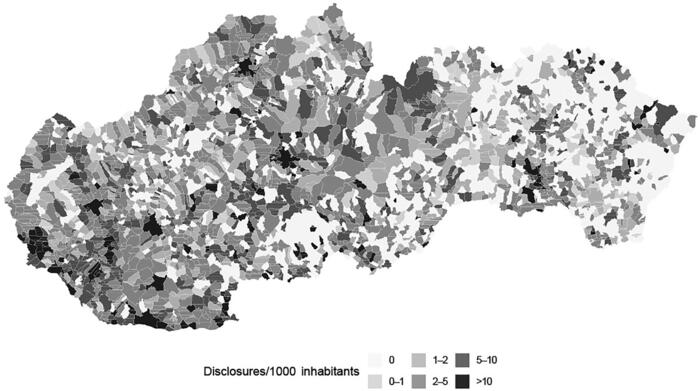
FIGURE 1: Noncompliance disclosures across Slovakian municipalities. Notes: The map visualizes the total number of unique firms involved in VAT noncompliance disclosures per 1,000 inhabitants between 2009 and 2021 for all Slovak municipalities, using the 2009 population.
The natural experiment supports Paci’s argument, as municipalities where disclosures are made prior to the donation deadline are 16% more likely to donate. This is not a small effect, corresponding to a difference of about 20,000 Euros. To reiterate, the intuition here is that pre-deadline disclosures provide critical information to taxpayers about how underfunded state-provided public services will be (due to noncompliance); this, in turn, motivates them to donate to nonstate providers.
Paci then fielded a survey experiment among over 2000 Slovakians online. This presented treated respondents with written “vignettes” that replicate the real-life disclosure lists. By contrast, control group respondents simply received an ordinary list of taxpayers. Afterwards, some respondents played a “dictator game” in which they could choose whether to donate Euros to NGOs.
The results of these surveys provide additional evidence for Paci’s argument, as respondents exposed to information about noncompliance donated 10% more to NGOs than the control group. In terms of the motives underlying donations, Paci finds evidence for the importance of altruism and reputation. Regarding the former, those who believed their municipality was critically dependent on public services were more likely to donate. Reputation motives were important because survey respondents were less likely to donate if their contributions were kept anonymous.
Finally, Paci presents evidence from Europe-wide value surveys conducted in 1999. These interviewed over 40,000 people from 33 countries. Consistent with the Slovakia-specific evidence, there is a strong correlation between respondents’ beliefs about perceived tax cheating and their propensity to volunteer for local NGOs.
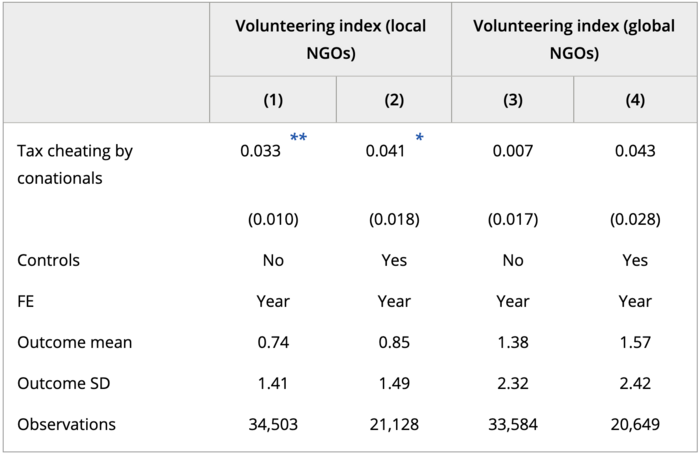
TABLE 7: Perceptions of tax cheating and volunteering. Note: †p < .10; *p < .05; **p < .01.
In all, Paci’s findings caution against drawing simplistic and pessimistic conclusions about free-riding and taxation. Yet readers may wonder how much of a difference name-and-shame policies could really make. On one level, few countries have passed such laws, and few politicians will likely see name-and-shame legislation as a vehicle for advancing their careers. On another level, it is not clear that nonstate service provision can even come close to compensating for just how much the welfare state has retrenched across the Western democratic world. Voluntary donations, whether motivated by self- or other-centered concerns, simply cannot sustain the widening gaps in modern healthcare or mass education systems.
*Brief prepared by Adam Fefer.