
Simulating Gossip as a Means of Conveying Information and Boosting Cooperation
Simulating Gossip as a Means of Conveying Information and Boosting Cooperation
CDDRL Research-in-Brief [4-minute read]

Introduction and Contribution:
Gossip — sharing information, both positive and negative, about absent third parties — plays a major role in social life. Two friends spread a rumor about their neighbor’s infidelity, an employee’s hard work is praised at a manager's meeting, and so on.
From an evolutionary standpoint, however, the origins and proliferation of gossip are somewhat puzzling. Not only is it costly — acquiring personal information, sharing it with others, perhaps risking ostracism for being a yenta — but the evolutionary benefits are not clear. Indeed, gossiping may be entertaining, but it seems like a stretch to think it could improve human adaptation, let alone survival.
In “Explaining the evolution of gossip,” Xinyue Pan, Vincent Hsiao, Dana S. Naub, and Michele J. Gelfand conduct a series of computer simulations to model the gossiping process and shed light on the benefits it generates for both society and gossipers. The authors posit two such benefits that help explain its evolution: First, gossip spreads information about others’ reputations, helping people identify those who will (not) cooperate with them. Second, gossip reduces selfishness, as those who otherwise would not cooperate will choose to do so with gossipers in order to manage their reputations. These are called the “reputation dissemination” and “selfishness deterrence” functions, respectively.
Readers come away with a sense of the power of agent-based modeling to solidify our intuitions about complex social processes. Indeed, gossip involves dynamics of communication, cooperation, geographical proximity, as well as both personal and collective gain. Models help simplify these dynamics. In addition, the authors illustrate how an ostensibly non-strategic activity has very important strategic dynamics and implications.
The Simulation Setup:
Agents in the simulation develop a strategy based on two decisions: whether or not to gossip and how exactly to cooperate with other agents. The former is a binary choice, whereas the latter permits six choices. Of these six, three are especially important: The “exploitive” agent is one who only chooses to cooperate if they believe their partner cannot easily be taken advantage of in the game. In other words, exploiters condition their choice on the other agent’s reputation. Next, the “virtuous” agent cooperates if it believes the other agent will and otherwise defects. Finally, the “opportunist” agent will only cooperate with gossipers and never with non-gossipers.
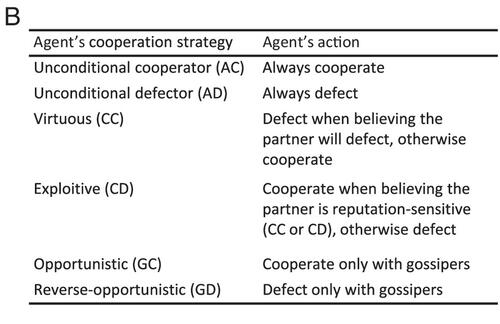
Figure 2b. Plot (B) illustrates an agent’s action as a function of their own strategy and their belief about the interaction partner’s strategy.
The other three cooperation strategies are as follows: “unconditional defectors” and “unconditional cooperators” are, as the names imply, insensitive to information about others’ reputations. Meanwhile, “reverse opportunists” only cooperate with non-gossipers and never with gossipers. Perhaps unsurprisingly, the authors will show that agents tend to discard these three strategies over time. If gossip is, in fact, beneficial from an evolutionary standpoint, then both cooperative and gossiping strategies must increase over time.
To model the gossiping process requires that agents respond to new information and update their strategies accordingly. This will help them maximize their success and avoid being exploited by others. Information can thus be obtained in two ways: either agents observe each other’s behavior during the game and use it to infer their strategy, or information is disseminated to them via gossip.
The simulation proceeds in three steps. First, agents play a “cooperation game,” whereby each player simultaneously decides whether to cooperate or defect. (The rules are as follows for two agents, A and B: A incurs a cost of 1 for cooperating while B’s benefit is 3, and vice versa. A thus gains by cooperating, but is tempted to defect to gain 3 while B pays a cost of 1, and vice-versa.) The second step involves the dissemination of gossip. Finally, strategies are updated based on the first and second steps.
Simulation Results:
The authors show that over time, the vast majority of agents (90%) choose to gossip and to cooperate (78%). The three most common cooperation strategies are “exploitive” (57%), “opportunistic” (18%), and “virtuous.” By contrast, none of the other three cooperation strategies is chosen more than 5% of the time.
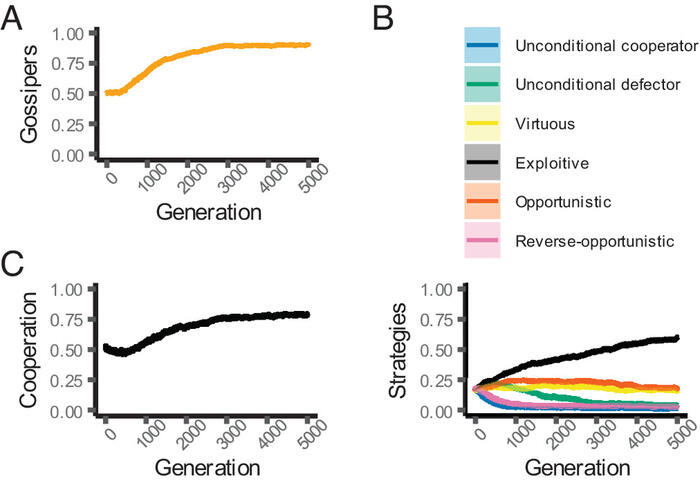
Figure 3. The evolutionary trajectories of different strategies and behaviors. The lines are average trajectories from 30 simulation runs with all the six cooperation strategies under the default parameter choice. The shadows show the SEs of the average trajectories. Plot (A) illustrates the evolution of gossipers. Plot (B) illustrates the evolution of different cooperation strategies. Plot (C) illustrates the evolution of cooperation.
At first glance, the high prevalence of cooperation and exploitive/opportunistic strategies may appear puzzling. However, the growth of gossip helps guard against exploitation and opportunism. In other words, it remains strategically rational to exploit when feasible, but doing so simply becomes less feasible over time.
One surprising finding is that gossipers and opportunists actually need each other. Opportunists cooperate with gossipers to protect their reputations, and in doing so give gossipers a real survival advantage over non-gossipers. As co-author Michele J. Gelfand said in a recent interview, “Opportunistic agents kind of get a bad rap. They’re seen as kind of sneaky…But in fact, they’re actually helping a lot in the population.”
The final aspect of the simulation involves showing that both functions of gossip, (1) disseminating reputations and (2) deterring selfishness, are jointly necessary to explain its evolution. To do this, the authors begin by analyzing solely function (1). Yet, this provides no direct benefit to gossipers: they spend time and energy disseminating information that helps others, but without deterring opportunists, who are not necessarily more likely to cooperate with them. In this situation, gossiping strategies will not proliferate. This is why function (2) must be part of the explanation. Gossipers directly benefit when opportunistic agents must manage their reputations by cooperating with them. In this way, they can deter the prospect of defection, which non-gossipers still face.
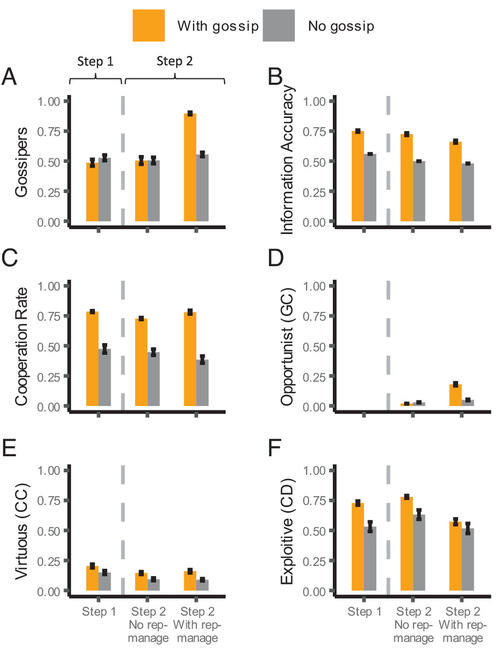
Figure 4. Results of Steps 1 and 2. Each condition is the average of 30 simulation runs. The value is calculated as the average value from the 4,000th to the 5,000th iterations of each simulation run. The error bars show the SEs. On the Left side of each plot are the results from Step 1; on the Right are the results from Step 2. Plot (A) shows that gossipers evolve only when both reputation dissemination and selfishness deterrence functions exist (i.e., with-gossip and with-rep-manage). Plots (B and C) show that the existence of gossipers (yellow) increases reputation accessibility and cooperation. Plot (D) shows that opportunists evolve only when both reputation dissemination and selfishness deterrence functions exist. Plots (E and F) show that the existence of gossipers increases the proportion of reputation-sensitive agents.
In all, “Explaining the evolution of gossip” is an insightful exercise in “abductive reasoning.” No historical account could ever hope to conclusively show how gossip actually developed. Instead, the simulation shows readers how gossip could possibly have developed in order to provide us with better information and encourage cooperation.
*Brief prepared by Adam Fefer.