
Nationalist Tweets After Russia’s Invasion of Ukraine
Nationalist Tweets After Russia’s Invasion of Ukraine
CDDRL Research-in-Brief [4-minute read]

Introduction and Contribution:
Wars have wide-ranging effects on the political attitudes and behaviors of citizens and elites. For example, European leaders were pressured to make democratic reforms and build large welfare states during World War II in order to stabilize their countries and encourage wartime sacrifice. After the 9/11 attacks and the initial Afghanistan invasion, George W. Bush’s approval ratings soared to 90%.
The Russo-Ukrainian War has been one of the defining wars of this century. Its consequences for the politics of both countries — such as Ukrainian national unity or the repression of Russian dissidents — are beginning to be understood. Yet it is less clear how the war has affected third-party states. In light of Russia’s imperial ambitions, as well as Ukraine’s need for international support to combat a regional hegemon, this is a pressing issue.
Leaders of third-party states have responded to the war in a range of ways, including imposing sanctions on Russia and mediating between the two countries. Wars also affect how rulers communicate with their citizens: they may be motivated to emphasize their shared connections with either warring party, their need for national self-reliance in a hostile international system, and so on.
In “Between wars and words,” Ana Paula Pellegrino, Benjamin R. Burnley, and Laia Balcells show that leaders of third-party states increased their nationalist rhetoric on X (formerly known as Twitter) after the invasion. The authors analyze over 10,000 tweets from the heads of 130 states both before and after the invasion, mapping these along a nationalist-cosmopolitan spectrum. The effects of Russia’s invasion on nationalist tweets were strongest among North Atlantic Treaty Organization (NATO) members and weaker among members of the pro-Russia Collective Security Treaty Organization (CSTO).
“Between wars and words” provides evidence that leaders react to wars in similar ways as do masses, whose sense of national identity tends to increase during periods of global uncertainty and conflict. As politicians increasingly use X to communicate, a more precise understanding of their tweets before and after major conflicts may help social scientists better understand their beliefs and threat perceptions.
Methodology:
The authors collect tweets from the 14 days before and after the invasion using an unsupervised learning algorithm called GloVe. This process is diagrammed in Fig. 1 below. GloVe identifies relationships between words by analyzing how often they appear together, grouping together words with similar meanings. This enables the authors to code each tweet according to its topic and sentiment (e.g., positive vs. negative).
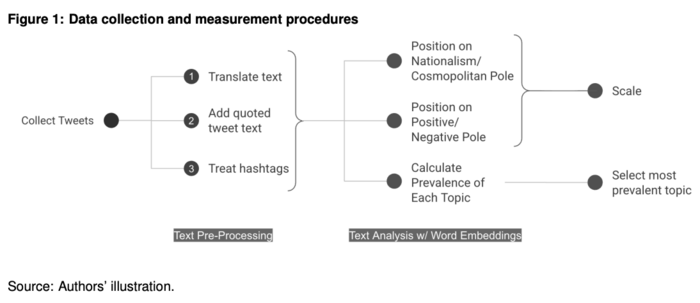
To code the level of nationalism versus cosmopolitanism, the authors employ the Concept Mover’s Distance (CMD) approach. CMD measures how closely the words in each tweet align with sets of ‘anchor terms’ representing each concept, placing tweets along a continuum between the two. Briefly, nationalism refers to a set of beliefs about the reality and value of nations, the obligations that members of a nation have to one another, and the right of that nation to determine its political affairs, whether as its own state or within an existing state. By contrast, cosmopolitanism is the view that all humans, irrespective of their national memberships, ought to be seen as part of a single world (kosmos) community. Returning to CMD, nationalist tweets are those that align with anchor terms such as ‘pride, glory, patriot, forefathers, homeland,’ and ‘heritage.’ Cosmopolitan anchors include ‘cooperation, humanity, multilateral,’ and ‘universal.’
Importantly, nationalistic tweets need not bear an obvious relationship to (inter)national security — the authors hypothesize that Russia’s invasion merely increased nationalist rhetoric, not rhetoric of a specific kind. For example, 10 days after the invasion, Bolivian President Luis Alberto Arce Catacora tweeted, “In 2019, the glorious Alteño people once again showed us their courage and love for our country.” Conversely, 12 days prior to the invasion, Argentine President Alberto Fernández espoused several cosmopolitan sentiments when he tweeted: “With the logic of multilateralism, Argentina has discussed with Russia the possibility of deepening financial assistance and increasing bilateral investment and trade between the two countries.”
Findings:
The authors show that Russia’s invasion did significantly increase nationalist rhetoric by third-party heads of state, whether or not one controls for topic and sentiment. As an example of this, consider Austrian Chancellor Karl Nehammer: Three days prior to the invasion, he tweeted, “Austria continues to rely on diplomacy and de-escalation to prevent war. The OSCE…is the appropriate framework.” On the day of the invasion, by contrast, Nehammer tweeted “I promise that I will do everything to protect the people who live in Austria.” Other international leaders, such as Joe Biden and Justin Trudeau, tweeted out more cosmopolitan statements about the importance of collectively pressuring Putin and respecting international law.
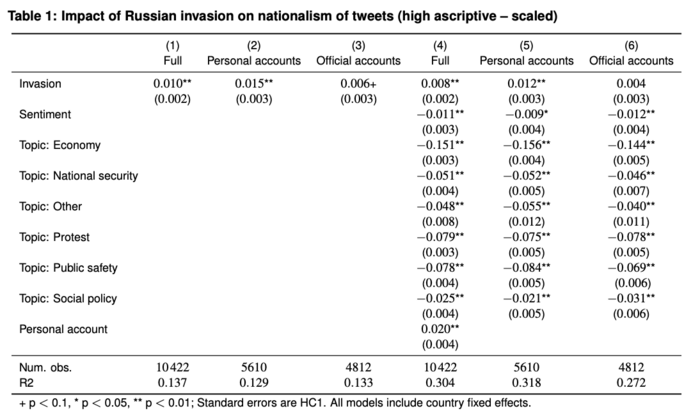
Why might an international war prompt the leaders of third-party states to use more nationalist rhetoric? The authors provide a number of hypotheses. For one, wars lead to feelings of uncertainty, and nationalist rhetoric by elites can afford citizens a sense of safety. Third parties might also make nationalist statements to signal their support of (or opposition to) one of the belligerent parties; for example, “our proud nation will not stand idly by as Russia attacks Ukraine.”
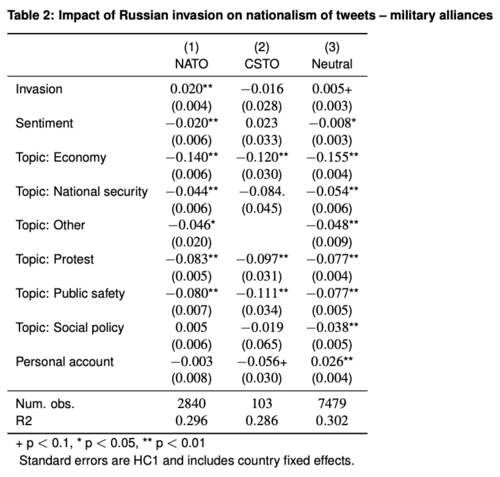
Although the invasion increased nationalist discourse on average, these effects are driven primarily by the behavior of NATO members. This is likely because the alliance has historically taken a strong stand against Russian aggression. As mentioned above, CSTO members did not tweet in a more nationalistic way, nor did leaders of states with histories of territorial armed conflicts resembling the Russo-Ukrainian War.
*Brief prepared by Adam Fefer.