
Germans Who Move and Declines in Local Political Engagement
Germans Who Move and Declines in Local Political Engagement
CDDRL Research-in-Brief [4-minute read]

Introduction and Contribution:
Most people move for economic or personal reasons, such as attending college, starting a new job, or being closer to family. Accordingly, residential moves are often beneficial for movers: they can improve life satisfaction, offer movers new economic opportunities, and increase long-term earnings. However, what is often little acknowledged is that moving can generate significant political costs: movers may have to learn about the political issues salient in their new place of residence while simultaneously facing the daunting task of settling into a new place of residence. It is because of these challenges that moving can change the extent to which someone engages in politics.
In “The local costs of moving,” Hans Lueders proposes that to understand how moving affects political engagement, we need to distinguish between national and local engagement. Studying political engagement among movers in Germany, he finds that German movers remain similarly engaged in national politics but become considerably less engaged in local politics. Lueders argues that national engagement is unlikely to change much after a move because the political context remains the same. Intuitively, the same political candidates run for national office no matter where one lives, and the country’s most pressing political issues remain the same as well. By contrast, the political context changes significantly when it comes to local engagement: living in a new place means that movers have less political knowledge (e.g., of local political candidates or salient issues), limited social networks to facilitate local engagement, and a weaker sense of civic duty to engage. Lueders finds no evidence that movers adopt new norms or political ideas — mainly because Germans tend to move to places that are socially and politically similar.
Lueders draws our attention to how moving — and the disengagement it generates — can undermine local democratic accountability. Indeed, when movers cannot communicate their preferences to local leaders, what follows is “representational inequality” between movers and “stayers.” That domestic migration can add or remove 5-10% of a county’s population over a decade, thus has serious consequences for the quality of democracy.
Importantly, Lueders broadens the geographic scope of research on political engagement. Social science research on moving has been heavily informed by data from the US, where “strict voter registration requirements…have been described as more costly than the act of voting itself.” Indeed, the US’s unique — and uniquely burdensome — voting regime has been shown to weaken both local and national engagement for movers. Lueders’s research suggests that these findings do not travel beyond the US. In Germany and much of the Western democratic world, movers are legally required to register their new address with local authorities, and are then automatically added to the electoral rolls. This removes a key barrier to political engagement, at least at the national level. American readers may rightfully ask which interests are advanced or undermined by the current status quo.
Engagement Before and After Moving:
Lueders introduces two competing accounts of how moving affects political engagement. On the first account, moving imposes serious epistemological and social costs: movers must learn new information about politics, form new social networks, and come to see themselves as members of a new community. Not only does all of this take time, but movers usually prioritize more urgent personal matters — e.g., finding housing or childcare — such that politics takes a back seat.
Weakened social ties mean that movers interact less often with people who could inform them about local issues, candidates, or initiatives — which are hard enough for longtime residents to grasp. Members of social networks also enforce norms of participation on each other; movers who lack social ties will thus be more content to abstain from voting or volunteering for campaigns. It could be inferred from this account that the further away one moves, the less engaged one will be with one's new home: candidates and issues seem even more novel, while social networks become even more fractured.
A second account highlights how the context of a new place can change engagement, as movers are exposed to new political ideas or norms around participation. This may be because movers are persuaded to approach politics differently, or for more instrumental reasons (e.g., if one’s preferred party already wins by large margins in the new place, engagement will seem less pressing). The contextual account assumes that moving entails a big change in one’s political environment.
Methods and Findings:
Lueders uses German household panel data collected between 1984 and 2020, which totals over 500,000 “respondent-year observations.” By comparing how engagement varies over time between movers and stayers, he can home in on the changes in engagement caused by moving itself, accounting for any baseline differences caused by the kinds of people who choose to move or stay. National engagement is measured by self-reported levels of national political interest, whether respondents voted in the last national election, and whether they plan to vote in the upcoming one. Local engagement is measured by self-reported attachments to one’s place of residence, how frequently they participate in local political and citizen initiatives, and their frequency of volunteering in local associations and organizations.
Lueders’ findings are consistent with the first account, in which local engagement declines due to lower-quality information and weaker social ties. He finds no evidence that Germans’ levels of national engagement change, regardless of the distance of one’s move.
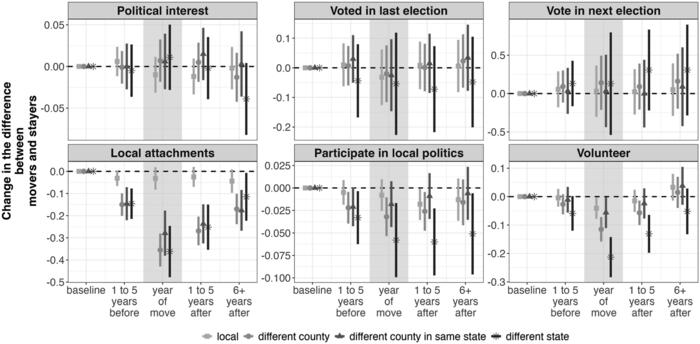
Figure 2. Changes in engagement around moves of varying distances. This figure explores whether movers’ engagement in national (top panel) and local engagement (bottom panel) changes around moves of varying distance. Each coefficient reflects the estimated change in engagement among movers compared to the baseline (all stayers plus movers six or more years before a move). Vertical bars are 95% confidence intervals. Data from the German Socio-Economic Panel (Goebel et al., 2019).
By contrast, the V-shaped patterns in the lower panel show that local engagement changes significantly, declining in the lead-up (around five years) before a move, reaching its lowest point in the year of a move, and then slowly returning to pre-move levels in subsequent years, but without fully recovering. Importantly, engagement declines with distance, as the most local moves (i.e., within the same town or county) leave engagement largely unchanged.
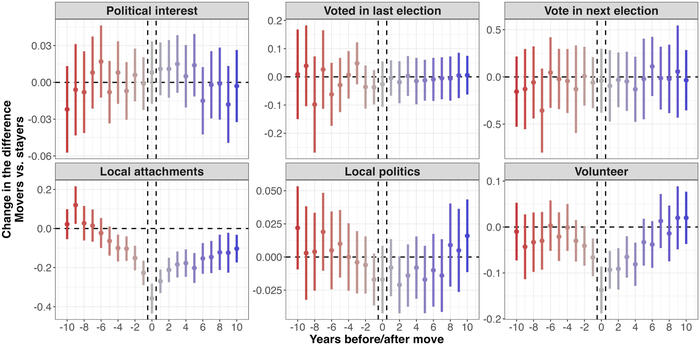
Figure 1. Changes in engagement before and after a move. This figure explores whether movers’ engagement in national (top panel) and local engagement (bottom panel) changes around a move. Each coefficient reflects the extent to which movers depart from the overall trend in engagement in a particular year before or after their move. Vertical bars are 95% confidence intervals. Data from the German Socio-Economic Panel (Goebel et al., 2019).
Against the “contextual” account, Lueders finds that the majority of German moves occur over short distances, which makes it unlikely that contexts differ dramatically. And indeed, most of the places to which Germans move are sociopolitically similar (to where they left) in terms of levels of turnout and federal election outcomes.
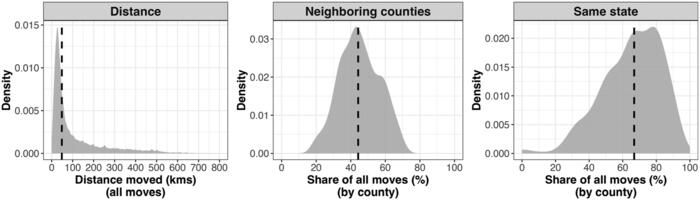
Figure 3. Most moves occur over short distances. This figure uses data on all cross-county moves in Germany in 2015 to compute various metrics of the distance of such moves. Left panel: distribution of the distance between origin and destination counties. Center panel: share of all moves from a particular county that go to neighboring counties. Right panel: share of all moves from a particular county that lead movers to other counties in the same state. Own calculations using data from FDZ der Statistischen Amter des Bundes und der Lander (2019). The vertical dashed line indicates the median move (left) or median county (center and right).
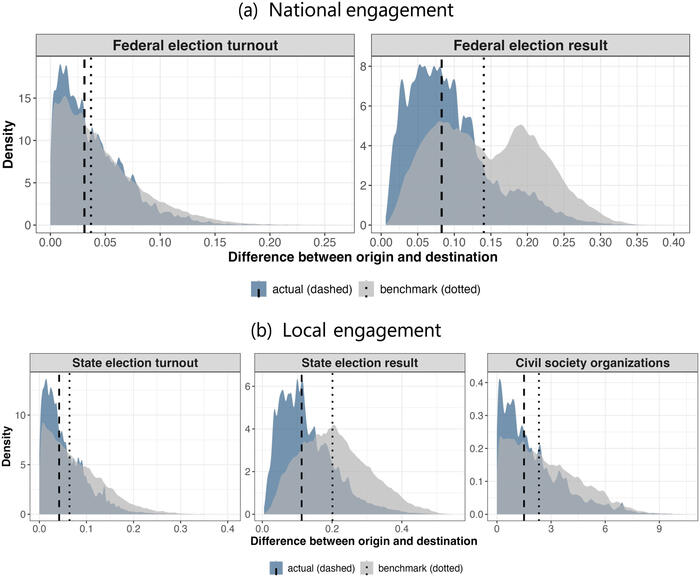
Figure 4. Movers tend to move between politically similar environments. This figure reports the distribution of the change in environments that movers experience upon a move (dark blue). This distribution is contrasted with the distribution of change in environments one would expect when simply considering population totals between county pairs (grey). The vertical lines indicate the medians for the actual (dashed line) and benchmark (dotted line) distributions, respectively.
Ultimately, “The local costs of moving” underscores how highly individual life events can undermine the quality of collective governance.
*Brief prepared by Adam Fefer