Institutions and Organizations
Authors
Hesham Sallam
News Type
News
Date
Paragraphs

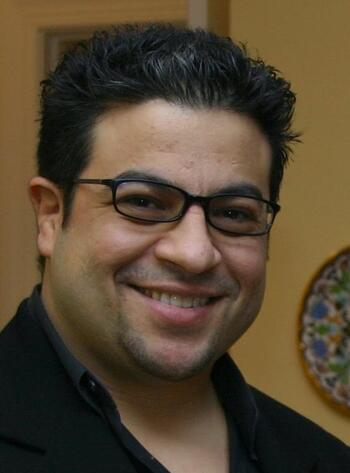
In a talk hosted by the Program on Arab Reform and Democracy on October 31, 2022, Hicham Alaoui, founder and director of the Hicham Alaoui Foundation, discussed his latest book – Pacted Democracy in the Middle East: Tunisia and Egypt in Comparative Perspective (Palgrave Macmillan, 2022).

During the event, co-sponsored by Stanford’s Abbasi Program in Islamic Studies and the Center for African Studies, Alaoui presented a new theory for how democracy can materialize in the Middle East, and the broader Muslim world. He explained that one pathway to democratization lays not in resolving important, but often irreconcilable, debates about the role of religion in politics. Rather, it requires that Islamists and their secular opponents focus on the concerns of pragmatic survival—that is, compromise through pacting, rather than battling through difficult philosophical issues about faith.

You can purchase the book online, and watch a recording of the event below:

Hero Image
Hicham Alaoui
All News button
1
Subtitle

To mark the 20th anniversary of the establishment of CDDRL, the Program on Arab Reform and Democracy (ARD) at CDDRL hosted a talk featuring Hicham Alaoui, founder and director of the Hicham Alaoui Foundation, who discussed his latest book – Pacted Democracy in the Middle East: Tunisia and Egypt in Comparative Perspective (Palgrave Macmillan, 2022).

All Publications button
1
Publication Type
Conference Memos
Publication Date
Subtitle
The Project on Middle East Political Science partnered with Stanford University’s Center for Democracy, Development and the Rule of Law and its Global Digital Policy Incubator for an innovative two week online seminar to explore the issues surrounding digital activism and authoritarianism. This workshop was built upon more than a decade of our collaboration on issues related to the internet and politics in the Middle East, beginning in 2011 with a series of workshops in the “Blogs and Bullets” project supported by the United States Institute for Peace and the PeaceTech Lab. This new collaboration brought together more than a dozen scholars and practitioners with deep experience in digital policy and activism, some focused on the Middle East and others offering a global and comparative perspective. POMEPS STUDIES 43 collects essays from that workshop, shaped by two weeks of public and private discussion.
Authors
Larry Diamond
Authors
News Type
Commentary
Date
Paragraphs

To mark five years since the onset of the January 25 Revolution, five Egypt scholars examined the evolving political landscape in Egypt as part of a panel titled “The Containment of Politics in Egypt,” organized by the Program on Arab Reform and Democracy (ARD). The panel featured Stanford Historian Joel Beinin, Associate Professor of Political Science at Stanford Lisa Blaydes, ARD Visiting Scholar Amr Hamzawy, Executive Director of the Tahrir Institute on Middle East Policy Nancy Okail, and ARD Associate Director Hesham Sallam. The discussion revolved around a number of key issues, including the recent legislative elections, the cohesion of the ruling coalition, the regime’s responses to various economic challenges, and the impact of state repression on spaces for political contestation and resistance.

Hero Image
slide1
All News button
1
-

Abstract

After nearly five years since the start of the uprising, Syria finds itself divided and embattled, with no end in sight. More significantly, more than half of the Syrian population is displaced and the death toll surpassed 300,000 by all counts. The Syrian tragedy persists and, more than any other case of mass uprising in the region, continues to be shrouded in political power-plays and contradictions at the local, regional, and international levels. Defined increasingly by an absence of a clear favorable outcome, considering existing parties to the conflict, the logic of the lesser evil reigns supreme. This lecture is an attempt to understand the roots and dynamics of the tragic Syrian uprising, with particular attention to its background and to the recent Russian intervention.

Speaker Bio

Image
unnamed
Bassam Haddad is Director of the Middle East Studies Program and Associate Professor in the Department of Public and International Affairs at George Mason University, and is Visiting Professor at Georgetown University. He is the author of Business Networks in Syria: The Political Economy of Authoritarian Resilience (Stanford University Press, 2011). Haddad is currently editing a volume on Teaching the Middle East After the Arab Uprisings, a book manuscript on pedagogical and theoretical approaches. His most recent books include two co-edited volumes: Dawn of the Arab Uprisings: End of an Old Order? (Pluto Press, 2012) and Mediating the Arab Uprisings (Tadween Publishing, 2013). Haddad serves as Founding Editor of the Arab Studies Journal a peer-reviewed research publication and is co-producer/director of the award-winning documentary film, About Baghdad, and director of the critically acclaimed film series, Arabs and Terrorism, based on extensive field research/interviews. More recently, he directed a film on Arab/Muslim immigrants in Europe, titled The "Other" Threat. Haddad is Co-Founder/Editor of Jadaliyya Ezine and serves on the Editorial Committee of Middle East Report. He is the Executive Director of the Arab Studies Institute, an umbrella for five organizations dealing with knowledge production on the Middle East and Founding Editor of Tadween Publishing.


This event is co-sponsored by The Markaz: Resource Center at Stanford University.


[[{"fid":"221861","view_mode":"crop_870xauto","fields":{"format":"crop_870xauto","field_file_image_description[und][0][value]":"Bassam Haddad January 21","field_file_image_alt_text[und][0][value]":"","field_file_image_title_text[und][0][value]":"","field_credit[und][0][value]":"","field_caption[und][0][value]":"","field_related_image_aspect[und][0][value]":"","thumbnails":"crop_870xauto"},"type":"media","attributes":{"width":"870","class":"media-element file-crop-870xauto"}}]]


CISAC Central Conference Room
Encina Hall, 2nd Floor
616 Serra St
Stanford, CA 94305

Bassam Haddad Associate Professor George Mason University
Seminars

Tickets are no longer available for this event. If you are interested in signing up for the notifications list, please visit the Stanford Ticket Office.  

This is a ticketed event, only guests with tickets will be admitted. Directions and parking information is available below. This event is hosted by the Program on Arab Reform and Democracy at the Center on Democracy, Development and the Rule of Law and co-sponsored by OpenXChange, Stanford in Government and the Abbasi Program in Islamic Studies.  


[[{"fid":"220434","view_mode":"crop_870xauto","fields":{"format":"crop_870xauto","field_file_image_description[und][0][value]":"Bassem Flyer 9.24.15","field_file_image_alt_text[und][0][value]":"","field_file_image_title_text[und][0][value]":"","field_credit[und][0][value]":"","field_caption[und][0][value]":"Bassem Flyer 9.24.15","field_related_image_aspect[und][0][value]":"","thumbnails":"crop_870xauto"},"type":"media","attributes":{"width":"870","style":"font-size: 13.008px; font-weight: normal; line-height: 1.538em;","class":"media-element file-crop-870xauto"}}]]Abstract

International media sensation and Egyptian political satirist Bassem Youssef, also known as the “Arab Jon Stewart,” will share with the Stanford community his thoughts on why political satire has come to embody an important element of modern day politics. He will also reflect on his own experience as the co-founder and host of the internationally acclaimed political satire talk show “Al-Bernameg.” Youssef will discuss the challenges and obstacles he faced in providing the Egyptian public alternative viewpoints on politics not represented by the mainstream news media.


Speaker Bio

Image
media01

Named one of TIME’s “100 most influential people in the world” in 2013, Bassem Youssef is an Egyptian satirist, columnist, and talk show host. A cardiac surgeon by training, Youssef turned to comedy after he was inspired by the Egyptian revolution. He uploaded the first episode of his homemade newscast, “The B+ Show,” to YouTube in May 2011. After it garnered more than 5 million views in three months, Youssef was named the host of “Al-Bernameg,” a satirical newscast modeled after Jon Stewart’s “The Daily Show.” Youssef’s bold, intelligent, and humorous critiques of Egyptian politics quickly became a hit with audiences in the country and garnered more than 40 million viewers. In 2012, Mohamed Morsi’s government pursued charges against Youssef for "insulting the president," “insulting Islam," and “reporting false news.” In March 2013, Youssef was briefly detained, released on bail, and fined. CBC suspended the broadcast of “Al-Bernameg” in November 2013. In 2014, Youssef announced that he was ending the program due to the dangerous political climate in Egypt. In the spring of 2015 Youssef served as a resident fellow at the Institute of Politics at the John F Kennedy School of Government at Harvard University. He has recently been announced as the host of the International Emmy Awards gala of 2015.


Directions 

Via I-280 (north or south): LINK

From the east bay via CA-92 (San Mateo Bridge): LINK

Via US 101 (north or south): LINK

Additional directions are available here


Parking 

Parking Structure 7 offers underground parking at the Knight Management Center. Permits are required and enforced Monday through Friday from 8 am to 4 pm. Click here to access Campus Maps.

One-day visitor permits (called “scratchers”) allow for parking in any pay-and-display or metered space, and are available for purchase at the Parking and Transportation Services (P&TS) office for $12 each. Be sure to scratch off the correct date and hang your permit facing outward from your rear-view mirror. "A," "C," and "shared" resident/commuter lots are enforced Monday-Friday, 6 a.m. to 4 p.m. You are free to park in these areas after enforcement hours.

You can also pay for parking using the pay-by-space kiosks located in Structure 7. Simply enter the number for your parking space and pay with cash or card. You do not need to display your receipt in your vehicle. The receipt is not valid in any other location.

Other nearby parking locations include:

  • Parking lot at Bonair Siding Rd. and Serra St. — coin-meter spaces, two-minute walk
  • Parking lot at Memorial Way and Galvez St. — pay-and-display machine, five-minute walk
  • Visitor Center parking lot at 295 Galvez St. — pay-and-display machine, ten-minute walk
  • Parking Structure 6 at Campus Dr. East and Wilbur Way — pay-and-display machine, ten-minute walk

Meters are generally enforced 8 a.m. to 4 p.m., unless otherwise posted. You are free to park in these areas after enforcement hours.

More parking and permit information is available here.

We honor any state's disabled person placards in nearly all marked parking spaces on campus. Please visit the Persons with Disabilities page for more information.

Event Flyer
Download pdf

Cemex Auditorium, Knight Management Center

655 Knight Way
Stanford, CA 94305

Bassem Youssef Egyptian Political Satirist Egyptian Political Satirist
Seminars
Subscribe to Institutions and Organizations