


Seminar on the Regional Dimensions of Authoritarianism in the Arab World
News Type
News
Date
Paragraphs
On March 30, 2010, Prof. Samer Shehata from Georgetown University gave a research seminar for the Program on Arab Reform and Democracy at CDDRL titled The Regional Dimensions of Authoritarianism in the Arab World. Prof. Shehata’s talk was in response to the research puzzle, as he called it, of the persistence of authoritarian politics at the regional level in the Arab world. He argued that the subject that has received most attention in political science is the question of authoritarianism and absence of democracy. The question of why there are no democracies has offered a number of possible reasons including: the qualities and consequences of oil and rentier politics; absent or weak civil societies in the Arab world; social class-based explanations; the issue of political liberalization instead of democratization; external factors such as US support for authoritarian regimes, which he argued has not decreased since the end of the Cold War; regional conflicts like Palestine/Israel and the Gulf wars; institutions of authoritarianism including how elections, parliaments and single parties work; Islamist politics creating deep divisions among opposition groups; and patronage, clientelism and the (absence of) social contract.
Prof. Shehata then proceeded to say that there has been some positive development in the approach to democracy in the Arab world, but that there remains insufficient attention to the regional dimensions of authoritarianism. He argued that the Arab world is authoritarian not just on the state level, but also on the regional level. As International Relations specialists have spoken about the existence of an Arab regional system, the institutional dimension of this system, such as the Arab League, needs to be studied.
He stated that there are three mechanisms of the reproduction of authoritarianism on the regional level: authoritarian learning, authoritarian cooperation, and regional organizations. Cases of authoritarian learning take both direct and indirect forms where certain regimes “learn” from one another. He gave the example of constitutional amendments that allow elections but that give the illusion of competition, where electoral outcomes are similar. In Tunisia, for example, Ben Ali “learned” from the Algerian experience by not allowing Islamists an electoral opening.
Authoritarian cooperation, he went to argue, occurs mainly regarding security matters. He gave the example of certain activists not being to allowed certain countries in the Arab world (like the Tunisian Moncif Marzouki, who was not allowed into Lebanon). Such “cooperation” widens the scope of authoritarianism beyond the borders of individual states.
Prof. Shehata’s ended with a discussion of the third mechanism, regional organizations. He talked about institutionalized cooperation within the Arab League and the GCC, calling the Arab League a “club for authoritarian regimes” that is not committed to democracy. An example of this in action is the Arab League accords on security and anti-terrorism which have ended up extending authoritarian rules across the Arab world. Another example is the Arab media charter that was put in place in February 2008, and which limits internet and media freedom. Prof. Shehata acknowledged that further research needs to be done on those three mechanisms and the floor was then opened to questions from the audience.
Hero Image

All News button
1
Inaugural conference held - Political Reform in the Arab World: Problems and Prospects, May 10-11, 2010
News Type
News
Date
Paragraphs
On May 10-11, 2010 the Program on Arab Reform and Democracy at CDDRL held its inaugural international conference. In line with the Arab Reform Program’s vision, the conference featured internationally renowned scholars, activists, and practitioners from the Arab world, Europe, and the United States.
Over the two days, conference participants engaged in multidisciplinary debates addressing hard politics as well as soft politics, and analyzing political reform from different angles, with panels on the economy, state systems, the media, civil society, political opposition, youth politics, and the role of international actors. Problems facing political reform in the Arab world today were discussed and scrutinized, as were possible paths forward. The conference debates unearthed the need for a deep understanding of the problems facing political reform in region that is driven by an analysis of long-term and often ignored issues that are at the core of political developments. The debates also highlighted that problems and prospects for reform are different in each Arab country because each country has its own unique set of issues and because within each country different ethnic groups, classes, and locales have different takes on and stakes in political developments. The conference closed with a speech by Dr. Saad Eddin Ibrahim.
All News button
1
Arab Reform and Democracy Program
News Type
News
Date
Paragraphs
يقوم برنامج الإصلاح و الديمقراطية في العالم العربي بمركز الديمقراطية و التنمية و سيادة القانون في جامعة ستانفرد، بتحليل الديناميات الإجتماعية و السياسية ذاخل البلدان العربية. كما يقوم بتحليل أنظمتها السياسية وذلك من خلال التركيز على الأوضاع، الفرص، و الطرق الممكنة من أجل تفعيل الإصلاحات الديمقراطية بالمنطقة.
و يستقطب هذا البرنامج المتعدد الإختصاصات محاضرين و مشاركين من مختلف مراكز صناعة القرار، منظمات المجتمع المدني، المنظمات الغير حكومية، الإعلام، و المجتمعات السياسية. بالإضافة إلى استقطاب فعاليات أخرى ،من العالم العربي، من مختلف الخلفيات و المرجعيات. وذلك من أجل بحث كيفية إمكانية ترسيخ الديمقراطية و تأسيس حكامة مسؤولة و عادلة كتحدي عام يواجه المنطقة ككل و بالأخص ذاخل بعض البلدان و المجتمعات.
ويهذف هذا البرنامج إلى أن يكون منبعا للرصيد المعرفي حول مواضيع الحكامة الجيدة والإصلاح السياسي في المجتمعات العربية، من خلال إنتاج بحوث أكاديمية دقيقية و سباقة تقوم على أساس عمل ميداني ذاخل العالم العربي يتيح فرصة التعبير أمام مختلف الآراء والأصوات.
كما يستفيد هذا البرنامج من المشاركات الغنية و القيمة للمجتمع الأكاديمي بجامعة ستانفرد بكل مكوناته: أساتذة، باحثون، وطلبة. بالإضافة إلى المساهمات القيمة لشركائنا في العالم العربي و أوروبا.
وتبعا لمهمة مركز الديمقراطية و التنمية و سيادة القانون، الذي يحتضن هذا اليرنامج، فإن برنامج الإصلاح و الديمقراطية في العالم العربي ملتزم بإنتاج بحث معمق في ميدان سن القوانين.
وتتضمن النشاطات الخاصة بالبرنامج مايلي:
بحث متعدد الإختصاصات: يعمل البرنامج على إنجاز بحث متعدد الإختصاصات في مجال السياسة مركزا على أوجه متعددة للإصلاح و الديمقراطية في العالم العربي. و يتم ذلك من خلال مشاريع بحوث قصيرة وطويلة المدى، يتم العمل عليها عبر مواضيع منفردة بالإضافة إلى بحوث أكثر شمولية تركز على بلدان عربية محددة. ويتكلف أعضاء فريق البرنامج بالقيام بالأبحاث بالإضافة إلى الشركاء الدولين.
برنامج الباحث الزائر: يستظيف برنامج الإصلاح و الديمقراطية في العالم العربي باحثين و مهنيين رائدين من أجل استكمال و القيام ببحوث فريدة خلال اقامتهم بمركزالديمقراطية و التنمية و سيادة القانون.
تداريب: يعمل البرنامج على خلق فرص تداريب جديدية بالنسبة لطلبة ستانفرد لتمكينهم من قضاء بعض الوقت في العالم العربي و أيضا لتمكينهم من العمل ذاخل المركز.
ورشات ونذوات: يستظيف البرنامج عدة نذوات، الورشات ومحاضرات، غالبا بالتعاون مع شركائنا بستانفرد و بأماكن أخرى، كما يستضيف أحداث أخرى بالعالم العربي.
مطبوعات: يشارك البرنامج في نشر’مجلة الشرق الأوسط للثقافة و التواصل‘ و هي مجلة متعددة التخصصات [تنشر من طرف برل]. كما يقوم البرنامج بنشر مقالات و مسودات و كتب محررة.
All News button
1
Political Reform in the Arab World: Problems and Prospects
On May 10-11, 2010 the Program on Good Governance and Political Reform in the Arab World at CDDRL held its international inaugural conference. In line with the Arab Reform Program's vision, the conference featured internationally renowned scholars, activists, and practitioners from the Arab world, Europe and the United States. Over the two days, conference participants engaged in multidisciplinary debates addressing hard politics as well as soft politics, and analyzing political reform from different angles, with panels on the economy, state systems, the media, civil society, political opposition, youth politics, and the role of international actors. Problems facing political reform in the Arab world today were discussed and scrutinized, as were possible paths forward. The conference debates unearthed the need for a deep understanding of the problems facing political reform in the region that is driven by an analysis of long-term and often ignored issues that are at the core of political developments. The debates also highlighted that problems and prospects for reform are different in each Arab country because each country has its own unique set of issues and because within each country different ethnic groups, classes, and locales have different takes on and stakes in political developments. The conference closed with a speech by Dr. Saad Eddin Ibrahim.
Bechtel Conference Center
Conferences
Iron Fists in Silk Gloves: Building Political Regimes in the Middle East - Project completed 2010
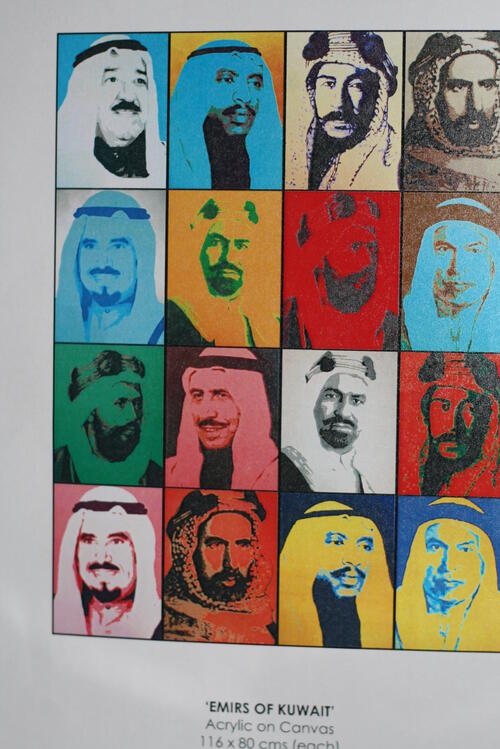 "Emirs of Kuwait" catalogue photo by Laudi Abilama on display at Bardo, Beirut, August 2008
This book manuscript explores the historical development of authoritarian regimes in the Middle East over the past century, arguing that w
Autocracy Ten Years On: How Change Supports Continuity in Morocco and Jordan
-
Hind Arroub is a Visiting Scholar at CDDRL in the calendar year 2010, affiliated with the Program on Good Governance and Political Reform in the Arab World, and an associate researcher at the Laboratory of Sociology "Culture et Societe en Europe", affiliated with the CNRS (Centre National de la Recherche Scientifique) and the University of Strasbourg in France. She has a PhD in Law and Political Science from Mohammed V University of Juridical, Economic and Social Sciences in Rabat. Her work takes an interdisciplinary approach to the study of international law, political and social sciences, human rights and media, and her research interests revolve around Morocco and the Arab World with a focus on: politics and religion, authoritarian regimes and democracy, riots and social movements, media freedom, human rights, and global politics' relationship to the Arab World. She is the author of "Revolutions in the Era of Humiliocracy" (with Mahdi El-Mandjra), "The ‘Makhzan' in Moroccan Political Culture" (2004) and "Approach to the Foundations of Legitimacy of the Moroccan Political System", published in November 2009.
Sean Yom is a Hewlett Postdoctoral Fellow at CDDRL at Stanford University. He finished his Ph.D. at the Department of Government at Harvard University in June 2009, with a dissertation entitled "Iron Fists in Silk Gloves: Building Political Regimes in the Middle East". His primary research explores the origins and durability of authoritarian regimes in this region, focusing on the historical interplay between early social conflicts and Western geopolitical interventions.
Richard and Rhoda Goldman Conference Room
Hind Arroub
616 Serra St.
Encina Hall, C151
Stanford, CA 94305-6055
0
hinda@stanford.edu
hind_arroub.jpg
PhD
Hind Arroub is a Visiting Scholar at CDDRL in the calendar year 2010, affiliated with the Program on Good Governance and Political Reform in the Arab World, and an associate researcher at the Laboratory of Sociology "Culture et Societe en Europe", affiliated with the CNRS (Centre National de la Recherche Scientifique) and the University of Strasbourg in France.
She has a PhD in Law and Political Science from Mohammed V University of Juridical, Economic and Social Sciences in Rabat. Her work takes an interdisciplinary approach to the study of international law, political and social sciences, human rights and media, and her research interests revolve around Morocco and the Arab World with a focus on: politics and religion, authoritarian regimes and democracy, riots and social movements, media freedom, human rights, and global politics' relationship to the Arab World (such as the Iraq war, international terrorism and the impact of globalization).
Hind was a lecturer in Hassan II University of Law in Casablanca where she taught "Constitutional Law and the Political". She has 10 years experience in journalism in Morocco and abroad, and is one of the founders of the Moroccan academic journal Wijhat Nadar (Point of view) and member of its editorial board and scientific committee. She is also a human rights activist. She has participated in, organized and managed a number of conferences, study days, colloquia, round tables, and workshops in Morocco and France.
Hind's first book "Revolutions in the Era of Humiliocracy'", co-authored with the Moroccan Professor of Futurism Mahdi El-Mandjra, addresses major questions of democracy in Morocco and the Arab world and other international issues related to the Middle East and North Africa region.
She is also the author of "The ‘Makhzan' in Moroccan Political Culture" (2004) and "Approach to the Foundations of Legitimacy of the Moroccan Political System", published in November 2009.
Hind is also a poet, she has a poetry collection in Arabic called "Milad Nassim Assef" (Birth of a Stormy Breeze).
CV
Document
Hind_Arroub-CV.pdf
(271.19 KB)
File title
Hind_Arroub-CV.pdf
Sean Yom
N/A
0
CDDRL Hewlett Fellow 2009-2010
Sean Yom finished his Ph.D. at the Department of Government at Harvard University in June 2009, with a dissertation entitled "Iron Fists in Silk Gloves: Building Political Regimes in the Middle East." His primary research explores the origins and durability of authoritarian regimes in this region. His work contends that initial social conflicts driven by strategic Western interventions shaped the social coalitions constructed by autocratic incumbents to consolidate power in the mid-twentieth century--early choices that ultimately shaped the institutional carapaces and political fates of these governments. While at CDDRL, he will revise the dissertation in preparation for book publication, with a focus on expanding the theory to cover other post-colonial regions and states. His other research interests encompass contemporary political reforms in the Arab world, the historical architecture of Persian Gulf security, and US democracy promotion in the Middle East. Recent publications include articles in the Journal of Democracy, Middle East Report, Arab Studies Quarterly, and Arab Studies Journal.
Seminars
Inaugural seminar: Exploring the missing link between liberalization and democratization in the Middle East
News Type
News
Date
Paragraphs
On February 17, 2010 the Program on Good Governance and Political Reform in the Arab World at CDDRL held its inaugural seminar with Prof. Philippe C. Schmitter, Professor Emeritus, European University Institute, Florence and Visiting Scholar at CDDRL and Dr. Sean Yom, Hewlett Postdoctoral Fellow at CDDRL.
The seminar was titled Exploring the missing link between liberalization and democratization in the Middle East. The seminar aimed to start a public discussion on one of the routine assumptions of students of democratization, which is that there is a close, causal relationship between liberalization and democratization. The former is said to drive those who concede it toward convoking credible elections and, eventually, tolerating ruler accountability to citizens. The link between those processes of regime transformation is alleged to be the mobilization of civil society. It has been argued that the weakness or absence of this linkage is one (among many) of the conditions which make the polities of the Middle East and North Africa resistant to democratization.
In his response to this argument, Philippe Schmitter began by saying that in the work that he started on Southern Europe and Latin America, there was a distinction between democratization and liberalization. Once an autocratic regime enters a process of liberalization, it faces unexpected consequences. Thus, the most vulnerable time for a regime is when it starts to reform itself. Some of the consequences of this process are the resurrection of civil society, more freedom of expression and movement, the release of political prisoners and the freer operation of political parties. Such consequences are what liberalization means.
Schmitter argued that all autocratic regimes have tried this process, and that this process is normally triggered by divisions within the regimes or succession struggles, where regimes feel the need to open up. The kind of liberalization that takes place depends on the type of autocracy present. But the objective of liberalization, Schmitter said, is to coopt and produce a large social basis for autocracy, for example, through cultivating political parties that agree not to be too oppositional.
Schmitter added that many autocracies are under pressure from external regimes. Most of the countries in the Middle East have some kind of agreement with the EU for example, which carries clauses on issues like the rule of law. Another factor is that liberalization is selective in its inclusion, focusing on the urban middle class. It is thus "voluntary", conceded from above by the regime, and not based on any form of mobilization from below. In other words, Schmitter argued that regimes choose to liberalize and are not forced to do so. Thus, regimes are limited in their scope of liberalization (elections for example are not always genuinely free). He then presented a scale of measures of autocracy liberalization, saying that the most difficult measure in the Middle East is that of releasing political prisoners, while the easiest measure is concessions on the level of human rights.
He presented the hypothesis is that almost all efforts at democratization are preceded by liberalization. This is triggered by the resurrection of civil society, which itself is triggered when the costs of repression increase quite significantly and a regime is faced with the question of is it "better" to repress or tolerate? Often, in this case, regimes choose to tolerate the self organization of groups that are not tolerated otherwise. But mobilization of such groups, like lawyer groups, may lead to mobilization on the street. Schmitter said that although Arab regimes liberalize, this kind of process does not normally happen in the Middle East. Liberalization occurs then declines without the regimes suffering many consequences. He finished by stating that there seems to be something in the Middle East region that encourages liberalization, but that leads this liberalization to decline.
Sean Yom responded by saying that for the last 10 years, scholars of democratization literature have made ethnocentric assumptions about this issue. He argued that it is almost assumed that democracy is easy, but what actually happens at the end stage of liberalization is complex. He said that if we take a historical view of the Middle East, the literature says that regimes are durable. But countries like Iran, Iraq, Libya and Syria have all witnessed regime termination. The dictators today in the Arab world are merely the winners of the state-building process. So why is liberalization not followed by democratization for these survivors?
Yom argued that distinctive regimes have distinctive ways through which they liberalize but not democratize. He related the lack of democratization following on from liberalization to two key questions: Why are there no elite splits in the public arena during times of crisis? And why has the middle class not staked any sacrifice to demand more of a democratic and revolutionary change?
He presented two reasons: the first is that many current regimes have well institutionalized methods of dealing with elite splits before they hit the public domain. Hegemonic ruling provide one such mechanism. The National Democratic Party in Egypt, the Neo-Destur of Tunisia, and the Baath parties in Syria and Iraq for example were able to coopt/isolate softline elites well before their conflict became rebellion. Yom argued that in monarchical autocracies, incumbents have just as well-institutionalized mechanisms of co-optation that revolve around the palace; such networks were developed shortly after colonial rule, and were designed to effectively enshrine a certain distribution of power.
The second reason, Yom argued, lays in the nature of social opposition. No dictator liberalizes because they want to give up power. That is, they do not liberalize to achieve democracy; they liberalize in order to survive in the face of burgeoning social unrest. The problem is that in the MENA context, the so-called "middle-sector"-labor, professionals, intellectuals, and other urban forces-have not staked out sacrifice to their demands for greater freedom, when push comes to shove. One reason is that they were incorporated into ruling coalitions early on in the state-building process, and that such early coalitional bargains that traded loyalty for prosperity have proven durable even during economic crises in the 1980s and 1990s. For instance, large-scale employment in the public sector to certain groups is a common side-payment. Countries like Jordan and Bahrain exploit population cleavages (the Palestinians and the Shiites, respectively, being the key factors), where the regimes operate an optimal mix of loyalty and oppression/coercion. In these cases, leaders strategically choose to incorporate different constituents into different networks of patronage.
The presentations were followed by a question and answer sessions where additional factors were discussed and others elaborated on, such as the role of Islamists; authoritarian pacts with the West especially in the cases of "countries that are too important to be politically conditioned" as Schmitter put it, or in the case of illegal Western dealings with Middle East states which makes it difficult for the West to present them with reform conditions; the absence of independent middle classes; and the issue of political prisoners, who are the hardest to coopt by any given regime, and hence tend to be kept inside prisons.
Hero Image

All News button
1
Hind Arroub
616 Serra St.
Encina Hall, C151
Stanford, CA 94305-6055
0
hinda@stanford.edu
hind_arroub.jpg
PhD
Hind Arroub is a Visiting Scholar at CDDRL in the calendar year 2010, affiliated with the Program on Good Governance and Political Reform in the Arab World, and an associate researcher at the Laboratory of Sociology "Culture et Societe en Europe", affiliated with the CNRS (Centre National de la Recherche Scientifique) and the University of Strasbourg in France.
She has a PhD in Law and Political Science from Mohammed V University of Juridical, Economic and Social Sciences in Rabat. Her work takes an interdisciplinary approach to the study of international law, political and social sciences, human rights and media, and her research interests revolve around Morocco and the Arab World with a focus on: politics and religion, authoritarian regimes and democracy, riots and social movements, media freedom, human rights, and global politics' relationship to the Arab World (such as the Iraq war, international terrorism and the impact of globalization).
Hind was a lecturer in Hassan II University of Law in Casablanca where she taught "Constitutional Law and the Political". She has 10 years experience in journalism in Morocco and abroad, and is one of the founders of the Moroccan academic journal Wijhat Nadar (Point of view) and member of its editorial board and scientific committee. She is also a human rights activist. She has participated in, organized and managed a number of conferences, study days, colloquia, round tables, and workshops in Morocco and France.
Hind's first book "Revolutions in the Era of Humiliocracy'", co-authored with the Moroccan Professor of Futurism Mahdi El-Mandjra, addresses major questions of democracy in Morocco and the Arab world and other international issues related to the Middle East and North Africa region.
She is also the author of "The ‘Makhzan' in Moroccan Political Culture" (2004) and "Approach to the Foundations of Legitimacy of the Moroccan Political System", published in November 2009.
Hind is also a poet, she has a poetry collection in Arabic called "Milad Nassim Assef" (Birth of a Stormy Breeze).
CV
Document
Hind_Arroub-CV.pdf
(271.19 KB)
File title
Hind_Arroub-CV.pdf