Democracy
-

Abstract:

The roots of the revolts known as the Arab Spring lie in many sources but one of the leading causes was the high rates of unemployment, low skill levels, and the growth of the youth populations. Now Arab governments are faced with the dual challenges of creating new political and economic systems that can meet the needs and demands of the peoples of their countries. This presentation will focus on the role of the private sector and the need to build an entrepreneurial eco-system that can foster rapid economic growth. Practical examples of reform programs will be emphasized drawing from the work of the Center for International Private Enterprise.

Speaker Bio:

John D. Sullivan is the executive director of the Center for International Private Enterprise (CIPE), an affiliate of the US Chamber of Commerce. As associate director of the Democracy Program, Sullivan helped to establish both CIPE and the National Endowment for Democracy in 1983. After serving as CIPE program director, he became executive director in 1991. Under his leadership CIPE developed a number of innovative approaches that link democratic development to market reforms: combating corruption, promoting corporate governance, building business associations, supporting the informal sector, and programs to assist women and youth entrepreneurs. Today, CIPE has more than 90 full-time staff with offices in Afghanistan, Egypt, Iraq, Pakistan, Romania, Russia, and Ukraine.

Sullivan began his career in Los Angeles’ inner city neighborhoods, helping to develop minority business programs with the Institute for Economic Research and the Office of Minority Business Enterprise. In 1976 he joined the President Ford Election Committee in the research department on campaign strategy, polling, and market research.  Sullivan joined the public affairs department of the U.S. Chamber of Commerce in 1977 as a specialist in business and economic education.

Encina Ground Floor Conference Room

John D. Sullivan Executive Director Speaker The Center for International Private Enterprise (CIPE)
Seminars
Paragraphs

Democracy, Political Parties and Reform: A Review of Public Opinion in Yemen,” by Chris Miller, Hafez al-Bukari and Olga Aymerich provides a rare glimpse into Yemeni public opinion. The survey data presented in the paper paints a picture of a population that is overwhelmingly supportive and enthusiastic about democracy as a mode of governance. At the same time, it highlights a lack of knowledge of basic electoral rights as well as options for institutional change. As Yemen prepares for a process of national dialogue and constitutional reform, the public opinion data in the paper provides a critical window into the demands and priorities of citizens.

All Publications button
1
Publication Type
Working Papers
Publication Date
Journal Publisher
CDDRL Working Papers
Authors
-

Abstract:

Turkey redefined its geographical security environment over the last decade by deepening its engagement with neighboring regions, especially with the Middle East. The Arab spring, however, challenged not only the authoritarian regimes in the region but also Turkish foreign policy strategy. This strategy was based on cooperation with the existing regimes and did not prioritize the democracy promotion dimension of the issue. The upheavals in the Arab world, therefore, created a dilemma between ethics and self-interest in Turkish foreign policy. Amid the flux of geopolitical shifts in one of the world’s most unstable regions, Turkish foreign policy-making elites are attempting to reformulate their strategies to overcome this inherent dilemma. The central argument of the present paper is that Turkey could make a bigger and more constructive impact in the region by trying to take a more detached stand and through controlled activism. Thus, Turkey could take action through the formation of coalitions and in close alignments with the United States and Europe rather than basing its policies on a self-attributed unilateral pro-activism.

Ziya Öniş is Professor of International Relations and the Director of the Center for Research on Globalization and Democratic Governance (GLODEM) at Koç University in Istanbul, Turkey. He received his BSc. and MSc. in Economics from London School of Economics, and his Ph.D. in Development Economics from University of Manchester.  He also taught at Boğaziçi University (Istanbul), Işık University (Istanbul), and University of Manchester. He has written extensively on various aspects of Turkish political economy. His most recent research focuses on the political economy of globalization, crises and post-crises transformations, Turkey’s Europeanization and democratization experience and the analysis of new directions in Turkish foreign policy. Among his most recent publications are  “Beyond the Global Economic Crisis: Structural Continuities as Impediments to a Sustainable Recovery” (All Azimuth, 2012), “Power, Interests and Coalitions: The Political Economy of Mass Privatization in Turkey” (Third World Quarterly, 2011), “Europe and the Impasse of Center-Left Politics in Turkey: Lessons from the Greek Experience” (Journal of Balkan and Near Eastern Studies, 2010), Turkey and the Global Economy: Neo-liberal Restructuring and Integration in the Post-Crisis Era (2009), and Turkish Politics in a Changing World: Global Dynamics and Domestic Transformations (2007)

The event is organized as part of the Annual Koç Lecture Series, a three-year project organized under the framework of the Mediterranean Studies Forum’s Turkish Studies Initiative and in collaboration with Stanford Center for Russian, East European, and Eurasian Studies, and the Sohaib & Sara Abbasi Program in Islamic Studies. It is also co-sponsored by the CDDRL Program on Arab Reform and Democracy.

Richard and Rhoda Goldman Conference Room

Ziya Öniş Professor of International Relations and the Director of the Center for Research on Globalization and Democratic Governance (GLODEM) Speaker Koç University in Istanbul, Turkey
Panel Discussions
-

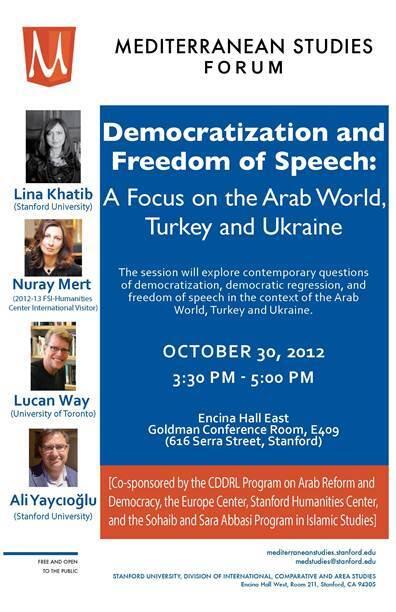
Co-sponsored by CDDRL Program on Arab Reform and Democracy, the Europe Center, Stanford Humanities Center, and the Abbasi Program in Islamic Studies

More info: http://www.stanford.edu/group/mediterranean/cgi-bin/web/2012/08/democratization-and-freedom-of-speech-a-focus-on-turkey-arab-world-and-ukraine/

Image

Richard and Rhoda Goldman Conference Room

Nuray Mert FSI-Humanities Center International Visitor Panelist
Lina Khatib Program Manager for the Program on Arab Reform and Democracy Panelist CDDRL
Lucan Way Associate Professor of Political Science Panelist University of Toronto
Ali Yaycioğlu Assistant Professor of Middle East History Moderator Stanford
Panel Discussions
-

Abstract:

Nearly two years after the Tunisian uprisings launched a massive wave of regional protest across the Arab world, many important and highly contested questions remain. How has the protest wave affected the dynamics of regional politics? Has the protest wave ended, or is it likely to recur? What explains the timing, the accomplishments and the limitations of that protest wave? What does the survival of many Arab regimes, the frustration of revolutionaries, the rise of Islamist movements in electoral politics, and the spiraling conflict in Syria mean for hopes of democratization and peaceful political change?

About the speaker:

Marc Lynch is associate professor of political science and international affairs at The George Washington University, where he directs the Institute for Middle East Studies. He also directs the Project on Middle East Political Science, edits the Middle East Channel for ForeignPolicy.com and the Columbia University Press book series Columbia Studies on Middle East Politics, and is a non-resident senior fellow at the Center for a New American Security. His most recent publications include The Arab Uprising (PublicAffairs 2012), Islamists in a Changing Middle East (ForeignPolicy 2012), and Blogs and Bullets II: New Media and the Arab Spring (US Institute for Peace).

CISAC Conference Room

Marc Lynch Director, Institute for Middle East Studies Speaker George Washington University
Seminars
-

Abstract:

Marking the publication of Lina Khatib's latest book Image Politics in the Middle East: The Role of the Visual in Political Struggle, this seminar focuses on the evolution of political expression in the Middle East over the past decade, highlighting the visual dimension of power struggles between citizens and leaders in Lebanon, Iran, Egypt, Libya, and Syria.

About the speaker:

Lina Khatib is a co-founder and Program Manager of the Program on Arab Reform and Democracy at the Center on Democracy, Development, and the Rule of Law at Stanford University. She joined Stanford University in 2010 from the University of London where she was an Associate Professor. Her research is firmly interdisciplinary and focuses on the intersections of politics, media, and social factors in relation to the politics of the Middle East. She is also a consultant on Middle East politics and media and has published widely on topics such as new media and Islamism, US public diplomacy towards the Middle East, and political media and conflict in the Arab world, as well as on the political dynamics in Lebanon and Iran. She has an active interest in the link between track two dialogue and democratization policy. She is also a Research Associate at SOAS, University of London, and, from 2010-2012, a Research Fellow at the USC Center on Public Diplomacy at the Annenberg School.

Lina is a founding co-editor of the Middle East Journal of Culture and Communication, a multidisciplinary journal concerned with politics, culture and communication in the region, and in 2009 co-edited (with Klaus Dodds) a special issue of the journal on geopolitics, public diplomacy and soft power in the Middle East. She also edited the Journal of Media Practice from 2007-2010. She is one of the core authors of the forthcoming Arab Human Development Report (2012) published by the UNDP.

She has written two books, Filming the Modern Middle East: Politics in the Cinemas of Hollywood and the Arab World (IB Tauris 2006), which is a study of the link between international relations and film, focusing on 25 years of cinematic representation of politics in the region (1980-2005), from the Arab-Israeli conflict to the Gulf War to Islamic fundamentalism, and Lebanese Cinema: Imagining the Civil War and Beyond (IB Tauris 2008). The book takes a socio-political approach to the study of Lebanese cinema over the last thirty years, focusing on the issues of Lebanese national identity, history, sectarian conflict, and memory of the Civil War.

Lina has recently finished writing a book titled Image Politics in the Middle East: The Role of the Visual in Political Struggle for IB Tauris. The book examines the power struggles among states, other political actors, and citizens in the region that are expressed through visuals, and focuses on case studies from Lebanon, Egypt, Syria, Libya, and Iran, with a focus on the role of the image as a political tool in the Arab Spring. She has also recently led a multidisciplinary research project on US public diplomacy in the digital age, in collaboration with the University of Oxford and the University of Wolverhampton, the outcome of which will appear in the Middle East Journal in 2012.

Before joining the academic field, Lina worked in broadcast journalism in Lebanon. She is a frequent commentator on the Middle East in the media with appearances on Al-Jazeera (Arabic and English), CNN, BBC, Sky News and other media outlets across the globe

CISAC Conference Room

Lina Khatib Program Manager for the Program on Arab Reform and Democracy Speaker CDDRL
Seminars
Paragraphs

In this article, Oliver Roy argues that in order to grasp what is happening in the Middle East, a number of deep-rooted prejudices must be set aside. First among them is the assumption that democracy presupposes secularization; the democratization movement in the Arab world came precisely after thirty years of what has been called the “return of the sacred,” an obvious process of re-Islamization of everyday life, coupled with the rise of Islamist parties. The second is the idea that a democrat must also, by definition, be a liberal. The article concludes that what is at stake during the Arab Spring is the reformulation of religion’s place in the Middle East’s public sphere. 

All Publications button
1
Publication Type
Journal Articles
Publication Date
Journal Publisher
Journal of Democracy
Authors
Authors
News Type
News
Date
Paragraphs

In less than a week, Egypt has witnessed a reversal of many of the gains it made during the course of the 16-month revolutionary period. The interim military body guiding the transition period since Hosni Mubarak's ouster has consolidated its power by dissolving the Islamist-led parliament, introducing a new charter stripping presidential powers, and hand-picking an assembly to draft a new constitution.

In the midst of this counter-coup by Egypt's Supreme Council of the Armed Forces (SCAF), presidential run-off elections took place June 16 and 17. The Muslim Brotherhood's Mohammad Mursi emerged as the winner against Ahmed Shafiq, Mubarak's former prime minister, capturing 51.7% of the vote.

A former academic who earned a doctorate in engineering from the University of Southern California, Mursi is a relative newcomer to the Egyptian political scene having served in parliament from 2000-2005. Described as a behind-the-scenes operator, Mursi rose to lead the Brotherhood's Freedom and Justice Party in 2011 positioning himself as a presidential contender. While little is known about Egypt's first democratically elected president, many claim that Mursi was elected less for his personal politics than for his affiliation with the Muslim Brotherhood.

Lina Khatib, head of the Arab Reform and Democracy Program at FSI's Center on Democracy, Development, and the Rule of Law, weighs in on the upheaval in Egypt's revolution, the power of the presidency, and the steps the SCAF have taken to cement their rule.

Have the SCAF outsmarted the opposition in their recent grab for power?

Looking back at the 16 months since the start of the Egyptian revolution, it becomes clear that the SCAF were hedging their bets to come up with a political formula that would guarantee the continuation of their political and economic authority. For a while the Muslim Brotherhood was almost in bed with the SCAF, but the equation quickly changed after the parliamentary elections. As the Brotherhood arose as a potentially serious challenger to the SCAF, the military needed an effective strategy to undermine its rising power.

In what way was the Muslim Brotherhood posing a challenge to the SCAF?

The (now-dissolved) parliament was dominated by the Muslim Brotherhood, which claimed 46% of the seats. With Mohammad Mursi the president-elect, the Muslim Brotherhood would have presided over two key state institutions - the legislative and executive branches. That would have been too much for the SCAF to bear, particularly as they started perceiving the Brotherhood as a political competitor. Based on this, the SCAF could safely calculate that fresh parliamentary elections — under a revised electoral system — would most likely not lead to a Muslim Brotherhood-dominated parliament.

With no constitution in place how can the presidential powers and limits be defined?

The stalled process of putting together a Constitutional Assembly means that Mohammad Mursi assumes this role without knowing the full authorities of the position. The SCAF have been managing the membership of the Constitutional Assembly and will likely have a significant input into the content of the constitution itself. The sequencing of having a president in place before a constitution is drafted presents the military with the opportunity to design the constitution according to who wins the presidential race. If Ahmed Shafiq had won, it is likely that the new constitution would have given him more privileges than Mursi.

With Mursi the new president of Egypt, does this signal a victory for the Muslim Brotherhood?

The Muslim Brotherhood has been shortsighted in the way it has performed since the start of the Egyptian revolution. Its keenness on ascending to political power often led it to engage in compromises with the SCAF that have now backfired. This also served to lessen its support among the Egyptian people, as well as among its political allies. Although the Brotherhood pushed for the presidential elections to go ahead because it was convinced that Mursi would win, this victory can be viewed as only a partial one as the SCAF are in control of most state institutions.

Have recent events reversed the gains made by the revolution?

The real victory for Mursi would be if he is able to put in place checks and balances on the power of the SCAF, secure the independence of the judiciary, guarantee the rights of minorities, and establish an accountable civil state in Egypt that involves the country’s multiple stakeholders. However, the SCAF have so far blocked the path towards achieving all of those goals, and in the process are attempting to silence the voices of the opposition that were initially empowered by the revolution.

How can reformers re-assert themselves in the current political climate?

Egyptian reformists need a long-term strategy. A key part of this strategy is having a viable leadership and advocacy structure that can stand up to the authority of the SCAF. Even though the SCAF have announced that they would hand over power to the incumbent president, their behavior indicates that they are keen on maintaining their authority behind the scenes, regardless of who sits in the presidential seat.

 

Hero Image
June Election Logo
All News button
1
Subscribe to Democracy