Society

FSI researchers work to understand continuity and change in societies as they confront their problems and opportunities. This includes the implications of migration and human trafficking. What happens to a society when young girls exit the sex trade? How do groups moving between locations impact societies, economies, self-identity and citizenship? What are the ethnic challenges faced by an increasingly diverse European Union? From a policy perspective, scholars also work to investigate the consequences of security-related measures for society and its values.

The Europe Center reflects much of FSI’s agenda of investigating societies, serving as a forum for experts to research the cultures, religions and people of Europe. The Center sponsors several seminars and lectures, as well as visiting scholars.

Societal research also addresses issues of demography and aging, such as the social and economic challenges of providing health care for an aging population. How do older adults make decisions, and what societal tools need to be in place to ensure the resulting decisions are well-informed? FSI regularly brings in international scholars to look at these issues. They discuss how adults care for their older parents in rural China as well as the economic aspects of aging populations in China and India.

-

This special panel will address the challenges facing Egypt's transition today.

Dr. Maha Abdelrahman will speak on the historical roots of post-Mubarak politics by 
examining two main features of the decade long of protests since 2000.

Dr. Amr Adly will speak on how Egypt's economic crisis interacts with the shaping of the new political sphere, and whether this can be framed as Egypt's failed transition to democracy or transition to failed democracy. He will argue that the country was put on the trajectory of a conservative democratic order which indeed has been instilled but the only problem is that it is quite dysfunctional.

Ahmed Salah will discuss  the position of revolutionary groups toward Morsi's Regime and how and why it devolved.

Prof. Robert Springborg will present on "The Muslim Brotherhood and the Military: The Mongoose and the Cobra Revisited".

Prof. Joel Beinin will present on "Workers, Trade Unions, and Egypt's Political Future".


The panel is co-sponsored by the Stanford Humanities Center and the Abbasi Program in Islamic Studies.

Encina Ground Floor Conference Room

Joel Beinin Donald J. McLachlan Professor of History and Professor of Middle East History Speaker Stanford University
Robert Springborg Professor Speaker Naval Postgraduate School
Amr Adly Researcher Speaker Program on Arab Reform and Democracy (ARD), Stanford University
Maha Abdelrahman Lecturer Speaker University of Cambridge
Ahmed Salah Activist Speaker
Panel Discussions
-

This event is presented by CDDRL and the Program on Arab Reform and Democracy

Esraa Abdel Fattah is Vice-Chairman at the Egyptian Democratic Academy.

* Founder of Free Egyptian Woman, a group for women’s political empowerment.

* Columnist at El- Masrey-Al-Youm newspaper, the most widely distributed, privately owned newspaper in Egypt, and has her own talk show on channel “On TV Life " every weekend.

* Co-founded April 6 General Strike Egypt in 2008, a Facebook group, to promote a day of civil disobedience calling for workers to stay home in protest against low wages and soaring food prices. After being dubbed the social-networking phenomenon “Facebook Girl”, she was detained by Egyptian security and spent two weeks in prison.

* Political Activist, played a leading role in the mass protests in Tahrir Square during the 25th January Revolution. She was not only active on the Internet, but also on the ground, updating Al Jazeera TV with the latest news related to the opposition.

* Named Woman of the Year 2011 by Glamour Magazine for her leadership in organizing the historic Tahrir Square movement in Egypt.

* Named as one of Arabian Business Magazine's 100 most powerful Arab women in 2011 & 2012.

* Nominated for the Nobel Peace Prize, 2011.

* Co-Founder and member of the Steering Committee in ElDostor Party , 2012. 

.

Philippines Conference Room

Esraa Abdel Fattah Egyptian Political Activist Speaker
Conferences
-

Abstract:

Marking the publication of Lina Khatib's latest book Image Politics in the Middle East: The Role of the Visual in Political Struggle, this seminar focuses on the evolution of political expression in the Middle East over the past decade, highlighting the visual dimension of power struggles between citizens and leaders in Lebanon, Iran, Egypt, Libya, and Syria.

About the speaker:

Lina Khatib is a co-founder and Program Manager of the Program on Arab Reform and Democracy at the Center on Democracy, Development, and the Rule of Law at Stanford University. She joined Stanford University in 2010 from the University of London where she was an Associate Professor. Her research is firmly interdisciplinary and focuses on the intersections of politics, media, and social factors in relation to the politics of the Middle East. She is also a consultant on Middle East politics and media and has published widely on topics such as new media and Islamism, US public diplomacy towards the Middle East, and political media and conflict in the Arab world, as well as on the political dynamics in Lebanon and Iran. She has an active interest in the link between track two dialogue and democratization policy. She is also a Research Associate at SOAS, University of London, and, from 2010-2012, a Research Fellow at the USC Center on Public Diplomacy at the Annenberg School.

Lina is a founding co-editor of the Middle East Journal of Culture and Communication, a multidisciplinary journal concerned with politics, culture and communication in the region, and in 2009 co-edited (with Klaus Dodds) a special issue of the journal on geopolitics, public diplomacy and soft power in the Middle East. She also edited the Journal of Media Practice from 2007-2010. She is one of the core authors of the forthcoming Arab Human Development Report (2012) published by the UNDP.

She has written two books, Filming the Modern Middle East: Politics in the Cinemas of Hollywood and the Arab World (IB Tauris 2006), which is a study of the link between international relations and film, focusing on 25 years of cinematic representation of politics in the region (1980-2005), from the Arab-Israeli conflict to the Gulf War to Islamic fundamentalism, and Lebanese Cinema: Imagining the Civil War and Beyond (IB Tauris 2008). The book takes a socio-political approach to the study of Lebanese cinema over the last thirty years, focusing on the issues of Lebanese national identity, history, sectarian conflict, and memory of the Civil War.

Lina has recently finished writing a book titled Image Politics in the Middle East: The Role of the Visual in Political Struggle for IB Tauris. The book examines the power struggles among states, other political actors, and citizens in the region that are expressed through visuals, and focuses on case studies from Lebanon, Egypt, Syria, Libya, and Iran, with a focus on the role of the image as a political tool in the Arab Spring. She has also recently led a multidisciplinary research project on US public diplomacy in the digital age, in collaboration with the University of Oxford and the University of Wolverhampton, the outcome of which will appear in the Middle East Journal in 2012.

Before joining the academic field, Lina worked in broadcast journalism in Lebanon. She is a frequent commentator on the Middle East in the media with appearances on Al-Jazeera (Arabic and English), CNN, BBC, Sky News and other media outlets across the globe.

Encina Ground Floor Conference Room

Lina Khatib Program Manager for the Program on Arab Reform and Democracy Speaker CDDRL
Seminars
-

Abstract:

The roots of the revolts known as the Arab Spring lie in many sources but one of the leading causes was the high rates of unemployment, low skill levels, and the growth of the youth populations. Now Arab governments are faced with the dual challenges of creating new political and economic systems that can meet the needs and demands of the peoples of their countries. This presentation will focus on the role of the private sector and the need to build an entrepreneurial eco-system that can foster rapid economic growth. Practical examples of reform programs will be emphasized drawing from the work of the Center for International Private Enterprise.

Speaker Bio:

John D. Sullivan is the executive director of the Center for International Private Enterprise (CIPE), an affiliate of the US Chamber of Commerce. As associate director of the Democracy Program, Sullivan helped to establish both CIPE and the National Endowment for Democracy in 1983. After serving as CIPE program director, he became executive director in 1991. Under his leadership CIPE developed a number of innovative approaches that link democratic development to market reforms: combating corruption, promoting corporate governance, building business associations, supporting the informal sector, and programs to assist women and youth entrepreneurs. Today, CIPE has more than 90 full-time staff with offices in Afghanistan, Egypt, Iraq, Pakistan, Romania, Russia, and Ukraine.

Sullivan began his career in Los Angeles’ inner city neighborhoods, helping to develop minority business programs with the Institute for Economic Research and the Office of Minority Business Enterprise. In 1976 he joined the President Ford Election Committee in the research department on campaign strategy, polling, and market research.  Sullivan joined the public affairs department of the U.S. Chamber of Commerce in 1977 as a specialist in business and economic education.

Encina Ground Floor Conference Room

John D. Sullivan Executive Director Speaker The Center for International Private Enterprise (CIPE)
Seminars
-

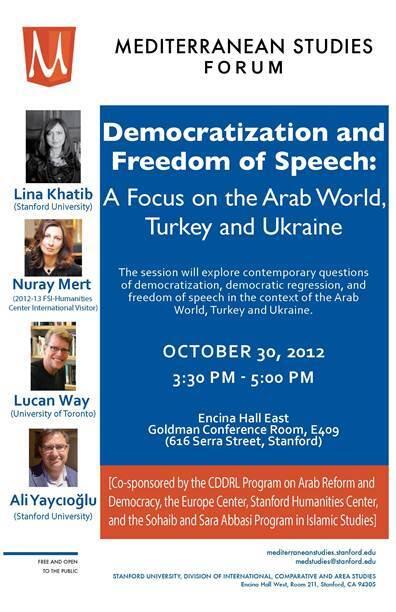
Co-sponsored by CDDRL Program on Arab Reform and Democracy, the Europe Center, Stanford Humanities Center, and the Abbasi Program in Islamic Studies

More info: http://www.stanford.edu/group/mediterranean/cgi-bin/web/2012/08/democratization-and-freedom-of-speech-a-focus-on-turkey-arab-world-and-ukraine/

Image

Richard and Rhoda Goldman Conference Room

Nuray Mert FSI-Humanities Center International Visitor Panelist
Lina Khatib Program Manager for the Program on Arab Reform and Democracy Panelist CDDRL
Lucan Way Associate Professor of Political Science Panelist University of Toronto
Ali Yaycioğlu Assistant Professor of Middle East History Moderator Stanford
Panel Discussions
-

Abstract:

Nearly two years after the Tunisian uprisings launched a massive wave of regional protest across the Arab world, many important and highly contested questions remain. How has the protest wave affected the dynamics of regional politics? Has the protest wave ended, or is it likely to recur? What explains the timing, the accomplishments and the limitations of that protest wave? What does the survival of many Arab regimes, the frustration of revolutionaries, the rise of Islamist movements in electoral politics, and the spiraling conflict in Syria mean for hopes of democratization and peaceful political change?

About the speaker:

Marc Lynch is associate professor of political science and international affairs at The George Washington University, where he directs the Institute for Middle East Studies. He also directs the Project on Middle East Political Science, edits the Middle East Channel for ForeignPolicy.com and the Columbia University Press book series Columbia Studies on Middle East Politics, and is a non-resident senior fellow at the Center for a New American Security. His most recent publications include The Arab Uprising (PublicAffairs 2012), Islamists in a Changing Middle East (ForeignPolicy 2012), and Blogs and Bullets II: New Media and the Arab Spring (US Institute for Peace).

CISAC Conference Room

Marc Lynch Director, Institute for Middle East Studies Speaker George Washington University
Seminars
-

Abstract:

Marking the publication of Lina Khatib's latest book Image Politics in the Middle East: The Role of the Visual in Political Struggle, this seminar focuses on the evolution of political expression in the Middle East over the past decade, highlighting the visual dimension of power struggles between citizens and leaders in Lebanon, Iran, Egypt, Libya, and Syria.

About the speaker:

Lina Khatib is a co-founder and Program Manager of the Program on Arab Reform and Democracy at the Center on Democracy, Development, and the Rule of Law at Stanford University. She joined Stanford University in 2010 from the University of London where she was an Associate Professor. Her research is firmly interdisciplinary and focuses on the intersections of politics, media, and social factors in relation to the politics of the Middle East. She is also a consultant on Middle East politics and media and has published widely on topics such as new media and Islamism, US public diplomacy towards the Middle East, and political media and conflict in the Arab world, as well as on the political dynamics in Lebanon and Iran. She has an active interest in the link between track two dialogue and democratization policy. She is also a Research Associate at SOAS, University of London, and, from 2010-2012, a Research Fellow at the USC Center on Public Diplomacy at the Annenberg School.

Lina is a founding co-editor of the Middle East Journal of Culture and Communication, a multidisciplinary journal concerned with politics, culture and communication in the region, and in 2009 co-edited (with Klaus Dodds) a special issue of the journal on geopolitics, public diplomacy and soft power in the Middle East. She also edited the Journal of Media Practice from 2007-2010. She is one of the core authors of the forthcoming Arab Human Development Report (2012) published by the UNDP.

She has written two books, Filming the Modern Middle East: Politics in the Cinemas of Hollywood and the Arab World (IB Tauris 2006), which is a study of the link between international relations and film, focusing on 25 years of cinematic representation of politics in the region (1980-2005), from the Arab-Israeli conflict to the Gulf War to Islamic fundamentalism, and Lebanese Cinema: Imagining the Civil War and Beyond (IB Tauris 2008). The book takes a socio-political approach to the study of Lebanese cinema over the last thirty years, focusing on the issues of Lebanese national identity, history, sectarian conflict, and memory of the Civil War.

Lina has recently finished writing a book titled Image Politics in the Middle East: The Role of the Visual in Political Struggle for IB Tauris. The book examines the power struggles among states, other political actors, and citizens in the region that are expressed through visuals, and focuses on case studies from Lebanon, Egypt, Syria, Libya, and Iran, with a focus on the role of the image as a political tool in the Arab Spring. She has also recently led a multidisciplinary research project on US public diplomacy in the digital age, in collaboration with the University of Oxford and the University of Wolverhampton, the outcome of which will appear in the Middle East Journal in 2012.

Before joining the academic field, Lina worked in broadcast journalism in Lebanon. She is a frequent commentator on the Middle East in the media with appearances on Al-Jazeera (Arabic and English), CNN, BBC, Sky News and other media outlets across the globe

CISAC Conference Room

Lina Khatib Program Manager for the Program on Arab Reform and Democracy Speaker CDDRL
Seminars
Paragraphs

In this article, Oliver Roy argues that in order to grasp what is happening in the Middle East, a number of deep-rooted prejudices must be set aside. First among them is the assumption that democracy presupposes secularization; the democratization movement in the Arab world came precisely after thirty years of what has been called the “return of the sacred,” an obvious process of re-Islamization of everyday life, coupled with the rise of Islamist parties. The second is the idea that a democrat must also, by definition, be a liberal. The article concludes that what is at stake during the Arab Spring is the reformulation of religion’s place in the Middle East’s public sphere. 

All Publications button
1
Publication Type
Journal Articles
Publication Date
Journal Publisher
Journal of Democracy
Authors
Subscribe to Society